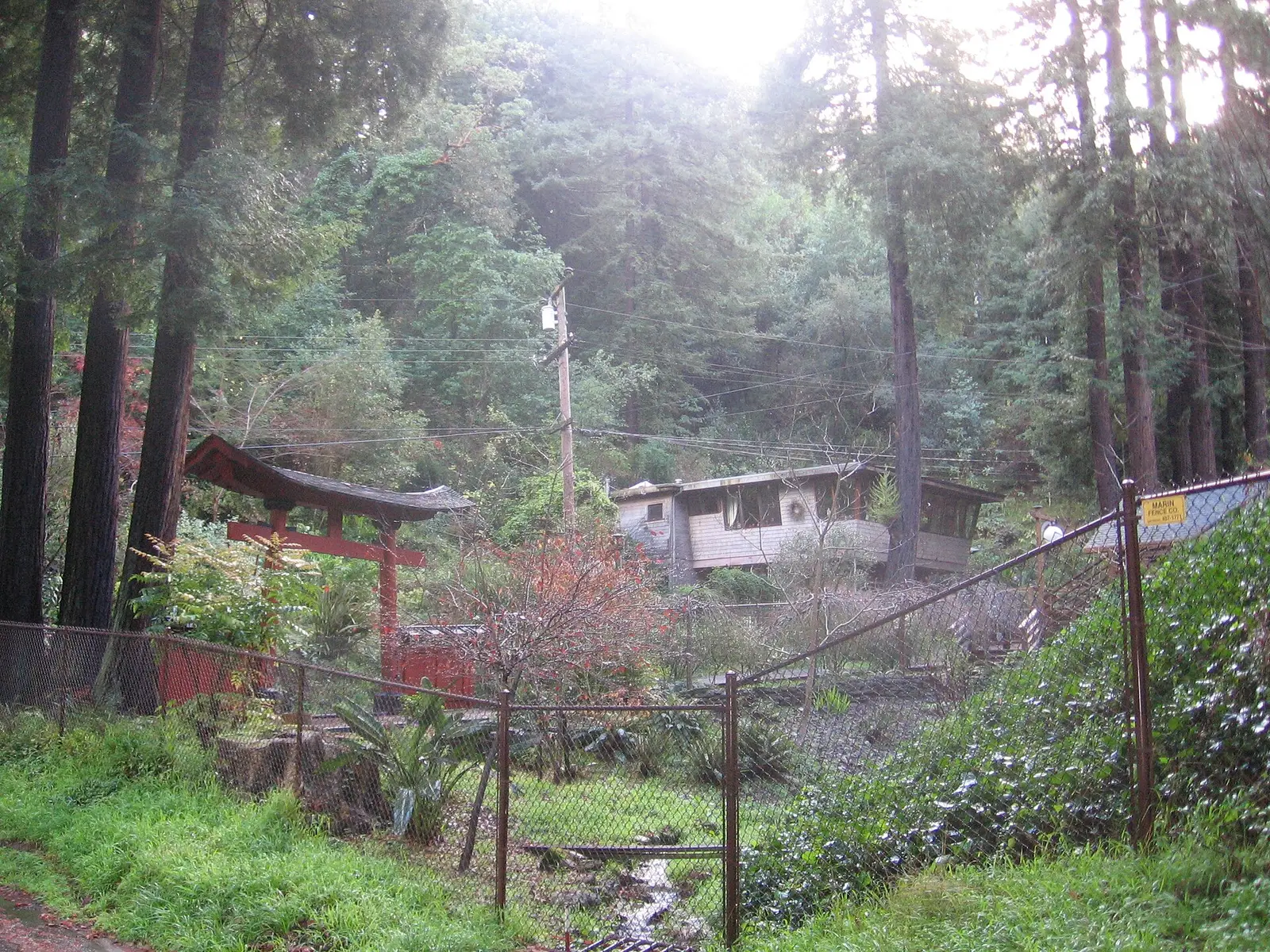
Mill Valley repairs under the redwoods and up the steps
Second-growth redwoods fill the canyons on Mount Tamalpais's southeastern slopes, so canyon houses stay shaded and damp: deck boards soften, doors swell and steps grow moss. About three-quarters of the city also lies in the wildland-urban interface, where clearing combustibles from around and under the house is routine upkeep.
Trees and houses in Blithedale Canyon, Mill Valley. Photo: Burntorange72, CC BY 3.0, via Wikimedia Commons.
ZIP codes
94941
When the homes were built
1890s-present
Main streets
Throckmorton Avenue, Miller Avenue, Blithedale Avenue, Cascade Drive
Landmarks
Old Mill Park, Dipsea Stairs, Mill Valley Public Library
What homes in Mill Valley need most
Soft deck boards in canyon shade
A deck built out over a slope in Cascade or Blithedale Canyon may see direct sun for only part of the day, and redwood needles packed into the gaps between boards hold water against the wood. Boards soften at the ends and around fasteners first. A handyman can replace failing boards and stair treads, clear the gaps so they drain, and tighten loose railings. If the joists or posts underneath are soft too, that is a structural repair for a licensed contractor. More about fence, deck and gate repair
Redwood needles in gutters
Canyon roofs sit under trees that drop needles and small branchlets onto them, and gutters clog quickly. A blocked gutter overflows onto steps, decks and the ground beside the house, which is where rot and slippery moss take hold. Dry needles in a gutter or on a roof are also the kind of fuel fire agencies ask homeowners to remove. Cleaning gutters and downspouts before the first winter storms, and again at the end of summer, suits most canyon lots.
Handrails on long entry stairs
Mill Valley has 24 public stairways with more than 100 steps, and many private houses above the canyon roads have entry stairs nearly as steep. A handrail that wobbles or stops a few steps short is a common complaint, especially on damp, mossy treads. A handyman can replace rotted rail sections, add a continuous rail where one is missing and re-anchor posts into sound wood. Stairs whose stringers are rotting or pulling away from their supports need a licensed contractor. More about carpentry, shelves and trim
Doors that swell every winter
In a damp canyon house, a wood door that closes easily in September can bind by January. Usually it has soaked up moisture through an unsealed top or bottom edge, or its hinges have worked loose in old framing. A handyman can tighten or shim hinges, move the strike plate and plane the door where it rubs, then seal the cut edges so it takes on less water next winter. Old cottage doors are usually worth repairing rather than replacing. More about door and window repair
Mildew on walls and ceilings
Shade, moisture and the limited airflow of small older cottages give mildew an easy start on bathroom ceilings, closet walls and the inside face of exterior walls. Surface spots can be cleaned and the area repainted with a mildew-resistant paint. If staining comes back quickly, or plaster or drywall feels soft, there is probably a leak or trapped moisture behind it, and that has to be found first. Patching and repainting can follow once the source is dealt with. More about interior painting and touch-ups
How the houses here are built
Summer cottages from the 1890s onward in Cascade and Blithedale canyons, older cottages and bungalows on the flats along Miller Avenue, and hillside houses above them, many reached by the city's public steps, lanes and paths.
Houses are wood-framed and set into canyon slopes, with decks and exterior stairs doing the job a yard does on flat ground. Under dense redwood cover, sun rarely reaches north-facing walls, deck surfaces and steps, so wood holds moisture far longer than it would on an open lot.
Summers are dry, but canyon lots under the redwoods stay cool and shaded, so wood soaked by wet winters gets little sun to dry it.
Good to know before a job in Mill Valley
Fire rules in the wildland-urban interface
In July 1929 a fire swept down Blithedale Canyon and destroyed more than 100 homes. The city's 2019 vegetation management ordinance covers roughly 5,000 parcels, about three-quarters of Mill Valley, and requires removing flammable vegetation within 100 feet of structures and 10 feet of property lines and driveways, with interface properties required to comply before a sale. Well-pruned single redwoods and heritage trees can stay with the fire code official's approval. Fire Safe Marin also asks that nothing combustible be stored under decks.
Steps, lanes and paths
The city counts 192 steps, lanes and paths, 89 of them developed, under a numbering system that dates to 1925. The best known are the Dipsea Stairs, 676 steps in three flights starting at Cascade Drive and Molino Avenue behind Old Mill Park. For many hillside houses a stair lane is the front walk, and narrow canyon roads leave little room to park. When you request a job, say whether the house is reached by steps and how close a vehicle can get.
How a request works
Describe the job
A sentence and a photo or two is enough. It takes about a minute.
A local handyman gets in touch
By call or text, to ask what the photos don't show and give you a price.
You decide
Agree a time and price with the handyman directly, or don't. Requesting costs nothing.
Questions from Mill Valley homeowners
Does Mill Valley's vegetation ordinance matter when I sell my house?
It can. When the ordinance was adopted in 2019, properties in the wildland-urban interface, about three-quarters of the city, had to be in compliance before being sold or transferred. Confirm the current requirements with the Southern Marin Fire Protection District. A handyman can haul out dead brush and debris and clear stored lumber from under decks; cutting or limbing large trees is work for an arborist.
Will the fire rules make me take down my redwoods?
Not necessarily. The city's fire code lets single trees, redwoods and heritage trees included, stay when they are well pruned, maintained so they do not carry fire quickly, and approved by the fire code official. Work on the tree itself belongs to an arborist. A handyman can take care of what sits around it: clearing needles from gutters and decks and moving firewood away from the house.
Our house is on a stair lane off Cascade Drive. Can materials still be brought in?
Yes, with some planning. Roads near Old Mill Park are narrow, and a lane can mean carrying every board, tool and fixture up by hand. Tell us how many steps there are, where a vehicle can stop and whether anything long or heavy, like a door or a stack of deck boards, is involved, so the visit is booked with enough time and hands.
Why does our canyon deck rot faster than our friends' deck on the flats?
Sun and airflow. Under redwoods on a canyon slope, a deck may get only a few hours of light, needles pile up between the boards, and wet winters leave the wood little chance to dry. Along Miller Avenue the same lumber dries out between storms. Keeping the gaps clear, replacing boards before rot spreads and sealing cut ends all slow it down.
Checked against these public sources in September 2026. Rules change: confirm anything permit-related with the city or town of Mill Valley before work starts.