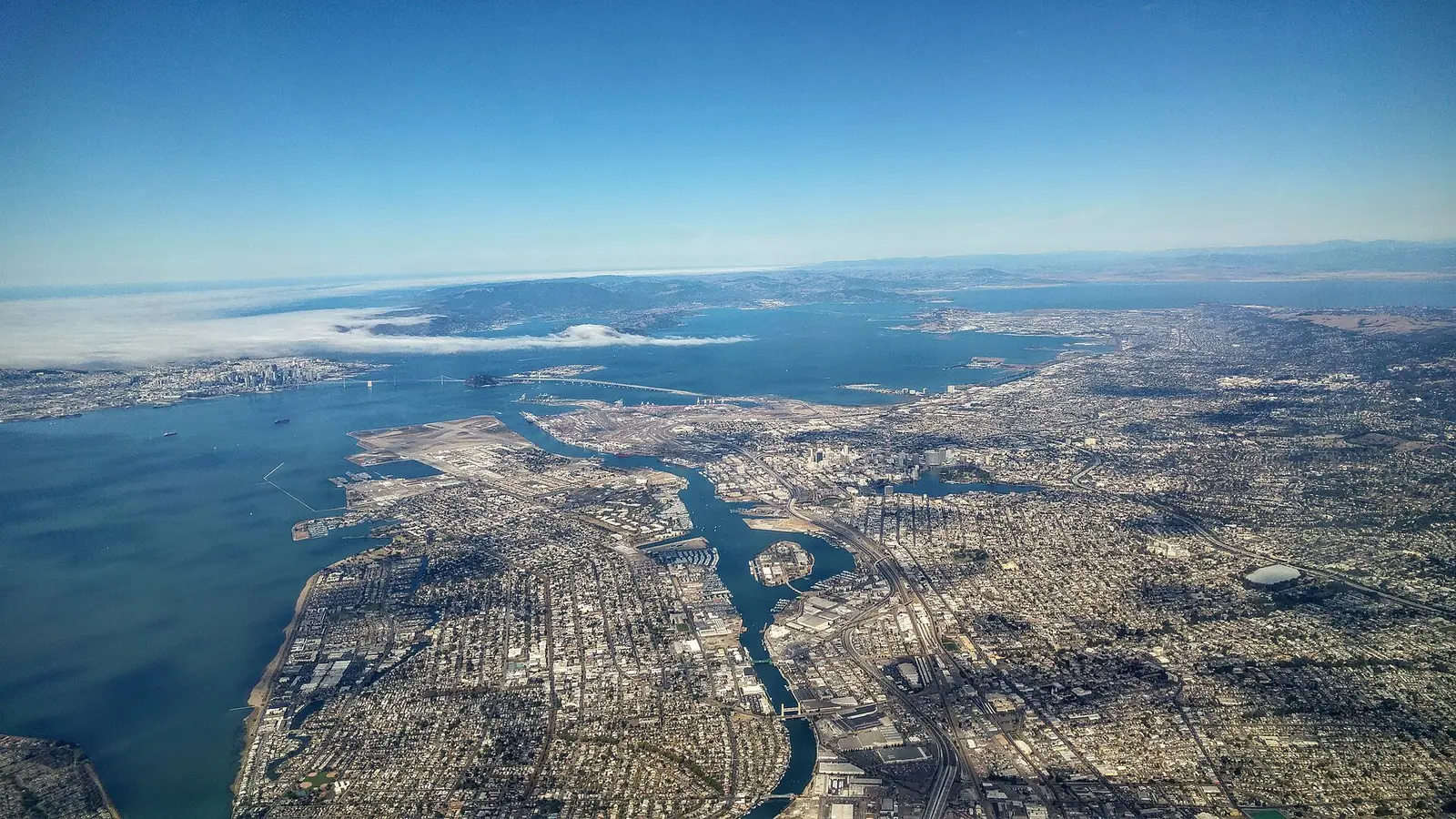
Repairs across the East Bay's flats, hills and valleys
Two lines shape East Bay housing: the Hayward Fault along the base of the hills, and the ridge that the Caldecott Tunnel cuts through. Older wood houses fill the bayside flats, fire-rebuilt homes climb the hills, bay fill carries parts of Alameda, and hot inland valleys hold post-war suburbs. Describe the job and a local handyman calls or texts back.
The Hayward Fault runs about 74 miles along the western base of the hills, through Richmond, El Cerrito, Berkeley, Oakland, San Leandro, Castro Valley, Hayward and Fremont. It creeps slowly and constantly: at UC Berkeley's Memorial Stadium, which sits directly on it, the end walls have been offset 13 inches since 1923. Creep like that cracks curbs, sidewalks and roads along the trace. The fault's last major earthquake, in 1868, is estimated at magnitude 7.0 and caused damage as far away as San Francisco.
The ridge above the fault divides the climate. On a summer day you can enter the Caldecott Tunnel in warm sun on its east side and come out into fog and cold on the west. The tunnel opened in 1937, and once its eastern approach became a freeway around 1960, central Contra Costa changed from farm country into a major suburb. The result is two housing stories: older, damper cities facing the bay, and newer, hotter valleys behind the hills.
How the work differs across the area
Bayside flats of Oakland and Berkeley
The flats below the hills filled with wood houses long before the valleys did, including brown-shingle homes of the First Bay Tradition, built from the 1880s into the early 1920s with locally sourced redwood. Houses of that age share a familiar list: doors and sash windows that stick, cracked plaster, uneven floors and worn original hardware. Right along the fault trace, creep can add cracks to walls, steps and paths. Repairs go best with someone who matches old trim, shingles and plaster rather than pulling them out.
Hills with a fire history
The Berkeley and Oakland hills have burned badly twice in a century. The 1923 Berkeley fire destroyed 584 houses north of the campus, spread by burning cedar shakes, and stucco and tile roofs replaced much of that construction. In October 1991 the Oakland Hills firestorm destroyed 2,843 single-family homes and 437 apartment and condominium units, driven by Diablo winds through dry vegetation, wood shake roofs and mulch. Many hill homes now stand on steep, winding streets rebuilt since then, where clean gutters and sealed gaps matter more than in the flats.
Island and bay fill
Alameda became an island in 1902, when a tidal canal was finished through the marsh on its Oakland side. Alameda Point, Bay Farm Island and South Shore are largely built on bay fill, and rising groundwater there adds to the liquefaction risk of saturated soil. The former naval air station closed in 1997 and is being redeveloped as Alameda Point. On low, filled ground, moisture near the foundation, in garages and around exterior doors makes weatherproofing and wood repair near grade a regular part of upkeep.
Inland valleys behind the hills
East of the ridge, Walnut Creek, the San Ramon Valley and the Tri-Valley grew as suburbs from the mid-twentieth century on; San Ramon only incorporated in 1983. Summer days in the Tri-Valley run from the 80s to over 100 degrees, with cool nights, which is hard on exterior paint, wood fences, decks and weatherstripping on sun-facing walls. Joseph Eichler built here too, with more than 300 homes at Rancho San Miguel in Walnut Creek. Where a subdivision has a homeowners association, check its rules before changing fences or exterior colors.
How a request works
Describe the job
A sentence and a photo or two is enough. It takes about a minute.
A local handyman gets in touch
By call or text, to ask what the photos don't show and give you a price.
You decide
Agree a time and price with the handyman directly, or don't. Requesting costs nothing.
Common questions
Can a handyman fix cracks caused by Hayward Fault creep?
Cosmetic cracks in drywall or plaster, sticking doors and open trim joints can be patched, painted and adjusted. Cracks that keep reopening, run into the foundation, or come with floors that slope a little more each year point to movement a patch will not fix, and a licensed contractor or engineer should look first. Homes right on the fault trace are the most likely to see this, because the fault moves slowly and continuously.
What fire-season upkeep in the hills is handyman work?
Clearing leaves and needles from gutters and roof valleys, repairing damaged vent screens, sealing gaps under doors and along siding, and fixing or moving wood fences and gates that touch the house are the kind of jobs a handyman takes. Replacing a roof, rebuilding a deck with fire-resistant materials, or any new structure is contractor work. Both the 1923 and 1991 fires spread through wood shake roofs and flying embers.
Is the work different in the inland valleys than in the bayside cities?
Mostly in what wears out. Behind the hills, summer heat and sun dry out fence boards, deck surfaces, caulking and exterior paint faster, while the bayside cities deal with fog, damp and older houses. The valley housing is also newer, so requests there lean toward drywall, fixtures, furniture assembly and outdoor wood rather than plaster and old sash windows.
Which East Bay cities and neighborhoods have their own pages?
Pages cover Oakland and its Rockridge, Temescal, Grand Lake and Montclair neighborhoods, Berkeley with North Berkeley and Elmwood, and Alameda, Emeryville, Albany, El Cerrito, Piedmont, San Leandro, Castro Valley, Hayward, Fremont, Walnut Creek, Lafayette, Orinda, Danville, San Ramon, Pleasanton and Dublin. For anywhere else, include the city and cross streets in the request.
Tell us what needs fixing in The East Bay.
One short request reaches handymen who work locally. You hear back by call or text.