Water heaters Daly City

Daly City water heaters: raised in the garage, vented past the roof

A replacement here is a quick plumbing permit, taken at the counter or through the city's portal, and the Building Division asks that the new unit meet the first-hour rating in Plumbing Code Table 5-1 before it writes one. The rest of the city's handout is about where the heater stands: 18 inches up in a garage, protected where a car could reach it, with the relief drain ending outside between six and 24 inches off the ground.

  • Free to request, no obligation to hire
  • Up to five local pros who take this work can reply
  • Rules on this page checked against 12 public sources, October 2026

Get quotes for water heater work in Daly City

Two short steps. A local pro who takes this work calls or texts you back.

To send a request, call or text (415) 449-8213.

Free to request, and you agree the scope and price with the person you hire before work starts. In California, a job over $1,000 in labor and materials, or one that needs a building permit, must be done by a contractor licensed by the CSLB in the right class. Ask for the license number and check it at cslb.ca.gov.

Before you hire

Before anyone orders a tank for a Daly City garage

  1. Ask what first-hour rating the proposed unit shows on its energy guide label, and whether it meets Table 5-1 for your bathroom and bedroom count.
  2. Confirm the platform is in the scope, or that a closed-combustion unit is going on a garage floor that already slopes to a drain or outdoors.
  3. Ask whether the existing flue can still reach a foot above the roof with no horizontal leg over three-quarters of its height.
  4. If a pressure regulator sits on the house supply, ask where the listed expansion tank will hang and whether it is in the scope.
  5. Look up the C-36 Plumbing number at cslb.ca.gov, and ask who files the quick permit in the city's portal under it.
Permit for a swap
Quick plumbing permit, over the counter or in the portal
Garage platform
18 inches to the glow, spark or flame
Sizing check
First-hour rating, Plumbing Code Table 5-1
Pressure zones
Roughly eight on the west side, eleven active on the east
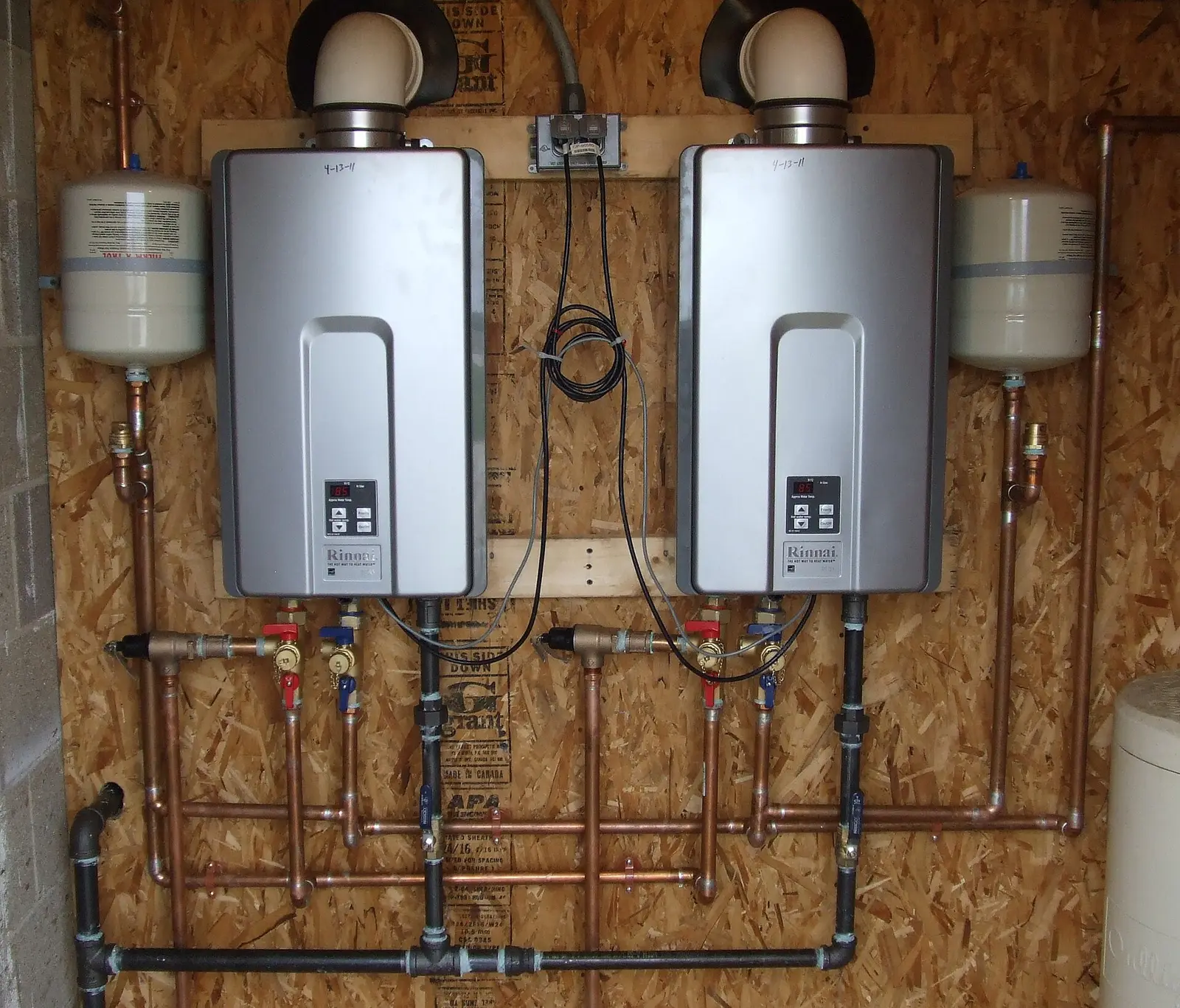
Two wall-mounted tankless water heaters plumbed with copper supply lines
Two wall-mounted tankless water heaters plumbed with copper supply lines. Photo: Behrat, CC BY-SA 3.0, via Wikimedia Commons.

The houses here

The tank stands in the garage, two floors below the roof

The form that repeats across this city puts the living space over a two-car garage, and the water heater goes in beside the car. Almost everything the Building Division's handout asks for follows from that. The tank sits on a platform holding the glow, spark or flame 18 inches off the slab, and where a vehicle could reach it the city wants protection, recommending a three-inch standard-weight pipe set as a bollard in the concrete. The flue then has to climb from garage level to a foot above the roof, so an offset around the rooms overhead gets drawn rather than improvised. Underneath it all is sand: the Safety Element describes a city mostly underlain by weak to moderately consolidated, loose to firm sands, close enough to the San Andreas that the potential for damage from ground shaking is high.

Free, no obligation. Next, add your details in the request form.

The work

Five places a straightforward swap stops being straightforward

  1. A flue that still has to clear the roof

    A fuel-burning heater vents to the outside, and the city's handout gives the run three tests at once. The vent extends at least five feet above the highest vent collar, terminates at least a foot above a roof anywhere between flat and a 6/12 slope, and any horizontal section may be no longer than three-quarters of the vent's total height, on a continuous upward slope of a quarter inch per foot. Starting at garage level under two floors of house, those three numbers usually decide whether the old flue can be reused or the quote has to include a new one.

  2. Where the relief valve drain is allowed to end

    Daly City lets the temperature and pressure relief drain finish in the garage or outside the building, which is the one piece of good news for a heater that sits under the bedrooms. The conditions are specific. The drain is the size of the valve outlet, typically three-quarters of an inch, built of copper or iron pipe, and it ends between six and 24 inches above the floor or ground. It may not be trapped, and it may not empty into the heater's own pan. An old run teed into a laundry drain or stopped short inside a wall is what the inspector catches.

  3. The expansion tank hiding behind a pressure regulator

    The city's water system is split in two and divided again by elevation, roughly eight pressure zones on the west side and eleven active ones on the east, with reduced zones gravity-fed off Reservoir 6 and a hydropneumatic station for houses too high for it to hold pressure. A house sitting low in its zone can see static pressure that the handout says must be cut to 80 pounds per square inch or less by an approved regulator preceded by a strainer. Fit a regulator with no bypass and the house becomes a closed system, which is exactly when the city requires a listed expansion tank for thermal expansion.

  4. Gas out, heat pump in, and a taller tank

    The first-hour rating is where this switch gets interesting. Daly City reads that number off the energy guide label and checks it against Plumbing Code Table 5-1 for the house's bathroom and bedroom count, and a 120-volt heat pump unit produces hot water slowly. San Mateo County's community electricity provider, now WestLight Energy, upsized every unit in its 120-volt pilot to 65 or 80 gallons precisely to account for those first-hour ratings. A taller, fatter tank has to fit a garage bay already holding a car, and the pilot also advises against exterior closets and sheds, where output falls off below 40 degrees.

  5. Bonding, insulation and the first five feet of pipe

    Several inspection items here have nothing to do with the heater itself. The handout calls for bonding across the hot water, cold water and gas piping, and says a number 8 copper wire threaded through the eye of brass or copper weaver clamps satisfies it. One inch of insulation goes on the first five feet of both the hot and the cold line, and a unit with an energy efficiency below 0.58 is wrapped in an external blanket rated R-12 or better. A fullway valve belongs on the cold supply at or near the appliance, and a union or flared connection on both water lines so the thing can come out again.

Permits and local rules

The four documents this work is actually judged against

  • The city's Water Heaters handout and its sizing table

    The Building Division publishes a single sheet covering this trade, and a plumbing permit is required to install, remove, replace or raise a heater, obtained before the work begins; work done without one may draw investigation or enforcement fees. Tank-type replacements can be taken over the counter, and Water Heater Replacement also appears on the quick-permit list in the city's online portal. The handout reprints Table 5-1, which runs from a 42-gallon first-hour rating for a one-bedroom, one-bathroom house up to 80 gallons at the larger counts. It also bars a fuel-burning heater from a sleeping room, a bathroom, or a closet or confined space opening into either.

    City of Daly City Building Division (opens in a new tab)
  • The Special Daly City Requirements line, and what happened to it

    The handout ends with a local rule: the heater must be raised on replacement, on a remodel or addition costing more than $1,000, or on sale or transfer of the property, citing Municipal Code Section 15.20.060. That section is no longer there. Ordinance No. 1484, adopted November 24, 2025, repealed the old plumbing chapter and enacted a new Chapter 15.20 that adopts the 2025 California Plumbing Code with three amendments, on unlawful connections, residential fire sprinklers and who reviews the building sewer. Nothing in it addresses elevation. The garage platform still comes from the plumbing code itself, so confirm the current point-of-sale position with the Building Division before a listing goes up.

    Daly City Municipal Code, Chapter 15.20 (opens in a new tab)
  • Strapping, and the ground it is written for

    State law has required since 1989 that all new and replacement water heaters, and all existing residential ones, be braced, anchored or strapped against falling or horizontal displacement in an earthquake, with the plumbing code as the minimum method; it reaches standard heaters up to 120 gallons for which a pre-engineered kit is readily available, and a seller must certify compliance in writing. The city's handout puts the straps within the upper and lower third of the tank's height, keeping four inches clear above the controls at the lower point. The Safety Element explains the urgency: the San Andreas Fault runs directly through the southwestern part of Serramonte and the coastal areas of the city.

    Source: California Legislative Information (leginfo.legislature.ca.gov)

  • The Air District standard, and the hearing on November 4

    Daly City sits inside the Bay Area Air District, whose Rule 9-6 works at the point of purchase rather than on a working appliance. The zero nitrogen oxide requirements adopted in March 2023 begin in 2027, 2029 and 2031 depending on equipment size and type, apply when current equipment burns out, and catch anything manufactured after the relevant date. On November 4, 2026 the district's Board of Directors considers changes for water heaters that would add exemptions to the standard and extend the compliance date, so the manufacture date of a unit being quoted now is worth asking about.

    Source: Bay Area Air District (baaqmd.gov)

State license for this work: C-36 Plumbing, C-20 Warm-Air Heating, Ventilating and Air-Conditioning, C-10 Electrical. Look up a contractor's license on the CSLB website (cslb.ca.gov).

Part by part

Four corners of town where the same replacement reads differently

  • Westlake, inside Zone 4

    The 2025 water plan has the Westlake pump station feeding Zone 4, mixing water from the Westlake well with supply taken off the Sullivan Avenue and Park Plaza Drive aqueduct turnouts, with Reservoir 4 for storage. One zone, one reservoir, and garages full of heaters of about the same age as each other, which is why a street here tends to need them in waves.

  • The reduced zones below Reservoir 6

    Zone 6 and Zone 6B gravity-feed three pressure-reduced zones, and the Skyline hydropneumatic station exists only to serve houses sitting too high for Reservoir 6 to hold adequate pressure and fire flow. On this terrain a house can end up well below the hydraulic grade line it is served from, which is where the regulator, and then the expansion tank, show up on a quote.

  • Southwestern Serramonte

    The Safety Element puts the fault trace running directly through this part of the neighborhood, and gives the Alquist-Priolo special studies zone here a width of 750 to 1,000 feet on each side of it. Straps in the upper and lower thirds are the code minimum; the flexible water connectors the city only recommends are worth the conversation on these blocks.

  • Bayshore

    Annexed later and built on a mixture of geologic formations near the Bay, parts of this neighborhood carry high to extremely high susceptibility to ground shaking in the city's own mapping, against moderately high to very high across the Colma and Merced Formations under most of Daly City. The Safety Element also notes the age of water and sewer infrastructure in older sections.

Timing

Two clocks run on a tank that has already let go

One is the counter. The Building Division sits on the second floor at 333 90th Street and takes applications Monday to Friday, eight to five, which is why the portal matters on a weekend failure: Water Heater Replacement is one of the quick permits it accepts, and the city recommends Microsoft Edge for it. The second clock is on the appliance rather than the paperwork. The Air District's zero nitrogen oxide standard keys off the date a unit was manufactured, not the date it is installed, and the Board takes up exemptions and a later compliance date on November 4, 2026, so a heater quoted now is worth asking about by date.

Free, no obligation. Next, add your details in the request form.

Questions

Water heater questions owners here actually ask

Does swapping a tank for the same kind of tank need a permit here?

Yes. A plumbing permit is required to install, remove, replace or raise a water heater, and it has to be in hand before the work starts; the city warns that work performed without one may be subject to investigation or enforcement fees. The good news is the route: tank-type replacements are issued over the counter, and Water Heater Replacement is one of the quick permits the city's online portal handles, alongside re-roofing, windows, furnaces and service upgrades.

Why does the city care what size tank we buy?

Because it checks the first-hour rating before issuing the permit. Daly City asks that the replacement meet the first-hour recovery sizing in Plumbing Code Table 5-1, a figure printed on the unit's energy guide label, and the table runs from 42 gallons for a one-bedroom house with one bathroom up to 80 gallons for the larger bedroom and bathroom counts. A unit that heats slowly, which includes most 120-volt heat pump models, has to be bought bigger to reach the same number.

Can the relief valve drain just end inside the garage?

Here, yes. The city's handout allows the temperature and pressure relief valve drain to extend to the garage or to the exterior of the building, terminating between six and 24 inches from the floor or ground. It must be the size of the valve outlet, usually three-quarters of an inch, in copper or iron pipe, and it may not be trapped or routed into the water heater's pan. That last rule rules out the shortcut of letting the drain dribble into the safety pan under the tank.

Our water pressure is high. Does that change the water heater job?

It adds two parts. The city requires an approved pressure regulator, preceded by an adequate strainer, with static pressure reduced to 80 pounds per square inch or less. A regulator without a bypass then blocks pressure from relieving back into the supply, and at that point a listed expansion tank for thermal expansion control becomes mandatory. High static pressure is common where a house sits low within its zone, and the city runs roughly eight pressure zones west of the freeway and eleven active ones east of it.

Would a heat pump water heater work in our garage?

Often, with two cautions from the county's own program. WestLight Energy, formerly Peninsula Clean Energy, published results from a 120-volt pilot in San Mateo County homes: it advises against putting these units in exterior closets or sheds, because performance drops at temperatures below 40 degrees, and it upsized every pilot unit to 65 or 80 gallons to satisfy the plumbing code's first-hour ratings. It also lists the best candidates as smaller households with a 120-volt circuit already present and no other heavy load sharing it.

What else does the inspector look at besides the straps and the vent?

Bonding and insulation, mostly. The handout wants a bonding connection across the hot water, cold water and gas piping, and accepts a number 8 copper wire threaded through brass or copper weaver clamps. One inch of insulation goes on the first five feet of both the hot and cold lines, and a heater with an energy efficiency under 0.58 gets an external blanket of R-12 or better. There should also be a fullway valve on the cold supply at the heater and a union or flared connection on each water line.

Where these facts come from

Checked against these public sources in October 2026. Rules and programs change: confirm permit requirements with the city before work starts, and a contractor's license on the CSLB website.

Water heater work in Daly City? Tell us what you see.

One request reaches local handymen and contractors who take this work. The Handyman SF connects you with them; it does not do the work.

HandymanNow for handymen Work in Daly City? Get job leads by text. Pick your trades and areas, take only the jobs you want. No subscription. Start getting leads HandymanNow for homeowners Get the HandymanNow app. Send a request with photos, message your handyman and follow them on the way. Download the app

HandymanNow app

Fix it faster. Find work faster.

Homeowners send a job with photos and follow their handyman on the map. Handymen get local jobs by text and take only the ones they want.

Call WhatsApp (opens WhatsApp) Free quote