Knob-and-tube, old panels and new circuits in Bay Area houses
Electrical contracting on older Bay Area houses is mostly replacing what earlier decades left behind: knob-and-tube circuits, panel brands that Palo Alto's utility flags as possible fire or shock hazards, and services never sized for heat pumps. All of it is C-10 permit work, and Berkeley and Menlo Park will not let an attic with knob-and-tube wiring be insulated without a signed electrical contractor's survey.
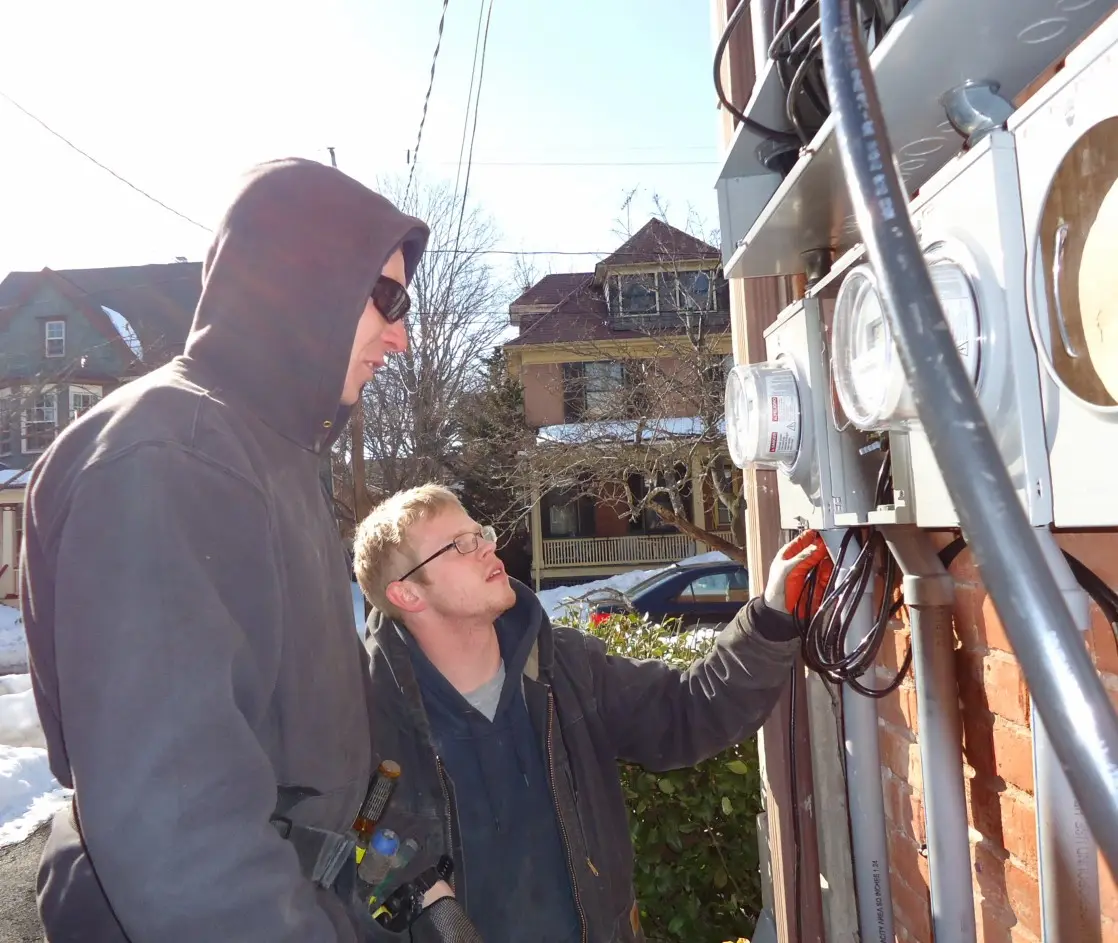
Electricians inspecting the electrical panels and meters on a multifamily house. Photo: Tomwsulcer, CC0, via Wikimedia Commons.
CSLB license class
C-10 Electrical
Where it applies
San Francisco, East Bay, Peninsula, South Bay
Request
Free, up to three local pros reply
Electrical jobs on Bay Area homes
Replacing knob-and-tube circuits
Knob-and-tube wiring runs single conductors on porcelain knobs through framing and porcelain tubes through joists, with no ground wire. Where it survives, it is often on a few original circuits mixed in with later cable. Replacing it means fishing new cable through walls and ceilings from the attic and crawlspace, with small openings cut where a run cannot be reached. San Francisco's permit rules require the new wiring to be inspected before it is covered.
Replacing a problem panel
The City of Palo Alto's utility names certain older panels, including Federal Pacific Electric, Zinsco, Challenger, Pushmatic, GTE-Sylvania and some Schneider Electric models, as possible fire or shock hazards. A panel from that list, or one with no spare breaker spaces, is a common reason to call an electrician. Replacing the panel at the same service size is a smaller job than a service upgrade, but it still means a permit, a shutdown and an inspection before the power comes back on.
Service upgrades
A service upgrade raises the amperage the utility delivers, which usually means a new meter base, main breaker and service conductors, and a coordinated disconnect and reconnect with the utility. The work is often driven by a remodel, an ADU, or plans to replace gas appliances. On overhead services the mast and weatherhead may change; on underground services the conduit may too. In Palo Alto and Alameda the utility on the other end is the city itself.
Subpanels and circuit sharing instead of a bigger service
A bigger service is not the only answer to a full panel. Palo Alto's utility suggests circuit sharing technology and higher-efficiency, lower-power equipment when panel capacity in amps is too low, and a subpanel or tandem breakers when the panel simply has no room. A C-10 contractor can run a load calculation first to show whether the house really needs more amperage or only more breaker space, which can take a service upgrade off the table.
Circuits for heat pumps and electric water heaters
Under the Air District's current schedule, new residential tank water heaters must be zero-NOx starting with units made after January 1, 2027, and furnaces after January 1, 2029, and today that means electric equipment. Each heat pump, heat pump water heater or induction range needs its own circuit, sized to the unit. In San Jose, plans for an electric water heater must include load calculations proving the existing service is adequate, and a heat pump water heater takes an electrical permit as well as a plumbing one.
The license this work needs
C-10 Electrical
CSLB's C-10 Electrical class covers placing, installing, erecting or connecting any wires, fixtures, appliances, raceways or conduits that generate, transmit or use electrical energy. Hanging a light or fan on an existing box is handyman work. Rewiring, new circuits, subpanels, panel changes and service upgrades need a permit and a licensed C-10 contractor. A B General Building contractor may take electrical work only as part of a larger job with other trades. Check the number at cslb.ca.gov.
Houses built before drywall became standard have lath-and-plaster walls and ceilings, which crack when cut and hide framing that is hard to locate from the room side. Rewiring them is slower than wiring an open wall, and the electrician's route through attic, crawlspace and closets decides how much patching follows. Ask early whether plaster repair is included, because it rarely is in an electrical contract and it shapes how the house looks when the job is done.
Electrification arriving on old services
The Air District's zero-NOx standards for water heaters and furnaces take effect as old gas equipment burns out, so more Bay Area houses are adding electric loads one appliance at a time. A heat pump water heater this year and a heat pump for heating in a few years land on the same service. Planning the panel for both at once, instead of reacting to each replacement, avoids paying for two rounds of electrical work on a house with limited capacity.
Insulating attics that hide old wiring
Attic insulation is one of the first energy upgrades many owners make, and in older houses the attic is exactly where knob-and-tube runs survive. The California Electrical Code does not allow concealed knob-and-tube in attics, walls or ceilings where loose, rolled or foamed-in-place insulation envelops the conductors, unless a specific exception is met. That turns a simple insulation job into an electrical question first, and the electrician's findings can decide whether insulation goes in before or after rewiring.
San Francisco limits who can pull an electrical permit by license. A C-10 contractor can take any electrical work, including fire alarms, while a C-7 is limited to low voltage and a C-46 to solar work, which needs a separate solar permit. B contractors can get electrical work tied to a kitchen or bath permit approved immediately. Only owners of a stand-alone single-family house may take a permit to wire their own home.
Berkeley's Knob-and-Tube Wiring Safety Report, Form 146, must be completed and signed by the certifying electrician, with copies posted in the attic before inspection and the original handed to the building inspector at final. In Oakland, replacing wall outlets without rewiring and swapping circuit breakers for the same type and size need no permit. In Alameda, electric service comes from Alameda Municipal Power, the city's own public utility.
Menlo Park requires a certification letter from an electrical contractor to be filed with the city and posted in the attic before an insulation inspection over knob-and-tube wiring. In Palo Alto, the city's utility says a 200-amp panel is adequate for most homes, and that many fully electric homes may be able to operate on 100 amps, a useful check before assuming an upgrade is needed.
San Jose's permit system at SJPermits.org lets owners look up permit records and property information by address, a quick way to see whether earlier electrical work in a house was ever permitted. The city also cautions that insurance companies may deny claims related to unpermitted work, which matters most for wiring hidden in walls by a previous owner.
Permits and rules to know
California Electrical Code 394.12 and knob-and-tube
Insulation may be installed around existing knob-and-tube only if an electrical contractor holding a California license surveys the wiring and certifies it is in good condition, with no deterioration, proper overcurrent protection and no improper connections or splices. The certification is filed with the building department and a copy goes to the owner. The insulation must be noncombustible with no conductive material, and every accessible area must carry a caution notice in English and Spanish. Repairs or extensions to the old system still need permits and inspections.
San Francisco electrical permits
San Francisco requires an electrical permit before installing new wiring or altering, extending or adding to an existing installation, with exemptions listed in San Francisco Electrical Code Section 89.121. Applications go through PermitSF. The form separates category 3 work, which covers services, subpanels, generators and transformers, and may ask for the service size in amps. Contractors authorized for Express Permits can skip staff review, and the work must be inspected before the wiring is covered.
Palo Alto utility service applications
In Palo Alto an electric service upgrade involves both the Development Services building permit and the City of Palo Alto Utilities. A utility service application goes to Utilities for review, and the city says it responds in about 10 business days when no building permit is involved. For an overhead service the applicant calls for the panel inspection with the Building Department before connection; an underground service also needs a pre-construction underground inspection.
Before you hire
Ask whether every knob-and-tube circuit will be removed or disconnected, or only the runs that are easy to reach.
Ask how many openings the rewiring will cut in plaster walls and ceilings, and who repairs them.
Check at cslb.ca.gov that the license lists C-10 Electrical for the business named on your contract.
For a service upgrade, ask who schedules the utility disconnect and reconnect, and how long the power will be off.
Ask whether circuit sharing or a load calculation could avoid a service upgrade before you agree to one.
Confirm the permit is issued under the contractor's license and that wiring is inspected before walls are closed.
Ask for the contractor's liability insurance certificate before work starts in rooms you live in.
How a request works
Describe the job
A few sentences and a photo of the problem or the space. It takes about a minute.
Local pros get in touch
Up to three handymen or contractors who take this kind of work may call or text to ask questions and quote.
Check, compare, decide
Look up the license, compare what you hear, and agree the scope and price with the one you pick. Requesting costs nothing.
Questions about electrical work in the Bay Area
Do I have to rewire knob-and-tube before insulating my attic?
Not always. The California Electrical Code allows insulation around knob-and-tube if an electrical contractor surveys the wiring and certifies it is in good condition, the insulation is noncombustible, and caution notices go up in English and Spanish. Berkeley's and Menlo Park's forms also let the electrician report that the wiring is not in good condition, or that it is disconnected or removed, which decides the next step.
Is my Zinsco or Federal Pacific panel a problem?
Palo Alto's utility lists Federal Pacific Electric, Zinsco, Challenger, Pushmatic, GTE-Sylvania and some Schneider Electric panels as older models that may pose fire or shock hazards. That is a reason to have a C-10 contractor inspect the panel and advise, not a reason to open the cover yourself.
Do I need a 200-amp service to go all-electric?
Often not. The City of Palo Alto's utility says a 200-amp panel will be adequate in most cases, and that many fully electric homes may be able to operate on 100 amps. Circuit sharing devices and lower-power equipment can close the gap, so ask for a load calculation before approving a service upgrade.
Can I replace an outlet or a breaker in Oakland without a permit?
Yes, within limits. Oakland lists replacing wall outlets, as long as it is not rewiring, and replacing circuit breakers with the same type and size among the electrical work that does not need a permit. Adding circuits, rewiring, and changing a panel or service all do.
Can I do my own electrical work in San Francisco?
Only on a stand-alone single-family house that you own. San Francisco lets those owners take out an electrical permit for their own work, but they must visit the Permit Center at 49 South Van Ness to discuss the job with an inspector, and if they cannot show they can do it safely, they must hire a licensed contractor instead.
Who deals with the utility during a service upgrade?
The electrical contractor normally coordinates it, because the utility has to disconnect the old service and connect the new one after inspection. In Palo Alto that means the City of Palo Alto Utilities, and in Alameda it is Alameda Municipal Power. Palo Alto's own guidance is to hire a licensed electrician with experience working in Palo Alto.
Checked against these public sources in September 2026. Codes and programs change: confirm permit rules with your city's building department and a license on the CSLB website before work starts.