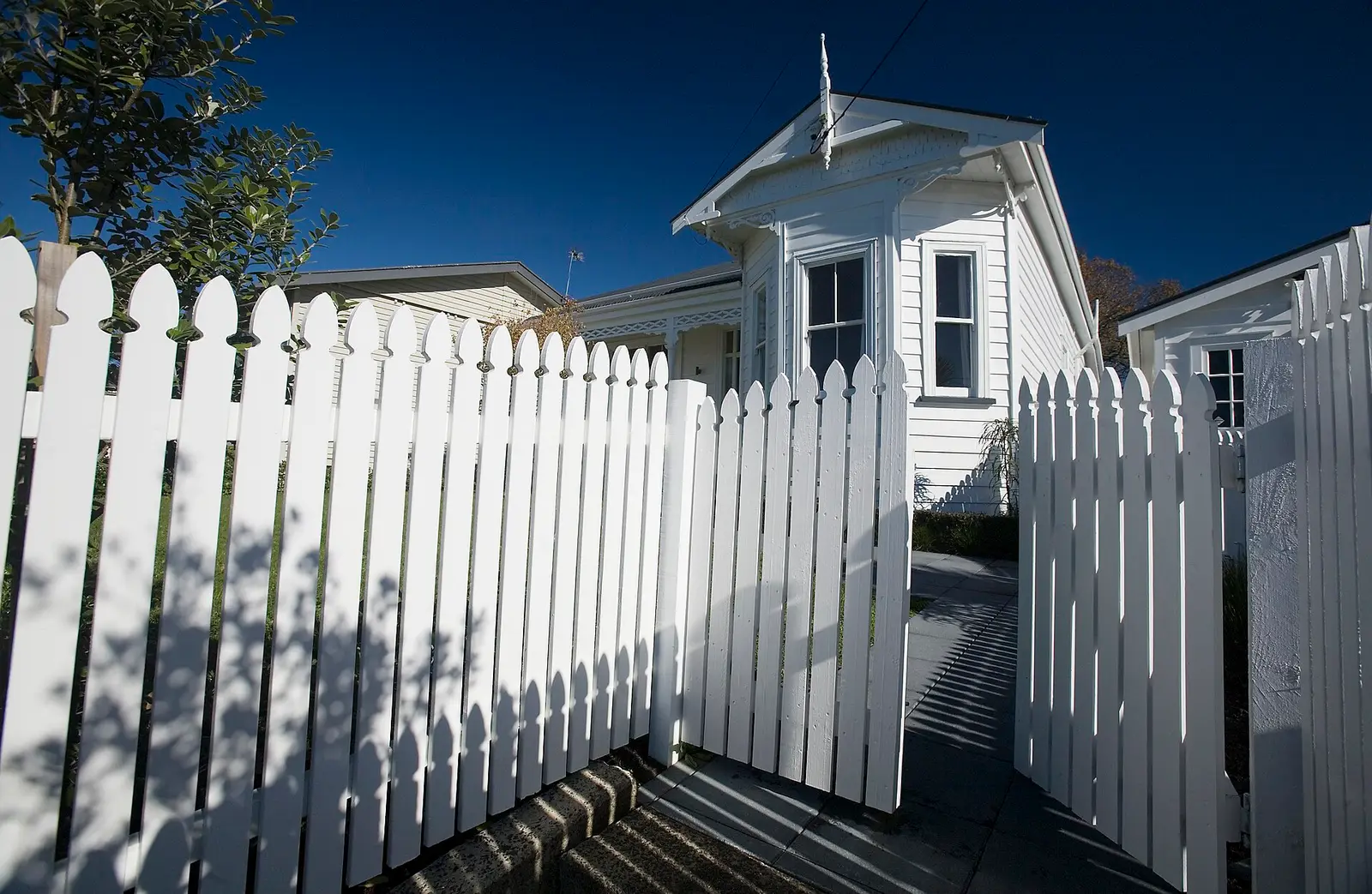
A white wooden picket fence with an open gate in front of a white weatherboard house
A white wooden picket fence with an open gate in front of a white weatherboard house. Photo: Jorge Royan, CC BY-SA 3.0, via Wikimedia Commons.

Fences and gates Daly City

Fences in Daly City: six feet behind, three out front, measured uphill

Daly City holds a fence to six feet where a parcel's only use is housing, below the seven feet the state code exempts from a building permit, and to three feet in a required front yard or within thirty-five feet of a street corner. Height is taken at the property line of whichever of the two adjoining lots sits higher, so the uphill grade sets the number.

  • Free to request, no obligation to hire
  • Up to five local pros who take this work can reply
  • Rules on this page checked against 13 public sources, October 2026
Residential cap
Six feet, Municipal Code 17.40.020
Front yards and corners
Three feet, and within 35 feet of a street corner
Height read from
The property line of the higher adjoining lot
Building permit
None for a fence of six feet or less

The work

Four fence calls that turn on a Daly City rule

  • The six-foot fence that cannot become seven

    A contractor used to working one city south may quote a seven-foot back fence out of habit, because the state residential code exempts fences up to that height from a building permit. Daly City zoning does not allow it. On a parcel whose sole use is residential the limit is six feet unless the law or a condition of approval requires more, and the city's own answer is that no permit is needed as long as the fence stays at or under six feet. A fence above that is not a taller permit, it is a code enforcement matter. Eight feet, and ten with administrative design review and a decorative material, belong to non-residential and mixed-use parcels.

  • Where the three-foot run begins and ends

    Out toward the street the limit drops to three feet, and it bites in two places: in any required front yard, and within thirty-five feet of the street corner on a corner lot in a residential zone. In R-1 the required front yard is fifteen feet. On a block only partly built out, though, the code sets it instead at the average front yard of the adjoining principal buildings, capped at fifteen feet, so where the low run has to end is a question about the neighbors' setbacks rather than a number on a table. The city also asks that any fence reaching into a front yard be cleared with it first.

  • An arbor over the gate, which is not a fence here

    Chapter 17.40 lifts trellises out of the fence section and sends them to the accessory-structure rules, which changes what can stand beside a three-foot front fence. A trellis may go in the front half of the lot up to ten feet tall and twenty feet of combined length. Gazebos and pergolas share the ten-foot ceiling but are kept out of front and side yards. Keep every accessory structure on the lot to a hundred and twenty square feet in total and the code asks for no setbacks, no lot-coverage arithmetic and no design review. A light or a socket inside one needs an electrical permit.

  • The low wall holding the ground up behind the boards

    On the stepped lots in St. Francis Heights, Serramonte and Southern Hills the fence line often sits above something carrying soil, and the city separates the two by what each holds: a fence carries only itself. A retaining wall is measured from the bottom of its footing to the top of the wall. Under forty-eight inches it may be wood, provided it takes nothing but landscape backfill and is pressure-treated or a species that resists decay on its own. Over forty-eight inches, or under it with a surcharge or an excavated uphill slope above, the wall takes a building permit, construction documents for structural review and a design by a licensed professional engineer.

Free, no obligation. Next, add your details in the request form.

The houses here

Loose sand under the post holes, lots with barely a side yard

The ground a post goes into here is mostly sand. Daly City's Safety Element describes the city as underlain for the most part by weak to moderately consolidated, loose to firm sands, with the Colma and Merced Formations beneath much of it and Franciscan rock showing only near San Bruno Mountain. The lots are tight on top of that: the R-1 district allows a width down to twenty-five feet with a fifteen-foot front yard, and the General Plan calls Crocker small lots with little or no setbacks, approaching twenty dwelling units an acre and the densest neighborhood in the city. The findings the Building Division filed with the 2025 code adoption name the weather working on all of it: a coastal marine climate, fog that sits, damp air, seasonal rain, and bursts of wind carrying ocean salt that wear at exterior materials. Latches, hinges and post bases go first.

Free request

Describe the fence and gate job once. Local pros who take work in Daly City reply by call or text.

  • No fee to request, and no obligation to hire
  • You agree scope and price with the pro you choose
  • Photos help them quote without a first visit

Get quotes for fence and gate work in Daly City

Two short steps. A local pro who takes this work calls or texts you back.

To send a request, call or text (415) 449-8213.

Free to request, and you agree the scope and price with the person you hire before work starts. In California, a job over $1,000 in labor and materials, or one that needs a building permit, must be done by a contractor licensed by the CSLB in the right class. Ask for the license number and check it at cslb.ca.gov.

Permits and local rules

The four Daly City documents behind a fence quote

  • Section 17.40.020 and the way height is taken

    The zoning section caps a fence at six feet on a parcel used only for housing, eight on a parcel with a non-residential use including mixed-use buildings, and ten there with administrative design review and a decorative material such as tubular metal or vinyl cladding. Whatever the use, three feet is the ceiling in a required front yard and within thirty-five feet of a street corner in a residential zone. The measuring rule catches people out: height comes from the ground level at the property line of the highest abutting property on either side. On a sloping parcel it is read at the shortest post in any panel up to eight feet long.

    Daly City Municipal Code 17.40.020 (opens in a new tab)
  • The Fences and Retaining Walls handout, and its three counters

    Economic and Community Development publishes a short sheet that splits this work across three divisions: Planning answers fence questions, Building issues permits, and Engineering handles clearances, easements and right-of-way. It repeats the six-foot and three-foot limits for all zoning districts, states plainly that construction of a fence six feet or less needs no building permit, gives the measurement as the highest ground level adjoining the fence on either side, and sets out the forty-eight-inch line and the wood-wall conditions for retaining walls. It also notes that any fence or wall extending into the front yard has to be approved for visibility to oncoming traffic and for clearance to fire hydrants, gas and water valves and utility boxes.

    City of Daly City, Fences and Retaining Walls (opens in a new tab)
  • The strip behind the sidewalk, and the streets Caltrans holds

    The handout warns that the lawn behind the sidewalk may be city easement or public right-of-way, anywhere from nothing to twelve feet back or out as far as the water meter, and that it usually carries gas and electric lines along with city water and sewer. An encroachment permit may be required there, and the city asks owners to confirm the property line with Engineering before building. On several Daly City frontages the permit is not the city's to give: Public Works lists Interstate 280, Highway 1, Skyline Freeway, Route 82 along Mission Street and San Jose Avenue, and El Camino Real south of San Pedro Road as streets where an encroachment permit is filed with Caltrans instead.

    City of Daly City Public Works (opens in a new tab)
  • A new fence in the -RP district is a conditional use

    Where the zoning map carries the -RP Resource Protection combining district, which takes in land designated open space in the general plan and land next to it, a new fence or wall is not an as-of-right structure. Chapter 17.27 names fences and walls among the new structures that need a use permit, and the application comes with a geotechnical report signed by a geologist covering topography, soils and geology, past and possible future landslide and erosion, groundwater and site stability, plus a CEQA evaluation. On a blufftop nothing may stand within fifty feet of the bluff edge as the city engineer draws it.

    Daly City Municipal Code, Chapter 17.27 (opens in a new tab)

State license for this work: C-13 Fencing, C-29 Masonry. Look up a contractor's license on the CSLB website (cslb.ca.gov).

Part by part

Four parts of town where the fence line reads differently

  • Crocker and lower Vista Grande

    The General Plan puts Crocker at close to twenty dwelling units an acre on small lots with little or no setbacks, the highest density of any neighborhood in the city, and describes the Vista Grande blocks south of John Daly Boulevard the same way: a regular grid with little or no side yard. There is frequently no room to stand on the far side of a side fence, which decides how boards and posts come out and go back.

  • Southern Hills

    Detached houses running in ribbons along the ridges of steeply sloped hillsides east of Interstate 280, usually two stories over a two-car garage. The Safety Element singles the slopes out for gorse and describes a city abatement program asking residents to clear gorse and other combustible vegetation fifty feet from structures, which is the brush standing on both sides of a back fence line here.

  • Westlake Palisades and the Skyline blufftops

    Everything beyond Skyline Boulevard, plus the slice of Westlake North on the ocean side of Eastgate Drive, falls in the state Coastal Zone, and the open space along the coast brings the -RP district with it. The Safety Element records twenty-one houses on Westline Drive declared unfit for occupancy and removed in 2000, and cliff retreat of one to thirteen feet logged along the 900 block of Skyline Boulevard between December 1974 and January 1982.

  • Bayshore

    Annexed in 1963, and the neighborhood the General Plan lists with dead-end streets and no curbs, gutters or sidewalks. With no sidewalk there is nothing on the ground marking where the public right-of-way stops, and that is the line the city's handout tells an owner to settle with Engineering before a front fence or wall goes in.

Before you hire

Settle these before a Daly City fence comes down

  • Ask which grade the six feet is measured from: the city takes it at the property line of whichever adjoining lot is higher, not necessarily yours.
  • For anything reaching into the front yard, ask who clears sight lines for oncoming traffic and clearance to the hydrant, the gas and water valves and utility boxes.
  • Before a post hole goes in near the sidewalk, ask whether that strip is city right-of-way, and whether the permit is the city's or Caltrans'.
  • If the line rides on a wall holding soil, ask whether the wall passes forty-eight inches or carries a surcharge, which puts it into permit and engineering territory.
  • Past the $1,000 line in labor and materials, look the C-13 Fencing number up at cslb.ca.gov before the first board comes off.

Free, no obligation. Next, add your details in the request form.

Questions

Daly City fence questions, answered from the code

Can a back fence in Daly City be seven feet tall?

No. The state residential code exempts a fence of up to seven feet from a building permit, but Daly City zoning stops at six on a parcel whose only use is residential, unless the law or a condition of approval requires more. The city says a fence of six feet or less needs no building permit, and it points fences above six feet to code enforcement rather than to a permit counter. Eight and ten feet are written for parcels carrying a non-residential use.

Our neighbor's yard sits higher than ours. Whose grade sets the height?

Theirs. Section 17.40.020 takes the allowed height from the ground level at the property line of the highest abutting property on either side of the fence, so the uphill lot fixes the number and the owner below ends up with less than six feet of screening on their side. On a sloping parcel the measurement is read at the shortest post in any panel up to eight feet long, which lets a fence step down a grade instead of climbing with it.

Who pays for the fence between two Daly City houses?

The city's own position is that fences fall under a good neighbor policy: it requires no fence, and ownership, building or rebuilding is a matter of agreement between the two owners, with the note that if one will not help with cost or labor the other may do the work alone. State law stands behind that conversation. Civil Code 841 presumes equal responsibility for a dividing fence and calls for written notice thirty days before an owner spends on it, which is why the written estimate matters.

Does a fence across the front lawn need any approval if no permit applies?

It needs a clearance rather than a permit. The city's fences sheet says a fence or wall extending into the front yard must be approved for visibility to oncoming traffic and for clearance to fire hydrants, gas and water valves and utility boxes. Height out there is three feet, and the same three feet applies within thirty-five feet of a street corner on a corner lot. Planning takes the fence question; Engineering takes anything touching an easement or the right-of-way.

We back onto open space. Will a new fence need a use permit?

If the parcel carries the -RP Resource Protection combining district, yes. Chapter 17.27 lists new structures there, fences and walls among them, as conditional uses, and the application includes a geotechnical report signed by a geologist and an environmental evaluation under CEQA. On a blufftop nothing may be placed closer than fifty feet to the bluff edge as the city engineer draws it, and every new structure has to leave a vista corridor at least five feet wide or fifteen percent of the lot width, whichever is greater.

Can the old boards and posts stay in the yard for a while?

Better not to plan on it. Daly City's code enforcement pages ask owners to check for and remove hazards such as stacked wood, discarded furniture or equipment and debris in front, side and rear yards, so a pile left behind after a fence comes down becomes the owner's problem rather than the crew's. Agree in the quote whether the contractor hauls the old fence away in its own truck or a debris box is ordered for it.

Where these facts come from

Checked against these public sources in October 2026. Rules and programs change: confirm permit requirements with the city before work starts, and a contractor's license on the CSLB website.

Fence and gate work in Daly City? Tell us what you see.

One request reaches local handymen and contractors who take this work. The Handyman SF connects you with them; it does not do the work.

HandymanNow for handymen Work in Daly City? Get job leads by text. Pick your trades and areas, take only the jobs you want. No subscription. Start getting leads HandymanNow for homeowners Get the HandymanNow app. Send a request with photos, message your handyman and follow them on the way. Download the app

HandymanNow app

Fix it faster. Find work faster.

Homeowners send a job with photos and follow their handyman on the map. Handymen get local jobs by text and take only the ones they want.

Call WhatsApp (opens WhatsApp) Free quote