Replacing a water heater under Bay Area air and earthquake rules
Replacing a water heater in the Bay Area means working to air rules as well as plumbing code. Under the Air District's rule as adopted, residential tank water heaters manufactured after January 1, 2027 must meet a zero-NOx standard, and draft amendments would move that date to 2028. Every tank, old or new, must also be strapped against earthquakes, and cities such as San Jose require a permit for any replacement.
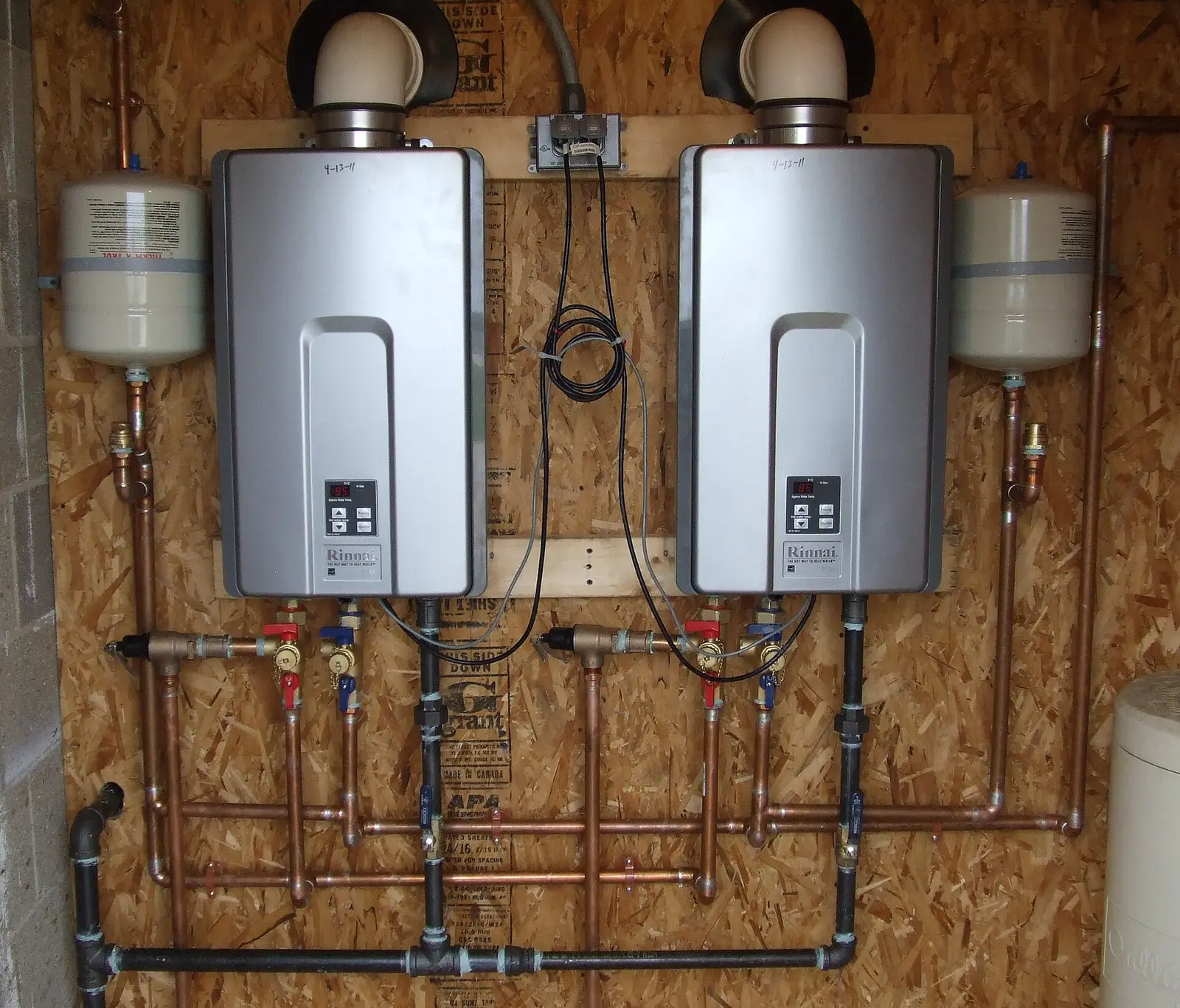
Two wall-mounted tankless water heaters plumbed with copper supply lines. Photo: Behrat, CC BY-SA 3.0, via Wikimedia Commons.
CSLB license class
C-36 Plumbing, C-20 Warm-Air Heating, Ventilating and Air-Conditioning, C-10 Electrical
Where it applies
San Francisco, South Bay, North Bay
Request
Free, up to three local pros reply
Water heater jobs on Bay Area homes
Like-for-like gas tank replacement
The most common call is a failed gas tank replaced by another gas tank in the same spot. For a single-family house or duplex in San Jose, that permit can be issued online through SJPermits. The inspection looks past the gas and water connections: straps sized to the tank, venting, and a temperature and pressure relief drain piped outdoors and ending between 6 and 24 inches above the ground. The Air District's zero-NOx standard is tied to the date a unit was manufactured, so it is worth asking about.
Switching to a heat pump water heater
A heat pump water heater pulls heat from the air around it, so where it goes matters. San Jose's guidance calls for a room of at least 10 by 10 by 7 feet, about 700 cubic feet, or else a door with a louvered panel of at least 2 by 3 feet. The unit also makes condensate, which must drain to an approved plumbing fixture or a drywell. San Jose requires both a plumbing and an electrical permit, and if the panel cannot carry the added load, it has to be upgraded.
Tankless units
Most tankless gas water heaters fall in a different size class under the Air District's Rule 9-6: heaters between 75,001 and 2 million BTU per hour, a group the Air District describes as typically commercial, multifamily and tankless units. Their zero-NOx date under the current rule is January 1, 2031, and the July 2026 draft amendments would move it to 2033. In a San Jose apartment building, an online permit covers only a like-for-like gas tank replacement; changing to a different type of heater requires plan review.
Attic and garage installations
Location rules catch many replacements. San Jose requires a water heater in an attic to sit in a safe pan with at least a three-quarter-inch drain to a visible spot, and attic access cannot be through a bedroom or bathroom. In a garage, a gas or electric heater that could ignite vapors needs its burner, pilot or elements at least 18 inches off the floor unless it sits in a separate compartment opened from outside. Gas heaters that are not direct-vent cannot go in bathrooms, bedrooms or closets opening into them.
Relief valve drains that end in the wrong place
An old installation can have a relief valve drain that tees into a laundry standpipe, runs into the crawlspace or shares a pipe with the air conditioner's condensate. San Jose's requirements rule each of those out. The drain has to run on its own, cannot connect to the sanitary sewer, cannot be trapped or fitted with a shutoff valve, and cannot end under the floor. A replacement is the moment to correct it, because the inspector checks the drain along with the new tank.
The license this work needs
C-36 Plumbing
C-20 Warm-Air Heating, Ventilating and Air-Conditioning
C-10 Electrical
CSLB's C-36 Plumbing class includes installing water heating equipment and its gas connections. The C-20 class, better known for furnaces and air conditioning, names water heating heat pumps in its scope, so an HVAC contractor can also install a heat pump water heater. Any new circuit the unit needs is C-10 Electrical work. Because a replacement needs a permit, it goes to a licensed contractor whatever its size. Check the license number at cslb.ca.gov.
Older houses tuck the water heater into a hall closet, a basement corner or a narrow garage alcove sized for a gas tank and its flue. A heat pump model needs a volume of air around it to work, so the same closet may not qualify without a louvered door or a move to another room. The Air District has heard this problem: its July 2026 draft amendments to Rule 9-6 include a one-time exemption for installations that are challenging because of space constraints.
Panels with no spare capacity
A standard gas tank needs little or no electricity, so many houses were never wired for anything else in that spot. Changing to an electric or heat pump unit can mean a new circuit, a new breaker space, or a larger panel. San Jose asks for electrical load calculations with plans for an electric water heater, to confirm the existing service is adequate. The Air District's draft amendments also propose a one-time exemption where the existing electrical system or panel would need upgrading.
Soft Hetch Hetchy water, hard South Bay wells
Water chemistry differs sharply around the Bay, and it decides how fast a tank scales up. San Francisco, which gets up to 85 percent of its water from Hetch Hetchy Reservoir, reported average hardness of 62 ppm in 2025. San Jose Water lists its groundwater at 183 to 440 ppm. Santa Clara Valley Water notes that hard water builds scale that reduces water heater efficiency, and San Jose Water warns that softener salt can corrode water heater anode rods.
In San Francisco, a plumbing permit can be pulled by a contractor holding a C-4 or C-36 license, or a B license once the scope is approved, through the city's online PermitSF system. Only owners of a stand-alone single-family house may take out a permit to do the work themselves, and they must then visit the Permit Center at 49 South Van Ness to discuss the job with an inspector.
San Jose states that installing or replacing a water heater requires a plumbing permit, and that an electrical permit may also be needed depending on the type. A single-family house or duplex that does not qualify for the online permit goes through Standard Plan Review instead. The city also cautions that insurance companies may deny claims related to unpermitted work, a practical reason to keep the permit card.
All of Marin County lies inside the Bay Area Air District, so Rule 9-6 applies to every Marin house from Sausalito to Novato. The district's boundary is different farther north: it takes in only the southern portion of Sonoma County and the southwest portion of Solano County, so an owner there should confirm which air district covers the address before planning a replacement around the zero-NOx dates.
Permits and rules to know
Air District Rule 9-6 zero-NOx standard
In March 2023 the Bay Area Air District adopted amendments to Regulation 9, Rule 6, setting a zero-NOx standard for water heaters under 75,001 BTU per hour, typically residential tanks, manufactured after January 1, 2027. It is a point-of-purchase rule: an existing heater can run until it burns out, and selling a house does not trigger it. Draft amendments released in July 2026 would delay that date to January 1, 2028 and add exemptions, with a Board hearing anticipated in November 2026.
California Health and Safety Code Section 19211
State law requires all new and replacement water heaters, and all existing residential water heaters, to be braced, anchored or strapped to resist falling or horizontal displacement in an earthquake. It covers standard water heaters up to 120 gallons for which pre-engineered strapping kits are available. When a house is sold, the seller must certify in writing that the requirement has been met, which can be done in the standard transaction documents.
Before you hire
Ask for the manufacture date of the unit being quoted, since the Air District's zero-NOx standard is tied to it.
For a heat pump model, ask whether the chosen room meets the size or louvered-door requirement before the unit is ordered.
Ask who will check whether your panel can carry an electric or heat pump unit, and whether that load calculation is in the quote.
Confirm the quote includes the permit, seismic straps and inspection, not only the tank and labor.
Ask where the relief valve drain will end, and where a heat pump unit's condensate will go.
Check the license at cslb.ca.gov for C-36 or C-20, plus C-10 if a new circuit is part of the job.
If the house has a water softener, ask how often the anode rod should be inspected.
How a request works
Describe the job
A few sentences and a photo of the problem or the space. It takes about a minute.
Local pros get in touch
Up to three handymen or contractors who take this kind of work may call or text to ask questions and quote.
Check, compare, decide
Look up the license, compare what you hear, and agree the scope and price with the one you pick. Requesting costs nothing.
Questions about water heater work in the Bay Area
Do I have to replace my working gas water heater in 2027?
No. The Air District's rule applies when equipment is bought and installed, not to heaters already in service. An existing water heater can stay in operation until it burns out or needs replacing, and selling the property does not trigger the rule. What changes is which new units can be sold and installed, based on their rating and date of manufacture.
Does the Air District rule cover my gas stove or clothes dryer?
No. Rules 9-4 and 9-6 cover furnaces, water heaters and small boilers. The Air District states that they do not apply to gas stoves, ovens, clothes dryers or any other gas appliance, so a water heater replacement does not affect the range in the kitchen.
I'm selling my house. Does the water heater need straps?
Yes. California Health and Safety Code Section 19211 requires existing residential water heaters to be braced, anchored or strapped against earthquake motion, and the seller must certify in writing that this has been done. If the straps are missing or loose, have them corrected before the disclosure is signed.
Is the January 2027 date final?
Not yet. In July 2026 the Air District released draft amendments to Rule 9-6 that would move the date for residential tank water heaters to January 1, 2028 and add exemptions, including one-time exemptions for tight spaces and for homes that would need a panel upgrade. A Board of Directors hearing is anticipated in November 2026.
Do I need a permit just to swap an old tank for a new one?
In the cities that spell it out, yes. San Jose requires a plumbing permit to install or replace any water heater, with an electrical permit for some types, and Oakland requires permits to replace plumbing systems. The inspection is where straps, venting, gas connections and the relief valve drain get checked.
Why does a water heater in the South Bay scale up faster?
Because the water is harder. San Jose Water's groundwater runs 183 to 440 ppm of hardness, compared with an average of 62 ppm in San Francisco's 2025 water quality report. Minerals settle as scale, which Santa Clara Valley Water says reduces water heater efficiency, so flushing and anode checks matter more in hard-water areas.
Checked against these public sources in September 2026. Codes and programs change: confirm permit rules with your city's building department and a license on the CSLB website before work starts.