Keeping Rohnert Park's planned-city houses in good repair
Most of Rohnert Park went up to one plan: lettered sections grouped around schools and parks, with more homes from 1960 to 1979 than any other era. Its tract houses, apartments and mobile homes need ordinary fixes under unusual rules: splash blocks under downspouts, fence heights set by yard, and a panel check on Federal Pacific or Zinsco boxes.
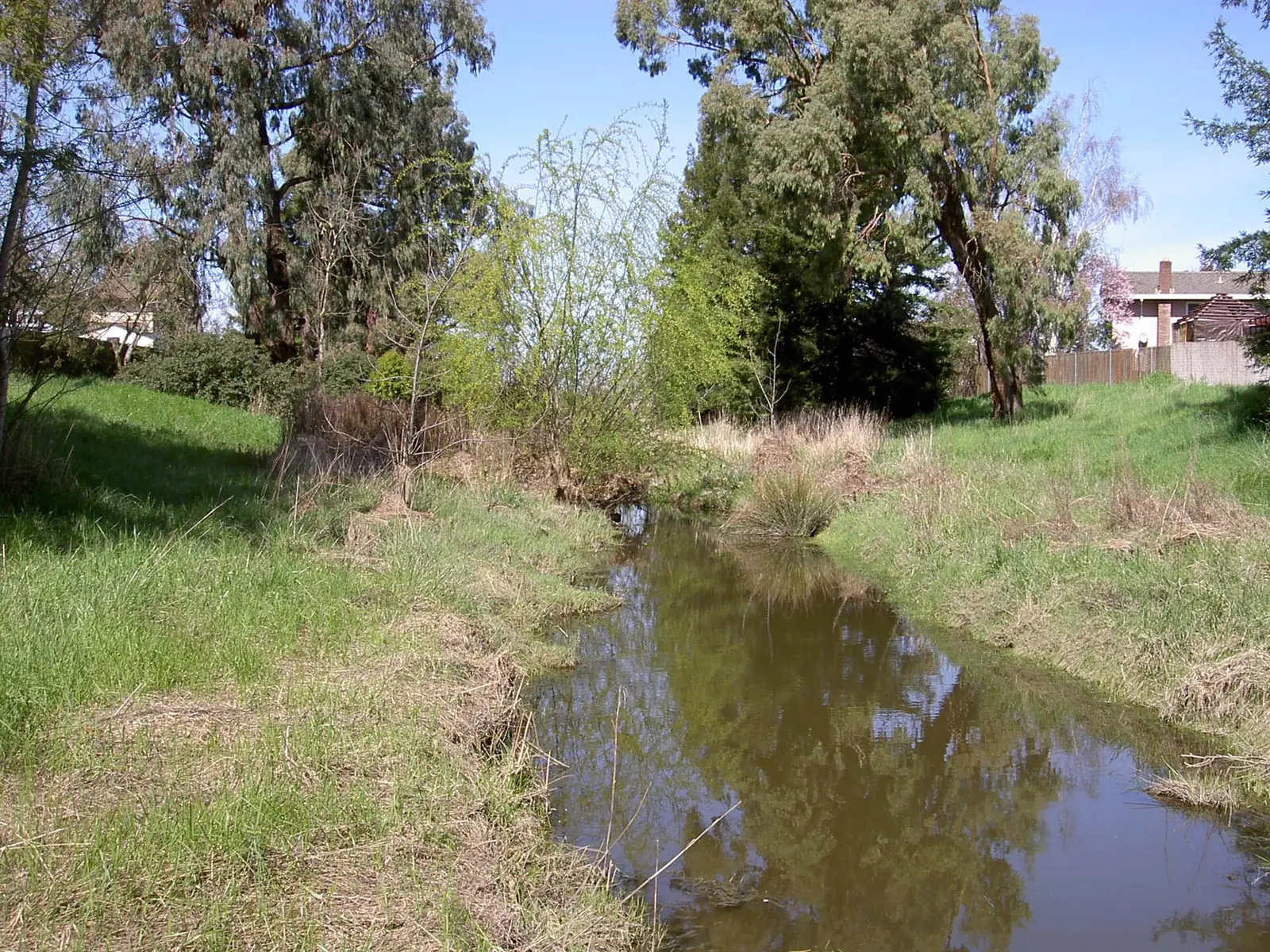
A slow creek between grassy banks and tall eucalyptus in Rohnert Park, with the backs of houses and a wood fence beyond. Photo: Stepheng3, Public domain, via Wikimedia Commons.
ZIP codes
94928
When the homes were built
1956-2020s
Main streets
Rohnert Park Expressway, Southwest Boulevard, Commerce Boulevard, Snyder Lane
Landmarks
Sonoma State University, Foxtail Golf Course, Roberts Lake
What homes in Rohnert Park need most
Fence heights the zoning code sets by yard
Rohnert Park's zoning code caps fences, walls and hedges at 3 feet inside a front yard setback and 6 feet along side and rear yards. Neighbors who agree can raise a shared fence to 8 feet when the top 2 feet is open lattice in the same material as the rest. On a corner lot the fence stays at least 3 feet back from the sidewalk and 3 feet clear of any fire hydrant, and lots beside the golf course set side or rear fencing six inches inside the property line. Rehanging a gate or replacing pickets and rails is repair; a masonry wall of any height needs a building permit. More about fence, deck and gate repair
Gutters, leaders and the required splash blocks
A local amendment to the building code requires rain gutters, downspouts, rain leaders and splash blocks on residential buildings and garages, a rule the city ties to poor local soil. The sewer code covers the other end: no roof downspout, area drain or foundation drain may be tied into a sewer lateral, and the city can order an illegal connection removed within 30 days of written notice. Clearing the gutters before the first storms, resetting loose downspout elbows and putting back a cracked or missing splash block keeps roof water on the surface and away from the slab.
Fixture swaps and the Federal Pacific question
Replacing a light or a ceiling fan on an existing box is handyman work. A permit is another matter here: under the city's amendment to the Electrical Code, applying for any permit on a house whose main service enclosure was made by Federal Pacific or Zinsco, rebranded versions included, can bring a required service upgrade. The Building Division decides on serviceability, from a licensed electrician's written inspection, and its bathroom remodel checklist asks for the panel's manufacturer on the plans. Anything that adds a circuit belongs to a licensed contractor (C-10 Electrical).
Fix the slider before it needs a permit
Rohnert Park asks for a building permit for any door or window installation, new, retrofit or replacement, with two inspections: the prepared opening, meaning its framing, flashing and weather barrier, before the unit goes in, and the sealant, fasteners and flashings once it is installed. That makes repair the quicker route when a sliding door drags, a latch will not catch or a sash sticks. New rollers, a cleaned track, adjusted strikes and fresh weatherstripping leave the opening alone. When the frame itself has failed, plan for the permit and its inspections. More about door and window repair
Sediment from the city's own wells
Part of Rohnert Park's water comes from wells inside the city, and Public Works says sand and iron-rich sediment from them settles in the mains until a main repair, hydrant use or construction demand stirs it up. Its instructions are specific: stop using water, report it, run the faucet in the front yard until clear, then run cold water from the fixtures nearest the street toward the back of the house, and hold laundry, since bleach can set iron stains. Grit that does reach the house tends to collect in faucet aerators and showerheads, and cleaning them restores the flow. More about faucet, toilet and fixture repair
Soft wallboard behind an old tub surround
Water that works behind a tired tub surround leaves soft drywall to cut out and replace. If the repair turns into retiling, the city's bathroom remodel checklist does not permit greenboard under thinset tile; the backing must be a cementitious board or a gypsum board approved for the use. Fixture swaps in kind can be permitted over the counter without plans, and the checklist calls for an exhaust fan controlled by an adjustable humidity sensor, because a window does not count as ventilation. Ceiling stains from a poorly vented bathroom can be patched and painted on the same visit. More about drywall and plaster repair
How the houses here are built
Single-family detached houses make up 47.3 percent of the city's housing, apartments in buildings of five or more units 27.4 percent and mobile homes 9 percent, by the 2023 Housing Element's count. The largest share, 7,805 units, was built from 1960 to 1979, and city officials place the homes most in need of rehabilitation in the A and B sections, central Rohnert Park and the mobile home parks on the west side.
The city's building code amendments, justified in its Housing Element by poor local soil, require new slab-on-grade buildings to sit on at least thirty inches of engineered non-expansive fill, and require residential buildings and garages to carry gutters, downspouts, leaders and splash blocks. Both rules are aimed at water collecting against a foundation, so a missing splash block or a downspout that empties onto the slab edge is worth fixing.
Using Santa Rosa weather records, the city's 2025 water plan puts average January lows near 37°F and late-summer highs near 83°F, with almost no rain between June and September, so caulk, paint and fence boards bake dry all summer and then stay soaked through the winter storms.
Good to know before a job in Rohnert Park
Lettered sections and alphabetical streets
The city is organized into sections named by letter, A through H and then J, L, M, R and S, and in most of them the names of streets and parks begin with the section's letter: the M Section has Maurice Avenue, Mercedes Way, Michael Way and Maximillian Place. The plan follows a neighborhood unit idea, with a school and a park within easy reach of each group of homes. The city still schedules work section by section; its 2026 water main flushing ran in Sections M and S. Giving the section letter along with the address helps a pro find the house.
Weekday permit parking in the M Section
Since February 2014, Maximillian Place and the stretch of Maurice Avenue between Mercedes Way and Michael Way have been a residential permit parking area under Ordinance 818, so parking on the street there needs a permit from 6 a.m. to 10 p.m., Monday through Friday. Residents apply through the Finance Department, the form offers a temporary permit, and a resident without a car can still request one for family, caretakers or service providers. If a work truck will need the curb on a weekday, arrange a permit or driveway space before the visit.
Faults, channelized creeks and ember rules
The Housing Element puts the Healdsburg-Rodgers Creek fault zone about five miles east of the city and the San Andreas system about 15 miles west, and warns of shaking, liquefaction and settlement; the city's water heater handout places Rohnert Park in seismic design category D. Ground near the channelized Copeland and Hinebaugh creeks, and the west side near the Laguna de Santa Rosa floodplain, see localized flooding. The Housing Element places the city outside CAL FIRE's High and Very High hazard zones, yet its 2025 residential code amendments require all roof and underfloor vents to be self-sealing or ember intrusion resistant.
How a request works
Describe the job
A sentence and a photo or two is enough. It takes about a minute.
A local handyman gets in touch
By call or text, to ask what the photos don't show and give you a price.
You decide
Agree a time and price with the handyman directly, or don't. Requesting costs nothing.
Questions from Rohnert Park homeowners
Can my neighbor and I build an 8-foot fence between our Rohnert Park backyards?
Yes, if you both agree. The zoning code lets a shared side or rear fence reach 8 feet when the top 2 feet is open lattice or another see-through design in the same material as the rest of the fence. Above 6 feet the zoning code also wants the building department's approval, and any masonry wall needs a building permit. In the front yard setback, the limit stays at 3 feet.
Our house has a Zinsco panel. Can that hold up a permit for a new bathroom fan?
It can. The city's Electrical Code amendment says the service disconnect of a one- or two-family house or a townhome may need an upgrade when any other permit is applied for and the main enclosure is Federal Pacific or Zinsco, rebranded versions included. The Building Division looks at serviceability: a licensed electrician inspects the panel at the owner's expense and puts the result in writing, and a panel found serviceable lets the project go ahead without the upgrade.
Do I need a permit to replace a sliding glass door in Rohnert Park?
Yes. The Building Division's window and door handout covers every installation, new, retrofit or replacement, and requires one inspection of the prepared opening before the door goes in and another of the installed unit. Flashing follows the manufacturer's instructions, with pan flashing at the sill where none are given. New rollers, a straightened track or a new lock work on the existing door rather than installing a new one.
Water pressure dropped at our house. What does the city suggest checking first?
The house valve below the faucet in your front yard. Public Works asks residents to make sure it is turned to the left as far as it will go. If pressure stays low, or there is no water at all and a billing problem is not the cause, contact Public Works. Pressure can also dip during the city's main flushing, which in 2026 ran from May into June, 8 a.m. to 4:30 p.m.
Are the A and B sections where Rohnert Park's oldest homes are?
They are among them. The 2023 Housing Element says city officials see the homes most in need of rehabilitation in the A and B sections and central Rohnert Park because of their age, along with mobile home parks on the west side. Across the city, the biggest share of housing dates from 1960 to 1979, and the city's sewer facilities were mostly installed between 1956 and 1980.
Checked against these public sources in October 2026. Rules change: confirm anything permit-related with the city or town of Rohnert Park before work starts.