Repairs on Sebastopol houses, from South Main to the Laguna floodplain
Most Sebastopol homes are past 50: the largest share went up between 1960 and 1979, South Main still has Victorians, and little has been built since voters drew an urban growth boundary in 1996. City wells deliver hard water, about 150 ppm, that scales up fixtures, and the east side sits on the Laguna de Santa Rosa floodplain, where winter water has covered Morris Street.
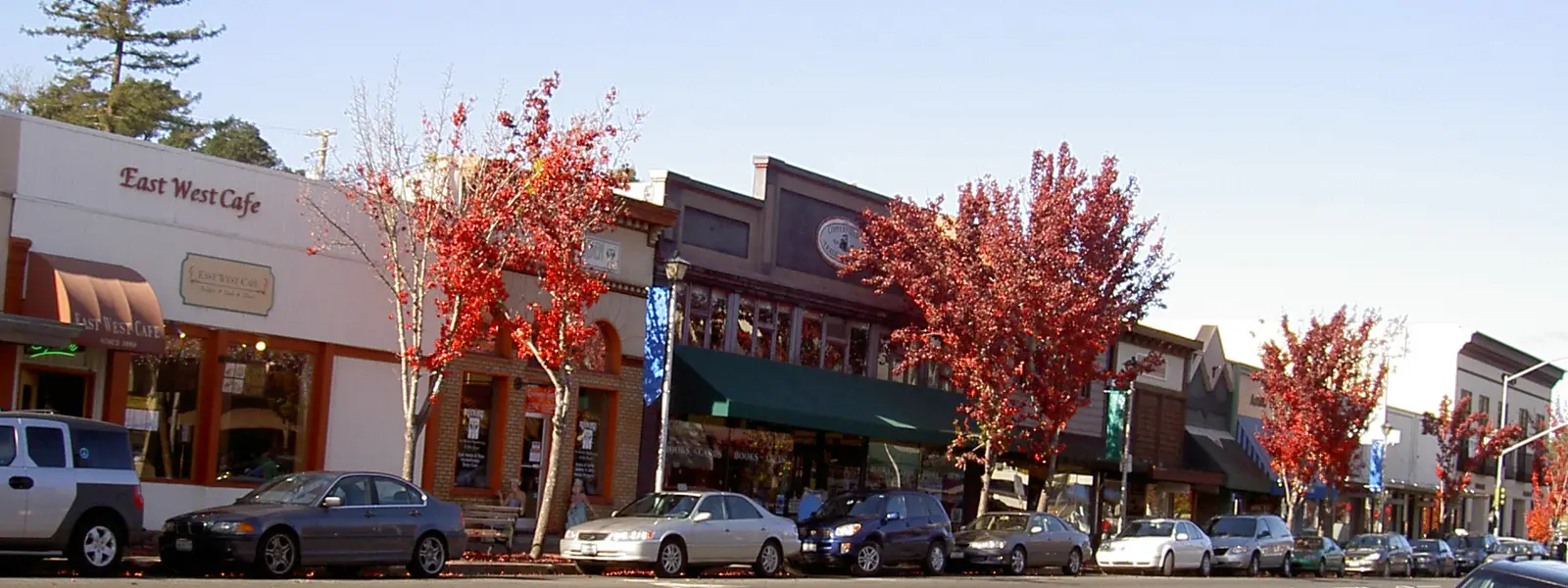
Main Street storefronts in downtown Sebastopol with red-leaved street trees and parked cars in autumn. Photo: Stephen Gold, Public domain, via Wikimedia Commons.
ZIP codes
95472, 95473
When the homes were built
Late 1800s-1970s
Main streets
Main Street, Petaluma Avenue, Bodega Avenue, Healdsburg Avenue
Landmarks
The Barlow, Ives Park, Laguna de Santa Rosa Wetlands Preserve
What homes in Sebastopol need most
White crust from city well water
Every tap in town draws on city wells in the Santa Rosa Plain groundwater basin, and the 2025 Consumer Confidence Report puts hardness at 150 parts per million, with readings from 120 to 160. The U.S. Geological Survey classes anything from 121 to 180 as hard. That mineral load builds up in faucet aerators, showerheads and toilet fill valves, so cleaning or swapping them usually brings the flow back. The new cellular water meters also feed the EyeOnWater app, which can alert an owner to a leak as it starts. More about faucet, toilet and fixture repair
Downspouts that end up in the Laguna
Most of the city's storm drain system, more than 24 miles of pipe, runs east and empties into the Laguna de Santa Rosa, while a smaller western area drains to Atascadero Creek. Whatever leaves a roof travels that way. The Building and Safety storm guide asks owners to keep gutters, downspouts, catch basins and yard grates clear, and not to let a downspout spill onto bare soil: splash stones, a driveway or a walkway should carry the water toward the street. Clearing gutters before the December storms keeps that path open.
Wash water kept out of the storm drain
The city's Power Washer Guidelines leave little room: wash water may not run into streets, storm drains or outside drains without a written variance from the city. Before a deck, driveway or wall is washed, nearby drain openings are blocked with sandbags, plugs or mats, and no soap goes in, not even a biodegradable one. The water then goes to a landscaped or gravel area large enough to soak it up, with the owner's consent. Sending it to the sanitary sewer through a sink or cleanout needs the city's approval first.
Repainting a house past fifty
The Housing Element says most homes here are more than 50 years old, and its data packet puts the largest group, 1,409 units, between 1960 and 1979. Most of them predate 1978, the cutoff for the EPA's Renovation, Repair and Painting rule, which requires the firm doing the work to be certified by the EPA once disturbed paint passes the rule's thresholds. The city's own guidelines for painters treat lead paint, or any paint applied before 1972, as hazardous, require paint chips stripped by a power washer to be collected and filtered, and forbid hosing paint into a gutter. More about interior painting and touch-ups
Anchoring furniture between two faults
No fault crosses the city, but its hazard mitigation plan names the San Andreas to the west and the Healdsburg-Rodgers Creek fault to the east as the main threats. Anchoring bookcases, dressers and tall cabinets to studs, latching kitchen cabinets and strapping the water heater are small jobs that limit damage indoors. The 2023 Housing Element also counts about 100 units that need seismic safety retrofits; foundation bolting and bracing of that kind is work for a licensed contractor, not a handyman. More about general handyman repairs
Drafts in a century-old bungalow
The city's profile describes housing that runs from Craftsman bungalows and farmhouses about 100 years old to modern subdivisions, and frost on a handful of nights each winter. In the older houses, cold air finds its way in around original doors, window trim and the spots where pipes pass through walls and floors. Weatherstripping doors, recaulking trim and sealing those openings cuts the drafts, and the city's winter water flyer adds insulating exposed pipes to its list of tips. More about weatherstripping, caulking and sealing
How the houses here are built
Craftsman bungalows and farmhouses about a century old, the many Victorian residences the General Plan notes along South Main, and the houses of 1960 to 1979, which hold the biggest share of the city's homes. Park Village, a city-owned mobile home park, sits on the Laguna's bank. The Housing Element counts only 26 units built after 2010.
The 1906 earthquake reduced most of the town's first buildings to rubble, so what stands downtown was largely rebuilt after it. The ground differs by side of town: the city's hazard plan puts most of Sebastopol in the very low liquefaction class, but about 120 acres along the Laguna on the east side fall in the very high class, ground that can lose its strength in hard shaking.
Frost can settle in on fewer than 10 days a year between December and March, the same months whose storms most often push the Laguna over its banks and across Highway 12.
Good to know before a job in Sebastopol
Where the Laguna comes over its banks
Sonoma County's Flood Insurance Study names ponding on the lower Laguna de Santa Rosa, backed up by the Russian River, as the city's principal flood problem. The 2022 hazard mitigation plan lists the worst spots: Sebastopol Avenue and Morris Street near the Laguna, and Pleasant Hill Road. On December 31, 2005, water covered Morris Street from Sebastopol Avenue to the Community Cultural Center. In February 2019 it reached Flynn Street, Park Village and about two-thirds of The Barlow, and the fire department made water rescues. The plan counts 23 repetitive-loss buildings, 18 of them in mapped A or AE zones. The city's flood damage prevention rules, Chapter 15.16, work from FEMA's study of March 7, 2017.
A city hall open Monday to Thursday
Building and Safety, Planning and the Engineering Division all close every Friday, keeping Monday-to-Thursday hours. Most applications now go through the city's e-permitting portal, and the city says an application is not considered submitted until payment is received; in-person intake is by appointment. The Building Department's list of work exempt from permits includes one-story sheds of up to 120 square feet and fences no taller than 7 feet, and it adds that an exemption never authorizes work that breaks the code or another city ordinance.
Moderate fire zones and nothing higher
On the State Fire Marshal's map of the city's local responsibility area, dated February 24, 2025, the only ranking shown is Moderate; the rest of the city is unzoned. Working from the earlier maps, the city's 2022 hazard plan found its 126 moderate-zone parcels along the southern and eastern edges and pointed to the Fircrest Mobile Home Park area and Robinson Road in the south. The CAL FIRE answers the city posts say the wildland-urban interface code, Chapter 7A, applies to new buildings in High and Very High zones of a local responsibility area, so a Moderate ranking alone does not bring it in.
How a request works
Describe the job
A sentence and a photo or two is enough. It takes about a minute.
A local handyman gets in touch
By call or text, to ask what the photos don't show and give you a price.
You decide
Agree a time and price with the handyman directly, or don't. Requesting costs nothing.
Questions from Sebastopol homeowners
Our house is on Flynn Street near the Laguna. How do we find out if it is in a FEMA flood zone?
Look up the address on FEMA's Flood Map Service Center. Sebastopol's maps come from the countywide Flood Insurance Study last revised on March 7, 2017, and the high-risk areas are labeled A or AE. Flynn Street homes flooded in February 2019, and the city's hazard plan expects the deepest water on the east side near the Laguna and along Sebastopol Avenue. The city has been in the National Flood Insurance Program since 1980, so flood policies are available.
Which air district covers a Sebastopol address, the Bay Area one or the Northern Sonoma County one?
It depends on the parcel. The County of Sonoma lists Sebastopol among four towns split between the Bay Area Air Quality Management District, which covers the southern part of the county, and the Northern Sonoma County Air Pollution Control District, based in Healdsburg. The county's online map shows which side an address falls on. It matters for appliance rules such as the Bay Area district's limits on gas water heaters.
We want to take out a tree in our Sebastopol yard. Who approves it?
The Planning Department, under Chapter 8.12 of the Municipal Code. The application goes through the online permit portal with a location map, a written description of the tree, a site plan and labeled photos. Planning has 30 days to decide whether the application is complete. Small removals may be reviewed by staff alone; others go to the Tree Board, which meets on the first and third Wednesdays at City Hall on Bodega Avenue.
Do we need a permit to retile a bathroom or replace kitchen cabinets in Sebastopol?
Not for the finish work itself. The Building Department's exempt-work handout lists painting, papering, tiling, carpeting, cabinets, countertops and similar finish work. Moving a sink or replacing a concealed drain or water pipe is different: once a hidden pipe has to be replaced with new material, the handout treats it as new work that needs a permit and an inspection.
Checked against these public sources in October 2026. Rules change: confirm anything permit-related with the city or town of Sebastopol before work starts.