Benicia repairs, from 1940s shiplap to Southampton hillsides
Two historic districts and a 1964 hillside boom split the repair work here. The lower town's older houses sit on a grid of numbered and lettered streets platted in 1847, where the city requires Planning review for any exterior change. North of them, Southampton's 1960s tracts and the 1940s shiplap cottages of The Highlands and West Manor bring faults of their own.
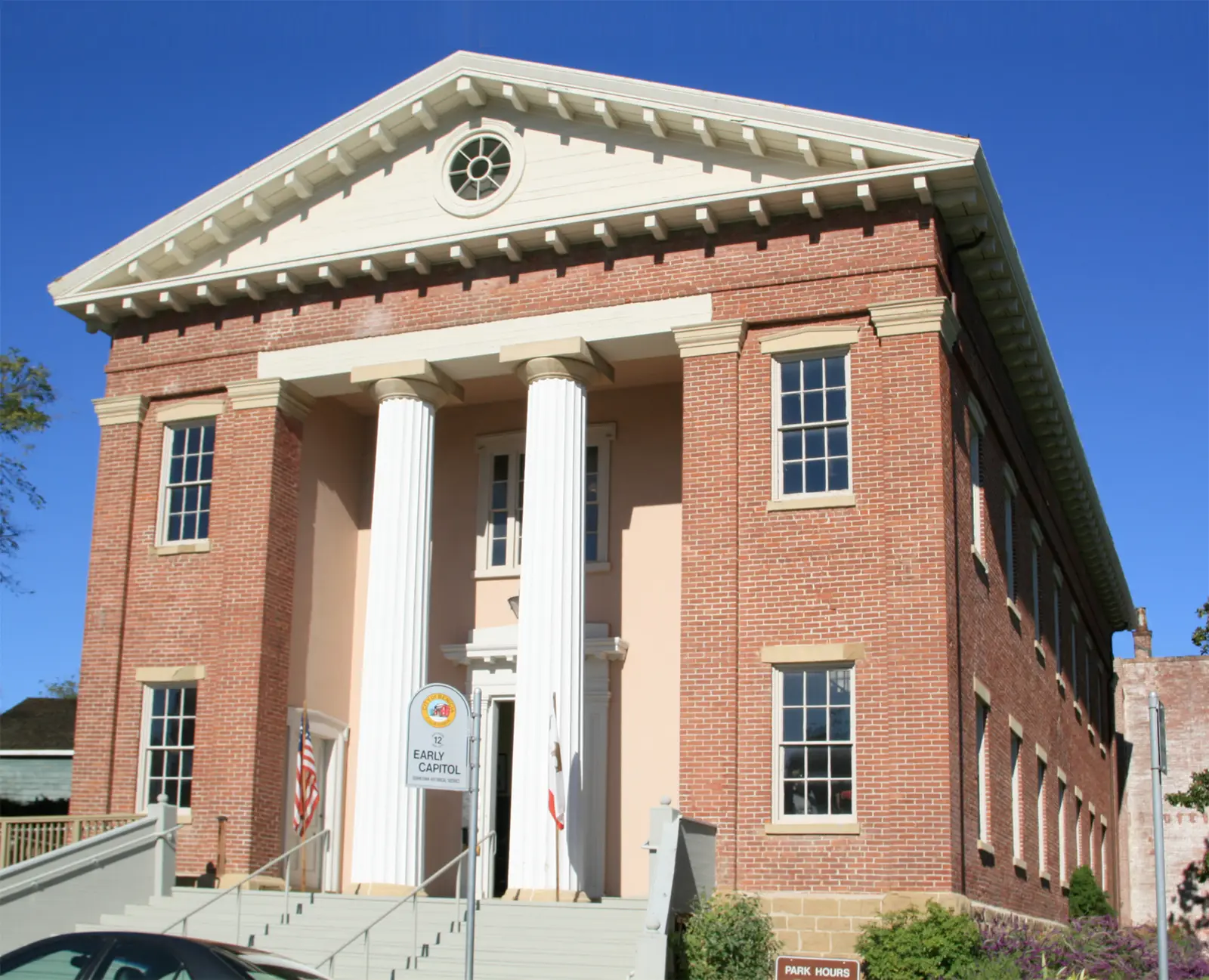
The brick Benicia Capitol, California's third state capitol, at Benicia Capitol State Historic Park. Photo: Leonard G., Public domain, via Wikimedia Commons.
ZIP codes
94510
When the homes were built
1850s-1975
Main streets
First Street, West K Street, Military East, East Second Street
Landmarks
Benicia Capitol State Historic Park, Benicia Arsenal clock tower, Benicia-Martinez Bridge
What homes in Benicia need most
Dry rot in shiplap siding and porches
Older housing here is wood frame clad in shiplap siding, with porches, steps and railings facing a peninsula open to the Strait on three sides. Water finds the joints first: the base of a porch post, the end grain of a siding board, the sill under a window. Cutting out soft wood and fitting new pieces to the same profile is ordinary work, and the city's design-review handout lists dry rot repair as minor repair that is exempt when it does not change the exterior appearance. A building permit does come into play once siding replacement passes five by five feet. More about carpentry, shelves and trim
Double-hung wood sash in the war-era tracts
The Highlands and West Manor went up quickly in the 1940s to house Arsenal war workers, and houses of that period were built with double-hung wood-sash windows, unglazed paneled wood doors and concrete entry steps. Eighty years on, sash cords part, layered paint seizes a sash in its channel, and doors bind on hinges nobody has touched. Freeing, re-cording and re-glazing an original sash keeps it working. Replacement is a different matter: the city lists replacing or altering a door, window or skylight among the work that needs a building permit. More about door and window repair
Decks, fences and gates on Southampton slopes
Southampton began in 1964 on the rolling hills north of the old town, so lots are graded and stepped and much of the usable outdoor space is deck, stair and retaining wall. Boards cup, posts work loose in soil that swells through winter and shrinks through summer, and a gate stops latching once its post moves. Replacing boards and rails, resetting a post and rehanging a gate are straightforward, and rear-yard decks and perimeter fences are exempt from historic design review. A leaning retaining wall, or a ledger pulling away from the house, is for a licensed contractor. More about fence, deck and gate repair
Repainting a house built before 1978
Most housing in town predates 1978, and the city asks anyone renovating, repairing or repainting a home from before that year to complete its lead Renovation, Repair and Painting form. The federal rule behind it covers work disturbing six square feet inside or twenty square feet outside, and requires firms doing that work to be certified by the EPA. Prep is where the dust comes from, so scraping, sanding and containment matter more than the topcoat. Inside the two districts, repainting a painted surface, including a change of color, is listed as exempt from design review. More about interior painting and touch-ups
Fixture swaps, and the one that needs a permit
City water arrives from three sources: the State Water Project through the North Bay Aqueduct, Lake Berryessa through the Putah South Canal, and Sulphur Springs Creek held at Lake Herman. The 2025 water quality report put calculated hardness at 87 milligrams per liter. Changing a faucet cartridge, a toilet fill valve, a showerhead or the supply lines under a sink is routine in these older houses. One job is not: replacing or installing a water heater is on the city's list of work requiring a building permit, so plan it before the old one fails. More about faucet, toilet and fixture repair
How the houses here are built
Nineteenth- and early-twentieth-century houses fill the downtown district the city first designated in 1969, among them frames thought to have been shipped around Cape Horn. The 1940s added The Highlands and West Manor for Arsenal war workers, and in 1964 Rooklyn Homes began the Southampton subdivision on the hills to the north.
War-era houses are wood frame in shiplap siding, with double-hung wood-sash windows, hip or gable roofs over exposed rafter tails and concrete entry steps; a few carry asbestos shingle cladding applied early on. Older houses in the lower town are wood frame as well, with porches, railings and trim the city treats as character-defining features. Southampton sits on graded hill pads, so decks, stairs and retaining walls do the work a flat yard would.
The city's own hazard report calls atmospheric rivers and high winds its most common severe weather, with Diablo winds through the year and an extreme-heat day defined locally as 97.6°F or hotter.
Good to know before a job in Benicia
Two historic districts and the review they trigger
The city designated its first downtown historic district in 1969 and adopted the Downtown Historic Conservation Plan in 1990; the Arsenal Historic District covers military-era resources spanning 1849 to 1964. For a designated Historic Resource, or any building inside either district, the city states that a building permit and Planning Division review are required for exterior changes. Design review itself, set out in Municipal Code chapter 17.108, exempts a long list of minor work, and commission-level review is aimed at modification of character-defining features such as materials, craftsmanship, decorative details, porches or bay windows. Check your address with the Planning Division before ordering parts.
What the ground does under the lower town
The city's safety background report puts the greatest downtown liquefaction potential along the shoreline areas east of First Street, taking in the condominium communities and the Rancho Benicia mobile home park, and in the Industrial Park near Suisun Bay and Bayshore Road. Mapped landslide susceptibility concentrates on the undeveloped hillsides to the northwest, north and east, and some hillside areas in Southampton show evidence of past landslide activity. The Concord-Green Valley fault system runs nearby, and the 2014 magnitude 6.0 South Napa earthquake, centered about fourteen miles northwest, was felt here. Only a site-specific geotechnical study settles what one lot is sitting on.
Fire zones, and the goats
Cal Fire designates very high fire hazard severity zones only within Local Responsibility Areas, and this city, which runs its own fire service, has none inside its limits. Sky Valley Open Space, a State Responsibility Area, is very high, and the largely undeveloped state areas north of the Valero refinery are moderate and high. Grassland dominates, which the city notes is controlled more easily by weed abatement than heavier brush would be. The Fire Department's Vegetation Management Program uses disking, spraying and goats to keep separation between vegetation and structures rather than stripping a lot bare.
How a request works
Describe the job
A sentence and a photo or two is enough. It takes about a minute.
A local handyman gets in touch
By call or text, to ask what the photos don't show and give you a price.
You decide
Agree a time and price with the handyman directly, or don't. Requesting costs nothing.
Questions from Benicia homeowners
Do I need a permit to replace a window here?
Yes. The city lists replacement or alteration of doors, windows and skylights among the work requiring a building permit, along with siding replacement over five by five feet and water heater changes. If the house is a designated Historic Resource, or stands in the Arsenal or Downtown Historic District, the city also requires Planning Division review for any exterior change. Repairing the existing sash instead avoids both.
My house is a contributing building downtown. Can I put vinyl windows in?
On a landmark or contributing building, a replacement matching existing dimensions, appearance and material characteristics is exempt from design review, and the city's handout gives wood to wood, vinyl to vinyl and wood to paintable composite as examples where details match. Changing material so it no longer matches the existing textural or visual characteristics goes to the Historic Preservation Review Commission instead. The Downtown Historic Conservation Plan also states that wood sash is preferred on historic buildings.
Can I repaint my downtown house a different color without asking the city?
Repainting a painted surface, including a change of color, is listed as exempt from design review in both districts. Two things still apply. The Downtown Historic Conservation Plan sets out color schemes by style, Italianate and Classical monochrome in white or off-white, Queen Anne and Stick/Eastlake polychrome. And the city asks for its lead Renovation, Repair and Painting form on any home built before 1978.
We are in Southampton on a slope. Is a sagging deck or fence a handyman job?
Replacing deck boards, resetting a fence post and rehanging a gate, yes, and rear-yard decks and perimeter fences are exempt from historic design review. But the city's safety background report records evidence of past landslide activity on some Southampton hillside areas. If a retaining wall is leaning, a deck ledger is pulling off the house, or new cracks keep opening at door corners, get a licensed contractor or a geotechnical engineer to look before anything is patched.
Is any part of town in a very high fire hazard severity zone?
Not inside the city limits. Cal Fire assigns very high zones only in Local Responsibility Areas, and the city's own report states there are none here. Sky Valley Open Space, a State Responsibility Area, is very high, and undeveloped state areas north of the Valero refinery are moderate and high. The Fire Department runs a Vegetation Management Program that uses disking, spraying and goats to maintain separation around structures.
Checked against these public sources in October 2026. Rules change: confirm anything permit-related with the city or town of Benicia before work starts.