Petaluma asks for permits on jobs many cities let slide: a replacement fence goes through Planning and dry rot repair needs a building permit. Downtown's three historic districts of iron-front stores and 1850s-1920s houses put exterior changes, windows and paint included, under city review. East of the river, subdivisions from the 1960s on need the everyday fixes of their age.
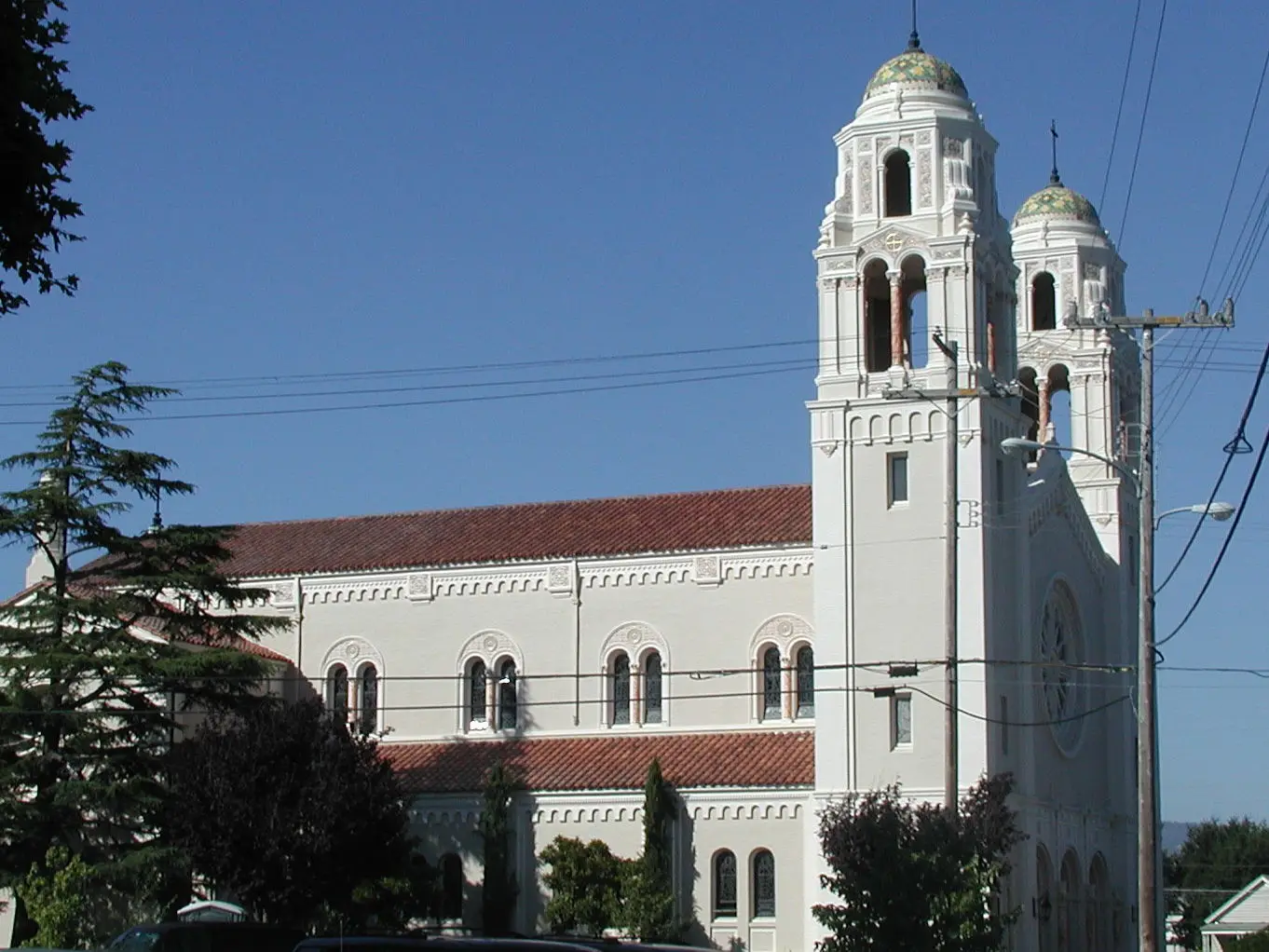
White Spanish-style church with twin tiled bell towers against a blue sky in Petaluma, with power lines along the street. Photo: Colin Marquardt, Colin Marquardt, Public domain, via Wikimedia Commons.
ZIP codes
94952, 94954
When the homes were built
1850s-2000s
Main streets
Petaluma Boulevard, Western Avenue, Kentucky Street, D Street
Houses in the Oakhill-Brewster district north and west of downtown and the A Street district to the south and east date largely from the 1850s to the 1920s, the era of wood sash windows that stick, rattle or hang on broken cords. Petaluma lists window replacement in a historic district building as permit work, and its Planning Division says exterior changes there, windows and paint included, carry special requirements. Freeing a painted-shut sash, renewing cords and stops or fitting new hardware from inside keeps the original window in service; talk to Planning before anything on the outside changes. More about door and window repair
Gates, boards and the city's fence permit
Resetting a sagging gate or swapping a few broken boards is repair. Replacing a run of fence is different here: Petaluma requires a fence permit for a new or replacement fence, filed with Planning, with a site plan showing property lines and an elevation drawing. Within a front setback the limit is 42 inches; along interior sides and the rear it is 6 feet solid with up to 2 feet of screening that is at least half open. Fences and walls are not allowed at all in the Floodway zoning district along the river. More about fence, deck and gate repair
Dry rot in trim, sills and porch posts
Petaluma treats dry rot repair as permit work. The application takes a written scope, and the city says a copy of the termite report is usually enough to describe it. That makes the order of events simple: get the report, file the permit, then cut out and replace the soft wood. Rotted fascia, window trim, door casings and porch decking are the kind of carpentry a handyman takes on; once the rot reaches mudsills, posts that carry a load or framing, the job belongs to a licensed contractor. More about carpentry, shelves and trim
Old toilets and dripping fixtures
Petaluma's year-round water waste rules count leaks in household plumbing as waste, and the city hands out leak-detection tablets, aerators and 1.5 gpm shower heads at its Water Field Office on North McDowell Boulevard. Its toilet rebate needs approval before the new toilet goes in: the old one must flush 1.6 gallons or more, the new one 1.1 gallons or less, and the old toilet stays until the rebate is approved. Swapping a toilet, faucet or shower head where the piping does not change needs no building permit. More about faucet, toilet and fixture repair
Drafts when the afternoon fog comes in
Fog drawn through the Petaluma Gap tends to arrive in late afternoon and linger into the next morning, so worn weatherstripping and gaps around old doors show up as cold rooms on summer evenings, not only in winter. Replacing door sweeps and jamb seals, recaulking trim joints and sealing around pipes and vents that pass through the walls keeps out damp air and the rain of the wet months. On a house in a historic district, choose seals that leave the visible trim alone. More about weatherstripping, caulking and sealing
How the houses here are built
Victorian, Queen Anne and Italianate houses around downtown, many inside the Oakhill-Brewster and A Street historic districts, and the single-family subdivisions that spread east as the city grew from 10,315 people in 1950 to 24,870 in 1970, laid out on near-identical 6,000-square-foot lots.
The city's own residential construction handout calls Petaluma a marine environment: it wants a drainage space behind new stucco and water under a raised floor carried outside through the foundation, as city ordinance requires. Wet wood is what those rules guard against, and dry rot repair sits on the city's list of work that needs a permit.
Marine air reaches Petaluma through the Petaluma Gap, so summer fog often arrives late in the afternoon and can sit until late the next morning, and about 24 inches of rain falls in a typical year.
Good to know before a job in Petaluma
Three historic districts, one demolition rule
Downtown's Historic Commercial District went on the National Register in 1995, with 96 contributing buildings on about 23 acres, including the iron-front Italianate and Second Empire buildings near Petaluma Boulevard and Western Avenue. The city added two residential districts of its own: A Street in 1986, a mix of houses, churches and apartments nearly all built between 1860 and 1925, and Oakhill-Brewster in 1990, with homes from the 1850s onward. Almost all exterior work in a district gets some level of review, and any building put up before 1945 comes under the city's demolition policy, which counts removing half or more of the exterior walls as demolition.
Living in the river's floodplain
The city counts five major floods since 1982; in heavy rain, water can cover low roads and fill underpasses, parking structures and basements. It has widened the river and built flood walls at Payran Reach, widened and deepened the floodplain at Denman Reach, and worked on Capri Creek east of North McDowell Boulevard to cut out-of-bank flooding. Check an address on the FEMA flood map the city publishes before planning work near the ground: the city approves no development in the mapped floodway and bars fences there. Before storms it announces sandbag stations, commonly at the Hopper Street corporation yard and Prince Park.
Soft ground along the old river corridor
The city's Housing Element puts most of Petaluma in a moderate liquefaction zone, with higher risk in the center near Washington Street and Western Avenue and along the railroad corridor that follows the river. The Tolay fault runs through the northwest of the city and the Rodgers Creek fault lies beyond it. Inside the house, that is a reason to strap the water heater at its upper and lower thirds, as the city's building handouts specify, and to anchor bookcases and tall cabinets to the studs.
How a request works
Describe the job
A sentence and a photo or two is enough. It takes about a minute.
A local handyman gets in touch
By call or text, to ask what the photos don't show and give you a price.
You decide
Agree a time and price with the handyman directly, or don't. Requesting costs nothing.
Questions from Petaluma homeowners
Do I need a permit to replace an old fence in Petaluma?
Yes. The city requires a fence permit for a new fence and for replacing an existing one, filed through the Planning Division with a site plan and an elevation drawing of the fence. Height depends on where it stands: 42 inches in a front setback, 6 feet plus open screening along sides and rear. Repairs such as new boards or a rehung gate are not a replacement.
Is dry rot repair really permit work in Petaluma?
It is. The city lists dry rot repair among residential projects that need a building permit. The application asks for a written scope of work, and the city says a copy of the termite report is usually adequate for that. The fee is based on the value of the work, materials and labor together.
Can I replace the windows on my house in the A Street or Oakhill-Brewster district?
Possibly, but not as an ordinary swap. Window replacement in a historic district building needs a building permit, and the Planning Division says exterior changes in the districts, including windows and paint, have special requirements. Talk to Planning before ordering anything. Repairing the existing sash, its cords and hardware is often the simpler route.
Which small jobs need no permit in Petaluma?
The city's list includes painting, wall and floor tile, carpet and other floor coverings, cabinet faces, door replacement, very small sheetrock patches, plumbing fixtures where the piping does not change, and replacing outlets, lights and switches. Work still has to meet code, other departments may have rules of their own, and the historic districts treat exterior work differently.
Where can a Petaluma water customer get free aerators or a leak check?
The Water Field Office at 202 North McDowell Boulevard and the Finance counter at City Hall hand out aerators, shower heads, hose nozzles and toilet leak-detection tablets free to city water customers, Monday through Thursday. The city also offers a free Water-Wise HouseCall, in which a trained water efficiency professional checks fixtures, the meter and irrigation for leaks.
Checked against these public sources in October 2026. Rules change: confirm anything permit-related with the city or town of Petaluma before work starts.