Fixing houses in the City of Sonoma, around the Plaza and past it
The City of Sonoma lists window replacement, exterior door replacement and dry rot repair as permit work, and older houses in its Historic Overlay Zone can need Planning review. Homes run from Mexican-era adobes off the Plaza and Craftsman bungalows on Second Street East to 1950s and 1960s Ranch tracts, so most jobs here start as repairs: sash, porches, patching.
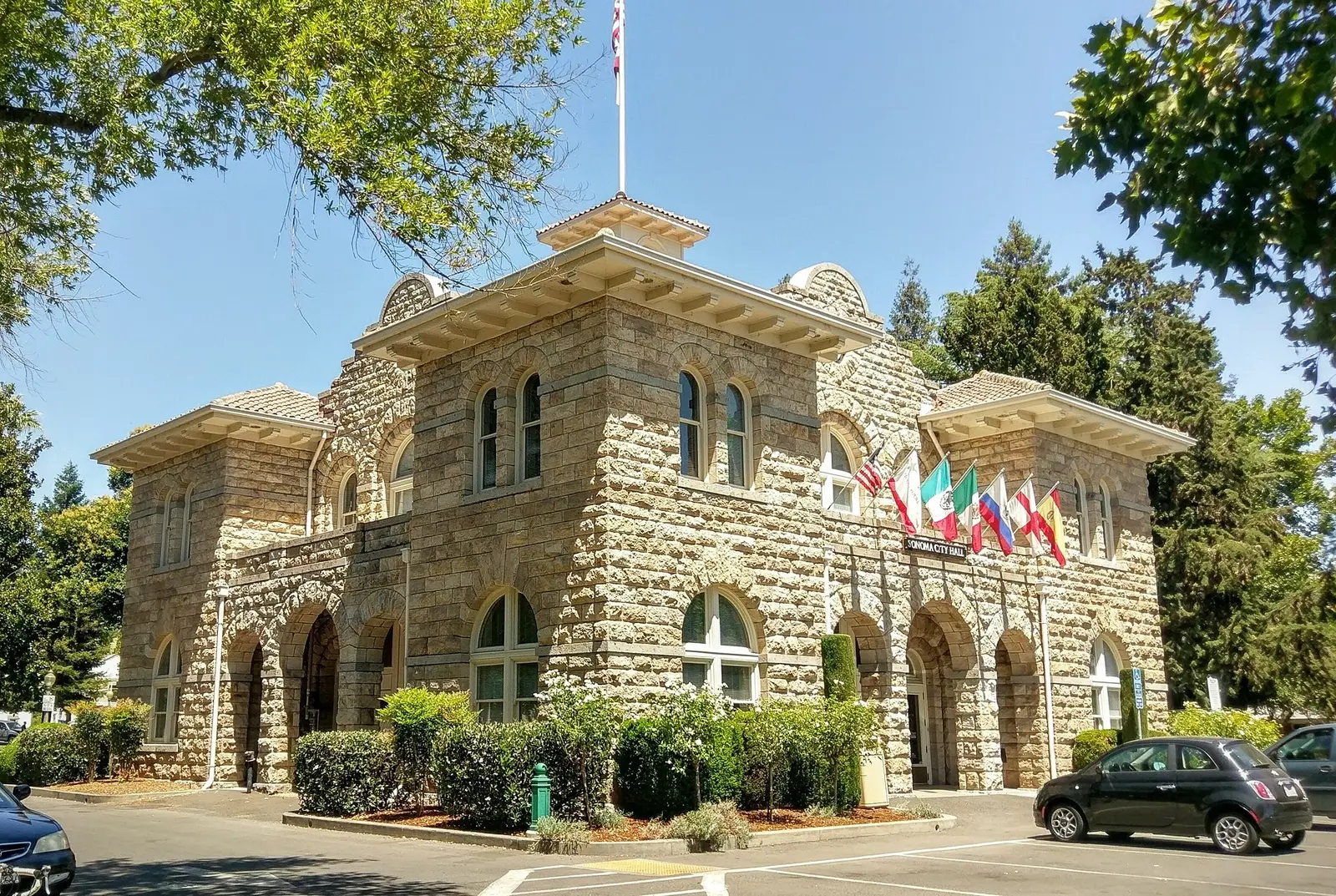
Sonoma City Hall, a two-story cut-stone building with arched windows and a row of flags, on the Sonoma Plaza. Photo: Cullen328, CC BY-SA 3.0, via Wikimedia Commons.
ZIP codes
95476
When the homes were built
1830s-1970s
Main streets
Broadway, West Napa Street, East Spain Street, First Street East
Landmarks
Sonoma Plaza, Mission San Francisco Solano, Sonoma Barracks
What homes in Sonoma need most
Old windows, and the permit to replace them
The Building Division's handout on when a permit is needed lists windows and window replacement, sliding glass doors and exterior door replacements, and its energy handout sends window projects to a compliance form available only from the city. Downtown's 2017 historic preservation design guidelines ask owners to keep original windows wherever possible, to repair before replacing, to fix one broken muntin or pane rather than the whole unit, and to avoid vinyl, fiberglass and aluminum replacements. Freeing painted-shut sash, renewing cords, reglazing and refitting stops are the repairs they favor; ask the Building Division before a frame comes out. More about door and window repair
Porches on the east-side bungalows
In the first quarter of the 1900s, builders filled the blocks east of the Plaza, roughly between First and Second Streets East and from Spain Street to Patten Street, with modest houses, and Craftsman bungalows with prominent porches clustered along Second Street East. Worn treads, split rails and loose fascia on those porches are carpentry work. The city lists termite and dry rot repair among jobs that need a permit, so once soft wood turns up in posts or framing, file for it and bring in a licensed contractor for anything that carries a load. More about carpentry, shelves and trim
Patches under the 32-square-foot line
Sonoma's permit handout exempts in-kind repair or replacement of less than 32 square feet of drywall, siding, stucco or roofing in any 12-month period. That covers most patching after a slow leak, a doorknob through a wall or a cracked stucco corner on a postwar Ranch house. A larger stretch of the same work, or a soft wall behind a tub, is different: shower and tub wall repair sits on the city's list of permit jobs, so plan the bathroom repair around that before the tile comes off. More about drywall and plaster repair
Gutters before the first heavy rain
With a strong El Niño possible for the 2026-27 winter, the city opened its self-service sandbag station at Depot Park earlier than in past years and asked residents to keep leaves out of gutters and storm drains instead of blowing or sweeping them into the street. Clearing gutters and downspouts once the trees have dropped, and pointing downspouts away from raised floors and foundation vents, keeps roof water from collecting under the house during a long storm.
Running toilets the new meters catch
In 2024 the city began replacing about 4,500 mechanical water meters with ultrasonic ones, and since February 2025 its Consumer Water Portal lets customers track use, set alerts for unusual consumption and spot a leak while they are away. A flapper that never quite seals or a dripping outdoor faucet shows up there as a steady line through the night. Stopping a leak or clearing a stoppage needs no permit here, but a new fixture, or a replacement where the piping changes, is on the city's permit list. More about faucet, toilet and fixture repair
Fire-season chores at the edge of town
The 2017 Nuns Fire burned the hills around the city and threatened its perimeter, and Cal Fire's 2025 local-responsibility map, reviewed by the city with the Sonoma Valley Fire District, enlarged the Very High and High hazard zones inside city limits. Parcels rated Very High need 100 feet of defensible space. Each year the fire district notifies owners whose lots need weed and brush abatement, and the city's fire-season notice says to mow before 10 a.m. and never in wind. Cutting dry grass, hauling brush and clearing debris off roofs are jobs to finish before a Red Flag Warning. More about general handyman repairs
How the houses here are built
A handful of Mexican-era adobes near the Plaza, among them the Leese-Fitch Adobe on First Street West and the Nash-Patten Adobe on First Street East; Folk Victorian cottages and Queen Anne and Italianate houses on the surrounding blocks; Craftsman bungalows of the 1900s to 1920s, thickest along Second Street East; and the Minimal Traditional and Ranch houses of postwar tracts such as the 1954 Sebastiani subdivision, Pueblo Park and Monte Vista Estates.
Before statehood, houses in town were built of adobe, stone or plain wood framing, and the city's 2026 historic context statement notes that its oldest houses have often had their cladding, materials and windows changed, and some have been moved. In Monte Vista Estates, annexed in 1965, Ranch houses combine brick, wood siding and stucco on a single front, so one repair can mean matching three materials.
The Bay Area Air District describes Sonoma Valley as warmer than the Petaluma side of the county and closer to Napa Valley, with plentiful sun and about 29 inches of rain in a typical year.
Good to know before a job in Sonoma
The landmark Plaza and the overlay around it
The National Park Service lists Sonoma Plaza as a National Historic Landmark designated in December 1960, and the National Register district around it, enlarged in 1992, counts 82 contributing buildings from 1835 to 1944. The city's Historic Overlay Zone, first drawn in 1974 and last redrawn in 2007, reaches well beyond downtown and brings expanded design review. Under the 2017 guidelines, permitted alterations to pre-1945 houses there that changed a street-facing side or the roof pitch went to design review. In 2025 the city proposed major and minor review tiers with lighter treatment for non-historic homes, so ask Planning which applies.
A survey of every older house
The city's register of historic sites and structures began with 94 entries in 2006 and now lists nearly 160. In 2025 the City Council hired consultants to write a historic context statement, released as a public draft in September 2026, and to survey properties at least 45 years old across the whole city, updating the city's 1998 survey. Survey findings are due for public review in spring 2027. A house that was never listed may be identified for the first time, which matters before planning exterior changes.
Where the town stops
Sonoma voters drew an urban growth boundary with Measure S in 2000 and, with Measure W in November 2020, extended it to the end of 2040; Measure W passed with 78.68 percent of the vote. Beyond city limits lie unincorporated communities such as Boyes Hot Springs, El Verano and Glen Ellen, where Permit Sonoma, the county agency, reviews and inspects construction, and the city sends water customers to the Valley of the Moon Water District. The Sonoma Valley County Sanitation District collects sewage on both sides of the line.
How a request works
Describe the job
A sentence and a photo or two is enough. It takes about a minute.
A local handyman gets in touch
By call or text, to ask what the photos don't show and give you a price.
You decide
Agree a time and price with the handyman directly, or don't. Requesting costs nothing.
Questions from Sonoma homeowners
Do I need a permit to replace windows or an exterior door in Sonoma?
Yes. The Building Division's handout lists windows and window replacement, sliding glass doors and exterior door replacements among jobs that need a permit; interior doors in a dwelling are the exception. Inside the Historic Overlay Zone, a change to the front or street side of an older house can also need Planning review. Repairing the existing sash is often the simpler route, so ask at City Hall, No. 1 The Plaza, before ordering anything.
How do I find out whether my Sonoma house is a listed historic resource?
Open the city's online Historic Resources Map, which shows locally listed buildings and four historic districts, with construction year and architectural style where records exist; the city calls it a work in progress. The Historic Overlay Zone has its own map and covers more ground. With the citywide survey running through 2027, the Planning Division and the Community Development Director are the people to ask.
Where can City of Sonoma residents get sandbags?
At the self-service filling station in Depot Park, 270 First Street West, where free sand is available to city residents; bring your own shovel. Empty bags are handed out at City Hall during business hours, up to 10 per resident while supplies last. In 2026 the station opened on October 20, and the city urged anyone whose property has flooded before to fill bags before rain is forecast.
We live in El Verano. Does the City of Sonoma issue our permits?
No. El Verano, Boyes Hot Springs and Glen Ellen are unincorporated, outside city limits, so construction there is reviewed, permitted and inspected by Permit Sonoma, the county agency. The city's own permit handouts and its Historic Overlay Zone do not apply. Sewer service is the exception that crosses the line: the Sonoma Valley County Sanitation District serves the city and those communities alike.
Does a higher fire hazard zone change work on an existing house?
It can. The city's 2025 notice on the new map says properties in Very High zones must follow stricter home hardening and defensible space standards, including 100 feet of clearance, and that new construction and major renovations in High or Very High zones must meet the Wildland-Urban Interface building codes. Where a parcel had more than one rating, the highest now applies, and the zone must be disclosed when the house is sold.
Checked against these public sources in October 2026. Rules change: confirm anything permit-related with the city or town of Sonoma before work starts.