Repairs for San Pablo's wartime cottages and small lots
Shipyard work took the town from about 2,000 people to 25,000 in a few years, and by the city's own account many of the small houses on small lots that characterize San Pablo were thrown up during the war, some never meant to be permanent. Roughly two-thirds of the housing predates 1980, the average single-family lot is about 5,100 square feet, and three creeks cross the flat plain.
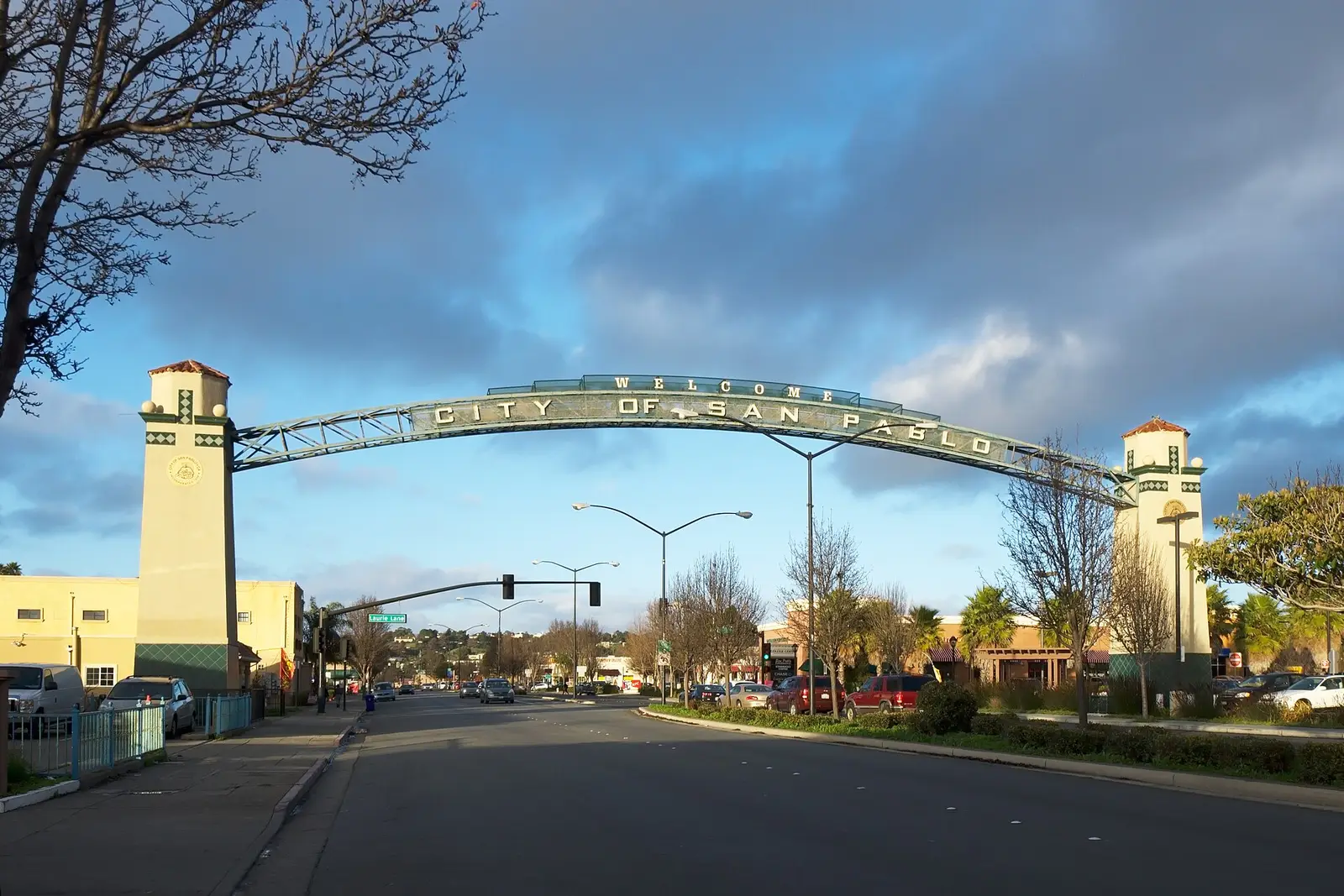
The welcome arch and its two tiled towers over San Pablo Avenue in San Pablo, with the hills behind. Photo: LPS.1, CC0, via Wikimedia Commons.
ZIP codes
94806
When the homes were built
1940-1960, with later infill
Main streets
San Pablo Avenue, Rumrill Boulevard, 23rd Street, Church Lane
Landmarks
Alvarado Adobe Museum, Blume House, Contra Costa College
What homes in San Pablo need most
Fences on 5,100-square-foot lots
With the average single-family lot about 5,100 square feet, fences sit close to the house and to the neighbors, and the zoning code is exact about them: three feet at most in a front yard, six in a rear or interior side yard, and up to eight where durable wood lattice tops a six-foot fence with administrative approval. On a retaining wall, height is measured from the bottom of the wall. Replacing split boards, resetting a leaning post and rehanging a dragging gate keeps an existing fence as approved; the Building Division sends anything taller than six feet to Planning and corner-lot fences to Public Works. More about fence, deck and gate repair
Old windows and the bars added to them
About 65 percent of the housing here went up before 1980, and plenty of those windows have had security bars fitted since. The zoning code allows bars on windows only where they follow the design guidelines and meet the fire district's standards, which matters most on bedroom windows that have to open from the inside in a hurry. Freeing a painted-shut sash, replacing worn sliding-window rollers, re-glazing and fixing latches and strikes are all repairs. Swapping the window itself sits on the city's list of work requiring a permit, so ask the Building Division before ordering one. More about door and window repair
Fixture and fan swaps that need paperwork first
The Building Division's residential bulletin puts new, relocated or replacement lighting fixtures and new or relocated ceiling fans on the list of work requiring a permit, which catches out owners who expect a like-for-like swap to be paperwork-free. The work itself is small: taking the old fixture down, checking that the box and its bracing can carry the replacement, hanging it and connecting it to the circuit already there. Ask the Building Division at 1000 Gateway Avenue how they want it handled, and leave new circuits and panel work to a licensed electrician.
Getting a house ready for creek season
Severe rainfall has put parts of the city under water before, including University Avenue beside Wildcat Creek, and flat ground gives the runoff nowhere quick to go. The jobs worth doing before the rains are the dull ones: new door sweeps and thresholds, fresh exterior caulk at window and trim joints, weatherstripping that has gone hard and brittle, and sealing the gaps where pipes and cables pass through exterior walls. When a series of storms is forecast, the city hands out sandbags free to residents at the corporation yard at 16th and Folsom. More about weatherstripping, caulking and sealing
Gutters, downspouts and undersized culverts
The general plan names the box culverts at Rumrill Boulevard, 23rd Street and Church Lane as unable to carry the flow they get, because they were built undersized or set at an angle to the channel. On a lot draining toward one of those, a blocked gutter has nowhere to spill but the wall and the ground against the foundation. Clearing gutters and downspouts, re-securing loose hangers and running the discharge well away from the house is simple work. City ordinance makes it illegal to put leaves or landscape debris into the drainage system, so it leaves with the crew.
Fixtures in houses the war built
Kitchens and baths in the wartime and 1950s houses have been updated piece by piece, so a recent faucet often sits above an angle stop that no longer shuts. The city's permit bulletin treats clearing a stoppage, stopping a leak and pulling and resetting a toilet as exempt, provided the repair does not replace or rearrange valves, pipes or fixtures; a replacement water heater is not exempt. Worn cartridges, flappers, fill valves, supply lines and sink traps fit into one visit. Corroded pipe inside a wall or under the floor is work for a licensed plumber. More about faucet, toilet and fixture repair
How the houses here are built
Small-lot single-family houses on about 78 percent of the residential land, from wartime cottages through the tracts that replaced the last farms and dairies in the 1950s, with multi-family buildings on roughly 8 percent and mobile homes on 1.4 percent, and newer apartments going up along the San Pablo Avenue and Rumrill Boulevard corridors.
Wood frame on a lowland plain about fifty feet above sea level, underlain by alluvial clay, silt, sand and gravel washed down from the hills to the east, with scattered pockets of loose fill laid over former marshland. Clay that swells wet and shrinks dry moves doors, gates and fence posts season to season, and lots averaging 5,100 square feet leave narrow side yards to work in.
The city limits stop short of the bayshore, so the weather that reaches these houses is winter rain over flat ground, carried through town by Wildcat, San Pablo and Rheem creeks rather than off the water.
Good to know before a job in San Pablo
A San Pablo address is not always the city
This is an enclave of 2.6 square miles, and several unincorporated county areas just north of it, Tara Hills, Bayview and Montalvin, carry San Pablo mailing addresses. The Building Division's first instruction to applicants is to check the city limit map, and it refers anyone outside the line to the Contra Costa County Building Department in Martinez. The outside agencies are their own mix as well: sewer through West County Wastewater District, water through EBMUD, fire through the Contra Costa County Fire Protection District. Give your street address, not just the city, when you describe a job.
Creeks that run through private yards
Wildcat Creek, San Pablo Creek and the smaller Rheem Creek all cross the city, and city ordinance makes it illegal to build structures in a creek channel. A flood damage prevention ordinance adopted in 1987 and amended in 2023 backs code controls on creek setbacks and minimum floor elevations above the base flood elevation. Work that would touch the channel or its bank runs through the state Department of Fish and Wildlife, the county Flood Control District, the Regional Water Quality Control Board and the Army Corps before the city will issue a permit. The 2021 Wildcat Creek restoration widened the bank between Vale Road and Church Lane.
East of I-80 the ground changes
Most of the lowland is mapped as potentially liquefiable, and the North Hayward Fault passes under the eastern part of the city. Because of the soil there, the nearness of an active fault and the landslide record on the steeper ground, the Building Division requires a geotechnical report for any development east of I-80, grading and tree removal included. Bolting tall furniture into studs, latching cabinets that hold heavy things and mounting shelves and screens into framing are small jobs. Foundations, retaining walls and drainage on sloping ground are for a licensed contractor or a geotechnical engineer.
How a request works
Describe the job
A sentence and a photo or two is enough. It takes about a minute.
A local handyman gets in touch
By call or text, to ask what the photos don't show and give you a price.
You decide
Agree a time and price with the handyman directly, or don't. Requesting costs nothing.
Questions from San Pablo homeowners
My mail says San Pablo. Am I inside the city limits?
Not necessarily. Tara Hills, Bayview and Montalvin lie north of the city in unincorporated Contra Costa County and use San Pablo mailing addresses. The Building Division asks applicants to check the city limit map first and sends everyone outside it to the county Building Department in Martinez. It decides which office issues a permit and which inspector turns up, so give the street address rather than the city name alone.
Does swapping a ceiling fan or light fixture need a permit here?
The city's residential bulletin lists new, relocated or replacement lighting fixtures and new or relocated ceiling fans as work requiring a permit, alongside window replacement, re-roofing and a new water heater. Painting, papering, tiling, carpeting, cabinets and countertops sit on the exempt list instead. The Building Division at 1000 Gateway Avenue confirms which applies to your job, and the answer shifts with each code cycle.
How tall can a fence be on a San Pablo lot?
Three feet in a front yard, six feet in a rear or interior side yard and six feet in a corner side yard, with durable wood lattice allowed above a six-foot fence to eight feet total by administrative approval. Fences need zoning clearance; the Building Division routes anything over six feet to Planning and a corner-lot fence to Public Works. Where a fence sits on a retaining wall, the height is measured from the bottom of that wall.
Our back fence runs along Wildcat Creek. Can it be rebuilt?
Along the bank usually yes, as long as the work stays out of the channel, because city ordinance makes structures in creek channels illegal and the flood ordinance sets creek setbacks. Anything in the channel itself needs sign-off from Fish and Wildlife, the county Flood Control District, the Regional Water Board and the Army Corps before the city issues a permit. Say that the creek is there when you describe the job.
Where do the old fence boards and fixtures end up?
The city runs a neighborhood clean-up program: vouchers for residents to take unwanted household items and trash to the Richmond dump, drop-off events roughly every six weeks, two curbside collections a year of up to fifteen bags each and one bulky-item pickup a year. Settle before the work starts who is hauling the debris, because even a small repair can leave a pile at the curb.
Checked against these public sources in October 2026. Rules change: confirm anything permit-related with the city or town of San Pablo before work starts.
sanpabloca.gov: Suburban City Era 1940 Present
sanpabloca.gov: Suburban City Era 1940 Present Continued
sanpabloca.gov: Building Services
sanpabloca.gov: WORK REQUIRING A PERMIT RESIDENTIAL
sanpabloca.gov: Creekbed Agency Information
sanpabloca.gov: Outside Agency Contact Info
sanpabloca.gov: 2023 31 Housing Element Certified Volume 1
sanpabloca.gov: 9 Safety and Noise Feb 2024
Tell us what needs fixing in San Pablo.
One short request reaches handymen who work locally. You hear back by call or text. Free, with no obligation to hire.