Vallejo repairs, from Georgia Street Victorians to Officers' Row
Much of Vallejo was built around a shipyard. Mare Island employed more than 44,000 civilians during World War II, and the city's two historic districts hold Italianate, Queen Anne and brown-shingle houses from the 1850s on. Changes visible from the street there go to a city commission, so repairing an original window or door usually beats replacing it.
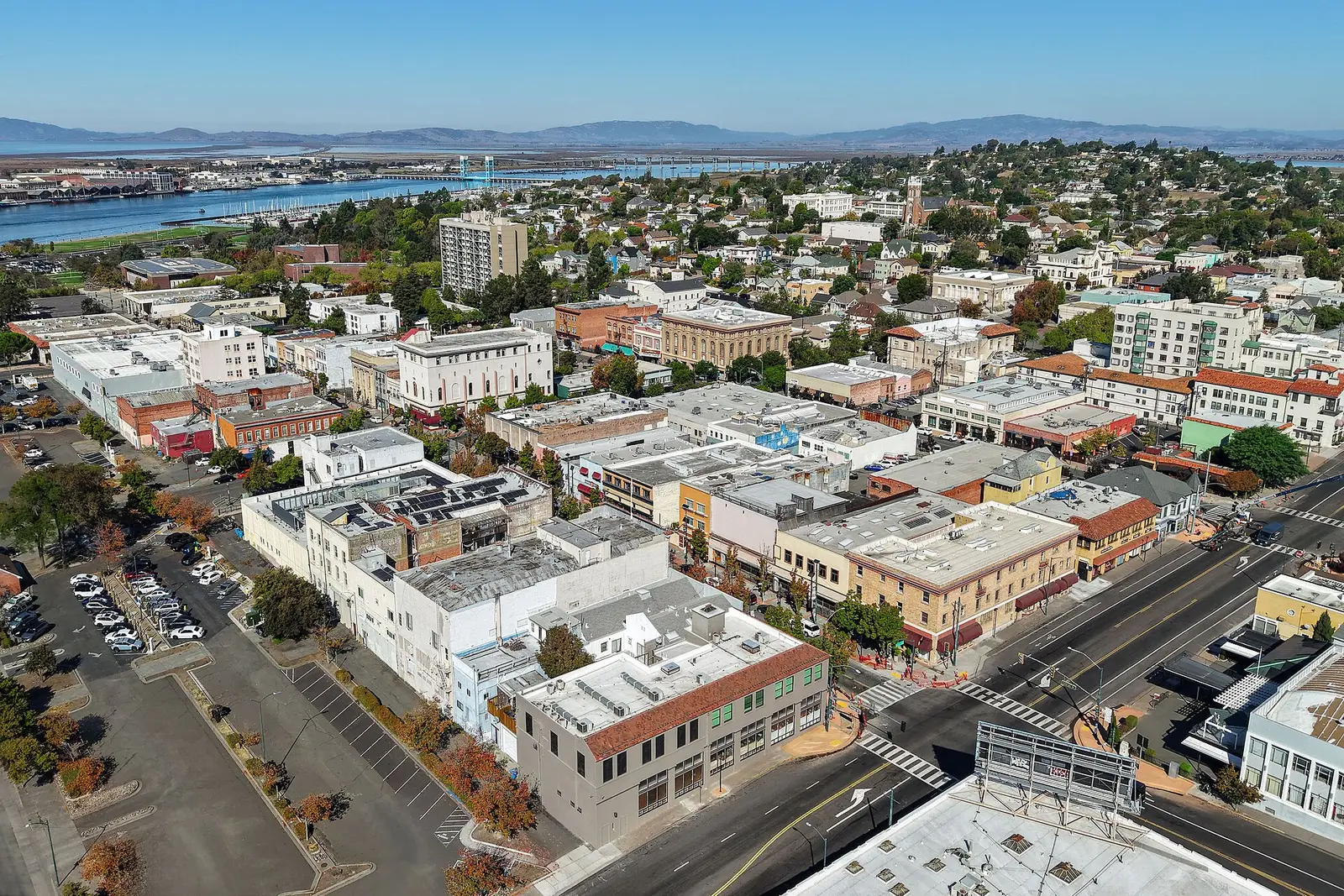
Aerial view of downtown Vallejo: low commercial blocks, houses climbing the hills behind, and the waterfront in the distance. Photo: Quintin Soloviev, CC BY 4.0, via Wikimedia Commons.
ZIP codes
94589, 94590, 94591, 94592
When the homes were built
1850s-today
Main streets
Georgia Street, Sonoma Boulevard, Tennessee Street, Mare Island Way
Landmarks
St. Vincent Ferrer Church, Empress Theatre, Vallejo Naval and Historical Museum
What homes in Vallejo need most
Original windows the city would rather keep
In St. Vincent's Hill and the Architectural Heritage District, Vallejo's code sends any exterior alteration that can be seen from the street, windows named among them, to the Architectural Heritage and Landmarks Commission with a 14-day public notice. Minor repair and routine maintenance need no certificate of appropriateness at all. Fixing what is there is the shorter road: freeing sashes painted shut, restringing broken sash cords, reglazing cracked panes, rehanging doors that bind and renewing worn hardware. If a frame is past saving, talk to the Planning Division before ordering a replacement. More about door and window repair
Repainting houses from before 1978
Painting is listed as ordinary maintenance in the city's historic preservation chapter, so repainting a contributing house in either district needs no certificate. Lead is the real question. Houses in both districts date mostly from the mid-1800s to the 1940s, and EPA's Renovation, Repair and Painting Rule requires anyone paid to disturb paint in a pre-1978 home to work for a firm certified by EPA in lead-safe practices. Ask about that before any scraping or sanding begins, and say whether children live in the house. More about interior painting and touch-ups
White crust on aerators and showerheads
Vallejo treats Lake Berryessa water, State Water Project water or a blend of the two at its Fleming Hill plant, and hardness moves with the source: 74 to 286 parts per million in the city's 2025 testing, with an average of 153. The minerals settle as white crust on faucet aerators, showerheads and toilet fill valves, and the Water Department suggests white vinegar for the residue. When an aerator or cartridge has clogged past cleaning, swapping it is everyday fixture work. More about faucet, toilet and fixture repair
Gates and fences that take the afternoon wind
Westerly winds through the strait keep pressure on gate hinges, latches and fence panels, most of all on open lots near the water. Replacing sagging hinges, resetting latches so gates stay shut and refastening loose boards are routine fixes. Inside a historic district, a new fence in a required yard along a street goes to city staff for review, and a deck more than 30 inches tall that is visible from the street goes to the commission, which makes a repair in kind the simpler job. More about fence, deck and gate repair
Staying on the right side of good repair
Vallejo's code obliges owners of buildings in a historic district, on the historic resources inventory or carrying a landmark designation to keep them in good repair. The city defines disrepair to include deteriorating exterior walls, plaster or mortar, failing roofs and exterior chimneys, and waterproofing that no longer works, broken windows and doors among it. Working through a list of small exterior fixes each year, from loose trim to a cracked pane, keeps an older house well clear of that line. More about general handyman repairs
How the houses here are built
Italianate, Queen Anne and brown-shingle houses in the Architectural Heritage District around Georgia Street and in St. Vincent's Hill; Craftsman bungalows and cottages built in matching groups where shipyard workers lived; Colonial Revival mansions on Mare Island's Officers' Row; and newer subdivisions such as Northgate and Hiddenbrooke.
The older houses are wood-frame, many of them shingled; architect Will Jones designed a run of brown-shingle homes on the 700 block of Georgia Street around 1900. On Mare Island the Officers' Row mansions went up after the 1898 earthquake badly damaged brick officers' quarters from 1855, and the shipyard's early shop buildings are brick, so anything hung there starts with knowing the wall.
In summer and fall, marine air is drawn east through the Carquinez Strait almost every day, and afternoon westerly winds along the strait put a steady load on gates, screen doors and fence panels.
Good to know before a job in Vallejo
Two districts and one certificate
St. Vincent's Hill runs roughly from Mare Island Way and Butte Street east to Marin Street and the properties along Sonoma Boulevard, with houses from 1868 to 1947 around St. Vincent Ferrer Church. The Architectural Heritage District radiates from Georgia Street between Sutter and Monterey streets, with Victorians going back to the 1850s. Section 16.614.09 of the municipal code requires a certificate of appropriateness before most exterior alterations in either one, while interior work is exempt unless the house is a designated landmark. The city's interactive zoning map shows whether an address falls inside.
Mare Island answers to its own plan
The Navy opened its first permanent West Coast base here in 1854 and decommissioned the shipyard on April 1, 1996; the first bridge to the island was built only in 1918. Today the island holds Touro University, businesses and homes. Any alteration of a contributing building in the Mare Island Historic District follows the standards of the Mare Island Specific Plan and its design guidelines for the historic district, so check with the city before work on an Officers' Row house or anything else in the historic core.
Cottages built for shipyard workers
At the height of the Second World War the yard had tens of thousands of civilian workers, and most of them needed a home nearby. The city's architectural tour points to groupings of bungalows and cottages in matching styles across neighborhoods that were home to shipyard workers, such as four side-by-side Craftsman bungalows in the 500 block of Alabama Street. Its Housing Element notes that smaller units in South Vallejo served the yard's workers. Houses built to a repeating plan tend to share the same faults, which makes them predictable to repair.
How a request works
Describe the job
A sentence and a photo or two is enough. It takes about a minute.
A local handyman gets in touch
By call or text, to ask what the photos don't show and give you a price.
You decide
Agree a time and price with the handyman directly, or don't. Requesting costs nothing.
Questions from Vallejo homeowners
Do I need city approval to replace the front windows on a St. Vincent's Hill house?
Usually, yes. Exterior alterations visible from the street, including windows, are reviewed by the Architectural Heritage and Landmarks Commission after a 14-day public notice under the city's historic preservation chapter. Repairing the existing windows counts as maintenance and needs no certificate. Call the Planning Division before ordering new units, and have the sashes looked at first; many can be freed, restrung and reglazed.
Does work inside a Heritage District house in Vallejo need a certificate of appropriateness?
Not unless the building is a designated landmark. The code exempts interior alterations in historic districts otherwise, so kitchen shelving, plaster patching or new interior doors go through the ordinary building rules only. Vallejo has 82 federally and locally designated landmarks, and the Planning Division's interactive map shows which properties carry a designation.
Can a handyman work on an Officers' Row house on Mare Island?
Interior repairs, yes, but anything that alters a contributing building in the Mare Island Historic District falls under the Mare Island Specific Plan and its design guidelines, not just the general preservation rules. Describe the house and the job when you book, and confirm with the city before any exterior change, including fences and signs, which the code names alongside buildings.
What is the capped pipe sticking out of the ground near our front foundation?
Most likely the sewer overflow device, which Vallejo Flood and Wastewater District says is usually within five feet of the foundation. It lets a blockage spill outside rather than into the house. If its cap is screwed down tight, the district suggests unscrewing it and resting it loosely on top. A plastic or aluminum mushroom-shaped cap is fine as it is, and the district offers a free check.
Checked against these public sources in October 2026. Rules change: confirm anything permit-related with the city or town of Vallejo before work starts.