Brick chimneys, walls and veneer in earthquake country
The brick chimney is the piece of masonry most likely to fail in a Bay Area earthquake. After the 2014 South Napa quake, FEMA assessment teams counted more than 100 damaged brick chimneys and advised that rebuilding one the old way leaves it just as vulnerable. Its recommended fix, under a building permit, replaces the masonry above the firebox with a metal flue inside a light frame.
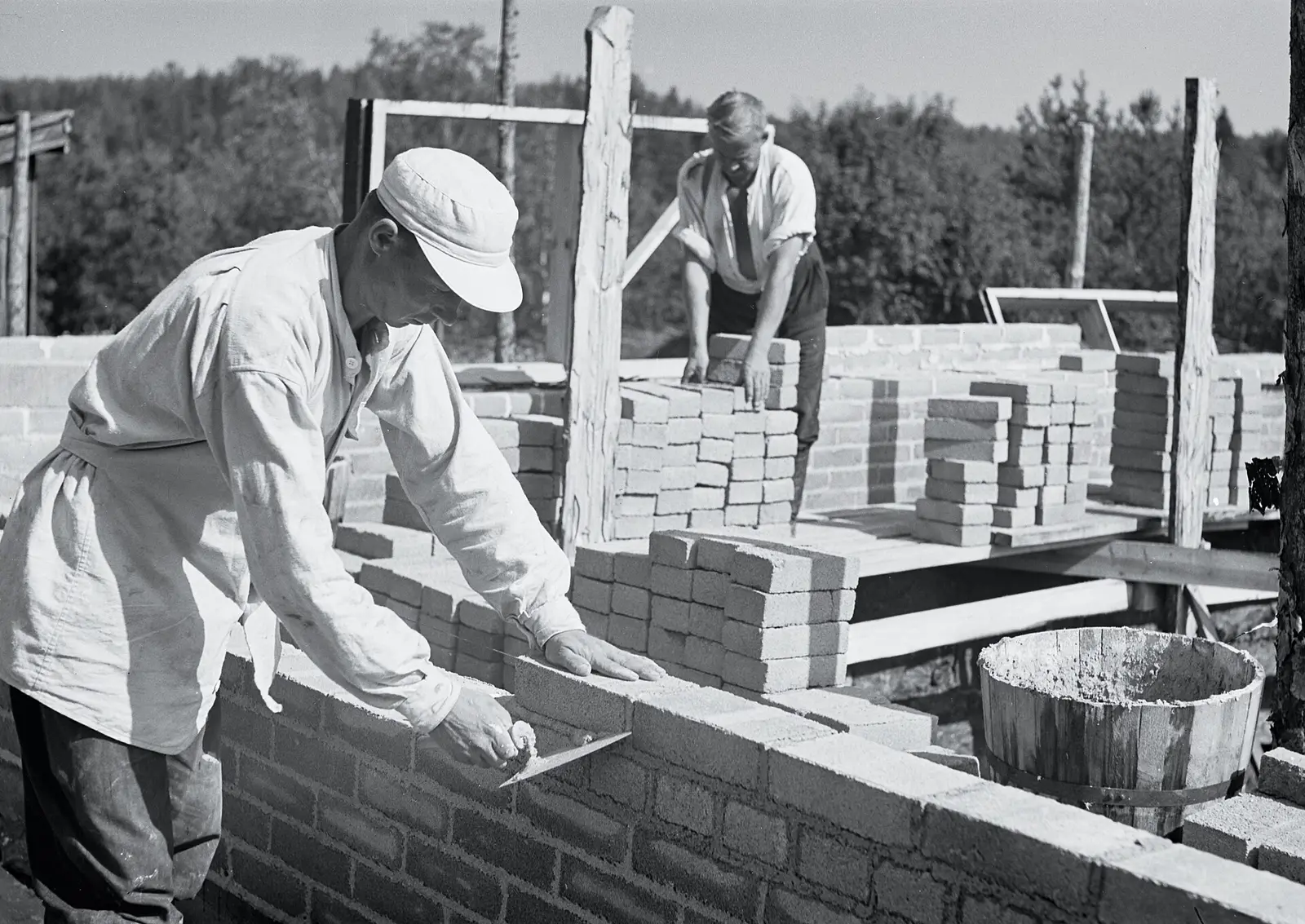
Bricklayers laying a brick wall, in a historic black-and-white photo. Photo: Kyytinen, Pekka, CC BY 4.0, via Wikimedia Commons.
CSLB license class
C-29 Masonry
Where it applies
North Bay, East Bay, San Francisco
Request
Free, up to three local pros reply
Masonry and chimney jobs on Bay Area homes
Rebuilding a chimney from the firebox up
FEMA's recovery advisory for Napa describes keeping an undamaged masonry firebox and replacing everything above it with a listed metal flue inside a cold-formed steel stud chase, tied to the house at each floor, the ceiling and the roof. A reinforced concrete beam and an anchor plate make the transition at the top of the firebox. The new chase can be finished in stucco, siding or adhered brick veneer, so the house can keep a brick look.
Capping a chimney at the roofline
On a single-story house whose chimney is damaged only at or above the roof, and whose fireplace will not be used again, FEMA's advisory allows the simplest option: take the chimney down to three to six inches above the roof and fit a sheet metal cap secured to the masonry. The fireplace opening is closed off. It removes the most dangerous part of the chimney, but the masonry left below the roof can still be damaged in a future earthquake.
Replacing the whole firebox and chimney
When earthquake damage runs below the shoulder of the firebox, or the owner wants all the masonry gone, the full option removes brick down to the foundation and installs a factory-built fireplace, listed to UL 127, in a light-frame chase. Fireboxes often reach a foot or more into the room, so mantels and interior brick veneer usually come out, and the foundation may need extending to fit the new unit's dimensions.
Fireplace inserts in an old masonry firebox
A factory-built insert puts a steel or cast iron firebox inside the original brick one, and in a rebuild it pairs with a new metal chimney above. FEMA notes plainly that an insert does not make a fireplace more earthquake-resistant, though it can burn more efficiently. Some houses already have prefabricated fireplaces that should not take an insert at all, and the difference can be hard to see without looking inside the firebox and flue.
Repointing and patching old brick
Cutting out crumbling mortar and repointing joints, or patching isolated cracks, is ordinary masonry maintenance and worth doing on a sound chimney or wall. It is not an earthquake fix. FEMA's advisory lists repointing and crack patching among methods that are not sufficient on their own and do little to reduce damage in future earthquakes, so a bid that sells repointing as seismic protection is overselling it.
Brick and stone garden walls
Freestanding brick, block and stone walls along a property line fall under the C-29 class as masonry fences. In Berkeley a fence under 7 feet high needs no building permit, but anything over 6 feet needs a zoning permit. A wall that holds back soil is a retaining wall with its own height rules, and a leaning or cracked freestanding wall near a sidewalk is worth having assessed before anyone leans on it for a repair.
The license this work needs
C-29 Masonry
The CSLB's C-29 class covers brick, concrete and clay block, natural and manufactured stone, terra cotta and firebrick: load-bearing and non-load-bearing walls, masonry fences with or without mortar, thin brick facing, masonry paving, and the clear waterproofing, cleaning and caulking that go with it. Ceramic tile is a separate class. Chimney reconstruction always needs a building permit, so it goes to a licensed contractor; check the license at cslb.ca.gov.
FEMA found in Napa that older unreinforced chimneys with degraded mortar are the most vulnerable, that even chimneys built to modern standards can be badly damaged, and that chimneys previously damaged and rebuilt collapsed too. Its conclusion is that bringing an old unreinforced chimney up to modern seismic performance is generally infeasible. Until a chimney is rebuilt, FEMA suggests not sleeping next to it and fitting plywood in the attic to slow falling brick.
Steel braces that can make it worse
Bracing a brick chimney with steel members down to the roof can look like a quick retrofit. FEMA advises against using them to retrofit masonry chimneys, noting that such bracing is thought to have promoted chimney failure in past earthquakes and must be carefully engineered. Bracing does appear in FEMA's own details, but on the new light-frame chase, where the code height above the roof requires it.
Air district limits on wood burning
The Bay Area Air Quality Management District bans wood-burning devices of any kind in newly built homes. A chimney or fireplace remodel that needs a building permit and exceeds the district's cost threshold may only install a gas-fueled or electric unit or a wood heater with EPA certification. Wood burning is also banned whenever a Spare the Air Alert is called, which affects how much an owner gains from rebuilding an open fireplace.
The magnitude 6.0 South Napa earthquake on August 24, 2014 was the largest to strike the greater Bay Area since Loma Prieta in 1989. The USGS recorded broken and cracked chimneys and failed cripple walls on wood-frame houses, and damaged pre-1950 masonry commercial buildings downtown that had not been retrofit. FEMA's chimney advisory was written for Napa's recovery, but its options apply to any one- or two-family house.
The Hayward fault runs along the foot of the East Bay hills and is considered capable of a magnitude 7.4 earthquake. Its 1868 rupture broke the ground surface from Fremont to San Leandro and nearly destroyed the town of Hayward, and chimneys, walls and other heavy architectural elements fell as far away as Oakland. An original brick chimney on a house near the fault is worth assessing before, not after, the next one.
Chimneys fell in San Francisco during the 1868 Hayward earthquake, and in 1906 a damaged chimney started one of the fires that followed the shaking: the Ham and Eggs fire began when a woman lit her stove for breakfast, unaware the chimney was badly damaged. After any strong shaking, have a masonry flue inspected before lighting a fire or running an appliance vented through it.
Permits and rules to know
Building permits for chimney reconstruction
FEMA's advisory states that building permits are always required for the chimney work it describes and must be issued before construction starts. Manufactured parts, including metal flues, anchor plates, flue caps, inserts and factory-built fireplaces, must meet the applicable UL standards and be installed to the manufacturer's instructions, which also set clearances for the surrounding framing. The rest of the work follows the California Residential Code as adopted and amended locally.
BAAQMD Regulation 6, Rule 3 on fireplace remodels
The Air District's wood-burning rule reaches into remodels. A Bay Area resident who begins a chimney or fireplace remodel that requires a building permit and costs more than the rule's threshold may install only a gas-fueled or electric unit or a wood device carrying EPA certification, not a new open wood fire. Owners who rely on wood as their only heat can claim the burn-ban exemption only with an EPA-approved device registered with the district; an open fireplace does not qualify.
Historic designation and matching brick
An older house may carry a federal, state or local historic designation, and building departments keep lists. FEMA notes that designation can bring preservation guidelines and review of the repair by the planning department and historic preservation board. It can also allow more flexibility, including rebuilding a damaged chimney in matching masonry; where that route is taken, FEMA recommends a structural engineer design the solution to limit future earthquake hazard.
Before you hire
Ask which option the contractor proposes, capping, rebuilding above the firebox, an insert or full replacement, and why it suits your chimney.
Confirm the building permit names the chimney work and ask who will schedule the inspections.
Ask for the UL listing of the metal flue, insert or factory-built fireplace being installed.
Question any plan to strap a brick chimney with steel braces to the roof unless an engineer designed it.
If you want to keep burning wood, ask how the job fits the Air District's rule on fireplace remodels.
Check the C-29 license at cslb.ca.gov and ask for proof of workers' compensation coverage.
How a request works
Describe the job
A few sentences and a photo of the problem or the space. It takes about a minute.
Local pros get in touch
Up to three handymen or contractors who take this kind of work may call or text to ask questions and quote.
Check, compare, decide
Look up the license, compare what you hear, and agree the scope and price with the one you pick. Requesting costs nothing.
Questions about masonry and chimney work in the Bay Area
Will repointing make our brick chimney safe in an earthquake?
No. FEMA's recovery advisory encourages repointing and patching as regular maintenance but says they do little to reduce the potential for damage in future earthquakes. The approaches it recommends involve removing some or all of the masonry and rebuilding with a metal flue or insert in light-frame construction.
Can a damaged chimney be rebuilt in brick so the house looks the same?
FEMA does not recommend rebuilding to the pre-earthquake configuration, because it does little to reduce future damage or risk to life. The usual compromise is a light-frame chase finished with adhered brick veneer, which keeps the look. Houses with a historic designation may be allowed matching masonry, and FEMA recommends a structural engineer design that rebuild.
We never use the fireplace. What is the simplest safe option?
For a single-story house with damage only at or above the roof, FEMA describes removing the chimney to just above the roofline, fitting a sheet metal cap and closing off the fireplace so it cannot be used. It removes the most exposed brick, though what remains below the roof can still be damaged in a future quake. Taller houses need one of the rebuild options.
Does a fireplace insert make an old chimney safer?
Not by itself. FEMA says a factory-built insert will not make a fireplace more earthquake-resistant, though it can be more efficient and cleaner burning. The seismic benefit in FEMA's insert option comes from replacing the brick chimney above the firebox with a metal chimney in a light frame, not from the insert.
What can we do now if a chimney rebuild is not in the budget yet?
FEMA suggests two interim steps: spend less time beside the chimney, especially avoiding sleeping next to it, and install plywood in the attic, on the rafters or ceiling joists, to slow brick coming through the ceiling. That plywood should not become attic storage, since the extra load can overstress the ceiling and roof framing.
Can we keep a wood fire after rebuilding the fireplace?
Maybe not. Under the Bay Area Air Quality Management District's rule, a chimney or fireplace remodel that needs a building permit and exceeds the rule's cost threshold may only install a gas or electric unit or a wood device with EPA certification. A smaller repair is treated differently, so ask the contractor and the Air District before choosing a firebox.
Checked against these public sources in September 2026. Codes and programs change: confirm permit rules with your city's building department and a license on the CSLB website before work starts.