Carpentry on Bay Area houses: soft sills, rotted trim, worn stairs
Most carpentry calls on Bay Area houses start with wood that water or insects reached first: a window sill, a fascia board, siding near the soil, a back-stair tread. Cutting out soft wood and fitting sound wood is the job. The line that matters is structural: the state residential code lets ordinary repairs go ahead without a permit, but not cutting a beam, removing a load-bearing support or changing a required exit.
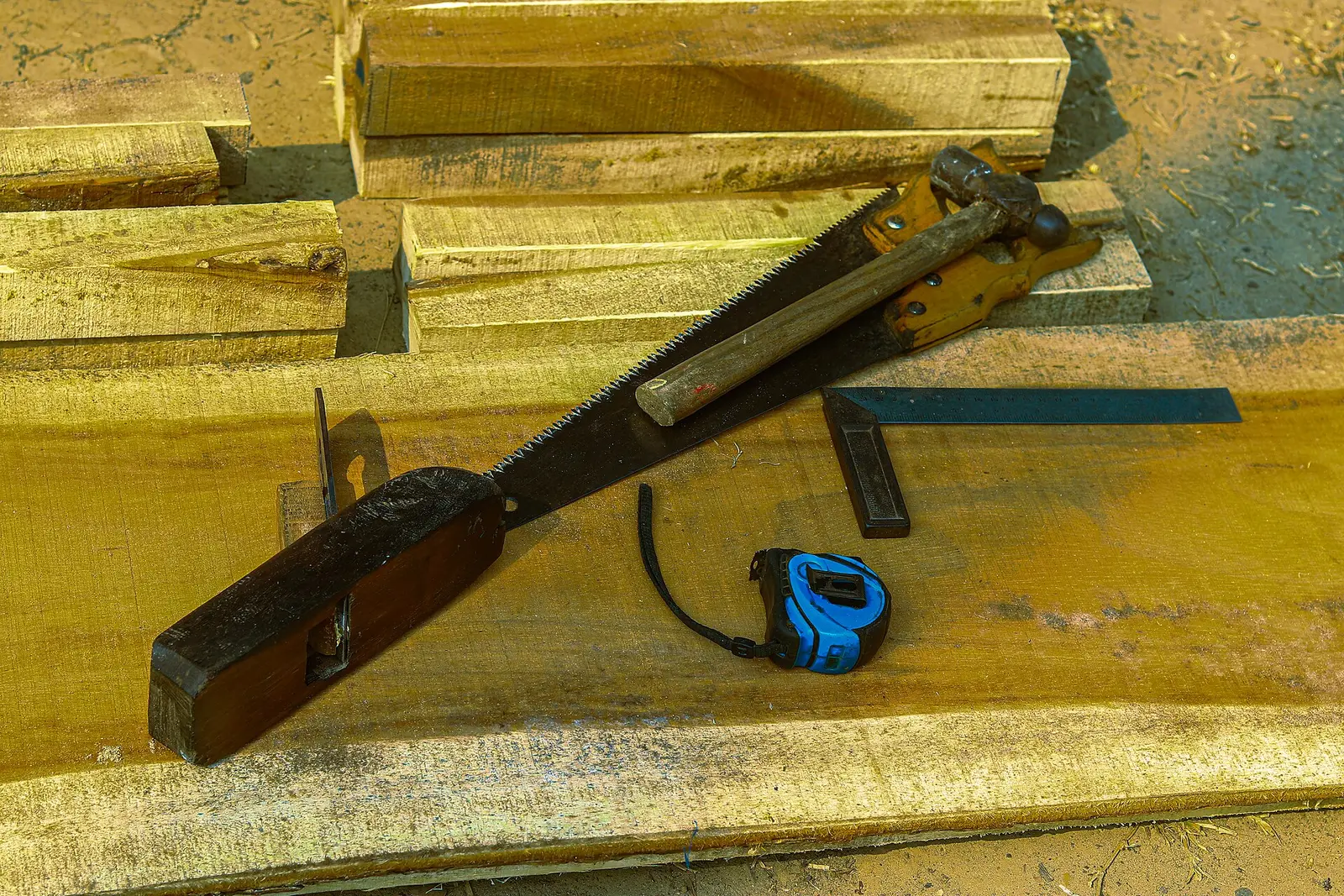
A hand plane, a saw, a hammer, a steel square and a tape measure lying on rough timber planks. Photo: A S M Jobaer, CC BY-SA 4.0, via Wikimedia Commons.
CSLB license class
C-6 Cabinet, Millwork and Finish Carpentry, C-5 Framing and Rough Carpentry, B General Building
Where it applies
San Francisco, East Bay, South Bay
Request
Free, up to five local pros reply
Carpentry jobs on Bay Area homes
Cutting rot out of sills, fascia and trim
Decay needs wood that stays wet, so a lasting repair has two halves: removing every soft fiber back to sound wood, and stopping the water that soaked it. UC's pest note on drywood termites says the damage dampwood termites cause in wet wood is best handled by correcting the moisture problem, such as a leaking roof or deck, and replacing the damaged wood. A sill rebuilt under a window that still lacks flashing, or a new fascia board under a gutter that still overflows, leaves the cause in place.
Wood repairs listed on a termite report
California pest reports come from companies registered with the Structural Pest Control Board, and the inspection is made by a Branch 3 field representative or operator who holds a board license. The law has the report name damaged members the way builders do, from siding, studs and rafters to joists, fascia, subfloor, sheathing and trim, which is the list a carpenter prices from. UC's termite note treats wood replacement as a localized fix that works only as well as the damage was found, and says load-bearing wood calls for an architect, engineer or general contractor, and possibly a permit.
Replacing stair treads, risers and handrails
Section R318.7 of the 2025 California Residential Code sets stair geometry: risers no taller than 7 3/4 inches, treads at least 10 inches deep, and no more than 3/8 inch of difference between the largest and smallest riser, or tread, in one flight. A replacement tread that is thicker or thinner than its neighbors changes two riser heights at once. A flight with four or more risers needs a handrail on at least one side, and Section R320.2 puts its top between 34 and 38 inches above the nosings.
Siding boards and trim that sit close to the ground
Near the soil, the code stops trusting ordinary lumber. Section R304.1 calls for naturally durable or preservative-treated wood in siding, sheathing and wall framing less than 6 inches from the ground, or less than 2 inches above concrete steps, porch slabs and patios exposed to weather. Ends, notches and holes cut into treated wood on site must be treated again, and fasteners touching it are, with a few exceptions, hot-dipped galvanized, stainless steel, silicon bronze or copper. Plain steel screws in new treated trim break that rule.
Baseboard, casing, shelving and built-ins
Interior finish carpentry is the C-6 end of the trade: baseboards, door and window casings, crown molding, shelving and built-in cabinets. The residential code's permit exemptions include painting, tiling, carpeting, cabinets, counter tops and similar finish work, and many Bay Area building departments use the same wording, though not every city's list matches it. In a house built before 1978, taking out painted trim for pay is renovation under EPA's lead rule, which defines renovation to include removing building components.
Porch railings, balusters and guards
A porch, landing or stair whose open side sits more than 30 inches above the ground within 36 inches of its edge needs a guard under Section R321.1.1. Section R321.1.2 sets the guard at 42 inches above the walking surface, or 34 inches on the open side of a stair, and openings must stop a 4-inch sphere, except on the open side of a stair, where the limits are 4 3/8 inches and 6 inches in the triangle under the bottom rail. A rail that wobbles can mean the post, or the framing it bolts to, has softened, so the repair may start below the rail.
The license this work needs
C-6 Cabinet, Millwork and Finish Carpentry
C-5 Framing and Rough Carpentry
B General Building
Carpentry splits across CSLB classes by what the wood does. A C-6 contractor makes and installs cabinets, sashes, doors, trim, nonbearing partitions and other finish carpentry. A C-5 contractor does framing and rough carpentry, and the class names sub-flooring, siding, exterior staircases and railings. A B general building contractor may take a framing or carpentry contract on its own. Refitting a length of baseboard or a rotted door stop stays handyman work while the whole job is under $1,000 and needs no permit; past that, look the number up at cslb.ca.gov.
UC's pest notes put the western drywood termite, California's most common drywood species, along the Pacific coastal region and into the Central Valley, living deep inside wood with no need for soil. Dampwood termites, common in cool, humid coastal areas, need wood high in moisture, often wood touching soil. Subterranean termites come up from the ground, and UC advises keeping substructural wood at least 12 inches above the soil and clearing stored lumber, buried scrap and untreated fence posts from beside the house.
Treated lumber protects only the piece it is in
UC's subterranean termite note warns that termites can build shelter tubes over chemically treated wood and infest untreated wood above it, and that only exterior-grade pressure-treated lumber belongs where weather reaches, since the chemical can otherwise leach out. The residential code requires each treated piece to carry a quality mark naming the treating plant, the preservative, its retention, the end use and the inspection agency. Ask to see the stamp or end tag on any treated wood going into a repair.
Lead paint on old stairs and trim
In a house built before 1978, paid work that disturbs painted wood falls under EPA's Renovation, Repair and Painting rule unless the components test free of lead. The rule treats the treads and risers of a single staircase as an integrated whole, so one component can be tested for all of them unless some look separately repainted. It prohibits open-flame burning or torching of painted surfaces, and allows a heat gun only below 1,100 degrees Fahrenheit.
Old stairs that cannot meet today's rise and run
Older Bay Area houses often keep stairs built to earlier rules: steep, narrow or tucked under a low ceiling. The residential code does not force those into modern geometry during a repair: Section R318.7.9 says alterations to existing stairs need not comply where the existing space and construction do not allow the pitch or slope to be reduced. Rebuilding a stair in a new location, or adding one, is new work and is held to the full section.
San Francisco's own summary of work that needs no building permit, drawn from its Building Code Section 106A.2, lists painting, papering and similar finish work, movable cases, counters and partitions no taller than 5 feet 9 inches, and surface mounting of readily removable materials on interior walls. Cabinets and counter tops, which the state residential code names as exempt finish work, do not appear on it, so ask the Department of Building Inspection before built-in cabinetry or shelving goes in.
Oakland requires a building permit to repair or replace any stucco or siding, and its page names dry rot among the reasons the work comes up. Design Review is added unless the job is like-for-like, which can apply for a Design Review Exemption. Every Oakland building permit also needs an approved recycling plan before it is issued, and a project that disturbs paint on a structure built before 1978 needs a lead-based paint work plan.
California's Water Boards publish the landfills authorized to accept treated wood waste, conditionally, under AB 332 and Health and Safety Code Section 25230. In Santa Clara County the list names Guadalupe Rubbish Disposal Company, Kirby Canyon Recycling and Disposal Facility and Newby Island Landfill. DTSC advises calling a landfill or transfer station before hauling treated wood there, because some set acceptance conditions of their own, such as a pre-approved waste profile.
Permits and rules to know
Ordinary repairs, and where they stop (CRC R105.2.2)
Section R105.2.2 of the 2025 California Residential Code says ordinary repairs to structures need no application or notice to the building official. It then sets out what is never an ordinary repair: cutting away any wall, partition or portion of one, removing or cutting a structural beam or load-bearing support, and removing or changing a required means of egress. Replacing a rotted post under a porch beam, or cutting into joists, falls on the permit side of that line.
Finish work and emergency repairs (CRC R105.2)
The residential code's list of building work exempt from permit includes painting, papering, tiling, carpeting, cabinets, counter tops and similar finish work, and a deck of 200 square feet or less that is no more than 30 inches above grade, is not attached to the dwelling and does not serve the required exit door. Where repairs must be made in an emergency, Section R105.2.1 lets the work go ahead and asks for the permit application within the next working business day.
Treated wood waste under AB 332 (HSC 25230)
Assembly Bill 332, signed August 31, 2021, set alternative management standards for treated wood waste in Health and Safety Code sections 25230 to 25230.18. DTSC's fact sheet says households, which usually produce it when a fence or deck is replaced, must keep it separate, leave any marking that shows it is treated, store under 1,000 pounds for no more than 30 days and take it to an authorized facility. It may not be burned, chipped, ground or mulched. Painted or varnished natural wood is not treated wood.
Before you hire
Ask the pro to probe around the soft spot and show you where sound wood begins before the job is priced.
Ask what will keep the water out of the repaired spot: flashing, a drip edge, a cleared gutter or regraded soil.
For termite-report work, hand over the whole report and ask which numbered items the bid covers.
Ask whether any member being replaced is load-bearing, and if so who pulls the permit and whether an engineer signs off.
In a house built before 1978, ask whether the firm is certified by EPA for renovation and how the painted wood will be tested.
Ask where the old treated lumber will go, since it cannot leave with ordinary debris.
Once the job passes $1,000, check the C-6, C-5 or B number at cslb.ca.gov and ask for proof of workers' compensation coverage.
How a request works
Describe the job
A few sentences and a photo of the problem or the space. It takes about a minute.
Local pros get in touch
Up to five handymen or contractors who take this kind of work may call or text to ask questions and quote.
Check, compare, decide
Look up the license, compare what you hear, and agree the scope and price with the one you pick. Requesting costs nothing.
Questions about carpentry work in the Bay Area
Can a handyman replace a rotted window sill?
Often, yes. Replacing a sill in kind is an ordinary repair, and a person without a contractor's license may take the job while labor and materials stay under $1,000 and no permit is needed. Two things change that: rot that runs from the sill into the studs or framing below, and any cut into a load-bearing member, which the residential code keeps out of ordinary repairs. Either one makes it work for a C-5 or B contractor.
Do I need a permit to replace a few worn stair treads?
Usually not for a like-for-like repair: the residential code exempts ordinary repairs from any application or notice. Removing or changing a required means of egress is excluded from that exemption, so rebuilding or relocating the stair is permit work. Either way, the new treads should leave every riser in the flight within 3/8 inch of the others, as Section R318.7.5.1 requires.
How can I tell whether old deck boards or a sill plate are pressure-treated?
DTSC lists the signs: small indentations across the surface from the treatment process, staining that shows only around the edge when a board is cut, a green or dark brown color, and sometimes an end tag naming the preservative and its use. Once wood is known to be treated, DTSC lets the person disposing of it presume it is hazardous waste and follow the alternative standards rather than pay for laboratory testing.
Why would a renovator test just one stair tread for lead?
Because EPA's rule treats the treads and risers of a single staircase as an integrated whole. A renovator certified by EPA, using a recognized test kit, may test one component for all of them, unless some treads or risers look as if they were repainted or refinished separately. A clean result on all affected components is what takes the job outside the rule.
Will rebuilding with pressure-treated lumber keep termites out?
Not on its own. UC's termite note says subterranean termites can build shelter tubes over treated wood and attack untreated wood above it, so the untreated framing a new piece touches is still exposed. Treated wood also has to be the exterior grade where weather reaches it, and the residential code requires its field-cut ends, notches and holes to be treated again on site.
Can I find out whether my house had a termite inspection before I bought it?
Yes, for the last two years. The Structural Pest Control Board's Wood Destroying Organism database shows whether a property was inspected in that period; the board suggests searching on just the building number and ZIP code. If a record turns up, you can ask the board in writing for copies of the inspection or completion reports.
Checked against these public sources in October 2026. Codes and programs change: confirm permit rules with your city's building department and a license on the CSLB website before work starts.