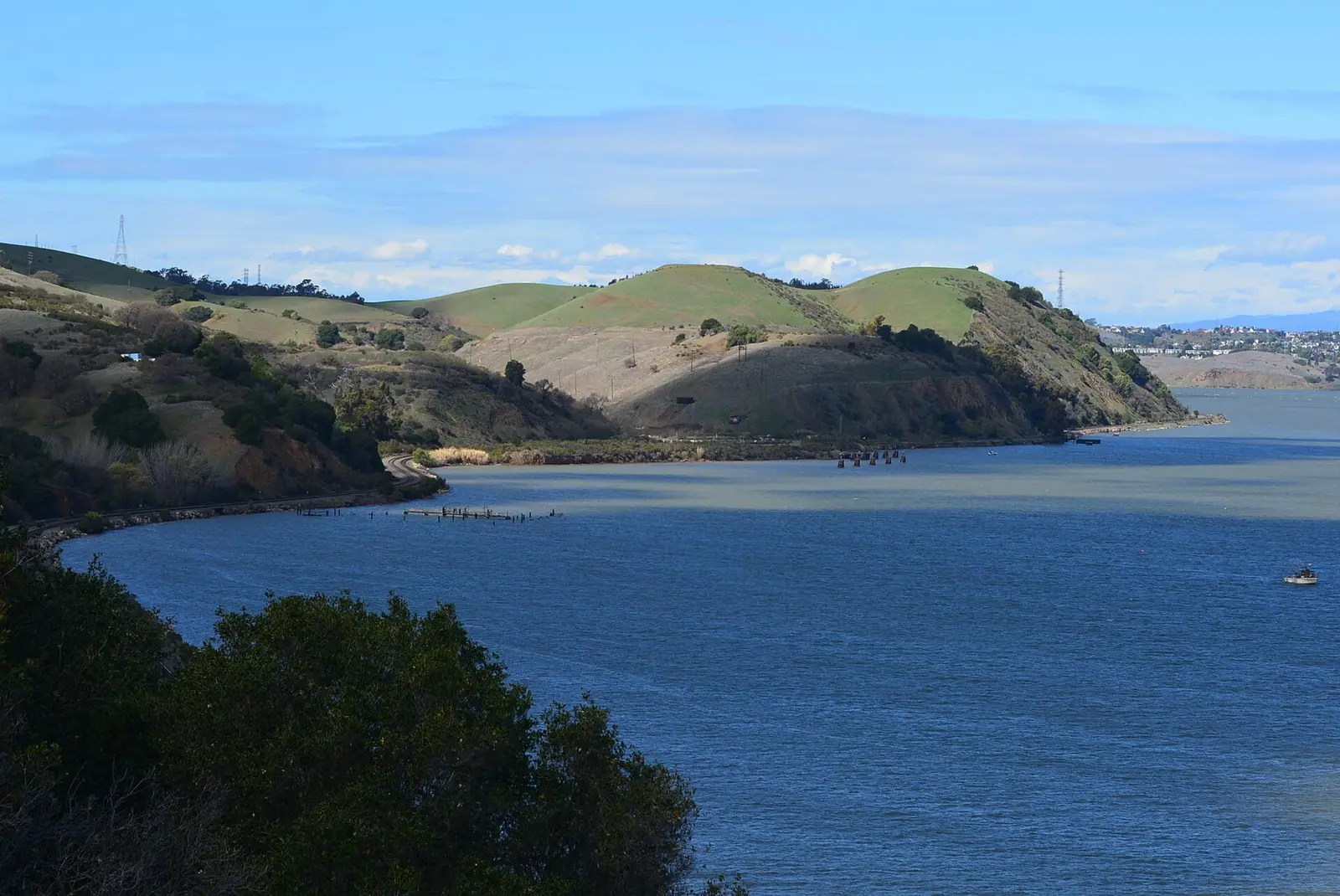
Repairs in Martinez, the county seat on the Carquinez Strait
Martinez housing splits in two: downtown, on the Alhambra Creek floodplain, keeps 1890s cottages and 1920s bungalows, while most other neighborhoods, Muir Oaks among them, were built between 1970 and 1999. Wet winters, hot summers and refinery shelter-in-place alerts drive the common jobs: binding wood windows, drafty doors, clogged gutters and worn fixtures.
Carquinez Regional Shoreline on the Carquinez Strait by Martinez. Photo: Federico Pizano, CC BY 3.0, via Wikimedia Commons.
ZIP codes
94553
When the homes were built
1970-1999
Main streets
Alhambra Avenue, Main Street, Ferry Street, Escobar Street
Landmarks
John Muir National Historic Site, Contra Costa County Finance Building (1901), Martinez Amtrak station
What homes in Martinez need most
Wood windows and doors in downtown cottages
The blocks nearest Main Street and Susana Park hold cottages from the 1890s and 1900s and bungalows from the 1920s, many still with their wood sash and original doors. Winter rain swells that wood and dry summers in the upper 80s shrink it again, so sash binds in the frame, lock cams stop meeting their keepers and doors rub at the head. Freeing a painted-in sash, replacing a snapped cord, planing a door edge and moving a strike plate keep the original windows and doors in service. More about door and window repair
Doors and windows that close tight for a shelter-in-place alert
Martinez has been a refinery town since Shell opened its plant here in January 1916, now run as Martinez Refining Company. When a fire there in February 2025 led to a shelter-in-place order for parts of Martinez, residents were told to close windows and doors, turn off fans and cover cracks around doors and windows with tape or damp towels. Fresh weatherstripping, a new door sweep and caulk where window frames meet siding leave fewer gaps to cover. Always follow the county's instructions during an alert. More about weatherstripping, caulking and sealing
Gutters ready for the storms that raise the creek
Alhambra Creek drains about 16.5 square miles of hills straight through downtown, and on New Year's Day 1997 it flooded the city center. Storms that heavy overflow a clogged gutter long before the creek rises: water pours over the front lip, soaks the fascia board and puddles against the foundation. Clearing gutters in late fall and making sure downspouts discharge away from the house matters most on lots near the oak woodland around Mount Wanda and the John Muir National Historic Site.
Porch steps and railings on older houses
The porches on the older houses along Estudillo and Escobar streets take every winter storm head-on. Rot starts where water sits: the lowest tread, the foot of each post and the spot where a railing meets the wall. A loose railing is the one to deal with first, because it gives way under a hand. Cutting out soft wood, splicing in a matching piece, setting posts on metal bases to keep them off wet concrete and refastening rails with exterior screws usually saves the porch. More about carpentry, shelves and trim
Fixtures in 1970s to 1990s houses and townhomes
Most of Martinez's housing went up between 1970 and 1999, so a great many kitchens and baths carry fixtures from that span or their first replacements. The usual failures are faucet cartridges that drip, toilet flappers and fill valves that run, braided supply lines past their life and shutoff valves that no longer close. In an attached townhome, as in much of Muir Oaks, a leak can reach a neighbor's wall, so fix a running shutoff early. Pipe work inside walls is a plumber's job. More about faucet, toilet and fixture repair
How the houses here are built
Downtown, around Susana Park and Escobar Street, keeps Victorian cottages from the 1890s and 1900s and bungalows from the 1920s. Most of the rest of the city, including Muir Oaks, was built between 1970 and 1999, where townhomes and attached houses make up an unusually large share.
The older downtown houses are wood-frame with wood siding, wood sash windows and front porches; the later neighborhoods are wood-frame with drywall interiors. Parts of the commercial blocks were rebuilt in brick after a 1904 fire, and the 1901 courthouse lost its dome in 1957 for earthquake safety.
July and August afternoons reach the upper 80s and winters are wet and cool with occasional frost, so exterior wood goes from baked dry to soaked every year.
Good to know before a job in Martinez
Downtown on the creek's floodplain
Martinez has flooded on and off since its founding in 1849. After the January 1, 1997 flood, a city flood-improvement project widened and rerouted Alhambra Creek, yet a significant flood still came in 2005. FEMA revised the flood maps for downtown effective September 30, 2015, and few downtown buildings sit outside a flood zone. In late 2006 two beavers built a dam 30 feet wide in the creek; rather than remove them, the city had a flow device installed so the pond cannot rise too high.
Downtown's historic overlay and the Historical Society
Much of downtown was rebuilt after the 1904 fire, and the Martinez Historical Society formed in 1973 to save an 1890 cottage from becoming a parking lot. The Downtown Specific Plan created a Downtown Historic Overlay District over the Downtown Core and Civic districts. Substantial modification, demolition or new construction there goes through the city's Design Review process under Chapter 22.34 of the Zoning Code and is referred to the Historical Society for comment. Check with Planning before changing a facade.
When refinery dust lands on the house
Over about six hours starting the night of November 24, 2022, Martinez Refining Company released 24 tons of spent catalyst dust that coated homes, cars, gardens and a schoolyard. The refinery did not alert authorities; Contra Costa Health learned of it from residents' posts two days later. The county's later soil testing found no long-term health risk and it lifted its advice against eating homegrown produce. If a release is ever reported again, wait for Contra Costa Health's guidance before washing down siding, decks or patios.
How a request works
Describe the job
A sentence and a photo or two is enough. It takes about a minute.
A local handyman gets in touch
By call or text, to ask what the photos don't show and give you a price.
You decide
Agree a time and price with the handyman directly, or don't. Requesting costs nothing.
Questions from Martinez homeowners
Is my house in downtown Martinez in a FEMA flood zone?
Quite possibly. FEMA revised its flood hazard maps for downtown Martinez effective September 30, 2015, and only a few downtown buildings fall outside a mapped flood zone because the center of town lies on the Alhambra Creek floodplain. Look up your exact address on FEMA's Flood Map Service Center, or on the city's GIS flood maps, before you buy, insure or plan work at ground level.
Do I need city approval to change the front of a downtown Martinez building?
For more than ordinary repair, often yes. The Downtown Historic Overlay District covers the Downtown Core and Civic districts, and substantial modification, demolition or new construction there goes through Design Review under Chapter 22.34 of the Zoning Code, with referral to the Martinez Historical Society. Like-for-like repairs are a different matter, but ask the Planning Division before changing windows, siding or storefronts.
What should I fix around the house before a refinery shelter-in-place alert?
The county's instructions are to go inside, shut and lock doors and windows, and turn off vents, air conditioners and fans; during the February 2025 refinery fire, residents were also told to close fireplace dampers and cover cracks with tape or damp towels. Doors that latch properly, windows that close fully and intact weatherstripping make those steps quicker. Listen to official alerts for anything beyond that.
Why do sirens sound in Martinez on Wednesday mornings?
Those are tests of Contra Costa County's Community Warning System, which has 43 sirens around industrial facilities from Richmond to Antioch. The full siren is tested on the first Wednesday of every month at 11:00 a.m., and on the other Wednesdays a quieter, low growl test runs at the same time. A siren at any other time means go inside and check for an alert.
Do the Alhambra Creek beavers make downtown flooding worse?
The city weighed that question in 2007 and chose to manage the dam rather than remove the beavers. A flow device was installed as a pipe through the dam, so the pond's water level cannot climb too high. The creek itself was widened and rerouted in the flood project that followed the 1997 flood, though downtown still sits largely inside FEMA flood zones.
Checked against these public sources in September 2026. Rules change: confirm anything permit-related with the city or town of Martinez before work starts.