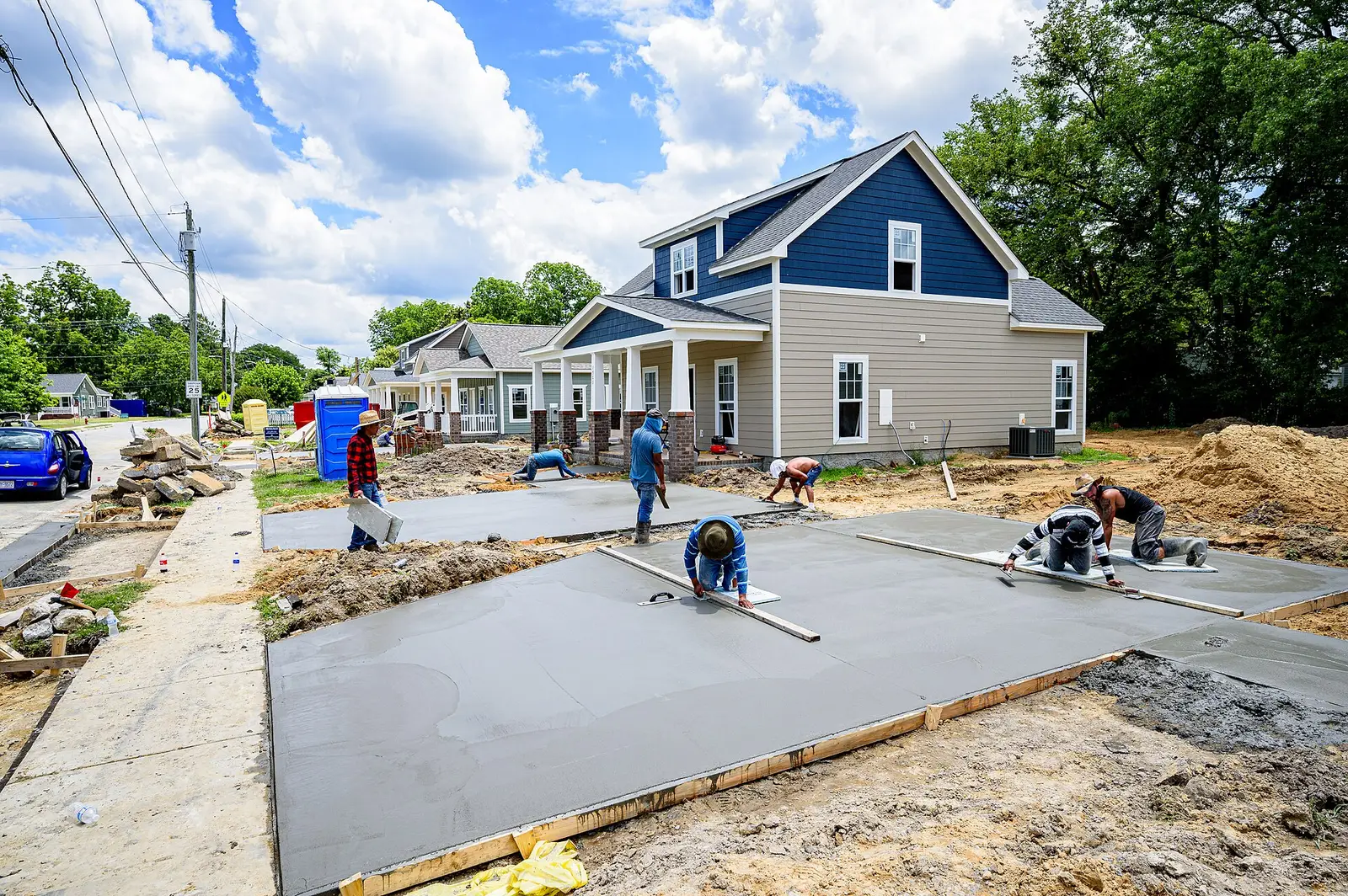
Workers finishing a freshly poured concrete slab beside new houses
Workers finishing a freshly poured concrete slab beside new houses. Photo: City of Greenville, North Carolina, Public domain, via Wikimedia Commons.

Concrete San Jose

Driveway aprons, park strips and paved front yards in San Jose

Along a San Jose lot, the sidewalk, park strip, curb and gutter are the owner's to keep up, and nothing gets poured there without a city permit. The private side has its own ceiling: since July 1, 1999 the Front Setback Paving Ordinance has limited how much of a single-family front yard may be paved. Underneath it all, the city's own geology report calls much of San Jose's soil moderately to highly expansive.

Owner's frontage
Sidewalk, park strip, curb and gutter (Municipal Code 14.16.2200-2270)
Front-yard paving cap
50% of the front setback on lots 40 feet wide or more
Approach width limits
12 ft for one car, 16 ft for two, 24 ft for three doors in a row
Soil
Moderately to highly expansive across much of the city

The work

Concrete work that needs a San Jose sign-off

  • Replacing lifted panels in the sidewalk or park strip

    Repair or replacement of sidewalk, curb and gutter, a driveway approach or a curb ramp needs a permit from the Department of Transportation, and the city invoices for it only after the work passes its final inspection. The owner may do the work, hire a licensed contractor, or authorize the city to arrange it. If a notice goes unanswered, the work is assigned to a city contractor and billed, and an unpaid bill becomes a lien on the property.

  • Widening the driveway or adding a second one

    A new or wider driveway on a single-family lot takes Public Works' Driveway and Sidewalk Permit. Each approach must keep 5 feet from the neighboring property line, from pull boxes, streetlights, hydrants and power poles, from sign poles and from street trees, measured from the top of the flare. A second driveway is possible on a corner lot whose other frontage has none, away from the corner, or midblock where the frontage runs 90 feet or more.

  • Paving the front yard for parking

    Expanding paved parking out front runs into the Front Setback Paving Ordinance. On a single-family lot 40 feet wide or more, no more than half of the front setback may be paved. A narrower lot may pave 10 feet or half its width, whichever is greater, plus a parking apron up to 18 feet wide and 25 feet long in front of two side-by-side required spaces. Pavers and brick count as paving, the same as concrete.

  • Decorative concrete and the park strip

    The park strip is the band between the sidewalk and the curb, and the owner maintains it with the walk. Public Works' driveway permit expressly cannot be used to put decorative concrete in that strip, so stamped or colored concrete out there is a separate question for the city before any forms go down. If a new approach means losing a city street tree, a Street Tree Removal permit from the City Arborist comes first.

  • Front steps on an older house

    Concrete is the usual answer to failing porch steps, but on a historic San Jose house the city's preservation guide pushes back. Your Old House advises against replacing wood porch decking and steps with concrete, and suggests restoring original wood steps where they were swapped out. Where termites are the worry, it suggests making only the bottom step concrete rather than the whole stair.

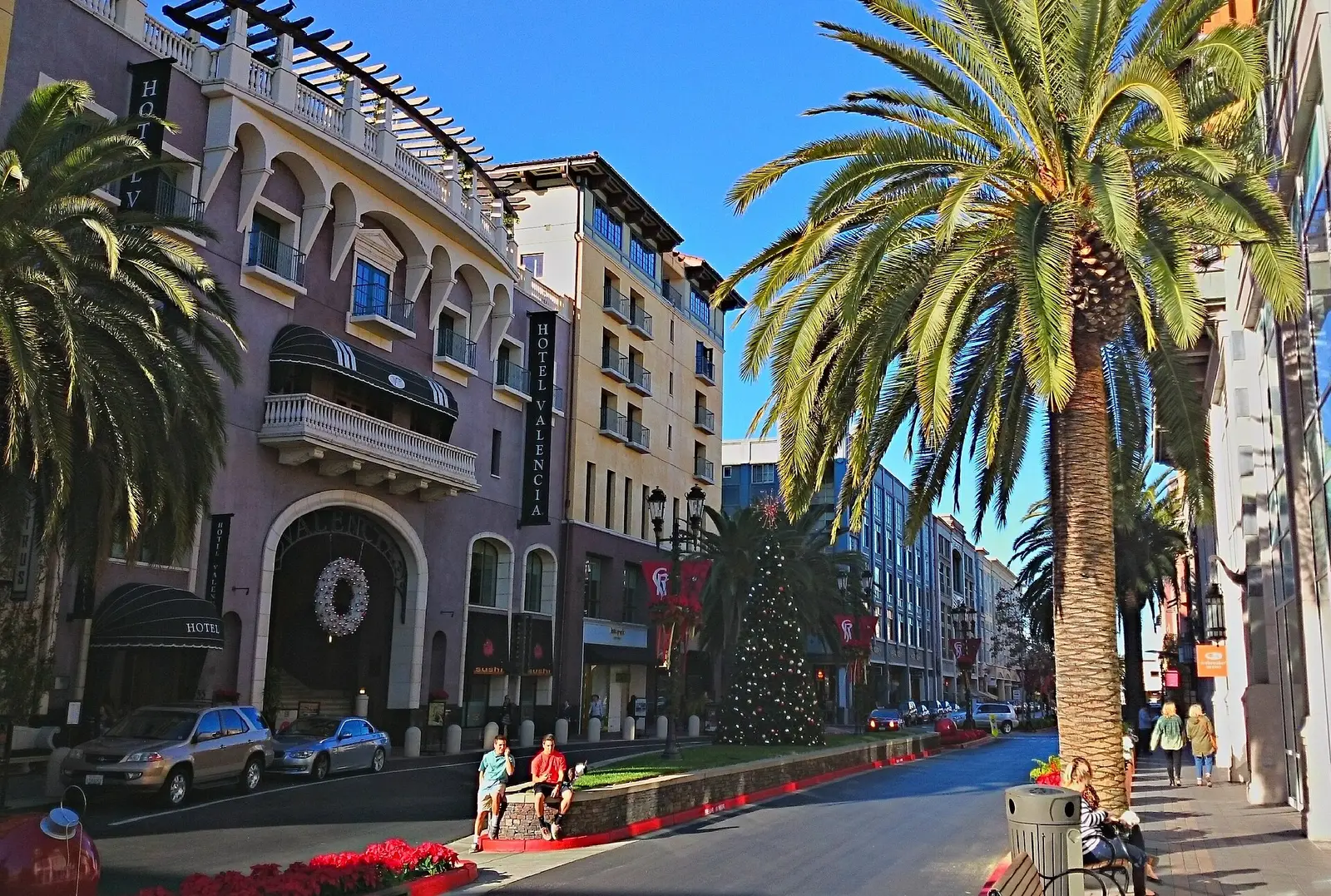
Hotel Valencia at Santana Row in San Jose
Hotel Valencia at Santana Row in San Jose. Photo: Payton Chung, CC BY 2.0, via Wikimedia Commons.

The houses here

Builder tracts, Eichler drives and long downtown driveways

The city's 1999 Single-Family Design Guidelines describe its builder houses as one or two stories on slab or low foundations, usually in large neighborhoods of similar houses by one builder, with garages attached. On those lots the concrete is a driveway to the garage and an apron across the city sidewalk. Eichler's Fairglen Additions came with divided-concrete driveways, concrete walks and patios, and detached sidewalks behind park strips with square concrete curbs, according to the tract's National Register nomination. Near downtown the pattern is older. Your Old House notes that parking was first an ancillary use placed at the rear of the site, and it treats concrete porch steps on historic houses as a replacement worth reconsidering.

Free request

Describe the concrete job once. Local pros who take work in San Jose reply by call or text.

  • No fee to request, and no obligation to hire
  • You agree scope and price with the pro you choose
  • Photos help them quote without a first visit

Get quotes for concrete work in San Jose

Two short steps. A local pro who takes this work calls or texts you back.

To send a request, call or text (415) 449-8213.

Free to request, and you agree the scope and price with the person you hire before work starts. In California, a job over $1,000 in labor and materials, or one that needs a building permit, must be done by a contractor licensed by the CSLB in the right class. Ask for the license number and check it at cslb.ca.gov.

Permits and local rules

Which city office signs off, and on what

  • Owner upkeep and hardship help

    Municipal Code Sections 14.16.2200 to 14.16.2270 make every owner responsible for the sidewalk, park strip, driveway approach and curb and gutter along the front or side of the lot, and the city currently passes the whole repair cost to owners. Hardship help exists but is limited to available funding: a household at or below 80 percent of area median income may qualify for a 50 percent reduction, and one at or below 50 percent may have all expenses covered.

    City of San José, Sidewalks & Curb Ramps (opens in a new tab)
  • Private side, public side

    San José's Driveways & Sidewalks page splits the job at the back of the sidewalk. Repairing or resurfacing a driveway on the private side needs no permit. Expanding a driveway or moving it needs a clearance or permit from Public Works, and any work on the sidewalk, curb or driveway apron needs a permit from Transportation. The page also warns that paving over the front yard excessively breaks Municipal Code 20.30.440 and can bring code enforcement and an order to remove the pavement.

    City of San José, Driveways & Sidewalks (opens in a new tab)
  • Public Works' driveway permit terms

    The Driveway and Sidewalk Permit is issued only for single-family homes; any other use needs Planning approval and a Minor Street Improvement permit. Approach widths are capped at 12 feet for a one-car garage, 16 feet for two cars and 24 feet for three garage doors in a row. The application sketch shows the curb-to-property-line width, at least 8 feet or a dedication may be required, and the issued permit is valid for 30 days unless extended.

    City of San José Public Works (opens in a new tab)

State license for this work: C-8 Concrete. Look up a contractor's license on the CSLB website (opens in a new tab).

Part by part

How the ground and the street change across San Jose

  • North San José and Alviso

    The city's General Plan geology appendix lists liquefaction, Bay Mud settlement, expansive soils, undocumented fill, high groundwater and regional subsidence here. For a slab or driveway near the bay, ask how the base will handle soft, wet ground before talking about thickness.

  • Almaden Valley, Silver Creek and the East Berryessa foothills

    The same appendix flags hillside neighborhoods for landslides, soil creep, cut-and-fill slopes and retaining walls. It notes that expansive soil creeping on a slope pushes sideways on foundations and retaining walls, which is worth raising before steps or a patio go in below one.

  • Hanchett and Hester Park, Naglee Park and other conservation areas

    For listed historic houses, Your Old House discourages paved parking in the front yard and plain asphalt. It favors exposed aggregate concrete, decomposed granite, pea gravel or chip seal, and suggests a Hollywood drive, two paved strips with turf between, instead of a full-width slab.

  • Fairglen Additions, Willow Glen

    The Eichler tract's National Register nomination records divided-concrete driveways and organic-shaped courtyard patios as original landscape features. The city's Eichler design standards for the district also prohibit canopies over driveways.

Before you hire

Questions before the first saw cut

  • Does the job touch the apron, sidewalk or curb, and will you pull the Transportation permit for that part?
  • If the driveway gets wider, how does the new paving stay within the front setback limit for our lot's width?
  • Where will a new approach sit relative to the street tree, the hydrant and the neighbor's property line?
  • What base and joint layout will you use on this soil, given the city's expansive-soil mapping?
  • Is the C-8 Concrete license current on the cslb.ca.gov lookup?

Questions

San Jose concrete questions, curb to front door

Who pays to fix the sidewalk in front of my San Jose house?

The owner does. San José's Municipal Code puts the sidewalk, park strip, curb and gutter along a lot on the owner, and the city says owners currently carry the entire cost. Hardship help is available within its funding to households at or below 80 percent of area median income, and the city may do the work for qualifying low-income owner-occupied homes.

Can I pave my whole front yard for parking in San Jose?

No. The Front Setback Paving Ordinance, in effect since July 1, 1999, caps paving at half the front setback on single-family lots 40 feet wide or more, with a 10-foot or half-width rule on narrower lots. Paving that predates the ordinance stays legal, but any increase after that date has to meet it.

We want a second driveway. Will San Jose allow it?

Sometimes. Public Works may permit one on a corner lot whose other frontage has no driveway, kept back from the corner for safety, or midblock where the lot's frontage is 90 feet or more. The change cannot be used to break the front setback paving rule, and a lot that is not a single-family home needs Planning approval instead.

Does resurfacing my driveway need a permit in San Jose?

Not on the private side of the sidewalk. The city lets owners repair or resurface a driveway on their own property without a permit. The apron that crosses the sidewalk to the curb is different: changes or repairs there need a Transportation permit, and a wider or relocated driveway needs Public Works.

Why does new concrete crack so soon on our San Jose lot?

Often the ground is moving under it. The geology appendix to the city's General Plan says much of San Jose's soil is moderately to highly expansive, on the valley floor and in the hills, and that maps of expansive soil zones are on file with the city. Concrete poured without allowing for that swelling and shrinking tends to crack along its weakest line.

Concrete work in San Jose? Tell us what you see.

One request reaches local handymen and contractors who take this work. The Handyman SF connects you with them; it does not do the work.

HandymanNow for handymen Work in San Jose? Get job leads by text. Pick your trades and areas, take only the jobs you want. No subscription. Start getting leads HandymanNow for homeowners Get the HandymanNow app. Send a request with photos, message your handyman and follow them on the way. Download the app

HandymanNow app

Fix it faster. Find work faster.

Homeowners send a job with photos and follow their handyman on the map. Handymen get local jobs by text and take only the ones they want.

Call Get a quote