Keeping winter water out of Bay Area houses, hillside to flatland
Water trouble on a Bay Area house shows up in winter and comes from three directions: a saturated hillside above the house, runoff and sewer backflow from the street below, and damp crawlspaces under raised floors. Most lasting fixes are drainage and site work rather than coatings, and on an Oakland lot beside a creek, a Creek Protection Permit comes before construction.
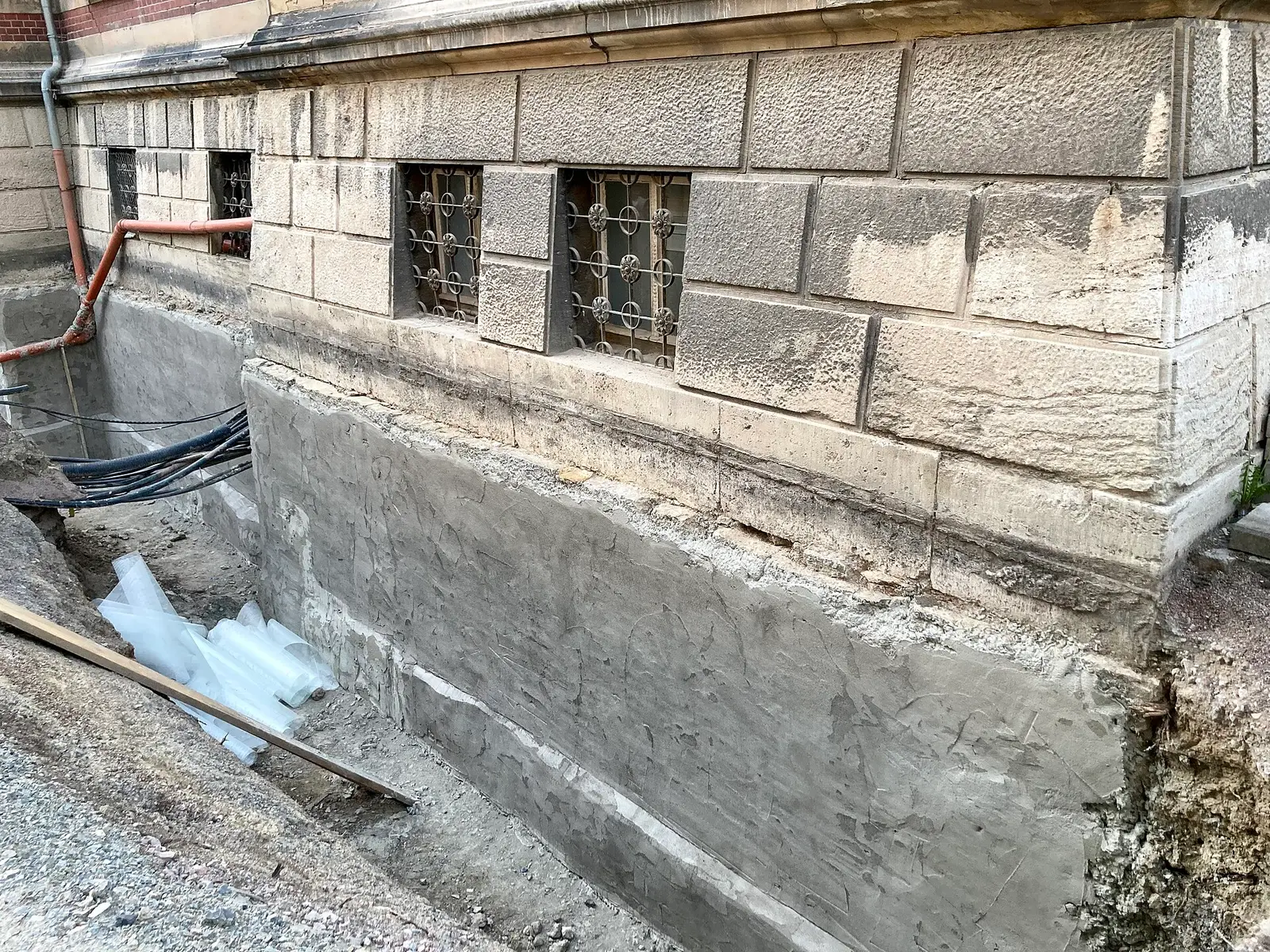
An excavated stone basement wall, plastered and ready for a waterproof coating. Photo: Kai Kemmann, CC BY-SA 4.0, via Wikimedia Commons.
CSLB license class
C-42 Sanitation System, C-12 Earthwork and Paving, C-8 Concrete
Where it applies
San Francisco, East Bay, South Bay
Request
Free, up to three local pros reply
Waterproofing and drainage jobs on Bay Area homes
Perimeter drains along a foundation
A perimeter or French drain is a trench dug beside the footing, lined with filter fabric, bedded with gravel and fitted with perforated pipe that carries water by gravity to a safe outlet. On a house cut into a slope, the uphill wall takes most of the water and is usually where the drain earns its keep. A good installation includes cleanouts so the pipe can be flushed, because fine silt from clay soils slowly fills a drain that cannot be cleaned.
Intercepting water above a hillside house
When the water comes from the slope rather than the roof, the fix starts uphill of the house: a curtain drain or a lined swale that catches groundwater and surface runoff before it reaches the foundation or the back of a retaining wall. The hard part is the outlet. Water collected across a whole slope has to go somewhere that can take it in a storm without eroding a neighbor's yard, a street shoulder or a creek bank.
Regrading and flood barriers at the driveway
A garage or lower floor that sits below the street floods when storm runoff overtops the curb and follows the driveway down. The San Francisco Public Utilities Commission has pointed to projects it helped fund for exactly this: a regraded driveway with raised planters that act as flood barriers, and deployable flood barriers that block driveways and doorways during storms. Regrading a driveway is C-12 or C-8 work, and a trench drain across it needs somewhere to discharge.
Downspouts and area drains
Roof water released at the base of a wall soaks the soil right where the foundation and crawlspace are most exposed. Extending downspouts, connecting them to solid pipe, or sending them to a dispersal point away from the house is often the simplest drainage improvement on a lot. Area drains in patios, lightwells and stairwells at the bottom of a slope clog with leaves and silt, and a blocked one can put water against a door in a single storm.
Waterproofing below-grade walls
Basement and lower-floor walls built against soil can be waterproofed from outside, by excavating to the footing, applying a membrane and adding drainage board and a footing drain, or from inside, by managing water that has already come through. Outside work stops water at the source but means digging along the house, which on a tight lot or a hillside may involve shoring. Inside systems are less disruptive but move water rather than keep it out.
Drying out a wet crawlspace
Raised wood floors over a crawlspace are common in older Bay Area houses, and a crawlspace that collects standing water each winter feeds rot in sills and joists. The usual fix combines grading or a drain to move water out, a sump pump where gravity cannot, and a ground vapor barrier over the soil. Before anyone seals a crawlspace, confirm where the water is coming from, since sealing over an active leak or a failed drain only hides it.
The license this work needs
C-42 Sanitation System
C-12 Earthwork and Paving
C-8 Concrete
There is no stand-alone waterproofing license to ask for. CSLB lists its old D-51 Waterproofing and Weatherproofing subcategory as 'under relevant class', so the class follows the work: C-42 covers storm drains and drain structures, C-12 covers cuts, fills, grading, trenching and backfill, and C-8 covers concrete. A B General Building contractor can take a job that needs two or more unrelated trades. Look up the license number at cslb.ca.gov.
The Bay Area's steep lots carry real risk when soil saturates. After the El Niño rainstorms of 1997 and 1998, the U.S. Geological Survey mapped damaging landslides across ten Bay Area counties, from Sonoma and Napa to Santa Clara and Santa Cruz, with reports beginning in early January 1998 and continuing through winter and spring. Drainage on a hillside lot is about keeping water from building up in the slope, not only keeping it out of the house.
Water that arrives from the street
In a heavy storm, some houses flood from below rather than above. The SFPUC recognizes two routes: water flowing in from the street or sidewalk, and sewage backing up from the city sewer through plumbing fixtures. A house whose garage or lowest floor sits below street level is exposed to both. Waterproofing the walls does little for either; the answer is controlling what reaches the door and what can rise through the drains.
Creeks through hill neighborhoods
Some East Bay hill lots have a creek crossing the yard or running along a property line, and drainage on those lots cannot simply pipe water to the bank. Oakland's creek protection rules restrict draining into a creek without controls for velocity and pollution, and call for drainage controls, such as dissipation and infiltration, that stop water from concentrating. A drain design that works on a flat lot can erode a creek bank and put the owner in violation.
For sewage backing up during storms, the SFPUC directs San Francisco owners to the Department of Building Inspection's Plumbing Division for guidance on backwater valves. Connecting a new drain to the building sewer, or installing a valve on it, usually means cutting into buried pipe, and San Francisco requires a plumbing permit before that work begins.
In Oakland, a lot counts as creekside when a creek or riparian corridor crosses it or runs alongside it, and that status decides whether drainage work needs a Creek Protection Permit. If it is unclear, the city's Creek Determination Application, or a Zoning Worksheet submitted through Oakland's Online Permit Center, settles it before the drain is designed.
San Jose's permit system flags two conditions that matter for drainage. Property information on SJPermits.org shows whether a lot is in a Geohazard or Seismic Hazard Landslide zone, and the city's Flood Hazard Zone Map shows Flood Zones A, AE, AH and AO. Being in one of those zones can also rule a project out of some of the city's faster permit services.
Permits and rules to know
SFPUC Floodwater Grant
San Francisco property owners whose property floods from the public right-of-way, or suffers sewer backflow during heavy rain, may qualify for the SFPUC's Floodwater Grant for flood protection measures. The process starts with the Floodwater Grant Guidebook, then a detailed interest form describing the flooding event, with photos or video if available. The grant team then schedules a site visit to judge eligibility and possible measures, and sends a Site Opportunity Assessment with next steps.
Oakland Creek Protection Permit
Oakland requires a Creek Protection Permit for construction on creekside property, and the category depends on the work and its distance from the creek. Category 1 is interior work. Category 2 is exterior work without earthwork more than 100 feet from the creek's centerline. Category 3 is exterior work between 20 feet from the top of bank and 100 feet from the centerline, or earthwork over three cubic yards beyond 20 feet. Category 4 is work from the centerline to within 20 feet of the top of bank.
Before you hire
Ask exactly where collected water will discharge, and whether that outlet can handle a large winter storm.
Ask which CSLB class the contractor holds for this job, since waterproofing itself has no separate license.
On a slope with cracks or a leaning wall, ask whether a geotechnical engineer should assess it before a drain is designed.
Ask for a sketch of the drain route that shows every cleanout, so the pipe can be flushed in future years.
If a San Francisco house flooded from the street or sewer, contact the SFPUC Floodwater Grant team before choosing a fix.
In Oakland, confirm whether the lot is creekside before any trenching or grading is scheduled.
Ask whether the quote covers restoring the landscaping, paths or concrete cut open to install the drain.
How a request works
Describe the job
A few sentences and a photo of the problem or the space. It takes about a minute.
Local pros get in touch
Up to three handymen or contractors who take this kind of work may call or text to ask questions and quote.
Check, compare, decide
Look up the license, compare what you hear, and agree the scope and price with the one you pick. Requesting costs nothing.
Questions about waterproofing and drainage work in the Bay Area
Is there a waterproofing license I should ask a contractor for?
No single one. CSLB lists the former D-51 Waterproofing and Weatherproofing subcategory as falling under the relevant class, so check that the contractor's license matches the work: C-42 for drain structures, C-12 for grading and trenching, C-8 for concrete, or B for a job combining several trades. Verify the license at cslb.ca.gov.
My San Francisco garage floods from the street in heavy rain. Is there help?
Possibly. The SFPUC's Floodwater Grant is for San Francisco property owners who flood from the public right-of-way or suffer sewer backflow during heavy rains. Start with the guidebook and the interest form, include photos or video of the flooding, and the grant team will schedule a site visit and send an assessment of possible measures.
Does drainage work on my Oakland lot need a creek permit?
Only if the lot is creekside, meaning a creek or riparian corridor crosses it or is contiguous to it. If so, the permit category depends on the work and how close it is to the creek, from interior work up to work within 20 feet of the top of bank. File a Creek Determination Application if you are not sure.
How can I tell if my San Jose property is in a flood or landslide zone?
Look the address up on SJPermits.org, where the property information shows Geohazard and Seismic Hazard Landslide zones, and check the city's Flood Hazard Zone Map for Flood Zones A, AE, AH and AO. The city also takes flood zone questions by phone and email.
Should a basement wall be waterproofed from inside or outside?
Outside is the more complete fix, because a membrane and drain on the soil side stop water before it reaches the wall, but it means excavating to the footing. Inside systems collect water that has already come through and pump or drain it away. On a tight lot or a hillside the choice often comes down to whether digging along the house is practical.
What should I watch for on a hillside lot after a big storm?
New cracks in walls, paths or retaining walls, doors that start to stick, soggy ground or springs where the soil used to be dry, and water collecting behind walls. The 1997 and 1998 El Niño storms set off damaging landslides across the region, so treat those signs seriously and have a geotechnical engineer look before hiring anyone to dig.
Checked against these public sources in September 2026. Codes and programs change: confirm permit rules with your city's building department and a license on the CSLB website before work starts.