Sidewalks, driveways and slabs that answer to city rules
The concrete in front of a Bay Area house is usually the owner's problem. California's Streets and Highways Code makes frontage owners keep the sidewalk from endangering people or property, and San Francisco, Oakland and San Jose each layer their own permits, deadlines and inspections on top. Flatwork is C-8 work, and anything in the public right-of-way needs a city permit before the first saw cut.
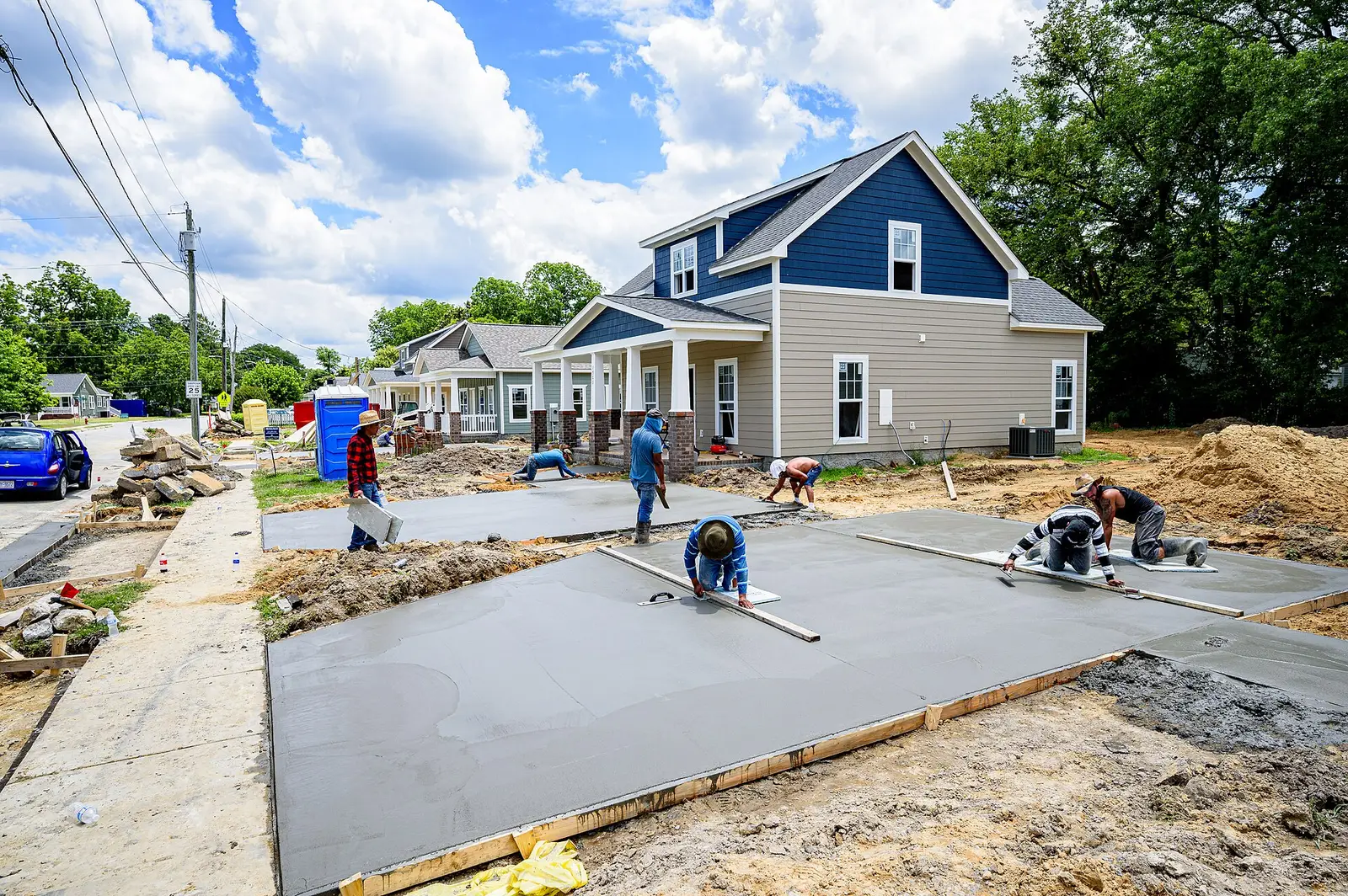
Workers finishing a freshly poured concrete slab beside new houses. Photo: City of Greenville, North Carolina, Public domain, via Wikimedia Commons.
CSLB license class
C-8 Concrete
Where it applies
San Francisco, East Bay, South Bay
Request
Free, up to three local pros reply
Concrete jobs on Bay Area homes
Lifted and sunken sidewalk panels
A sidewalk section that has heaved at a joint or dropped at one corner is seldom a job the owner gets to put off. In San Jose, for example, an inspection can be requested by the owner or by any concerned resident, and the inspector notes every deficiency found. The work means removing the damaged panels back to sound joints, dealing with any roots or soft base underneath, and forming and pouring to the city's standard, under the city's permit and inspection.
Driveway approaches and curb cuts
The sloped section where a driveway crosses the sidewalk and curb belongs to the street, not the lot. In San Francisco the standard residential curb cut is 10 feet long by 3 feet wide including 18-inch wings. A longer, non-standard cut needs Planning Department approval, and one 30 feet or longer needs an Overwide Driveway Permit from Public Works. Widening a cut for a new garage is a planning question before it is a concrete one.
Private driveways and garage aprons
Inside the property line, a replacement driveway often needs no building permit at all. Berkeley's exempt list includes sidewalks and driveways no more than 30 inches above adjacent grade and not over a basement or story below, provided they are not part of an accessible route. A driveway that bridges over a garage or basement is structural, and the exemption no longer applies.
Patios and walkways on clay
A patio slab poured straight onto expansive clay moves with the seasons and cracks where it is weakest. Union City's environmental review notes that building on expansive soil may require grade preparation such as removing problem soil and replacing it with engineered soil, and cites a geotechnical investigation that recommended designing exterior flatwork to limit swelling and shrinkage. On a larger patio, ask whether a soils report exists before choosing slab thickness and joint spacing.
Front steps that have settled or cracked
Poured front steps can pull away from the porch or foundation when the ground under them settles or swells, leaving a gap at the top riser and a tilt toward the street. A surface patch hides that gap without stopping the movement behind it. When the base has moved, the usual remedy is to break out the steps, correct what is underneath and pour again, which is work for a C-8 contractor and not a cosmetic fix.
The license this work needs
C-8 Concrete
A C-8 contractor, in the CSLB's words, forms, pours, places, finishes and installs mass, pavement, flat and other concrete work and sets screeds for pavement and flatwork. Plastering and placing reinforcing steel as a main business fall under other classes. San Francisco Public Works adds its own condition for curb, gutter and roadway work: the contractor must hold an A or C-8 license and have a city street excavation bond on file. Confirm the classification on the license lookup at cslb.ca.gov.
Expansive clay changes volume as its water content changes, and soils rich in smectite open deep cracks in dry seasons. The USDA classifies Brentwood clay loam, found on valley fans in Contra Costa County, as fine and smectitic. Rigid concrete over soil like that lifts in wet winters and settles in dry summers, which is why sidewalks and patios on clay crack in patterns that have nothing to do with the quality of the pour.
Street tree roots
Street trees and sidewalks share the same narrow strip, and when roots lift a panel, who pays for the repair differs sharply between Bay Area cities. San Francisco's StreetTreeSF program repairs sidewalks damaged by street trees. Oakland now holds owners liable for dangerous sidewalks whatever kind of tree caused them. San Jose currently leaves the entire cost of sidewalk and tree repairs with owners. Check your city's rule before hiring anyone.
A wet season from November to March
Bay Area rain is concentrated in the winter; Union City's environmental review describes the rainy season as generally running from November through March, when disturbed soil must not be left without erosion control. Excavated base, forms and fresh concrete all suffer in a storm. Larger jobs that open up bare ground are best scheduled in the dry months, and any quote for winter work should say how the site will be protected.
San Francisco's Sidewalk Inspection and Repair Program surveys neighborhoods and mails owners a Notice to Repair that lists the work and footage, with work to begin within 30 days. Owners in the program can choose to have the city's contractor do the repair. Separately, StreetTreeSF has maintained street trees and repaired the sidewalks they damage since July 1, 2017, unless an owner has opted out.
Oakland used to treat uplift from official city trees as the city's problem. It no longer draws that distinction: following its 2024 Urban Forest Plan, owners are liable for dangerous sidewalks regardless of tree type. Oakland also requires sidewalk repair when a property is bought or sold, or during a large renovation, and runs a Sidewalk Assistance Program for owners who cannot afford the work.
San Jose inspects sidewalks on request, and an inspector notes every deficiency at the site and next door. Repairs can be required for a vertical separation over half an inch, a rise or drop of more than an inch within eight inches, or spalling deeper than half an inch. Owners get 60 days from notice, with up to 30 more if work is progressing, and unpaid city repairs can become a lien.
Permits and rules to know
San Francisco Sidewalk Repair Permit
San Francisco Public Works requires a Sidewalk Repair Permit before any work starts on the sidewalk in front of a property, available through its online Permits Portal or at the counter at 49 South Van Ness. A Street Space permit may also be needed for materials or equipment. Work that touches the curb, gutter or roadway must be done by an A or C-8 contractor with a street excavation bond on file. Repairs are inspected, and work the inspector rejects can be replaced by the city and invoiced to the owner.
Oakland sidewalk permits over 25 square feet
In Oakland, sidewalk repairs larger than 25 square feet need a city permit, and driveways, curbs and gutters add to what the permit covers. The city's guidance is that a licensed contractor should perform repairs beyond that small exemption. Because repair is also triggered by a sale or a large renovation, a seller's sidewalk is worth checking early in an escrow rather than in the last week.
San Jose concrete permits and forms inspections
San Jose requires permits to repair or replace a sidewalk, curb and gutter, driveway approach or curb ramp. Inspections happen three times: to identify the deficiencies, after curb and gutter or driveway forms are set and before the pour, and after all work is done. A forms inspection needs 24 hours' notice, the owner need not be home, and results are left on a door hanger. Asphalt along new curb and gutter is typically patched within 30 days of the final.
Before you hire
Check the C-8 license at cslb.ca.gov; for San Francisco curb or gutter work, confirm a street excavation bond is on file with Public Works.
Ask who applies for the sidewalk or street permit, and put that responsibility in the written contract.
Give the contractor the city's notice and make sure the quote covers every panel and the full footage it lists.
Ask whether the price includes scheduling the forms inspection before the pour where the city requires one.
If a street tree caused the damage, find out whether your city pays for tree-related repairs before signing.
On clay soil, ask what base will go under new concrete and how joints will be spaced.
Ask for proof of workers' compensation coverage for the crew working in the street.
How a request works
Describe the job
A few sentences and a photo of the problem or the space. It takes about a minute.
Local pros get in touch
Up to three handymen or contractors who take this kind of work may call or text to ask questions and quote.
Check, compare, decide
Look up the license, compare what you hear, and agree the scope and price with the one you pick. Requesting costs nothing.
Questions about concrete work in the Bay Area
The city sent a notice about my sidewalk. How long do I have?
It depends on the city. A San Francisco Notice to Repair expects work to begin within 30 days. San Jose gives 60 days from the date of notification to finish, and will grant up to 30 more if repairs are underway. In both cities the repair needs a permit, so allow time to hire a contractor and get the permit issued inside that window.
A street tree lifted the sidewalk. Do I have to pay to fix it?
In San Francisco, generally not: StreetTreeSF repairs sidewalk damage from street trees, unless you opted out of the program to maintain the tree yourself. In Oakland, yes, since the city stopped exempting damage from official city trees. San Jose currently puts the whole cost of sidewalk and tree repairs on owners, with hardship assistance for qualifying low-income households.
Can I widen the curb cut for my San Francisco garage?
Possibly, with approvals. The standard residential curb cut is 10 feet long. Anything longer is non-standard and needs Planning Department approval, and a cut of 30 feet or more needs an Overwide Driveway Permit from Public Works. The concrete itself must be done by an A or C-8 contractor with a street excavation bond on file.
Does replacing my private driveway need a building permit?
Often not on the private side, but check. Berkeley exempts sidewalks and driveways no more than 30 inches above adjacent grade and not over a basement or story below. The part of the driveway that crosses the public sidewalk and curb is different: San Francisco and San Jose both require a city permit for work on a driveway approach.
Do I have to repair the sidewalk before selling a house in Oakland?
Oakland requires owners to repair the sidewalk when they buy or sell a property, or when they carry out a large renovation. Repairs over 25 square feet need a city permit. Getting a contractor to look at the frontage when you list, rather than near closing, leaves time for permits and inspection.
Why does our patio keep cracking even though it was poured recently?
On expansive clay, the ground moves more than the concrete can. Smectite-rich soils swell in wet months and shrink and crack in dry ones, and a rigid slab on top follows along. Replacing the slab without changing what is under it tends to repeat the result, so ask about base preparation and joint layout, and whether a soils report exists for the lot.
Checked against these public sources in September 2026. Codes and programs change: confirm permit rules with your city's building department and a license on the CSLB website before work starts.