Tile that holds up on springy floors, clay slabs and bay fill
Most tile failures on Bay Area houses start underneath: a wood floor too springy for stone, a shower lining nobody tested, or a slab moving on clay or settling fill. Setting tile is C-54 work. Permit rules split by jurisdiction: unincorporated Contra Costa County wants a permit and a shower pan inspection when a tub or shower enclosure is replaced, while Berkeley lists tiling as exempt finish work.
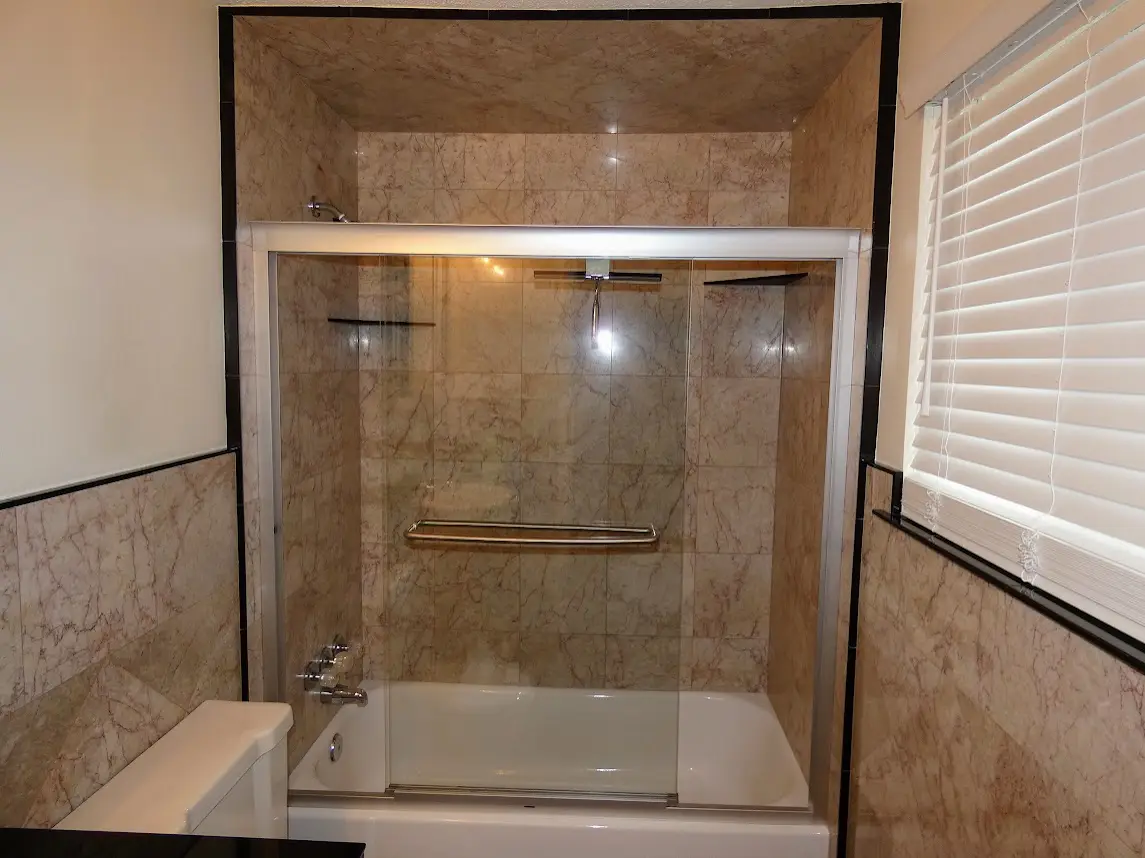
A marble-tiled bathtub and shower surround behind a sliding glass door. Photo: Tile Marble Granite, CC BY-SA 4.0, via Wikimedia Commons.
CSLB license class
C-54 Ceramic and Mosaic Tile
Where it applies
Peninsula, North Bay, East Bay
Request
Free, up to three local pros reply
Tile jobs on Bay Area homes
Shower pans that pass the flood test
A tiled shower floor is only as good as the waterproof lining under it. Contra Costa County's remodel checklist, drawn from California Plumbing Code 408.7, says a lining built on site must run at least 3 inches up the walls and slope a quarter inch per foot to the weep holes at the drain. The inspector sees that lining filled and tested before any tile covers it. A pan that skipped the test tends to announce itself later as a stain on the ceiling below.
Tub-to-shower conversions
Taking out a tub to build a walk-in shower is a reconfigured shower in code terms. Under the same county checklist, the finished stall needs at least 1,024 square inches of floor and room for a 30-inch circle, walls finished with a non-absorbent surface to 70 inches above the floor, and a floor sloped between a quarter and half inch per foot to the drain. A curb, if there is one, sits between 2 and 9 inches above the top of the drain.
Marble and slate over wood framing
Natural stone is weaker than ceramic, so it asks more of the floor under it. The Ceramic Tile Foundation, citing the TCNA Handbook, puts the deflection limit for stone on wood framing at L/720, twice as stiff as the L/360 accepted for ceramic, and requires two layers of structural wood panel when backer board is the substrate. On an upstairs bathroom or a house on a raised foundation, that can mean adding plywood or stiffening joists before any stone is set.
Replacing cracked floor tiles
One cracked tile under a dropped pan is a small repair: cut it out, set a match, regrout. Cracks that line up across a room are a different job, because they usually trace movement in the slab or framing below, and new tile laid over that movement cracks along the same line. Before paying for a new floor, ask the installer what caused the old one to fail and whether an engineer should look at the slab first.
Backsplashes, counters and fireplace surrounds
Tile that dresses a wall rather than sealing a wet area is the lightest end of the trade. Berkeley's list of work exempt from a building permit names painting, papering, tiling, carpeting, cabinets and counter tops as finish work, though the city notes the work must still follow the building code and a zoning permit can apply even when a building permit does not. If original decorative tile surrounds an old fireplace, ask before any of it is removed, since a matching replacement may not exist.
The license this work needs
C-54 Ceramic and Mosaic Tile
The CSLB's C-54 class prepares surfaces and sets glazed wall, ceramic, mosaic, quarry, paver, faience, glass mosaic and stone tile, including tile for tubs, showers and floors; hollow or structural partition tile is excluded. Regrouting or resetting a few loose tiles is small handyman work. A shower rebuild or a new tile floor belongs with a licensed contractor (C-54), and moving a drain or valve needs a licensed plumber. Look the number up at cslb.ca.gov.
Older Bay Area houses on raised foundations and crawlspaces carry their bathrooms and kitchens on wood joists, and rigid tile does not forgive bounce. The Tile Council of North America describes the accepted minimum floor rigidity for tile as L/360, measured before underlayment goes down: the joist span divided by 360 is the most the floor should deflect. A floor that fails that test cracks grout first and tile after, whatever the quality of the setting.
Clay soil that swells and shrinks
Smectite clays change volume with their water content and open deep cracks in dry seasons. East Contra Costa's Brentwood clay loam, formed on valley fans now irrigated for orchards and crops, is classified by the USDA as fine and smectitic. A tile floor on a slab over soil like that moves with the wet and dry seasons, so the installer's crack isolation and movement joints matter as much as the tile itself.
Soft ground along the bay margin
West of the Hayward fault, much of the East Bay sits on alluvial soils. Union City's environmental review for a 2020 project notes that those soils can compress, that weak soils of varying thickness settle unevenly, and that expansive soils damage structures and buried utilities. Uneven settlement under a slab reaches the surface as a crack that crosses several tiles in a line, and replacing the tiles does not stop it.
Eichler Homes built more than 11,000 houses between 1949 and 1966, with Palo Alto and San Mateo among the communities, and their concrete slab floors carry radiant heating inside them. Pulling up old flooring, grinding the slab or drilling for a toilet flange or door stop can hit a heating pipe. Ask the installer how the pipe runs will be located before anything cuts into the concrete.
Corte Madera's Marina Village and Mariner Cove were built on filled baylands in the 1950s. The town's shoreline plan says they have settled up to four feet, depending on the depth of bay mud, and are still subsiding by up to 1.4 inches per decade. Tile in those houses sits on ground that has not finished moving, which argues for flexible joints and for fixing sloped floors before tiling over them.
The same bathroom can be permit-free in one East Bay city and inspected in the next. Contra Costa County's permit process for an unincorporated address runs a rough plumbing and electrical inspection before wallboard, then the underlayment and shower pan test, then a final. Berkeley exempts tiling as finish work. Check with the building department for your address before demolition starts.
Permits and rules to know
Bathroom remodel permits in unincorporated Contra Costa County
Contra Costa County requires a building permit, obtained before work begins, for a bathroom remodel that replaces the tub or shower enclosure. Contractors apply through the county's ePermits Center with their CSLB license connected to the account. If fixtures move or the room changes size, the application needs a floor plan showing existing and proposed conditions and any affected load-bearing walls, plus a homeowners association approval letter where one applies.
Water-saving fixtures on a permitted remodel
The county's checklist, citing CalGreen 301.1.1, says a house undergoing a permitted alteration must replace non-compliant plumbing fixtures throughout the house, not only in the bathroom being tiled. It lists toilets over 1.6 gallons per flush and showerheads over 2.5 gallons per minute among them. Houses built after January 1, 1994 are exempt. Budget for it before a shower permit is pulled on an older house.
Finish tile without a building permit in Berkeley
Berkeley's Planning and Development Department lists painting, papering, tiling, carpeting, cabinets, counter tops and similar finish work among projects that need no building permit. The exemption covers the finish, not what is behind it: replacing a shower valve, moving a drain or rebuilding a rotted subfloor is separate work with its own rules. Exempt work must still meet the California Building Standards Code and Berkeley's own ordinances.
Before you hire
Look up the C-54 license number at cslb.ca.gov and confirm the name matches the contract.
For a shower rebuild, ask who pulls the permit and when the shower pan test inspection happens.
For marble or slate on a wood floor, ask how they will confirm the framing meets the L/720 limit for stone.
On an Eichler or other radiant-heated slab, ask how they will find the heating pipes before cutting or drilling.
If tiles have cracked before, ask what caused it and whether movement joints or crack isolation are included.
Ask for proof of workers' compensation coverage for anyone who will work in your home.
How a request works
Describe the job
A few sentences and a photo of the problem or the space. It takes about a minute.
Local pros get in touch
Up to three handymen or contractors who take this kind of work may call or text to ask questions and quote.
Check, compare, decide
Look up the license, compare what you hear, and agree the scope and price with the one you pick. Requesting costs nothing.
Questions about tile work in the Bay Area
Does retiling a shower need a building permit in the Bay Area?
It depends on the jurisdiction and on what gets replaced. Unincorporated Contra Costa County requires a permit for a bathroom remodel that replaces the tub or shower enclosure, with inspections of the underlayment and the shower pan. Berkeley exempts tiling itself as finish work. Anything involving the valve, drain or subfloor is a different matter, so ask your building department before demolition.
Why did marble crack on our upstairs bathroom floor when the old ceramic tile never did?
Stone needs a stiffer floor. Industry guidance cited by the Ceramic Tile Foundation sets the deflection limit for natural stone on wood framing at L/720, twice as stiff as the L/360 for ceramic, and calls for two layers of structural wood panel when backer board is used. A floor that was fine for ceramic can flex enough to crack stone.
What is the shower pan test?
It is an inspection of the waterproof lining under a tiled shower floor, done before the tile goes on. The lining is filled with water and checked for leaks. Contra Costa County schedules it with the underlayment inspection, after rough plumbing and before the final. Once tile covers a lining that was never tested, the first sign of a leak is often damage in the room below.
Will a permitted bathroom remodel make me replace toilets in other rooms?
In an older house, possibly. Contra Costa County's remodel checklist, citing CalGreen, says residential buildings undergoing permitted alterations must replace non-compliant fixtures throughout the house, such as toilets using more than 1.6 gallons per flush. Houses built after January 1, 1994 are exempt. Ask the contractor to count the fixtures before the permit is pulled.
Can new tile go down on the radiant-heated slab in our Eichler?
The concrete slab is a sound base for tile, but the heating pipes run inside it. Removing old flooring, grinding high spots or drilling anchors can puncture a pipe, and a leak there means opening the slab. Ask how the installer will locate the pipe runs first, and keep fasteners and cuts out of those areas.
Why do our floor tiles keep cracking in a straight line?
A crack that runs across several tiles usually follows movement in what is below: a joist line, a slab joint, or ground that is settling or swelling. Bay-margin fill and smectite clay both do this. New tile over the same movement will crack again, so have the cause looked at, and ask whether an engineer should see the slab before retiling.
Checked against these public sources in September 2026. Codes and programs change: confirm permit rules with your city's building department and a license on the CSLB website before work starts.