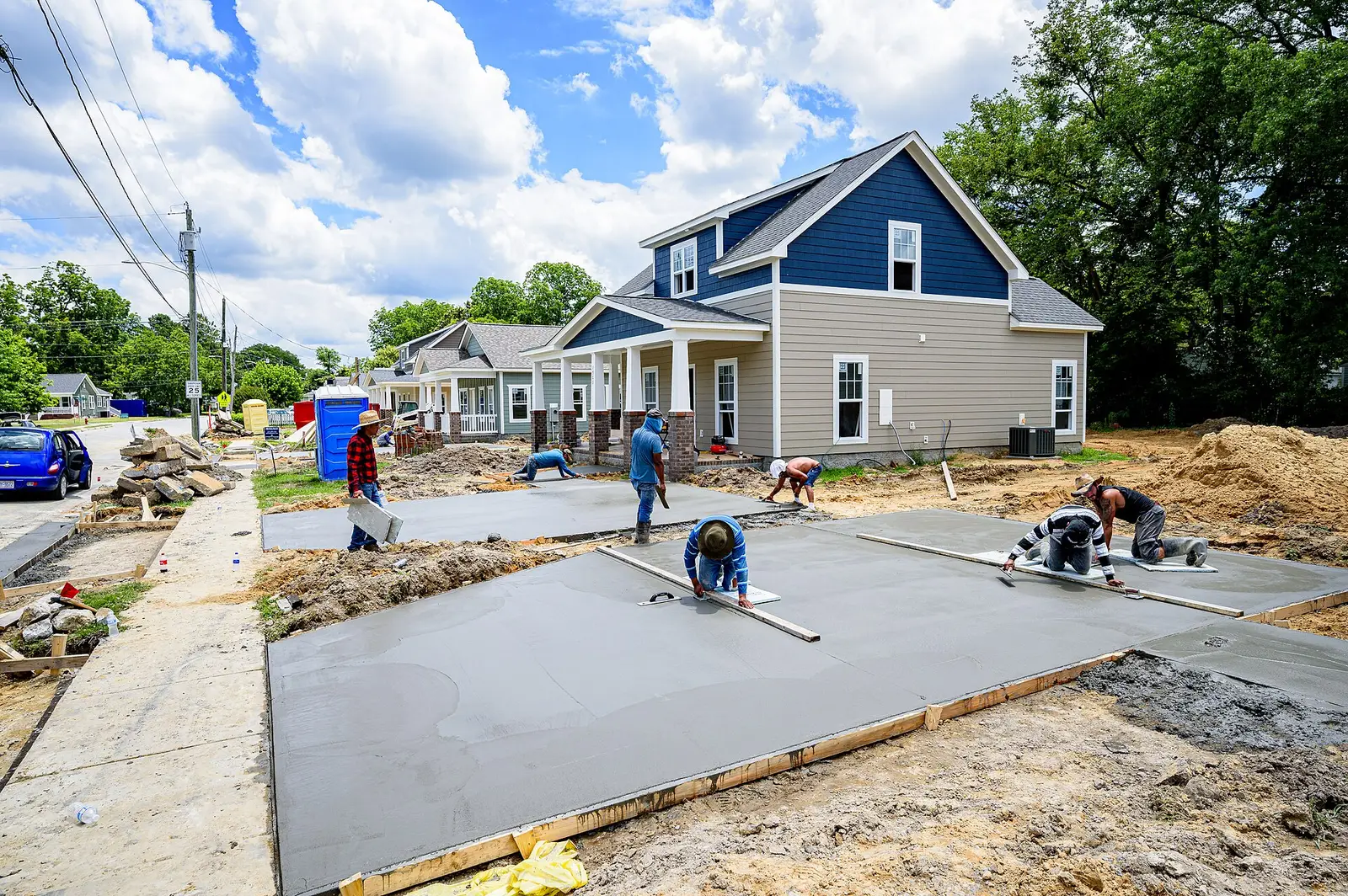
Workers finishing a freshly poured concrete slab beside new houses
Workers finishing a freshly poured concrete slab beside new houses. Photo: City of Greenville, North Carolina, Public domain, via Wikimedia Commons.

Concrete San Francisco

San Francisco sidewalk repair, from the white X to the re-inspection

Public Works Code Section 706 makes a San Francisco owner keep the sidewalk in front of the property in good repair, except at the corner, around a utility facility, over City-maintained tree roots, and on a few special surfaces. Inspectors mark defects with white X's or dots, a half-inch lip or hole in the walking path is a priority, and the normal fix is to remove the panel and pour it again, not to patch it.

Owner's duty
Public Works Code Section 706
Priority defect
A lip or hole of 1/2 inch or more in the walking path
Inspection cycle
Every city sidewalk, on a 25-year rotation since 2007
Standard finish
Concrete scored in 3-foot by 3-foot squares

The work

Sidewalk and frontage work that comes up here

  • Replacing the panels an inspector marked

    After a Public Works inspection, the damaged areas carry white X's or dots and a notice goes up on the property. The city's guideline is clear that the marks are not the whole job: an owner should also find and repair any other defect in the pavement to comply fully with Section 706. Standard practice is removal and replacement to the City's Standard Specifications, Section 204; patching and grinding are allowed only as temporary measures under a separate order.

  • Uplift from a street tree that is waiting its turn

    StreetTreeSF repairs sidewalks lifted by street trees, but Public Works says more than 31,000 sites need work and it may take several years, and damage that existed before July 1, 2017 stays the owner's responsibility. An owner can instead get a permit and hire a contractor now. Any digging within a street tree's dripline then calls for a Tree Protection Plan prepared with input from a certified arborist, because every street tree is protected under Article 16.

  • Re-pouring a driveway apron on a hill

    Where a garage meets a steep street, the apron and the sidewalk around it are both on a grade. Better Streets requires any surface at 6 percent or more to be slip-resistant and says sidewalks should not be interrupted by steps or level changes of more than a quarter inch. Matching the slope of the neighbors' panels, the scoring, and the finish is most of the skill in this job.

  • Trading some concrete for planting

    Public Works issues sidewalk landscaping permits that let an owner convert part of the sidewalk to a planted strip. Its FAQ on the permit sets a 9-foot minimum width for residential streets with parking: 4 feet of clear sidewalk, 3 feet of planting and a 2-foot courtesy strip at the curb. The owner signs the application and maintains the planting afterward, so it is a long-term commitment, not just a pour.

The Golden Gate Bridge and San Francisco, seen from the Marin Headlands
The Golden Gate Bridge and San Francisco, seen from the Marin Headlands. Photo: Paul.h, Public domain, via Wikimedia Commons.

The houses here

Driveways every 25 feet and sidewalks on a slope

A San Francisco frontage is short and does a lot. In the Sunset, with few exceptions, the tract houses of the 1920s to 1950s were built over their own garages, so a driveway apron crosses the sidewalk on almost every 25-foot lot, and SF Planning's Sunset District survey notes that builders sometimes scored those driveways and walkways in curvilinear or geometric patterns. Out at the curb, the city's Better Streets standard for an ordinary sidewalk is concrete scored in 3-foot squares, and on the hills any surface at a 6 percent slope or steeper must be slip-resistant. A repair has to tie the two together: the old pattern at the house and the city grid at the street, on ground that is often not level in either direction.

Free request

Describe the concrete job once. Local pros who take work in San Francisco reply by call or text.

  • No fee to request, and no obligation to hire
  • You agree scope and price with the pro you choose
  • Photos help them quote without a first visit

Get quotes for concrete work in San Francisco

Two short steps. A local pro who takes this work calls or texts you back.

To send a request, call or text (415) 449-8213.

Free to request, and you agree the scope and price with the person you hire before work starts. In California, a job over $1,000 in labor and materials, or one that needs a building permit, must be done by a contractor licensed by the CSLB in the right class. Ask for the license number and check it at cslb.ca.gov.

Permits and local rules

The orders and standards behind a notice

  • Section 706 and the four exceptions

    Public Works Order 178,884 restates the duty in Public Works Code Section 706: owners maintain the sidewalk in front of and adjacent to their property. It lists the exceptions: damage from City-maintained trees, damage in the sidewalk corner, damage related to a utility facility, and surfaces the City maintains, such as the Market Street bricks. Within the Throughway Zone, the path most people walk, a vertical displacement or void of half an inch or more is a priority, as is a curb defect over an inch.

    San Francisco Public Works (opens in a new tab)
  • How a block gets inspected

    The Sidewalk Inspection and Repair Program, implemented in 2007, inspects sidewalks on a 25-year cycle. Blocks with the most community elements go first: commercially zoned districts, Muni routes, and sidewalks within 500 feet of schools, public facilities, hospitals or senior centers, weighed with population density. If an owner fails to repair after proper notice, the City is entitled to do the work and invoice the owner for inspection and abatement.

    San Francisco Public Works (opens in a new tab)
  • Better Streets paving standards

    San Francisco's Better Streets guidance says standard sidewalks should be concrete scored in 3-foot by 3-foot squares. Surfaces sloping 6 percent or more must be slip-resistant, and no surface should be interrupted by steps or abrupt level changes of more than a quarter inch. Fronting owners generally maintain both standard and alternative paving, and anything other than standard concrete needs a Special Sidewalk Surface Permit.

    San Francisco Better Streets (opens in a new tab)

State license for this work: C-8 Concrete. Look up a contractor's license on the CSLB website (opens in a new tab).

Before you hire

Settle these before the saw comes out

  • Walk the whole frontage with the contractor and price every defect, not only the panels Public Works marked.
  • If a street tree is involved, ask who prepares the Tree Protection Plan and which arborist gives input on root work.
  • If the damage is at the corner or around a utility box cover, ask Public Works first, since those are not the owner's to repair.
  • Ask how the new panels will match the 3-foot scoring and any patterned concrete at your driveway or walkway.
  • Ask who tells the district inspector the work is done, so the re-inspection closes out the notice.

Questions

San Francisco sidewalk questions, answered

Is a half-inch lip really enough for Public Works to flag my San Francisco sidewalk?

Yes. Under Public Works Order 178,884, a vertical displacement of half an inch or more, or a void, crack or hole of half an inch or more, in the part of the sidewalk most people walk is a priority for repair. Curb defects count once they exceed an inch. The measurements take existing slopes and sidewalk patterns into account.

The broken concrete is at the corner of my block. Do I have to fix it?

Usually not. Public Works lists damage in the sidewalk corner, whether an angular corner or a corner return, among the exceptions to the owner's duty, along with utility-related damage and damage from City-maintained trees. Public Works also designs curb ramps, and residents can request one through 311.

Can I just grind the lip down instead of replacing the panel?

Only as a stopgap. Public Works says the normal repair is removal and replacement to the City's Standard Specifications, Section 204, while a separate order allows patching and grinding as temporary repair methods. A temporary fix does not end your duty to keep the sidewalk in good repair.

What happens if I ignore a sidewalk notice in San Francisco?

After proper notice the City may hire its own contractor, do the repair, and bill you for inspection and abatement. Unpaid amounts are added to the next property tax bill under Public Works Code Section 706.9 and Administrative Code Chapter 80, and are collected like ordinary taxes. Public Works also offers a deferred payment plan to owners who qualify under economic hardship.

A street tree lifted my sidewalk and StreetTreeSF hasn't come yet. Am I still liable?

Public Works says owners are liable for any damage or injury resulting from the sidewalk's condition in the meantime, and damage that existed before July 1, 2017 remains the owner's. With more than 31,000 sites on the list, an owner may choose to get a permit and repair it with their own contractor rather than wait.

Concrete work in San Francisco? Tell us what you see.

One request reaches local handymen and contractors who take this work. The Handyman SF connects you with them; it does not do the work.

HandymanNow for handymen Work in San Francisco? Get job leads by text. Pick your trades and areas, take only the jobs you want. No subscription. Start getting leads HandymanNow for homeowners Get the HandymanNow app. Send a request with photos, message your handyman and follow them on the way. Download the app

HandymanNow app

Fix it faster. Find work faster.

Homeowners send a job with photos and follow their handyman on the map. Handymen get local jobs by text and take only the ones they want.

Call Get a quote