Antioch repairs, from G Street Victorians to Deer Valley tracts
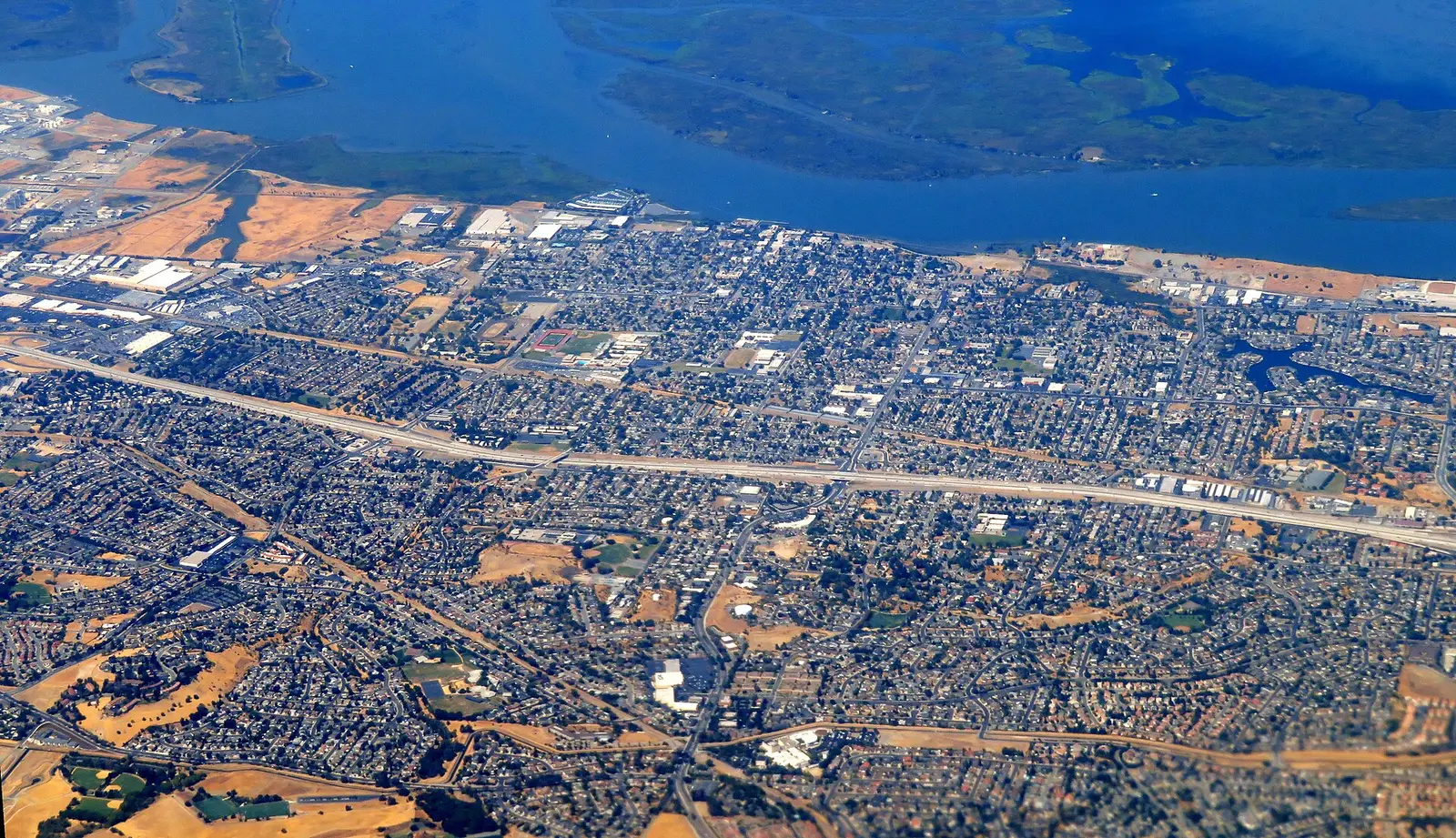
Highway 4 splits Antioch's housing in two. North of it, most homes predate the 1950s, including Victorian, Queen Anne and Craftsman houses east of G Street in Rivertown. South of it, most were built in the 1980s, 1990s and early 2000s on clay ground. Common jobs: stuck wood windows, recurring wall cracks and tired original fixtures.
Antioch from the air in August 2018, with Winter Island and Browns Island on the river. Photo: Pi.1415926535, CC BY-SA 3.0, via Wikimedia Commons.
ZIP codes
94509, 94531
When the homes were built
1894-2005
Main streets
West Second Street, G Street, Hillcrest Avenue, Lone Tree Way
Landmarks
El Campanil Theatre, Riverview Union High School Building (Antioch Historical Museum), Antioch Dunes National Wildlife Refuge
What homes in Antioch need most
Sash windows east of G Street
The downtown blocks east of G Street hold Victorian, Queen Anne and Craftsman houses, and a city market study of downtown listings found single-family homes built from 1908 to 1959. At that age, original double-hung windows have snapped sash cords, frames painted shut and glazing putty falling out, and heavy panel doors droop on worn hinges. Freeing a painted-shut sash, re-cording its weights, reglazing a cracked pane or rehanging a door keeps the original piece working instead of replacing it with something that does not match the house. More about door and window repair
Cracks that follow the clay
Antioch is mapped on the Capay-Rincon soil association, and the geotechnical study for the Ranch project in the southeast found expansive lean clay in every test pit, with moderate to high shrink-swell potential. Ground like that moves shallow foundations a little with each wet winter and dry summer, and indoors it shows as hairline cracks off the corners of doors and windows. South of Highway 4 the fix is tape and setting compound on drywall; in a pre-1950s house north of the freeway the wall may be plaster, which takes a different patch. A crack that widens year after year needs a structural engineer, not more filler. More about drywall and plaster repair
Fixtures from the 1980-1999 building wave
More of Antioch's housing went up between 1980 and 1999 than in any other period, 15,182 units in two decades, most of them south of Highway 4. The city's housing element notes that homes past 30 years old usually start needing plumbing work, and most of that wave has now passed the mark. Worn faucet cartridges, toilets with tired flappers and fill valves, cracked plastic supply lines and shutoffs frozen open are one-visit swaps. A leak inside a wall or below the floor is work for a plumber. More about faucet, toilet and fixture repair
Turnover lists for rental houses
About four in ten Antioch households rent, a higher share than Contra Costa County as a whole, and the older north side holds more of the rentals. Between tenants a landlord usually faces the same list: patch holes and scuffs, swap locksets, replace broken blinds, tighten cabinet hinges and drawer slides, and reset towel bars and door stops pulled out of the wall. Sending the whole list at once, with a photo of each room, lets the work be planned as a single visit rather than three. More about general handyman repairs
Fences around the southern subdivisions
With more than three quarters of the city's homes detached houses, most owners have a backyard fence, and in the subdivisions built from the 1980s onward those fences are into their second, third or fourth decade. Long hot summers dry out boards until they split and cup, and clay that drains slowly keeps posts wet at ground level through winter, which is where rot starts. Replacing broken boards, resetting a leaning post and rehanging a gate that drags usually saves the run without rebuilding it. More about fence, deck and gate repair
How the houses here are built
The city counts about 34,000 housing units, and more than three quarters are detached single-family houses. The older north side has more rentals and apartment buildings; the south side, out toward Lone Tree Way and Deer Valley Road, is subdivisions, and 15,182 units were built between 1980 and 1999 alone.
Everything is wood frame, but the two halves differ: the downtown houses in a 2014 city market study dated from 1908 to 1959 on lots of 4,500 to 5,000 square feet, and houses that age may still have original trim, wood windows and plaster walls, while the southern tracts have drywall interiors. Under both lies the Capay-Rincon soil association of clays and clay loams, which swell when wet and shrink as they dry.
The inland Delta location gives the city hotter summers and colder winter nights than the rest of the Bay Area, so clay ground and exterior wood go through a hard wet-dry cycle every year.
Good to know before a job in Antioch
Highway 4 is the dividing line
The city's own 2014 study for its downtown plan describes a housing market split by State Route 4. North of the freeway, the older city was built mostly before the 1950s, with lower homeownership and more multi-family buildings. South of it, most homes date from the 1980s, 1990s and early 2000s, with larger single-family houses and much of the city's remaining open land. Since May 2018 the Antioch BART station has sat in the freeway median at Hillcrest Avenue. When you describe a job, say which side you are on and when the house was built.
Coal hills to the south, sand dunes to the east
Coal was found in the hills south of town around 1859, and the Mount Diablo coalfield towns of Nortonville, Somersville, Stewartville, West Hartley and Judsonville produced about 4 million tons of coal before the mines closed. Sand mining for glass and foundry work followed there from the 1920s into the 1940s. East along the river, dunes that approached 120 feet were mined for brick sand. The city's lowlands near the river are loose alluvium, while the southern uplands are tilted sedimentary rock, so the ground under two Antioch houses can be very different.
How a request works
Describe the job
A sentence and a photo or two is enough. It takes about a minute.
A local handyman gets in touch
By call or text, to ask what the photos don't show and give you a price.
You decide
Agree a time and price with the handyman directly, or don't. Requesting costs nothing.
Questions from Antioch homeowners
Can a handyman work on my 1900s house in Rivertown, or does it need a specialist?
Most everyday repairs on an old downtown house are handyman work: freeing and re-cording sash windows, patching plaster, rehanging doors and replacing worn hardware. Anything structural, new wiring or new circuits, or work on a foundation belongs with a licensed contractor. Describe the house's age and style in your request so the right person comes prepared.
Why do wall cracks keep coming back in my house in south Antioch?
Much of Antioch sits on clay soils that swell in wet winters and shrink in dry summers, and a lightly loaded foundation moves slightly with them. A patch made with tape and setting compound holds far better than spackle. Photograph each crack with a tape measure beside it; if it is wider a year later, have a structural engineer check the foundation.
I own a rental north of Highway 4. Can one visit cover my whole turnover list?
Usually, yes. Wall patching, lock and blind replacement, cabinet adjustments and fixture swaps can be grouped into one visit if the list and photos arrive together. Mention whether the house has plaster or drywall walls, since a pre-1950s house on the north side may still have plaster, and note anything that a plumber or electrician will need to handle separately.
Where can I see what is left of Antioch's coal mining?
Black Diamond Mines Regional Preserve, in the hills south of the city, holds the remains of the coalfield towns, including Somersville and Nortonville, and opened as a regional park on May 8, 1976. The Antioch Historical Museum, in the 1911 Riverview Union High School building on West 4th Street, covers the town's history.
Checked against these public sources in September 2026. Rules change: confirm anything permit-related with the city or town of Antioch before work starts.