Concord repairs for hot summers, creeping curbs and old plaza homes
Two forces set the pattern for repairs in Concord. The city grew from 6,953 people in 1950 to 85,164 in 1970, so much of its housing is boom-era tract houses now 55 to 75 years old. And a creeping strand of the Concord fault, remapped in 2025, bends curbs across southeast Concord. July highs average near 88°F.
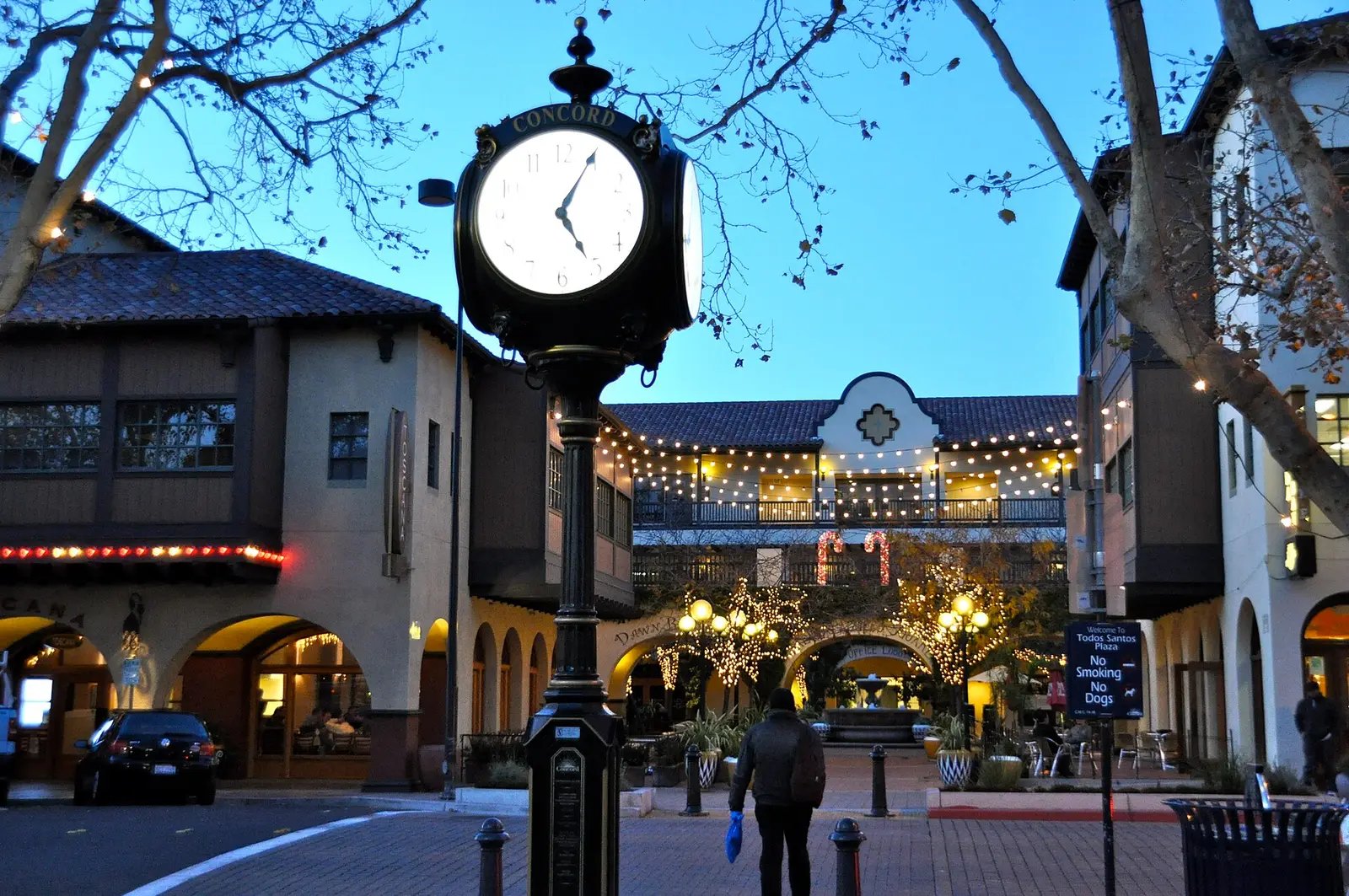
The street clock at Todos Santos Plaza in downtown Concord. Photo: Geraoma, Public domain, via Wikimedia Commons.
ZIP codes
94518, 94519, 94520, 94521
When the homes were built
1950-1970
Main streets
Willow Pass Road, Clayton Road, Monument Boulevard, Ygnacio Valley Road
Landmarks
Todos Santos Plaza, Galindo Home and Gardens, Concord Pavilion
What homes in Concord need most
Wall cracks near the fault's creeping strand
A 2025 study by the U.S. Geological Survey and the California Geological Survey traced an active strand of the Concord fault south from downtown, between Oak Grove Road and Lime Ridge, offsetting curbs on streets such as Minert Road. It slips about 3 millimeters a year, and not always smoothly: the researchers identified creep events of roughly a centimeter every three to four years, including one in 2018. In a house close to that line, a crack can stay quiet for years and then open in a step. Patch it with tape and setting compound, and pencil the date at each end first. More about drywall and plaster repair
Ceiling fans for July heat
Concord's July highs average close to 88°F and the city hit 115°F in 2017, so a bedroom ceiling fan earns its keep. Swapping an existing ceiling light for a fan is handyman work when the box overhead is rated to carry a fan, which is heavier than a light and wobbles as it turns. Many light-only boxes in houses from the 1950s and 1960s are not, so mention the age of the fixture when you describe the job. Where the ceiling has no fixture at all, running new wire belongs to a licensed electrician.
Fix lists before an apartment inspection
Since 2000 Concord has inspected rental buildings with four or more units on one parcel, on a two-year cycle, covering the units plus parking lots, fences, pools and common areas. Among the problems the city tells tenants to report are broken windows, smoke alarms that do not work, rotting wood and leaks. A good share of that list is small work: replacing a cracked pane in a standard window, fitting new battery smoke alarms, cutting out rotted trim or fence boards, and rehanging a door that no longer latches. Heaters, wiring and roof leaks go to a licensed contractor in that trade. More about general handyman repairs
Old wood houses around Todos Santos Plaza
Salvio Pacheco dedicated Todos Santos Plaza in 1868 as the square of a 20-block town, and the streets around it still hold 1800s and early-1900s houses built for shopkeepers, postmasters, blacksmiths and teachers. Many were hauled in from other parts of Concord to save them from demolition. Houses this old want carpentry that respects what survives: porch steps and railings rebuilt in wood, door and window casings patched to their original profile, old wood windows freed and rehung rather than swapped out. If yours is on the city's landmark list, talk to the city before changing anything on the outside. More about carpentry, shelves and trim
Kitchens and baths from the twenty-year build-out
Concord had 6,953 residents in 1950, 36,208 in 1960 and 85,164 in 1970. That means a large share of its kitchens and bathrooms were first plumbed within those two decades and have been updated one piece at a time ever since. The calls that come up most: a faucet cartridge that drips, a toilet flapper that lets the tank run, a stiff old supply line due for a braided one, an under-sink shutoff that will not close all the way. Anything behind the drywall, such as corroded old pipe, is for a plumber. More about faucet, toilet and fixture repair
How the houses here are built
Ranch houses from the 1940s through the 1960s fill neighborhoods such as Holbrook Heights, Dana Estates and Sun Terrace; apartment complexes of four or more units fall under a city inspection program; and a small core of 1800s and early-1900s houses stands around Todos Santos Plaza, several moved there to escape demolition.
Boom-era tract houses are wood-frame with drywall inside and stucco or wood siding outside, so most fixes are familiar ones. The older houses by the plaza are more likely to have plaster walls and hand-fitted wood trim, which reward matching repairs over replacement.
July highs average 87.8°F, the thermometer reached 115°F in 2017, and January nights drop to about 42°F, a wide yearly swing for exterior paint, caulk and wood.
Good to know before a job in Concord
The fault strand that was drawn in the wrong place
The largest recorded earthquake on the Concord fault, magnitude 5.4, struck on October 24, 1955. For decades the southern part of its active trace sat on maps where it is not. Curb surveys published in 2025 placed the creeping strand 100 to 450 meters west of the old line and 7 kilometers farther south, with right-lateral offsets of 4 to 20 centimeters on both sides of every street it crosses in southeast Concord and northeast Walnut Creek. The state is to draw a new Alquist-Priolo Earthquake Fault Zone along it, and that zone brings disclosure when a home is sold.
Concord's landmark houses
Concord picks its official landmarks under a 1974 preservation ordinance, and the Concord Historical Society lists around 40. They include the Fernando Pacheco Adobe from 1851 and the Galindo Home at 1721 Amador Avenue, built in 1856 and enlarged from six rooms to ten between 1875 and 1880; it is on the National Register and now serves as the society's museum. Several landmark houses were moved to save them, including the Eddy House, now at 1800 Clayton Road, and the Beebe House, now at 1921 Concord Avenue.
How a request works
Describe the job
A sentence and a photo or two is enough. It takes about a minute.
A local handyman gets in touch
By call or text, to ask what the photos don't show and give you a price.
You decide
Agree a time and price with the handyman directly, or don't. Requesting costs nothing.
Questions from Concord homeowners
Does Concord's multi-family inspection program cover my condo or rental house?
No. The program covers rental buildings with four or more units on one parcel, including their parking lots, fences, pools and common areas, on a two-year cycle. Single-family homes, condos, hotels and motels are excluded. A tenant in a covered building can file a complaint with the city, and inspectors visit on weekdays between 8 a.m. and 5 p.m.
I live near Minert Road. Does the newly mapped fault strand change how I should fix wall cracks?
It changes what you record, not whether you patch. The 2025 survey found the strand offsetting curbs on streets there, moving about 3 millimeters a year with occasional centimeter-scale jumps. Cosmetic cracks can still be repaired. Before patching, mark each end of the crack in pencil with the date; if the same crack keeps growing past those marks, a structural engineer should see it before more patching.
Can a ceiling fan go where the light is in my 1960s Concord bedroom?
Usually, as long as the ceiling box is rated for a fan and fixed to framing. A fan weighs more than a light and moves as it spins, so a light-only box is not enough. With a fan-rated box in place, swapping the fixture on the existing wiring is ordinary handyman work. Adding a wall switch or a new circuit needs a licensed electrician.
Where can I see original 1800s woodwork before repairing an old house near Todos Santos Plaza?
The Galindo Home and Gardens at 1721 Amador Avenue, built in 1856 and restored by the Concord Historical Society, is open on the first and third Sunday of each month from 1 to 4 p.m., except holiday weekends, and by appointment. Its doors, trim and porch are a useful reference when you want a repair to match what a house of that age would have had.
Checked against these public sources in September 2026. Rules change: confirm anything permit-related with the city or town of Concord before work starts.