Roofing Petaluma

Petaluma roofs: one Class A rule, two fire maps and a 1945 demolition line

A Petaluma re-roof is an over-the-counter permit with no plan review, filed through the city's online portal, with the fee based on the job's valuation. Two citywide rules set the rest: every roof covering in Petaluma must be Class A, wherever the house stands, and every project, roofing included, files a construction waste plan diverting at least 65 percent of its debris. Historic districts and the city's fire maps add review on some lots.

  • Free to request, no obligation to hire
  • Up to five local pros who take this work can reply
  • Rules on this page checked against 16 public sources, November 2026

Get quotes for roofing work in Petaluma

Two short steps. A local pro who takes this work calls or texts you back.

To send a request, call or text (415) 449-8213.

Free to request, and you agree the scope and price with the person you hire before work starts. In California, a job over $1,000 in labor and materials, or one that needs a building permit, must be done by a contractor licensed by the CSLB in the right class. Ask for the license number and check it at cslb.ca.gov.

The work

What Petaluma asks of a tear-off, a pitch change and a raised roof

  1. Tearing off composition shingle

    The Building Division treats a straight re-roof as an over-the-counter permit, with no plan review, and the application goes through the online permit portal with a fee figured from the project's valuation and materials. Whatever was on the roof before, the new covering has to be Class A, because the city's residential construction handout applies that rating to every roof in Petaluma. The tear-off also brings the Construction Waste Management Plan, on which roofing is one of the listed project types.

  2. Putting pitch on a flat roof

    Changing a roof from flat to sloped is a line of its own on Petaluma's list of work that needs a building permit, so it is not handled as a simple re-roof. The new framing is drawn to the city's residential handout: rafter and ceiling joist spans from the Residential Code tables, ridge boards, hips and valleys designed as beams with calculations where the slope is under 3:12, and attic ventilation sized to the attic area with at least an inch of air space between insulation and sheathing.

  3. Raising the roof of a house built before 1945

    Petaluma reviews the demolition of any structure built before 1945 under Council Resolution No. 2017-122 N.C.S., and its definition reaches roof work. Adding a second story that is not designed and differentiated to convey the original building's history can count as demolition, as can raising the building beyond what a new foundation requires. Replacing deteriorated material that cannot be repaired, in kind and with no change to the exterior, is not a demolition.

  4. Gutters and downspouts on an addition

    When a roof is part of an addition or a new house, the city's construction handout asks the site plan to show where surface and roof drainage go, through drain inlets, yard drains or swales, and it says roof drainage must be connected to an approved storm drainage system. Where gutters come off and go back on with the roof, ask the roofer where each downspout will discharge and whether the plan for it matches that line.

Free, no obligation. Next, add your details in the request form.

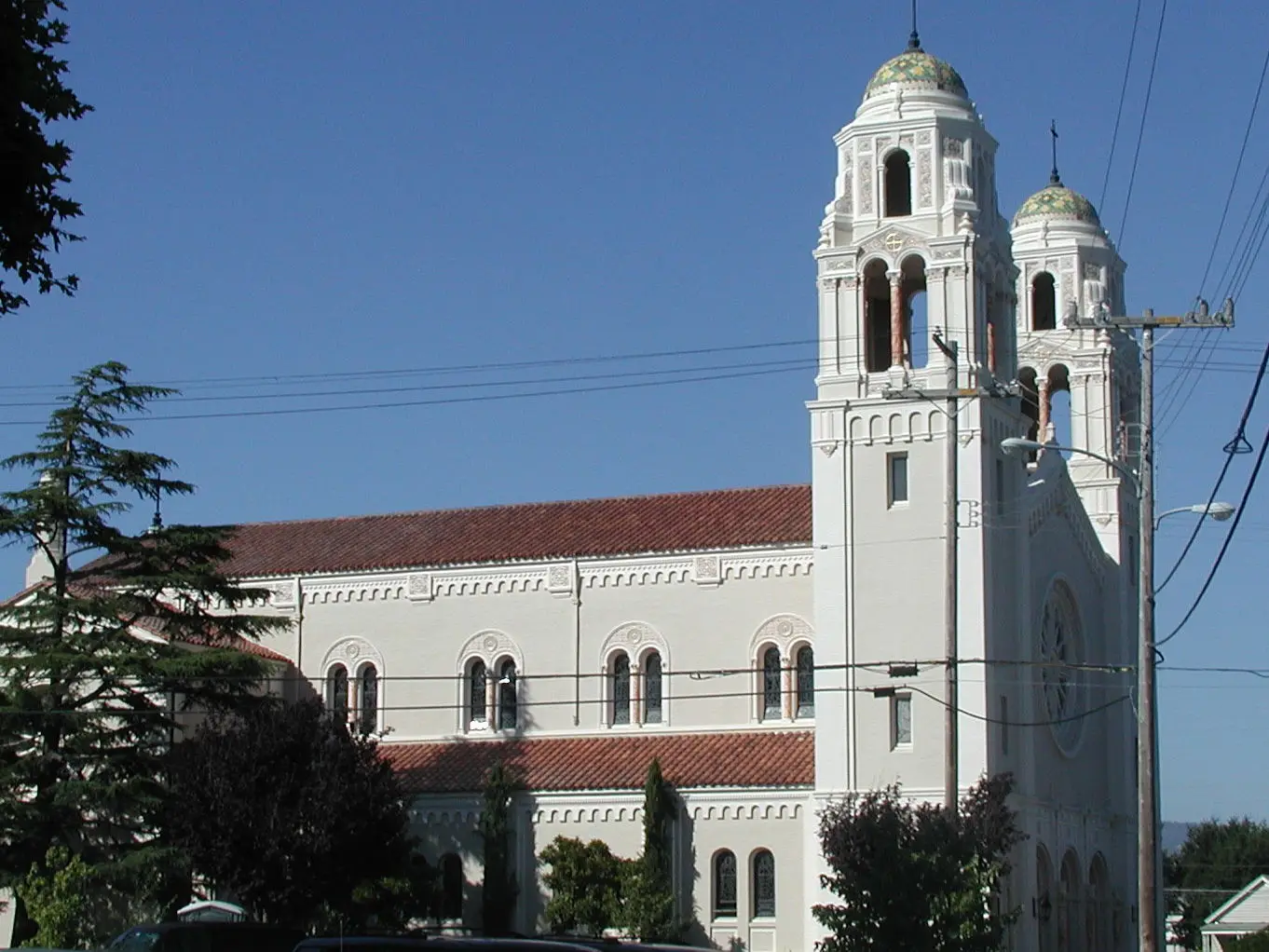
White Spanish-style church with twin tiled bell towers against a blue sky in Petaluma, with power lines along the street
White Spanish-style church with twin tiled bell towers against a blue sky in Petaluma, with power lines along the street. Photo: Colin Marquardt, Colin Marquardt, Public domain, via Wikimedia Commons.

The houses here

Pre-1906 Victorians west of the river, shingle and built-up roofs elsewhere

Petaluma came through the 1906 earthquake relatively unharmed, on stable bedrock, which is a large part of why pre-1906 buildings and Victorian houses still stand on the west side of the river. Most of the housing came much later. Table A12 of the Housing Element puts 18.9 percent of the city's homes in the 1970s and 18.2 percent in the 1990s, more than any other decade. The same document observes that composition shingle and built-up roofs cover a large share of Petaluma's homes, and ranks concrete tile, metal and clay tile after them. A Victorian's steep roof and a 1970s low-slope section can sit a few blocks apart, and they lead to very different bids.

Neighbourhood by neighbourhood

Petaluma lots where a roof job gets a second look

  1. Oakhill-Brewster

    North and west of downtown, this locally designated district holds architecture from the 1850s through the 1980s, so roofs on one block can be a century apart. Alterations to designated resources are filed as a Historic Site Plan and Architectural Review application and decided by Planning staff or the Historic and Cultural Preservation Committee, often after a qualified professional has documented the historic features.

  2. A Street

    Almost every building in this district south and east of downtown predates 1925, which puts nearly the whole district inside the city's demolition review for structures built before 1945. A roof raised to add a second story here is judged on whether the new work is designed and differentiated so the original building still reads.

  3. The Historic Commercial District

    Downtown's design guidelines, adopted in 1999, require roof-mounted equipment, antennas and utility gear to be screened, and screened by solid building elements such as parapet walls rather than add-on wood or metal slats. A re-roof that resets rooftop units on these blocks is a natural point to bring the screening in line.

  4. The west side toward Helen Putnam Regional Park

    The city's wildland-urban interface map, last updated June 25, 2007, is drawn over the west side, with streets from Sunnyslope Avenue and McNear Avenue out to Westridge Drive and Chileno Valley Road, the approach to Helen Putnam Regional Park. Because the city says that map is separate from the 2025 hazard map, owners on these streets have two lookups to make before choosing vents and gutters.

Permits and local rules

Reading Petaluma's permit FAQ, handouts and fire ordinance for a roof

  1. Re-roofs go over the counter

    Petaluma's permit FAQ defines an over-the-counter permit as one that does not require plan review, names re-roofs among the work the Building Division issues that way, and bases the re-roof fee on the valuation of the project and its materials. The application is made through the city's online permit portal. The same FAQ warns that homes in the historic districts have special requirements for exterior changes and sends owners to the Planning Division first.

    City of Petaluma Building Division (opens in a new tab)
  2. Class A for every roof covering

    The Building Division's residential construction information, posted April 30, 2026, opens its roof section with one sentence: all roof coverings in Petaluma must be Class A. The rule is not limited to fire hazard zones or the wildland-urban interface map. The same handout asks plans to show the roof covering and sheathing, attic access and ventilation, and skylight framing, and has truss calculations and layout handed to the inspector at the roof nailing inspection.

    City of Petaluma Building Division (opens in a new tab)
  3. A construction waste plan, roofing included

    Petaluma requires construction and demolition waste from all projects to be recycled or salvaged at a minimum of 65 percent, and contractors and owner-builders complete the Construction Waste Management Plan before a building or demolition permit is issued. The form, revised June 2, 2026, lists roofing among project types and asks for the tracking method and the hauler or facility. At the end the contractor files a recycling report of tons recycled and disposed, by material, before final inspection.

    City of Petaluma Building Division (opens in a new tab)
  4. Two maps for fire

    CAL FIRE delivered Petaluma's 2025 Fire Hazard Severity Zone map for its Local Responsibility Area on February 24, 2025, and Ordinance No. 2903 N.C.S., adopted June 16 and in effect July 16, 2025, wrote it into Municipal Code Section 17.20.040. The map's legend shows Moderate and High zones. That section also refers to a wildland-urban interface map, which the city stresses is different from the hazard map, so an address should be checked on both.

    City of Petaluma (opens in a new tab)

State license for this work: C-39 Roofing, B General Building. Look up a contractor's license on the CSLB website (cslb.ca.gov).

Before you hire

Five things to confirm before a Petaluma tear-off

  • Check the C-39 Roofing license at cslb.ca.gov and ask whether the permit will be filed online as an over-the-counter re-roof.
  • Ask for the Class A listing of the exact covering you are choosing, even if your street sits outside every fire map.
  • Ask which recycling facility takes the tear-off and who files the tonnage report before the final inspection.
  • On a house built before 1945, ask whether any change to the roofline needs Planning's demolition review first.
  • Look up the address on both the 2025 hazard map and the city's wildland-urban interface map before vents and gutters are ordered.

Free, no obligation. Next, add your details in the request form.

Questions

Answers for Petaluma owners weighing a new roof

Does a re-roof in Petaluma need plans or plan review?

Not for a straight replacement. The Building Division issues re-roof permits over the counter, which by its own definition means no plan review, and the application goes through the city's online permit portal. Plans come in when the roof changes shape: converting a flat roof to a sloped one is listed separately as work needing a building permit, and its framing has to be shown to the city's residential construction standards.

Is a Class A roof only required in Petaluma's fire zones?

No. The Building Division's residential construction handout says all roof coverings in Petaluma must be Class A, with no carve-out for lots outside the fire maps. Class A is the top fire classification for roof coverings and assemblies, and some products earn it only over a specified deck or underlayment, so ask the roofer for the listing that covers the exact product and assembly proposed.

Do roofing scraps really have to be recycled in Petaluma?

Yes. The city's Construction Waste Management Plan applies to all projects and requires at least 65 percent of construction and demolition waste to be recycled or salvaged. The form, which lists roofing as a project type, is completed before the permit is issued, names the hauler or facility and the tracking method, and ends with a report of tons recycled and disposed, filed before the final inspection.

We want to add a second story to our 1920s house in Petaluma. Does that count as a demolition?

It can. Under the city's demolition policy, which covers any structure built before 1945, a second-story addition that is not designed and differentiated from the original can count as demolition, as can raising the building beyond what a new foundation needs. The Planning Manager makes the first call and the Historic and Cultural Preservation Committee settles disputes, so talk to Planning before the roof framing is designed.

Which fire map applies to my Petaluma roof?

Possibly two. Ordinance No. 2903 N.C.S. adopted CAL FIRE's 2025 Fire Hazard Severity Zone map, whose legend shows Moderate and High zones in the city, and Municipal Code Section 17.20.040 also refers to a wildland-urban interface map that the city says is a different map. Check the address on the state's zone viewer and on the city's interface map, and ask the roofer which requirements each one brings to the job.

Roofing work in Petaluma? Tell us what you see.

One request reaches local handymen and contractors who take this work. The Handyman SF connects you with them; it does not do the work.

HandymanNow for handymen Work in Petaluma? Get job leads by text. Pick your trades and areas, take only the jobs you want. No subscription. Start getting leads HandymanNow for homeowners Get the HandymanNow app. Send a request with photos, message your handyman and follow them on the way. Download the app

HandymanNow app

Fix it faster. Find work faster.

Homeowners send a job with photos and follow their handyman on the map. Handymen get local jobs by text and take only the ones they want.

Call WhatsApp (opens WhatsApp) Free quote