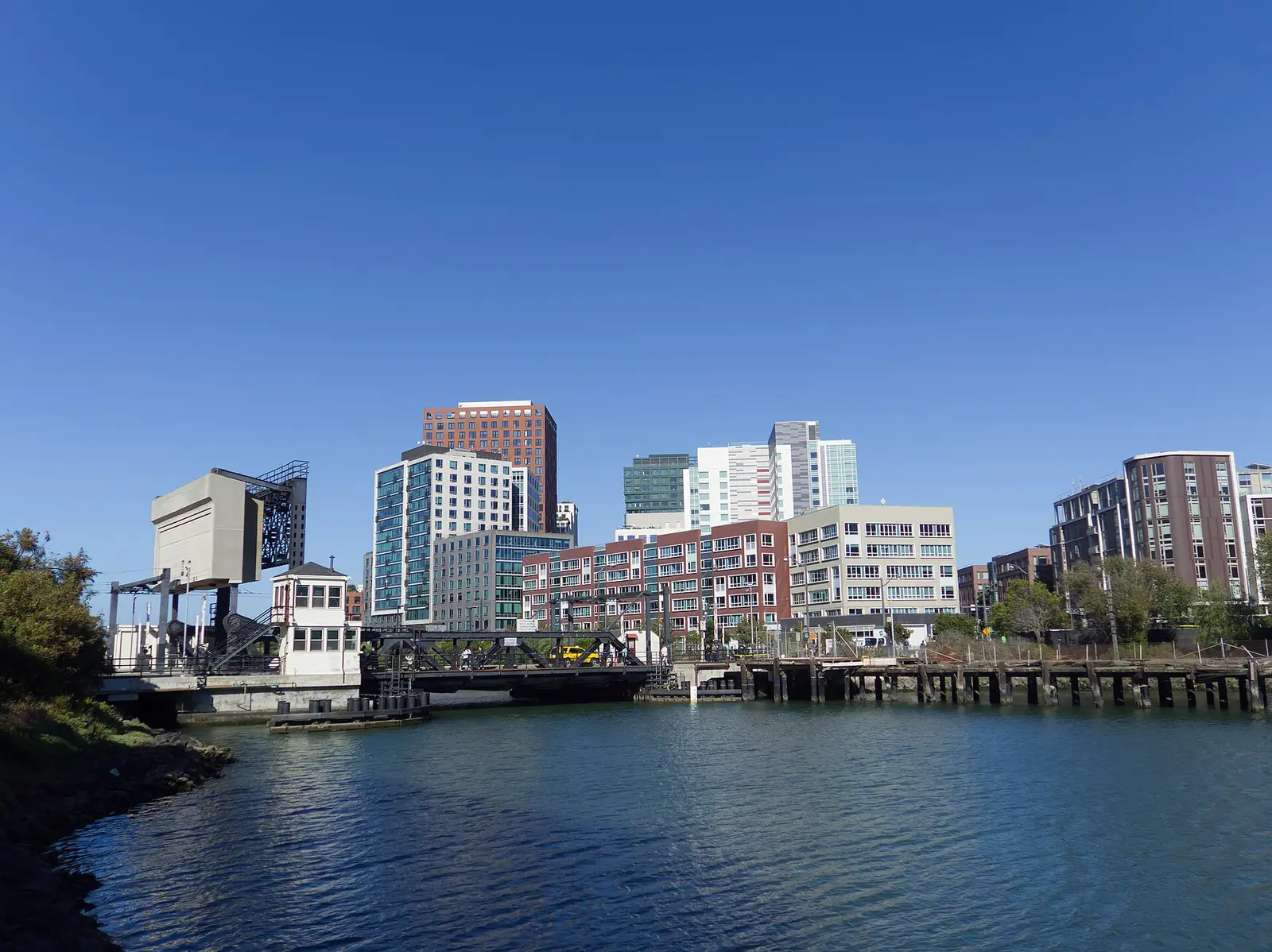
Almost every home in Mission Bay is a condominium or apartment in a building finished after 2000, on landfill that was a Southern Pacific rail yard. The jobs are move-in and apartment-scale: mounting TVs and shelves without drilling where you shouldn't, assembling furniture within HOA elevator and hour rules, swapping fixtures and patching drywall.
Mission Creek and new apartment buildings in Mission Bay. Photo: Lexi Mattick, CC BY 4.0, via Wikimedia Commons.
ZIP codes
94158, 94107
When the homes were built
2000-2020
Main streets
King Street, Berry Street, Mission Bay Boulevard, Channel Street
Landmarks
Chase Center, UCSF Mission Bay campus, Mission Creek Park
Walls in Mission Bay condos range from drywall over metal or wood studs to exposed concrete, and ceilings in the towers may be post-tensioned slabs carrying steel tendons. A TV mount on drywall needs the studs or rated anchors for metal framing; on concrete it needs masonry anchors in a location the building has cleared. Never drill into a post-tensioned ceiling or floor without the association's written go-ahead, which may require scanning first. More about tv mounting
Move-in assembly under HOA rules
With the neighborhood's population growing more than 200 percent between 2010 and 2020, move-ins are constant, and condo buildings here typically require elevator reservations, protective padding and set moving hours. Assembling beds, desks, dressers and shelving inside the unit keeps boxes out of hallways and loading areas, and hauling away packaging has to follow the building's rules. Tall furniture should be anchored to studs, which in a high-rise matters as much as anywhere. More about furniture assembly
Swapping builder fixtures
Condos finished in the 2000s and 2010s often came with basic builder-grade ceiling fixtures and track lights. Replacing them with pendants, fans or new flush mounts on the existing boxes is a straightforward swap, as long as the box is rated for the weight. Concrete ceilings limit new box locations, and anything requiring a new circuit or moving a box is work for a licensed electrician and likely the association.
Patching for move-outs and resales
Mission Bay condos change hands and tenants often, and every move leaves anchor holes, dented corners and scuffed walls. Patching holes, repairing corner bead and matching the smooth or light-texture finish typical of newer buildings gets a unit ready for inspection or a new occupant. Cracks that keep reopening where drywall meets a concrete column or slab should be reported to the association rather than just patched again. More about drywall and plaster repair
Window coverings, shelves and small fixes
Big windows, shared walls and HOA rules shape almost every small job here: hanging blinds and shades on window heads that may be concrete, installing closet systems and floating shelves, replacing cabinet hardware, and adjusting interior doors that rub or no longer latch. Bundling those into one visit is efficient, especially when the building requires advance booking for any contractor. More about general handyman repairs
How the houses here are built
Mid-rise and high-rise condominium and apartment buildings around Mission Creek, King Street, Berry Street and Mission Bay Boulevard, including affordable units, plus a small floating-home community on Mission Creek. Assessor records put nearly every residential parcel in the 2000s and 2010s.
Concrete towers and wood-frame mid-rise buildings, set on piles driven through the soft fill. Some towers, such as One Mission Bay, use post-tensioned concrete slabs with tensioned steel cables inside, which must never be drilled without the building's approval.
On the bay side of the city, where summer fog is less pronounced, sun through Mission Bay's large condo windows makes blinds, shades and curtain hardware some of the most practical installs.
Good to know before a job in Mission Bay
HOA rules come first
Nearly every home here is a condominium or apartment, so the building decides when work can happen, where vehicles can load, whether elevators must be reserved and what paperwork a contractor must bring. Some towers, such as One Mission Bay, use post-tensioned slabs that must not be drilled without approval. Before sending a request, get the building's contractor rules and loading instructions from management and include them, along with the unit number and the name of the building.
Built on fill that is still settling
Mission Bay sits on reclaimed marsh filled with Gold Rush silt and 1906 earthquake debris, later a rail yard. Buildings rest on piles driven to dense sand, but streets and sidewalks do not, and in 2016 the sidewalk on the 1200 block of Fourth Street had sunk as much as six inches, pulling away from a building. Gaps at entry thresholds or cracked paving outside are the building's and the city's to address, not a handyman patch.
How a request works
Describe the job
A sentence and a photo or two is enough. It takes about a minute.
A local handyman gets in touch
By call or text, to ask what the photos don't show and give you a price.
You decide
Agree a time and price with the handyman directly, or don't. Requesting costs nothing.
Questions from Mission Bay homeowners
Can a TV be mounted on the concrete wall in our Mission Bay condo?
Often, with masonry anchors, but only where the building allows it. Some towers have post-tensioned concrete with tensioned steel cables inside, and drilling into the wrong spot can damage them. Ask management for the drilling rules and whether scanning is required, and include that in the request.
Our building requires elevator reservations for deliveries. How should we schedule assembly?
Book the elevator window with management first, then request the assembly for that slot, noting the building name, loading entrance and any time limits. Having the boxes already in the unit before the visit, or delivered in the same window, keeps the job within the building's rules.
There is a gap between our building's entrance and the sidewalk. Can that be fixed?
Not by a handyman. Mission Bay's sidewalks are settling on the old fill while the buildings, on piles, stay put, and in 2016 the city planned inspections of blocks where sidewalks had pulled away from buildings. Report it to building management, who deal with the city on the public sidewalk.
We live on a floating home at Mission Creek. Is that work any different?
Yes. The houseboat community at Mission Creek Harbor has been moored there since around 1960, and repairs on a floating home involve marine hardware, moisture and access along the docks. Describe the boat, the job and how to reach the berth in the request, and say whether the harbor association has rules for outside workers.
Checked against these public sources in September 2026. Rules change: confirm anything permit-related with the City of San Francisco before work starts.