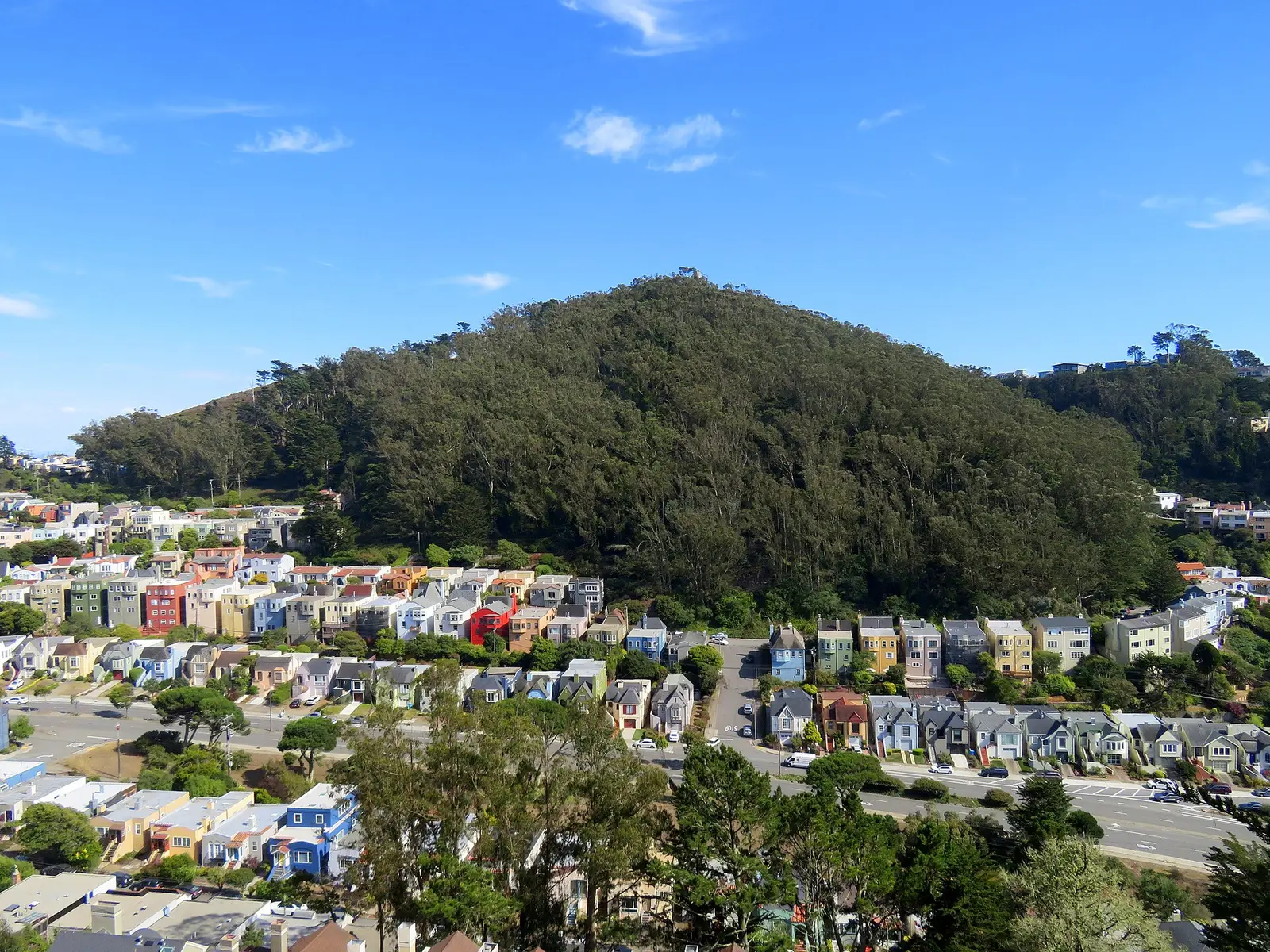
Fixing Miraloma Park's stucco houses on Mount Davidson
Some 2,200 one-story-over-garage houses make up Miraloma Park, built by the Meyer Brothers from 1926 into the 1950s on the east slope of Mount Davidson, with stucco fronts, red tile roofs and usually one bathroom. Common jobs are garage storage and doors, weatherstripping against the hill's fog and wind, bathroom fixtures and plaster or drywall patching.
The developers' plan put living space over a street-level garage, and with only two or three bedrooms upstairs, the garage often doubles as storage room, workshop and laundry. Wall shelving, overhead racks, workbenches and cabinets are the most requested carpentry jobs. Overhead storage has to clear the garage door track and opener, and anything heavy hung from the ceiling needs the framing above located first. More about carpentry, shelves and trim
Sealing against the fog and wind
Mount Davidson's east slope was described from the start as cold, foggy and windy, and eight decades of that weather wear out every seal on these houses. Worn weatherstripping on front doors, gaps at the garage door bottom, dried glazing putty and cracked caulk at window trim let damp air in. New door sweeps and weatherstripping, fresh garage door seals and caulk along trim and stucco joints make a real difference in these small houses. More about weatherstripping, caulking and sealing
One bathroom, heavy use
Miraloma Park was built for families of moderate means, and the standard plan had one bathroom. After decades of use by whole households, faucets drip, toilets run or rock on the floor, and shower valves wear out. Replacing faucets, toilet parts, shutoff valves and supply lines keeps the only bathroom working; old galvanized pipe in the walls or drain problems under the house need a licensed plumber. More about faucet, toilet and fixture repair
Doors on the stair up from the garage
In a house built over a garage, the interior stair and the door at its top or bottom see as much traffic as the front door, and the street-facing garage door takes the weather. Hinges loosen, latches drift out of line and doors start to bind after years of daily use. Rehanging and adjusting doors, replacing locksets, and repairing stair handrails are common. Repairs to the garage door opener or springs go to a garage door specialist. More about door and window repair
Walls from three decades of building
Because building ran from the late 1920s into the 1950s, interiors vary from house to house: earlier ones may still have plaster walls, while later houses and remodeled rooms are more likely drywall. Cracks at door corners, dents from furniture and old anchor holes are the usual repairs. Matching the patch to the wall type, and to the texture of the rest of the room, is what makes it disappear. More about drywall and plaster repair
How the houses here are built
Single-family houses of five or six rooms, two or three bedrooms and one bath, built as living space over a street-level garage. Detached near Portola Drive, then attached on smaller lots as building moved down Teresita Boulevard toward Monterey Boulevard.
Wood-frame houses with stucco facades and red clay tile roofs on 25-foot lots, many with no space between them. Assessor records spread construction across the 1930s, 1940s and 1950s, so interiors range from plaster to drywall.
Early accounts describe the east slope of Mount Davidson, the city's highest hill, as frequently cold, foggy and windy, which is hard on door seals, garage door bottoms and old window glazing.
Good to know before a job in Miraloma Park
Detached at the top, attached below
Meyer Brothers started with detached houses beside the firehouse at Marne Avenue and Portola Drive, then built along Portola and Juanita Way and down Teresita Boulevard. During the Depression, to hold prices, lots shrank and houses were built attached as they moved toward Monterey Boulevard. A detached house has side access to the back yard; an attached one sends everything through the garage, which is worth knowing before a yard or fence job.
Curving streets that lose visitors
Streets here were laid out wide and curving to follow Mount Davidson's contours, and a few carry Spanish names like Arroyo, Gaviota, Reposa and Isola. The loops can confuse anyone new to the area, so include your cross street, the nearest main route (Teresita, Foerster, O'Shaughnessy or Portola Drive) and any landmark in the request. The Miraloma Park Improvement Club, incorporated in 1936, is at 350 O'Shaughnessy Boulevard.
How a request works
Describe the job
A sentence and a photo or two is enough. It takes about a minute.
A local handyman gets in touch
By call or text, to ask what the photos don't show and give you a price.
You decide
Agree a time and price with the handyman directly, or don't. Requesting costs nothing.
Questions from Miraloma Park homeowners
Our house is attached on both sides. How does a fence or back yard job get done?
Everything goes through the garage, since attached houses on the lower streets have no side path. Clear a lane through the garage, move a car if needed and protect the stair or hall if anything must pass through the house. Mention it in the request so materials can be sized to fit through the garage door.
Can overhead racks be installed in our Miraloma Park garage?
Usually, as long as the ceiling framing above is solid and the racks clear the garage door, its track and the opener. Measure the ceiling height and note where the door travels. Racks go into framing, never just the ceiling surface, and are sized for the weight you plan to store.
Why is the front of our house so drafty compared with the back?
The front of the house usually faces the street and the open slope, where the fog and wind on Mount Davidson hit hardest. Old weatherstripping, dried glazing putty around window panes and gaps at the garage door let it in. Replacing seals and caulking trim joints is a straightforward fix that makes the front rooms noticeably warmer.
We have red tile on the roof. Can gutters or roof edge problems be handled at the same visit?
Gutter cleaning and reattaching a loose downspout are fine from a ladder. Clay tile breaks easily underfoot, so nothing involving walking on the roof, replacing tiles or fixing leaks at the roof edge should be done by anyone but a roofer who works with tile.
Checked against these public sources in September 2026. Rules change: confirm anything permit-related with the City of San Francisco before work starts.