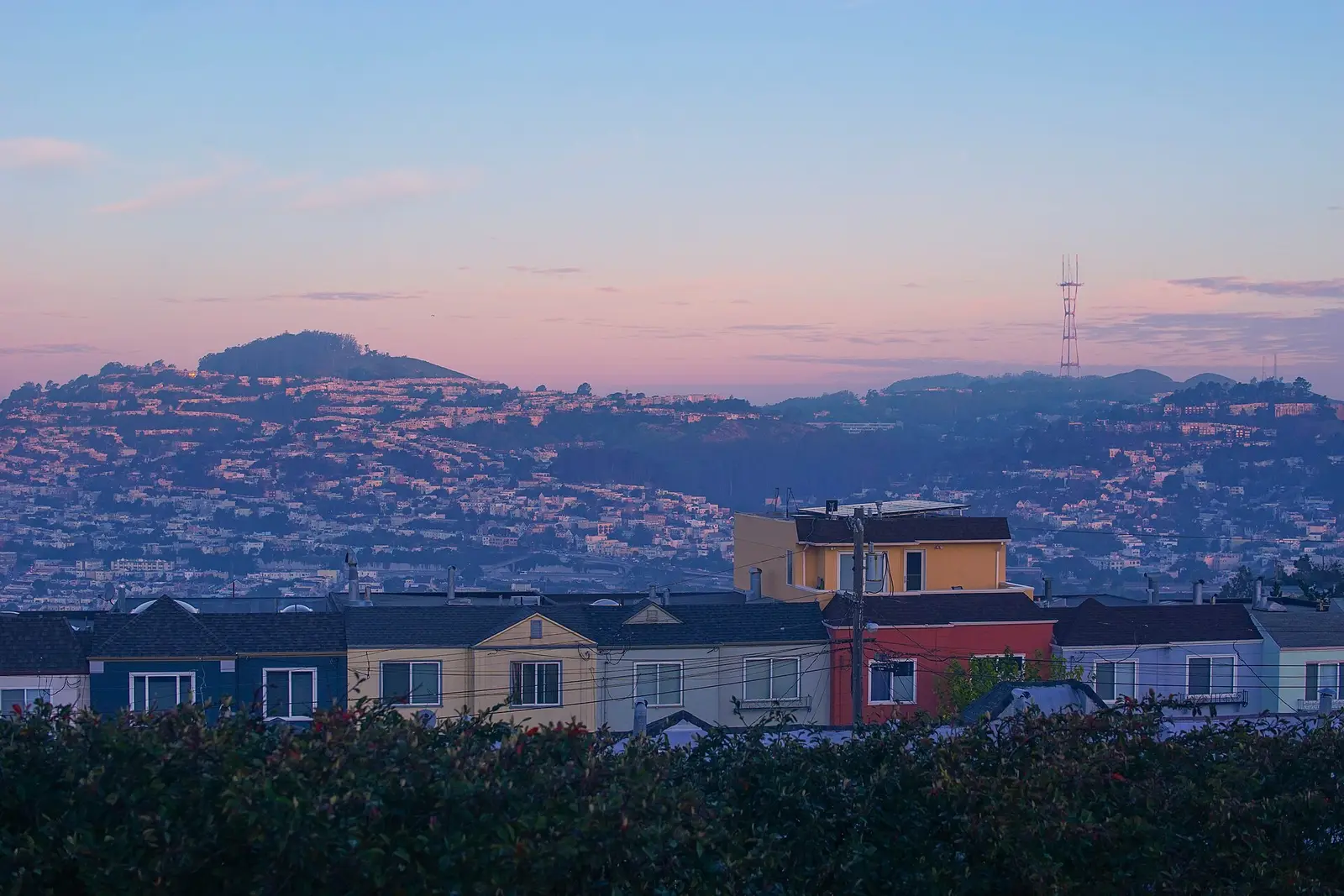
Low, owner-occupied single-family houses with actual back yards fill the Portola, built from the 1920s into the 1950s around blocks that were once flower nurseries. So outdoor work is common: fences, gates, planter boxes and gutters, alongside doors, windows and fixtures in houses lived in for decades.
Sunrise over San Francisco from John McLaren Park. Photo: Haldean Brown from San Francisco, USA, CC BY-SA 2.0, via Wikimedia Commons.
ZIP codes
94134
When the homes were built
1920-1960
Main streets
San Bruno Avenue, Silver Avenue, Woolsey Street, Bowdoin Street
Landmarks
770 Woolsey Street greenhouses, San Bruno Avenue business strip, John McLaren Park
Yards are relatively uncommon in San Francisco, but most Portola houses have one, so fence and gate repair comes up constantly. Posts rot where they meet soil that gets watered for gardens, gates sag on single hinges, and old side gates stop latching. Replacing posts and boards, rehanging gates on stronger hardware, and repairing short garden steps are the typical jobs. A leaning retaining wall at the back of a sloped lot is a job for a licensed contractor. More about fence, deck and gate repair
Planter boxes, benches and garden storage
The Portola grew flowers commercially for most of the last century, and it was officially named San Francisco's Garden District in 2016. Plenty of households still garden seriously, which is why raised planter beds, potting benches, tool storage and trellises are common small carpentry jobs here. Building with rot-resistant lumber and keeping beds off the house wall avoids trading one repair for another. More about carpentry, shelves and trim
Gutters on the blocks near McLaren Park
McLaren Park was mostly brush until a tree-planting project in 1927 brought cypress and eucalyptus, and those trees are now large enough to drop needles, leaves and bark on nearby roofs. Houses on the blocks closest to the park fill their gutters and downspouts faster than the rest of the neighborhood. On a one-story house, cleaning and flushing downspouts is ordinary ladder work; very steep lots or tall rear walls may need a roofer.
Doors and windows in 1920s-1950s houses
With houses spread across three decades of building, the Portola has everything from original 1920s wood sash windows to several generations of replacement frames. Front doors swell and bind, garage-to-house doors stop latching, and older windows lose their balances or seals. Adjusting, rehanging and re-hardwaring doors and freeing or re-sealing windows usually fixes them; badly rotted frames may call for a carpenter or a window replacement. More about door and window repair
Punch lists in long-held family homes
A very high share of Portola houses are owner-occupied, often by the same family for a long time, and small repairs accumulate: a loose handrail on the front steps, cabinet doors out of line, a towel bar pulled from the wall, weatherstripping gone at the back door. Bundling those into one visit saves time. A written list with photos in the request makes it possible to bring the right parts the first time. More about general handyman repairs
How the houses here are built
Low-slung single-family houses with yards, a high share of them owner-occupied, plus flats above shops on San Bruno Avenue. Assessor records spread construction across the 1920s through the 1950s, with the 1950s the single largest decade.
Wood-frame houses, generally one or two stories, on lots with space behind. With a yard to maintain, fences, gates, steps and garden structures wear out alongside the house itself.
Set in the city's southeast, where summer fog is less pronounced than on the west side, the Portola's yards get enough sun that nurseries once grew roses and snapdragons here for the city's flower trade.
Good to know before a job in Portola
The old nursery blocks
In the 1920s, family-run nurseries, many run by Italian and Maltese immigrants, covered upwards of 30 blocks of the Portola. Most closed by the 1960s. At 770 Woolsey Street the Garibaldi brothers' redwood-and-glass greenhouses grew roses for the Flower Mart until 1990. That gardening history is still visible in back yards across the neighborhood, and it is why so much of the work here happens outside.
A valley between two freeways
The Portola sits in a valley bounded by Interstate 280 to the north and US-101 to the east, with McLaren Park's ridge separating it from the Excelsior. San Bruno Avenue is the main commercial street, a business strip about nine blocks long. For houses on or just off San Bruno, a side street is the easier place to unload. Portola Heights climbs uphill west of University Street, so note steps or a steep driveway there.
How a request works
Describe the job
A sentence and a photo or two is enough. It takes about a minute.
A local handyman gets in touch
By call or text, to ask what the photos don't show and give you a price.
You decide
Agree a time and price with the handyman directly, or don't. Requesting costs nothing.
Questions from Portola homeowners
We have a large back yard with an old fence on three sides. Where do we start?
Walk the fence line and mark which posts move when you push them; rotted posts are usually the real problem, not the boards. Replacing posts and reusing sound boards is often enough. Tell the neighbors before work starts, since back fences here are usually shared.
Can someone build raised garden beds or a potting bench for our yard?
Yes. Raised beds, benches, trellises and tool storage are straightforward carpentry. Say what size you want, where it goes and what you plan to grow, since beds for vegetables are usually built with untreated rot-resistant lumber and kept a little away from the house and fence.
Our house backs toward McLaren Park and the gutters clog every winter. Is that a quick job?
On a one- or two-story house with safe ladder access, cleaning gutters and flushing downspouts is usually a short job. The big cypress and eucalyptus near the park shed a lot, so some households add gutter guards. Very steep lots, tall rear walls or gutters pulling away from the fascia may need a roofer instead.
Is Portola Heights, up the hill from University Street, part of the Portola?
Yes, Portola Heights extends uphill west of University Street toward the Excelsior. The streets are steeper there than on the valley floor near San Bruno Avenue, so mention front steps, a steep driveway or a garage entrance when you describe the job, since those decide how tools get to the door.
Checked against these public sources in September 2026. Rules change: confirm anything permit-related with the City of San Francisco before work starts.