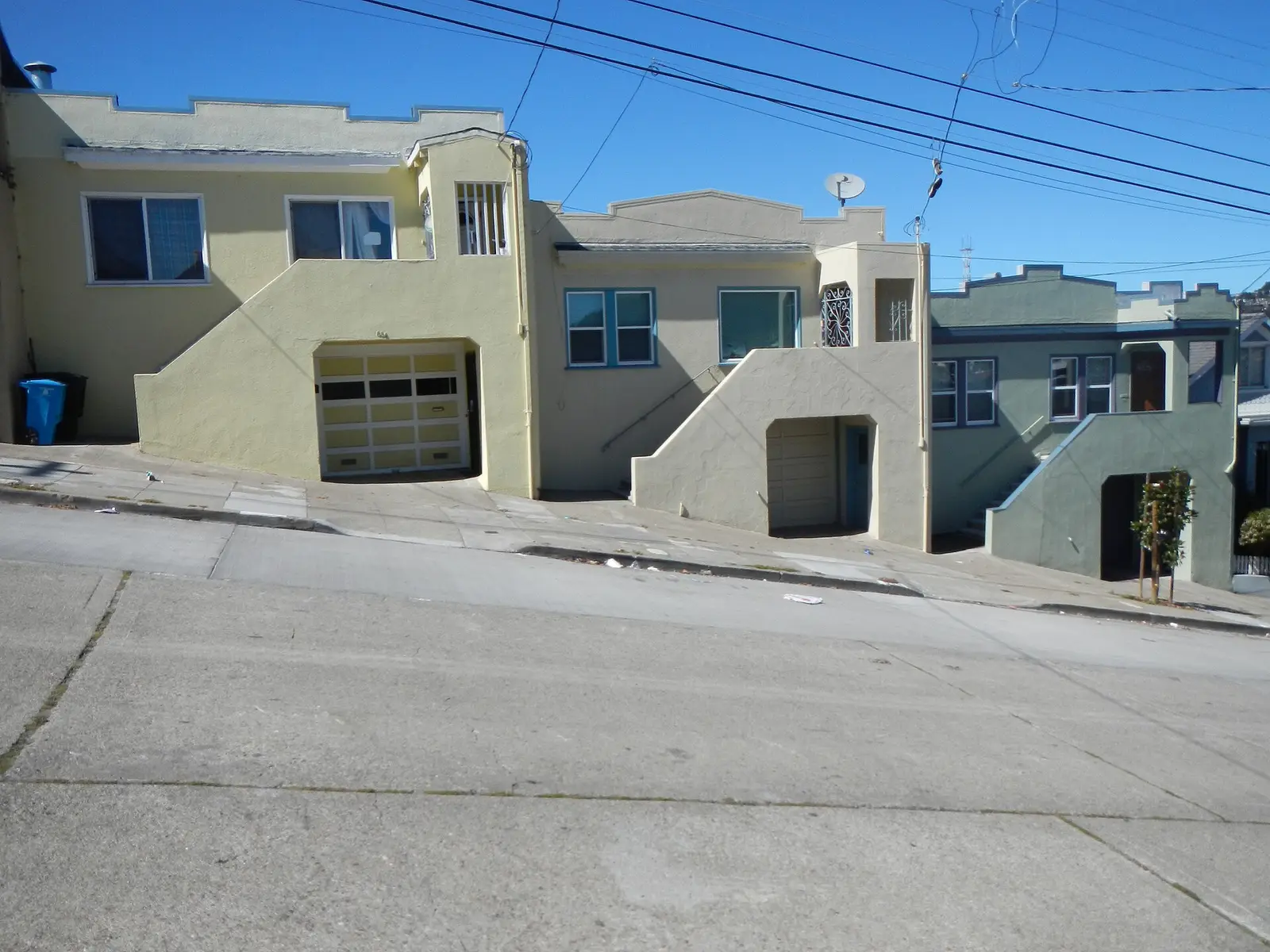
Fixing up single-family houses across the Excelsior
Single-family houses from three building waves share the same Excelsior blocks: early cottages and post-1906 houses, a big 1920s boom, and another round in the 1940s and 1950s. That mix means one street can need plaster repair next door to drywall, wood windows beside later ones, and fences on lots that climb toward McLaren Park.
Because the Excelsior filled in over half a century, the house built after 1906 and the one built in the 1940s next to it have different windows, frames and hardware. Older houses tend to have wood sash windows and heavy paneled doors that sag on worn hinges; later ones may have been refitted more than once. Diagnosing which is which comes first, then easing binding doors, replacing hardware and getting windows to open and lock properly. More about door and window repair
Plaster in the older houses, drywall in the newer
Houses from the 1900s and 1920s were generally plastered, while the 1940s and 1950s houses on the same street are more likely to be drywall. Patching the two is different work: plaster needs loose areas secured and built up in layers, drywall takes a cut-in patch. Many older homes have been partly remodeled, so a single room can have both, and the repair has to hide the seam. More about drywall and plaster repair
Back fences on the uphill blocks
East of Mission Street the grid climbs toward McLaren Park, so back yards on streets like Athens, Madrid and Lisbon step up the hill behind each row of houses. Fences between yards on a slope carry soil pressure and water runoff, and posts lean or rot at the base. Replacing posts, re-hanging gates and swapping fence boards are routine; a failing retaining wall holding up the hillside is a job for a licensed contractor. More about fence, deck and gate repair
Worn faucets and toilets in small bathrooms
Row houses built on narrow lots in the 1920s boom usually have one compact bathroom that gets heavy family use. Dripping faucets, running toilets, loose toilet bases and tired shower valves are routine fixes when the supply lines and shutoffs are still in serviceable shape. Corroded galvanized pipe inside the wall, or a drain line that needs rerouting, is work for a licensed plumber. More about faucet, toilet and fixture repair
A punch list for an older family house
Older family houses collect small problems: a cabinet door off its hinge, a gap under a threshold, a loose stair rail to the garage level, a towel bar pulled out of plaster. In a house that has seen several owners since the 1920s, earlier quick fixes often need redoing too. Grouping all of it into one visit is the practical way to handle it, and it works best with a written list and photos in the request. More about general handyman repairs
How the houses here are built
Overwhelmingly single-family houses, many built as rows on narrow lots, with a thin band of flats and storefronts along Mission Street. Assessor records put the largest share in the 1920s, with sizable groups from the 1900s and the 1940s.
Wood-frame houses throughout. The oldest have plaster walls and wood siding; later houses from the 1940s and 1950s were more often finished with drywall, so repair methods change from one house to the next.
Streets east of Mission climb toward the McLaren Park ridge, so many back yards step uphill and winter rain runs down through them toward the houses.
Good to know before a job in Excelsior
The city-and-country street grid
The Excelsior Homestead was filed in 1869, and its streets were named for world capitals and its avenues for countries, so Paris and Prague, Russia and Brazil sit a block or two apart. Three streets once named India, Japan and China were renamed Peru, Avalon and Excelsior. With so many similar foreign names, include the nearest cross street in any request; it saves a wrong turn between London and Lisbon.
Mission Street, Crocker-Amazon and Mission Terrace
Mission Street is the commercial spine, lined with shops and flats above stores, and the 14 Mission bus runs its full length. The broader Excelsior District also takes in Mission Terrace, where streets carry names like Seneca, Onondaga and Cayuga, and Crocker-Amazon south of Geneva Avenue, a tract laid out in 1912 by landscape engineer Mark Daniels. Requests from any of these parts work the same way.
How a request works
Describe the job
A sentence and a photo or two is enough. It takes about a minute.
A local handyman gets in touch
By call or text, to ask what the photos don't show and give you a price.
You decide
Agree a time and price with the handyman directly, or don't. Requesting costs nothing.
Questions from Excelsior homeowners
Our street is named after a European city. What should we put in the request so we're easy to find?
Add the nearest cross street and say which side of Mission Street you are on. Streets named for capitals like Vienna, Naples and Edinburgh run close together here, and several of the names are easy to mix up, so a cross street and a note about any steps up to the front door help a lot.
Is a post-1906 cottage east of Mission harder to repair than the newer houses?
It's different rather than harder. Older cottages usually have plaster walls, wood sash windows and doors that have settled out of square, so repairs take more fitting by hand. A 1940s or 1950s house tends to have drywall and more standard sizes, which makes parts easier to match.
The fence between our yard and the uphill neighbor is leaning. Who handles that?
Replacing rotted posts, resetting a leaning section and swapping boards is straightforward work, and it's worth talking to the neighbor since the fence is usually shared. If the fence is leaning because the ground behind it is pushing, or it sits on top of a retaining wall that is cracking, that needs a licensed contractor to look first.
Do requests from Crocker-Amazon or Mission Terrace count as the Excelsior?
Yes. Both are part of the broader Excelsior District, from the Crocker-Amazon blocks south of Geneva Avenue to Mission Terrace near San Jose Avenue. Describe the job and the street, and someone who works the southern neighborhoods can pick it up.
Checked against these public sources in September 2026. Rules change: confirm anything permit-related with the City of San Francisco before work starts.