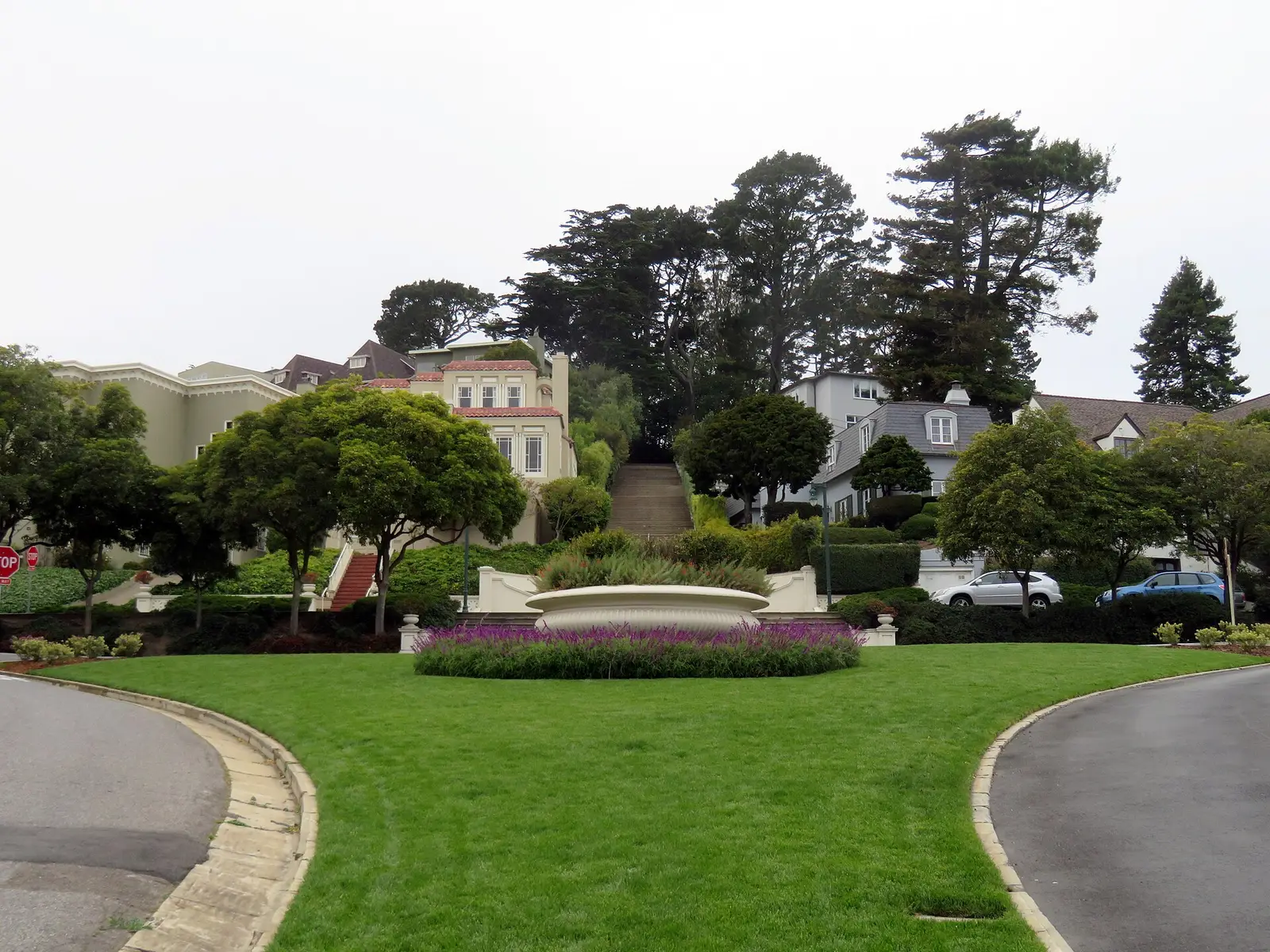
Home repairs on Forest Hill's winding, stepped streets
Forest Hill's roughly 650 houses sit on a steep, curving 1912 residence park laid out by Mark Daniels, most of them architect-designed period homes from the 1920s. Work here means custom-sized doors and windows, old plaster, gutters under heavy trees, and carrying tools up and down the neighborhood's public stair-paths and split-level streets.
Custom doors and windows in architect-designed houses
Many Forest Hill houses were drawn by individual architects in period revival styles, and Harold Stoner added picturesque Storybook designs to the mix. Their doors and windows were built to fit those designs, so a sticking door or sash can't simply be swapped for a stock unit. The fixes are rehanging and planing doors, rebuilding sash hardware, and fitting new stops and weatherstripping to the existing openings. More about door and window repair
Gutters under Forest Hill's trees
Forest Hill was carved out of Adolph Sutro's planted forest, and its streets remain winding, landscaped and heavily treed. Leaves, needles and bark load gutters fast, especially on houses directly under street trees. On houses with safe ladder access, cleaning and flushing downspouts is routine; very tall walls on the downhill side of a lot, or roofs that can't be reached safely from a ladder, call for a roofer.
Plaster in 1920s period houses
Houses built in Forest Hill's 1920s peak were plastered inside, and a century later that plaster cracks at ceilings, door heads and corners as houses on hillside lots move slightly over the decades. Repairs mean securing loose plaster to its backing before filling, then feathering the patch so it vanishes under paint, which a drywall patch set into plaster rarely does. Cracks that widen year after year point to movement a structural engineer should look at. More about drywall and plaster repair
Front steps, gates and low fences
Because houses sit above or below streets that follow the contours, many have a run of front steps, a gate and a garden wall or fence along the sidewalk. The original deed restrictions capped fences and walls within 15 feet of the street at four feet, which is why front gardens here were designed low and open. Replacing rotten wood steps, rehanging gates and rebuilding low fences are routine; masonry retaining walls that are cracking or leaning need a licensed contractor. More about fence, deck and gate repair
Mounting on thick plaster walls
Mounting a screen in a 1920s Forest Hill living room means fastening through plaster into the studs, working around windows, doorways and fireplaces that limit where it can go. Finding framing behind thick plaster and drilling without cracking it takes patience, and cables usually run on the surface or through existing openings rather than inside a plaster wall. Photos of the wall in the request help plan the mount. More about tv mounting
How the houses here are built
Detached single-family houses in period revival styles, many designed by individual architects, including Harold Stoner's Storybook houses and a few by Bernard Maybeck. Assessor records place most in the 1920s, with more in the 1930s and 1950s.
Wood-frame houses on graded hillside lots, often with the house well above or below the street. Doors, windows and trim were built to each architect's design, so replacement parts often don't come in standard sizes.
On the city's western slopes, where summer fog is heavier than in the eastern neighborhoods, the tree-covered streets keep roofs, gutters and north-facing walls shaded and damp.
Good to know before a job in Forest Hill
Stair-paths and split streets
Forest Hill has a network of public stairs and footpaths, including the grand staircase entrance off Dewey Boulevard and paths linking Pacheco Street, Castenada Avenue, Magellan Avenue and the streets around them. Several streets, among them Magellan, Pacheco and 9th Avenue, split into upper and lower lanes with medians and retaining walls between. If the easiest way to a house is by stairs, or it fronts the upper lane, say so in the request.
A private tract turned city streets
Newell-Murdoch opened Forest Hill in 1912 with streets that didn't meet city width and grade standards. Residents took over street, sewer and lighting management from the developer in 1919 through the Forest Hill Association, which still runs Bernard Maybeck's 1919 clubhouse on Magellan Avenue. The city only accepted responsibility for the streets and curbs in 1978. Narrow, curving roadways remain, so park carefully and expect tight turns for a van.
How a request works
Describe the job
A sentence and a photo or two is enough. It takes about a minute.
A local handyman gets in touch
By call or text, to ask what the photos don't show and give you a price.
You decide
Agree a time and price with the handyman directly, or don't. Requesting costs nothing.
Questions from Forest Hill homeowners
Our front door is an odd size with an arched top. Can it be repaired rather than replaced?
Usually. Doors in architect-designed Forest Hill houses were made for their openings, and replacing one means custom work. Tightening or resetting hinges, planing where it binds, fixing the latch and fitting new weatherstripping keeps the original door working. Rot in the bottom rail can often be repaired too.
Our house is reached by one of the public stair-paths. Can tools and materials still get there?
Yes, everything just comes in by hand, which takes longer than unloading at the curb. Say in the request how many steps there are and whether there is another route, such as a garage on the lower street, so large items like lumber or long ladders can be planned for.
Who is responsible for the curb and street in front of our Forest Hill house?
The city has been since 1978, when it took over the streets and curbs from the Forest Hill Association. Repairs to your own front steps, gate, fence and garden wall are yours. Damage to the street, curb or a public stair-path should be reported to the city.
We're in Forest Hill Extension, across Dewey Boulevard. Are the houses different?
Somewhat. The Extension was laid out with the original tract but filled in during the 1920s with a mix of large and more modest houses. Streets like Vasquez, Garcia and Kensington have their own divided lanes and medians, and the Pacheco Street stair climbs between them, so access notes matter just as much there.
Checked against these public sources in September 2026. Rules change: confirm anything permit-related with the City of San Francisco before work starts.