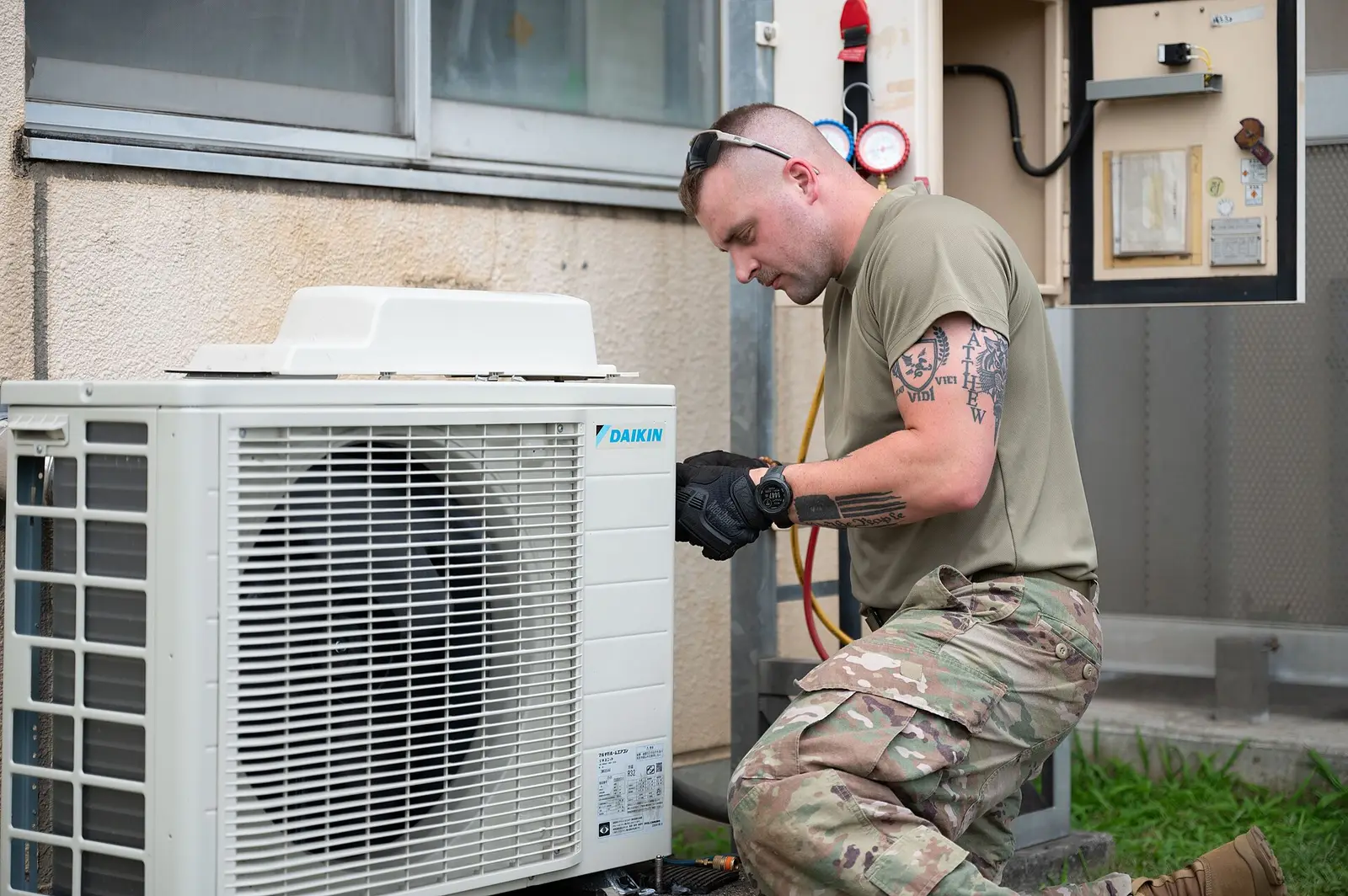
A technician servicing the outdoor unit of a heat pump
A technician servicing the outdoor unit of a heat pump. Photo: U.S. Air Force 102IW by Senior Airman Julia Ahaesy, Public domain, via Wikimedia Commons.

Heating, cooling and heat pumps San Francisco

Heat pumps for San Francisco's fog belt, flats and rentals

A heat pump in San Francisco is bought mostly for heat. The city's public health department reports the lowest rate of air conditioning ownership in the country, and the west side's fog belt stays cool all summer. Placing the outdoor unit is the hard part on narrow lots, since the Police Code holds a machine to 5 dBA above ambient at the property line, and since July 1, 2026 a major renovation that also replaces the heating falls under the city's all-electric rule.

Energy Code zone
Zone 3 in all 72 San Francisco ZIP codes on the state list
Outdoor unit noise
Up to 5 dBA above ambient at the property line
Rental heat minimum
70°F, 3 feet above the floor, in habitable rooms
Major renovations
All-electric rule since July 1, 2026 (Bulletin AB-112)

The work

Heat pump projects that suit how the city was built

  • Replacing the furnace in a Sunset garage level

    On a Sunset or Parkside tract house the living floor sits over the garage, and the furnace and its ducts are often down there with the car. A ducted heat pump can reuse that layout with an air handler on the garage level. The outdoor unit is the puzzle: with no side yard, the usual choices are the back of the lot or the roof, and either spot has to stay within the city's noise limit at the neighbor's property line.

  • Ductless heads for flats in a divided Victorian

    A Victorian split into two or three flats rarely has room for new ducts, so each unit tends to get its own ductless system, with indoor heads in the main rooms and refrigerant lines run up a light well or the rear wall. In a rental, the size is not a matter of taste: the Housing Code expects permanent heat able to hold 70°F in every habitable room, and every heater has to be permanently attached and wired under the San Francisco Electrical Code.

  • Adding cooling to a sunny top floor

    The health department notes that emergency visits and deaths in San Francisco begin to rise around 85°F, and that the city's homes are largely unprepared for heat. Top-floor flats and attic rooms on the sun belt side of town are where that bites. A heat pump replacing an old furnace or wall heater brings cooling with it, which is often the first air conditioning those rooms have ever had.

The Golden Gate Bridge and San Francisco, seen from the Marin Headlands
The Golden Gate Bridge and San Francisco, seen from the Marin Headlands. Photo: Paul.h, Public domain, via Wikimedia Commons.

The houses here

Fog belt, sun belt and the rooms in between

The city's Better Streets plan divides San Francisco into three climate zones: a coastal fog belt of cool temperatures, dense summer fog and westerly winds; a transition zone of light fog and moderate temperatures; and a bay-side sun belt that is warm, dry, clear and sunny. A heat pump in the Outer Sunset therefore works as a heater most of the year, while one on Bernal Heights may also be asked to cool a top-floor bedroom on a hot afternoon. The buildings set their own limits. Sunset tract houses stand wall to wall on 25-foot lots with no side yards, and many Victorians and Edwardians are divided into flats, each needing its own heat and somewhere to put an outdoor unit.

Free request

Describe the heat pump and HVAC job once. Local pros who take work in San Francisco reply by call or text.

  • No fee to request, and no obligation to hire
  • You agree scope and price with the pro you choose
  • Photos help them quote without a first visit

Get quotes for heat pump and HVAC work in San Francisco

Two short steps. A local pro who takes this work calls or texts you back.

To send a request, call or text (415) 449-8213.

Free to request, and you agree the scope and price with the person you hire before work starts. In California, a job over $1,000 in labor and materials, or one that needs a building permit, must be done by a contractor licensed by the CSLB in the right class. Ask for the license number and check it at cslb.ca.gov.

Permits and local rules

City codes a heat pump has to satisfy

  • Police Code noise limits for fixed equipment

    Article 29 of the Police Code, as rewritten in 2008, defines a fixed source to include pumps, fans, air-conditioning apparatus and refrigeration machines. On residential property such a machine may not make noise more than 5 dBA above the ambient at any point outside the property plane, and in a multi-unit building not more than 5 dBA above the local ambient inside another unit with its windows closed. Inside any bedroom or living room the limit is 45 dBA from 10 p.m. to 7 a.m. and 55 dBA during the day, measured with windows open.

    San Francisco Board of Supervisors (opens in a new tab)
  • Minimum heat in a rental unit

    In every residential rental unit except a hotel room, the San Francisco Housing Code requires a permanent heating source capable of keeping 70°F at a point 3 feet above the floor in all habitable rooms, not counting bathrooms and hallways. If the tenant does not control the heat, the landlord must provide it 24 hours a day. Portable space heaters do not satisfy the rule, and a tenant whose landlord falls short can call a building inspector and petition the Rent Board.

    San Francisco Rent Board (opens in a new tab)
  • The all-electric rule for major renovations

    Since July 1, 2026, a San Francisco project must be all-electric when it is both a major renovation, meaning a significant structural or non-structural alteration or an addition that counts as a substantial improvement, and a major upgrade to heating or hot water, such as replacing both systems for the whole building. The rule comes from Ordinance 174-25 and Administrative Bulletin 112. The building department lists exemptions, including technical infeasibility and appliances regulated by the US Department of Energy, gas models among them, which state energy and Air District rules still govern.

    San Francisco Department of Building Inspection (opens in a new tab)

State license for this work: C-20 Warm-Air Heating, Ventilating and Air-Conditioning, C-4 Boiler, Hot Water Heating and Steam Fitting, C-10 Electrical. Look up a contractor's license on the CSLB website (opens in a new tab).

Before you hire

Questions that sort out heat pump bids

  • Ask where the outdoor unit will sit and how its sound rating compares with the 5 dBA limit at your neighbor's property line.
  • For a rental, ask the installer to show the system can hold 70°F in every habitable room, not only the living room.
  • If the heat pump is part of a larger remodel, ask whether the project counts as a major renovation under the all-electric rule.
  • On a top-floor flat on the sunny side of town, ask how the system was sized for cooling as well as heating.
  • For refrigerant lines run up a light well or a shared wall, ask what the condominium or neighbors must agree to first.

Questions

Heat pump questions from San Francisco owners

Is cooling worth paying for in a San Francisco house?

It depends on where the house is. The fog belt on the west side stays cool through summer, while the bay-side sun belt is warmer and sunnier. The Department of Public Health reports that San Francisco has the lowest rate of air conditioning ownership in the country and that health impacts start rising around 85°F, so a top-floor room on the sunny side is where cooling earns its keep.

Can the outdoor unit go in the narrow gap between my house and my neighbor's?

Only if it stays within the Police Code. A fixed machine on residential property may not raise noise more than 5 dBA above ambient at any point outside the property line, and it may not push noise inside a neighbor's bedroom above 45 dBA at night with the windows open. A unit inches from a neighbor's window often fails that test, which is why the rear yard or roof is usually the better spot.

I rent out a flat. Can I replace its old wall heater with portable heaters?

No. The Rent Board's guidance on the Housing Code says portable space heaters do not meet the heating requirement. The unit needs a permanent heating source able to hold 70°F three feet above the floor in all habitable rooms, and heaters must be permanently attached and properly wired. A heat pump sized for every room satisfies that.

Does replacing my gas furnace make my whole house go electric?

Not by itself. San Francisco's all-electric rule for existing buildings applies to a major renovation, which needs both a substantial mechanical upgrade and a substantial alteration or addition. Swapping one furnace for another or for a heat pump is neither. The Air District's own furnace rule is separate and applies when equipment is replaced, so ask the installer about both.

Which climate zone is San Francisco for the Energy Code?

Zone 3. Every San Francisco ZIP code on the California Energy Commission's climate zone list is assigned to zone 3, the mild coastal zone, so the energy rules for a heat pump changeout are the same in the Outer Sunset as in the Mission, even though the summers feel very different.

Heat pump and HVAC work in San Francisco? Tell us what you see.

One request reaches local handymen and contractors who take this work. The Handyman SF connects you with them; it does not do the work.

HandymanNow for handymen Work in San Francisco? Get job leads by text. Pick your trades and areas, take only the jobs you want. No subscription. Start getting leads HandymanNow for homeowners Get the HandymanNow app. Send a request with photos, message your handyman and follow them on the way. Download the app

HandymanNow app

Fix it faster. Find work faster.

Homeowners send a job with photos and follow their handyman on the map. Handymen get local jobs by text and take only the ones they want.

Call Get a quote