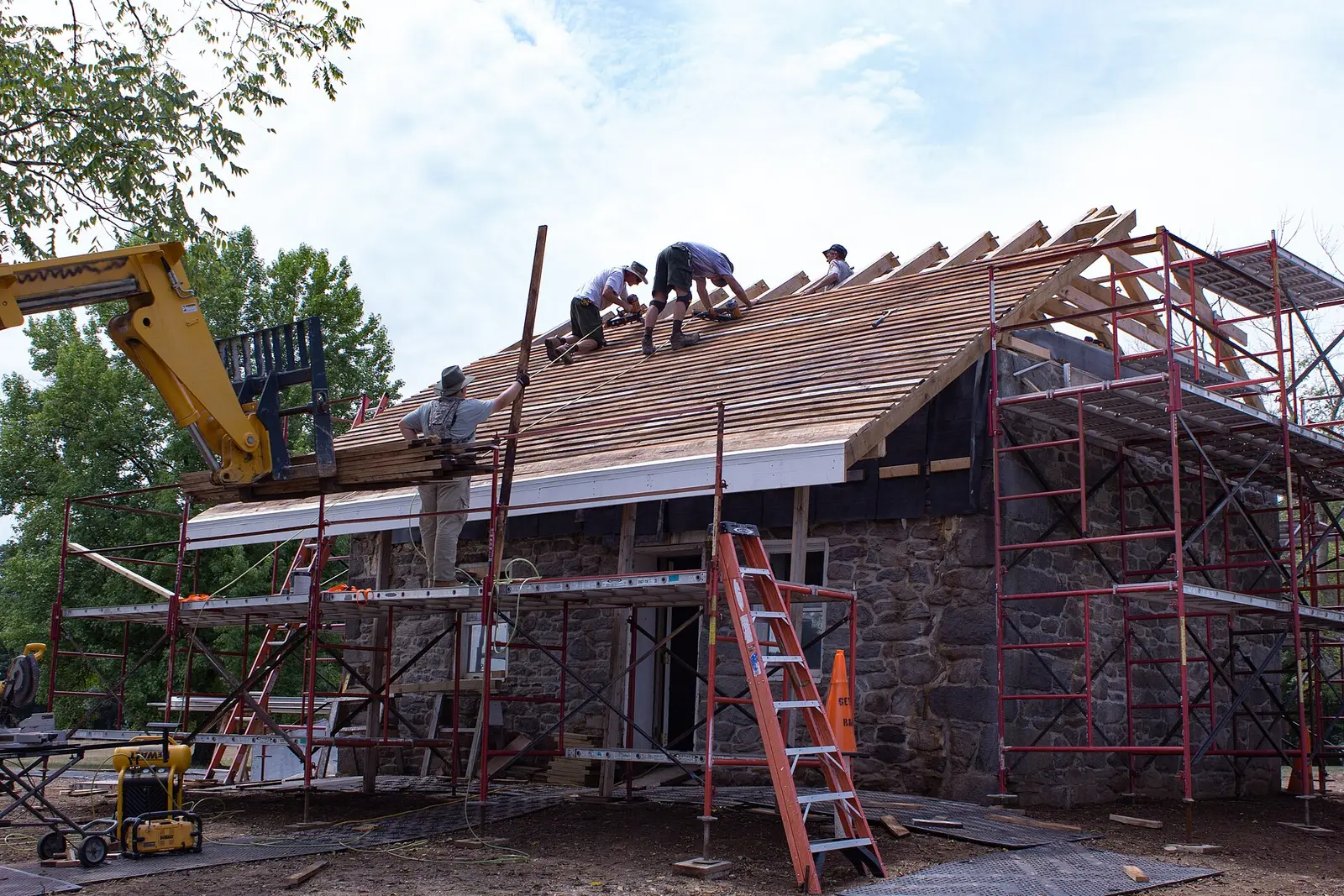
Roofers installing cedar shingles near the ridge while a telehandler lifts bundles onto the roof
Roofers installing cedar shingles near the ridge while a telehandler lifts bundles onto the roof. Photo: NPS photo, Public domain, via Wikimedia Commons.

Roofing San Francisco

San Francisco roofs behind false fronts, parapets and roof decks

A lot of San Francisco roofs can't be seen from the sidewalk: a flat or low-slope roof hidden by a Victorian false front, or the flat roof of a Sunset tract house behind its tile-capped parapet. A C-39 roofer can file the re-roof online when no plans are needed and no framing or decking changes, and that permit also covers the street space and parking signs a tear-off on a narrow city lot needs.

Online re-roof permit
C-39 contractors only, through PermitSF
Torch work notice
Call SFFD by 8:30 a.m. on the first day
Energy Code zone
Every San Francisco ZIP code is in climate zone 3
Tear-off debris
Mixed debris goes to a city-registered facility

The work

Where the roofing money goes on a city lot

  • Membrane roofs hidden behind a cornice

    Behind the straight cornice of an Italianate or Edwardian front there is often a flat or barely sloped roof draining toward the back of the lot or out through a scupper. Replacing it means stripping the old layers, rebuilding the edge where the membrane turns up the inside of the false front, and remaking the drains. Many of these membranes go down with a torch, which brings in the Fire Department's hot work rules, so ask early whether the proposed system uses a flame.

  • Flat roofs behind red-tiled parapets

    SF Planning's history of the Sunset's builders lists what nearly every tract house there shares, and a flat roof behind an ornamented parapet is on the list. The clay tile the street sees usually caps that parapet. A re-roof therefore has two parts: the membrane field, and the joint where it turns up the back of the parapet, since water that slips under a cracked cap ends up in the stucco below. Several Sunset tracts have been surveyed as potential historic districts, so match broken tile in kind.

  • Steep gables and mansards over the sidewalk

    A Queen Anne gable or a Second Empire mansard facing the street is roof and facade at once, and on a narrow city lot it rises above the front stairs and the public sidewalk. Working on it safely tends to mean scaffolding or a hoist out front, which is why the city's re-roof application asks how much street space the job needs and for how long. Decorative shingle patterns on those slopes are part of what the street sees, so ask how they will be matched.

  • Re-roofing under an existing roof deck

    A deck built on top of a flat roof has to come up before the membrane under it can be replaced. SF Planning's deck handout says a deck may be repaired or replaced in full while it still complies with the Planning Code; one that no longer meets current rules can be repaired only up to half its materials before a variance may be needed. Find out which kind yours is before the roofer quotes resetting it.

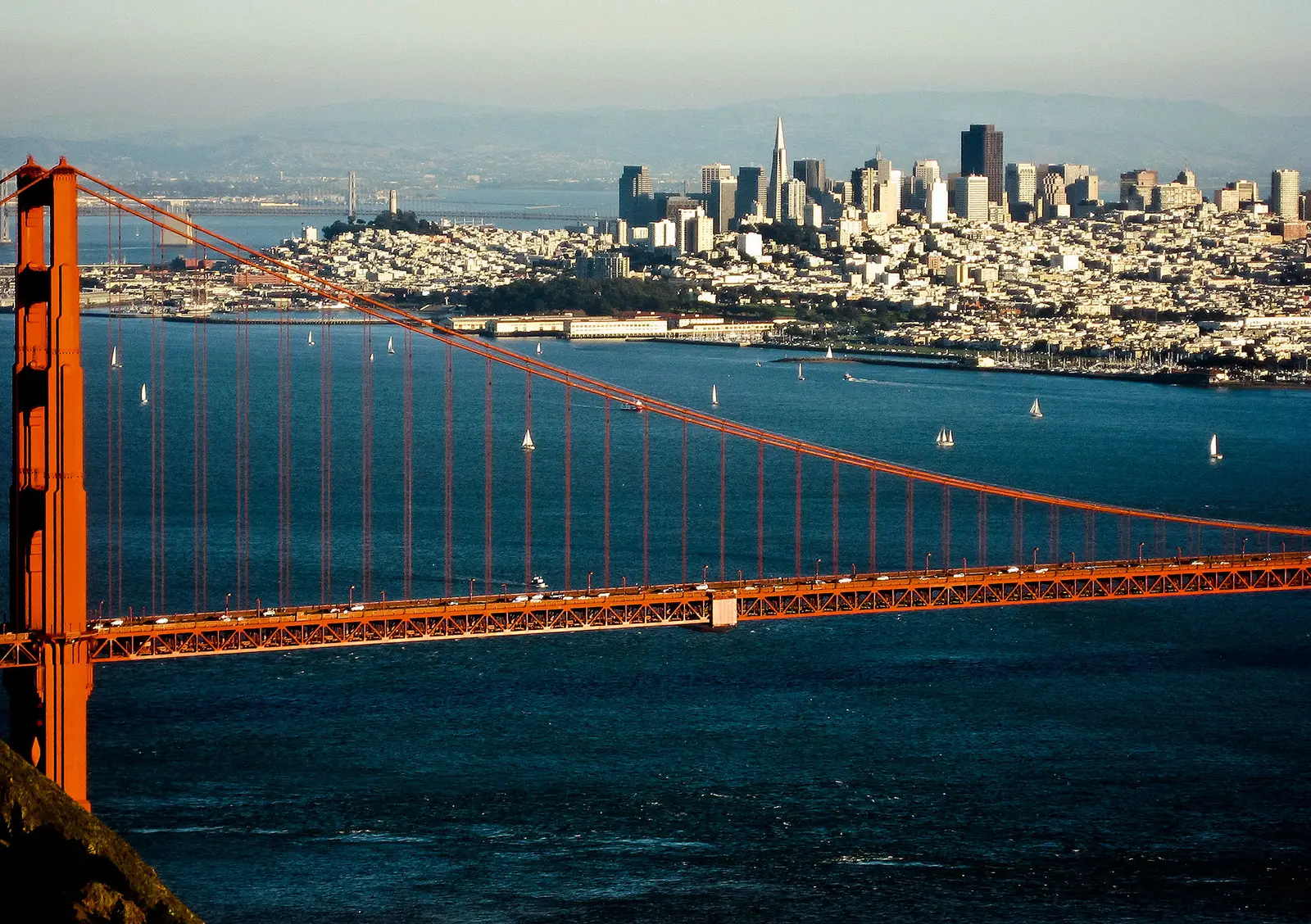
The Golden Gate Bridge and San Francisco, seen from the Marin Headlands
The Golden Gate Bridge and San Francisco, seen from the Marin Headlands. Photo: Paul.h, Public domain, via Wikimedia Commons.

The houses here

False fronts, mansards and tile-capped parapets

San Francisco Planning's guide to the city's architectural styles names false fronts as one of the things that set local Victorians apart. An Italianate facade runs straight up to a bracketed cornice, Stick/Eastlake houses carry flat or low-pitched gable or hipped roofs, Queen Annes turn open gables to the street, and Second Empire buildings wear a mansard with dormers in its steep lower slope. West of Twin Peaks the picture changes: Planning says most houses built there after 1920 derive from the Mediterranean Revival style, with red tile and parapets over stucco walls. In both halves of the city, the roof that keeps the rain out is often one the street never sees, so the edges where it meets a parapet or a cornice deserve the closest look.

Free request

Describe the roofing job once. Local pros who take work in San Francisco reply by call or text.

  • No fee to request, and no obligation to hire
  • You agree scope and price with the pro you choose
  • Photos help them quote without a first visit

Get quotes for roofing work in San Francisco

Two short steps. A local pro who takes this work calls or texts you back.

To send a request, call or text (415) 449-8213.

Free to request, and you agree the scope and price with the person you hire before work starts. In California, a job over $1,000 in labor and materials, or one that needs a building permit, must be done by a contractor licensed by the CSLB in the right class. Ask for the license number and check it at cslb.ca.gov.

Permits and local rules

City rules a San Francisco re-roof runs into

  • The online permit and the street space that comes with it

    San Francisco's online re-roof permit is open only to C-39 contractors and only for work that needs no plans and replaces no structural parts such as framing or decking. The application asks whether the roof is flat or pitched, whether any change will show from the street, whether there will be hot work, and how much street space the job needs and for how long. After the permit is issued, the roofer activates the street space permit and collects the required parking signs from Public Works; the street space is covered by the re-roof permit.

    San Francisco Department of Building Inspection (opens in a new tab)
  • A morning call before any torch is lit

    The Fire Department's roofing bulletin applies to anyone working with torches, tar kettles or bituminous melters. Before hot work starts at any San Francisco site, the contractor must call the department no later than 8:30 a.m. on the first day with the business name, a description of the work and the address. Propane cylinders come off the roof at the end of every day, rooftop storage is prohibited, and a tar kettle may never be placed on a roof or inside a building.

    San Francisco Fire Department (opens in a new tab)
  • Where the old roofing has to go

    Under Ordinance No. 144-21, in effect since January 1, 2022, mixed construction and demolition debris from a San Francisco job must be hauled by a transporter holding an Environment Department permit to one of the city's registered facilities. Every debris box needs its own permit wherever it sits, on the street or on private property, and a box placed in the street also needs a Public Works street space permit. Certain projects, as determined by the building department, must recycle or reuse at least 65 percent of what they discard.

    San Francisco Environment Department (opens in a new tab)
  • Roof decks answer to Planning, not just the building code

    SF Planning's residential decks handout says every deck over 30 inches needs a building permit and every deck over 3 feet also needs Planning review. For decks on the highest roof surface, Planning encourages a setback of at least 5 feet on all sides. A shade covering on a roof deck will usually require public notice because of its height, and wind screens up to 6 feet are typically allowed even above the height limit, though they may need 30-day notice.

    San Francisco Planning (opens in a new tab)

State license for this work: C-39 Roofing, B General Building. Look up a contractor's license on the CSLB website (opens in a new tab).

Part by part

Neighborhoods where the same roof job changes

  • Sunset and Parkside

    The avenues west of Twin Peaks are mostly stucco houses from the 1920s to the 1940s, many by merchant builders such as Henry Doelger and Ray Galli, sitting in the city's summer fog. Parapet caps, tile and north-facing slopes stay damp for months, so moss and wet underlayment at parapet corners are the first things to check.

  • Sea Cliff and the Outer Richmond

    Houses on the bluffs above China Beach and the Golden Gate take wind, fog and salt air straight off the strait. Metal flashing, gutters and exposed fasteners corrode sooner here than in the inner neighborhoods, so ask what the roofer plans to use for metal that faces the water.

  • Telegraph Hill

    Many east-slope houses are reached only by the Filbert or Greenwich steps or the Napier Lane boardwalk, so every bundle of roofing and every bag of tear-off travels by hand. The Telegraph Hill Historic District, adopted in 1986, covers that slope, so check with Planning before changing anything the street can see.

Before you hire

Pin these down before a roofer starts

  • Ask whether the permit will be filed under the roofer's own C-39 license and who will request the inspections in PermitSF.
  • For a torch-down membrane, ask whether the company holds the Fire Department's roofing hot work permit and who makes the first-morning call.
  • Ask where the debris box will sit, whether the hauler holds an Environment Department permit, and which registered facility takes the tear-off.
  • If there is a roof deck, ask whether lifting and resetting it is in the price, and whether any change to it needs Planning review.
  • On a house with tile-capped parapets, ask how the clay tile will be protected and reset, and whether matching spares are on hand.

Questions

What San Francisco owners ask about their roofs

Does a San Francisco house need a cool roof when it is re-roofed?

The city's online re-roof application asks for cool-roof information only from commercial buildings replacing more than half the roof area or 2,000 square feet, so a house going through that permit is not asked for it. Every San Francisco ZIP code sits in Energy Code climate zone 3. If your job needs plans instead of the online permit, have the designer confirm the energy requirements for the new roof.

Can the roofer leave a debris box in front of my house?

Yes, with two permits. The box needs a Public Works street space permit to sit in the street, which the city's online re-roof permit covers once it is activated, along with the parking signs. Since January 1, 2022 the hauler also needs an Environment Department permit for every box carrying mixed construction debris, even one parked in your own driveway.

Why does my roofer have to phone the Fire Department?

Because San Francisco treats roofing with a torch, a tar kettle or a melter as hot work. The Fire Department's roofing bulletin requires the contractor to call by 8:30 a.m. on the first day of work at any site, to post a trained fire watch, and to keep a completed pre-hot-work checklist on site. A roof done without a flame avoids all of this.

Can I add a roof deck while the old roof is off?

It is a good moment to plan one, but it is a separate approval. Any deck over 3 feet needs Planning review, and SF Planning recommends that decks on houses 45 years or older, which it may treat as potential historic resources, be minimally visible from the street. A pergola or shade cover on the roof will usually trigger neighborhood notice, which rules out over-the-counter approval.

What happens to the old shingles and membrane we tear off?

They cannot simply go to a landfill. San Francisco requires mixed construction and demolition debris to be hauled by a permitted transporter to one of the city's registered facilities, and some projects must reach a 65 percent recycling rate. Ask the roofer for the hauler's name and the facility before work begins.

Roofing work in San Francisco? Tell us what you see.

One request reaches local handymen and contractors who take this work. The Handyman SF connects you with them; it does not do the work.

HandymanNow for handymen Work in San Francisco? Get job leads by text. Pick your trades and areas, take only the jobs you want. No subscription. Start getting leads HandymanNow for homeowners Get the HandymanNow app. Send a request with photos, message your handyman and follow them on the way. Download the app

HandymanNow app

Fix it faster. Find work faster.

Homeowners send a job with photos and follow their handyman on the map. Handymen get local jobs by text and take only the ones they want.

Call Get a quote