Insulating a Bay Area home when the attic, ducts or roof are opened
On Bay Area houses, the state Energy Code ties insulation requirements to other work: a replacement duct system in a vented attic, or a low-slope re-roof. What it then asks for depends on the climate zone, and the region spans at least three, from Climate Zone 3 on the coast to Climate Zone 12 inland. Old vermiculite in an attic changes the job before any of that.
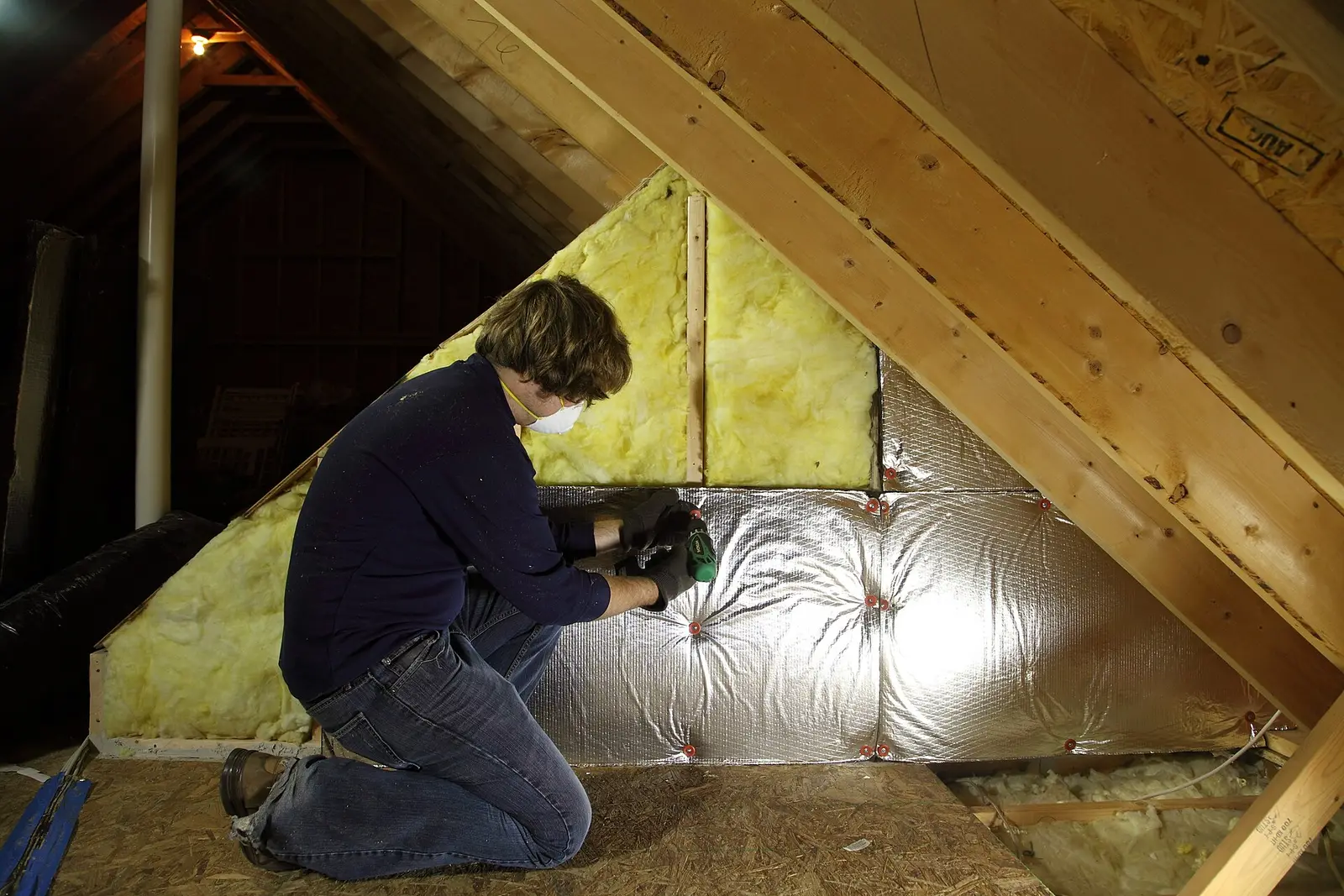
A worker in a mask fitting insulation batts between the rafters of an attic. Photo: The EnergySmart Academy, CC0, via Wikimedia Commons.
CSLB license class
C-2 Insulation and Acoustical, B General Building
Where it applies
San Francisco, East Bay, South Bay, Peninsula
Request
Free, up to three local pros reply
Insulation jobs on Bay Area homes
Attic insulation when the ducts are replaced
Replacing a whole duct system can pull the attic insulation into the same permit. Under the 2022 Energy Code, installing an entirely new or complete replacement duct system in a vented attic brought prescriptive ceiling insulation and sealing requirements in every climate zone except 5 and 7, with various exceptions. If the heating contractor and the insulation contractor are different companies, settle before the ducts come out who is responsible for meeting that part of the permit.
Roof-deck insulation during a flat re-roof
A flat roof laid directly over a tongue-and-groove ceiling can only be insulated from above, so the practical time is when the old roofing is off. BayREN's guide to the 2022 Energy Code required low-sloped roof replacements to be insulated in climate zones 1, 2, 4 and 8 through 16, unless less than half the roof was being replaced or the existing roof already had R-10 or greater continuous insulation above or below the deck. Insulation and roofing then have to be planned as one assembly, so get the roofer and any insulation contractor talking before either bid is final.
Vermiculite already in the attic
Pour-in vermiculite looks like pebbles, gray-brown or silver-gold, with pieces from fine grains to nearly an inch long. EPA says a mine near Libby, Montana supplied over 70 percent of the vermiculite sold in the United States from 1919 to 1990, and that ore was contaminated with asbestos. Its advice is to assume the material contains asbestos and not disturb it. If new insulation, wiring or ducts would disturb it, EPA says to hire a professional asbestos contractor first.
Attic vents in fire hazard zones
When attic vents are added or replaced during an insulation job in a fire hazard severity zone, the vents themselves are regulated. The Wildland-Urban Interface Code sections in San Bruno's re-roof handout require attic, gable, ridge and eave ventilation openings to resist ember and flame intrusion, and roof vents to carry noncombustible, corrosion-resistant mesh between 1/16 and 1/8 inch. Berkeley's Fire Zone Two guideline bars vents on the underside of eaves unless they are ember-resistant or meet one of a few listed conditions.
The floor over a ground-story garage
In San Francisco's Sunset District, tract builders from the 1920s on put the garage into the ground story and the living rooms above a combined garage and basement space, rather than building a detached garage. That makes the floor of the main living level the surface sitting over unheated space. The joists over the garage are the obvious place to look at insulation in a house of that plan, and it is worth asking whether the garage ceiling has old plaster or joint compound that should be tested first.
The license this work needs
C-2 Insulation and Acoustical
B General Building
The CSLB's C-2 Insulation and Acoustical class covers installing any insulating media, and preformed acoustical materials, for temperature or sound control. A D-65 Weatherization and Energy Conservation license is not a substitute: that class covers weatherstripping, caulking, pipe wrap and similar products, and its definition excludes insulation. A B General Building contractor can include insulation in a remodel with other trades. Removing vermiculite that may hold asbestos is a separate specialty. Check any license at cslb.ca.gov.
The 2022 Energy Code's alteration rules asked for air sealing of accessible areas of the ceiling plane between the attic and living space in climate zones 2, 4 and 8 through 16. BayREN places San Francisco, San Mateo County and coastal parts of Alameda and Contra Costa in Climate Zone 3, which is not on that list, while parts of Santa Clara County are Zone 4 and inland parts of Alameda and Contra Costa are Zone 12. Two similar attics a few miles apart can therefore face different requirements.
Asbestos-suspect materials around the attic
The Bay Area Air District's list of places asbestos turns up reads like an attic inventory: heating ducts, flue pipes, pipe lagging, acoustic ceilings, joint compound and plaster. The district treats any material that is not wood, metal, glass or rubber as suspect until a laboratory tests it. For a house of four or fewer units the owner may take samples, which is worth doing before anyone cuts old duct wrap or pulls down a ceiling to insulate.
Post-and-beam houses with no attic
Joseph Eichler's houses were built with post-and-beam framing, tongue-and-groove ceiling decking that follows the roofline, and concrete slab floors with radiant heating cast into them. That combination leaves no attic to fill and no crawlspace under the floor. Most of the insulation questions on these houses therefore come back to the roof, and to the large areas of glass, rather than to anything that can be blown into a cavity.
San Francisco sits in Climate Zone 3, outside the list of zones where the 2022 alteration rules required ceiling air sealing. The housing shapes the job more than the code does: Sunset tract houses from the late 1920s onward are nearly attached, with living rooms stacked over a garage and basement, so with neighbors close on both sides, the floor above the garage and the front and rear walls are the surfaces left exposed.
Oakland lets building owners and licensed contractors in the right classification self-certify insulation projects through its online permit center, with no city inspection after the work. Inland, parts of Alameda and Contra Costa counties fall in Climate Zone 12, one of the zones where the 2022 alteration rules required air sealing of the ceiling plane, so an attic job in the inland valleys can carry a requirement that one near the Bay does not.
Parts of Santa Clara County are Climate Zone 4, which the 2022 Energy Code named both for ceiling air sealing and for insulating low-sloped roof replacements. With Eichler tracts in Palo Alto, Sunnyvale and San Jose, that means a flat-roof replacement on a South Bay Eichler could bring an insulation requirement that the same house in San Mateo would not.
San Mateo County is in Climate Zone 3, which the 2022 code left off its list for insulating low-sloped roof replacements. That matters in the Highlands in San Mateo, the largest contiguous Eichler development, built from 1956 to 1964: under that edition, owners there decided for comfort, not compliance, whether to add insulation above the roof deck when a flat roof is replaced.
Permits and rules to know
Oakland's self-certification for insulation
Oakland handles these projects through Re-Roofing and Insulation Certificates rather than a conventional inspected permit. A building owner, or a contractor holding a state license in a classification appropriate to the work and a current Oakland Business Tax Certificate, applies online, does the work to code, then uploads a completion form certifying it. No inspection is required afterward and a certificate is valid for 180 days, so the completion form becomes the city's record of what was installed.
The Energy Code edition that applies
The California Energy Commission says buildings whose permit applications are filed on or after January 1, 2026 must comply with the 2025 Building Energy Efficiency Standards. The attic, air sealing and low-slope roof triggers described on this page come from guides to the 2022 edition, so a contractor pulling a permit now should confirm the current requirement for the climate zone. Required compliance forms are published by the Commission for each code edition.
Before you hire
Confirm a C-2 Insulation and Acoustical license at cslb.ca.gov; a D-65 weatherization license alone does not cover insulation.
Ask whether anything in the attic looks like vermiculite or old duct wrap, and what the plan is if it does.
Ask which climate zone the house is in and whether the Energy Code requires air sealing with this job.
If ducts are being replaced, ask the heating and insulation contractors which of them meets the attic insulation requirement.
In a fire hazard severity zone, ask whether any vent being added or replaced has noncombustible mesh sized to code.
Ask for proof of workers' compensation coverage, since attic work means moving across ceiling joists above finished rooms.
On an Eichler or other flat-roofed house, ask whether roof-deck insulation should be timed with the next re-roof.
How a request works
Describe the job
A few sentences and a photo of the problem or the space. It takes about a minute.
Local pros get in touch
Up to three handymen or contractors who take this kind of work may call or text to ask questions and quote.
Check, compare, decide
Look up the license, compare what you hear, and agree the scope and price with the one you pick. Requesting costs nothing.
Questions about insulation work in the Bay Area
Our attic has pebbly gray-brown insulation. Can new insulation go on top of it?
Not until someone qualified has dealt with it. That description matches vermiculite, and EPA's guidance is to assume vermiculite insulation contains asbestos and leave it undisturbed. Blowing or laying new material means working in it. If the renovation would disturb it, EPA says to hire a professional asbestos contractor, and the Bay Area Air District's notification rules apply if enough regulated material comes out.
Can a weatherization contractor blow in attic insulation?
Not on a D-65 license alone. The CSLB defines the D-65 Weatherization and Energy Conservation class around weatherstripping, caulking, water heater blankets, storm windows, window film and similar products, and the definition states that it does not include insulation. Insulation falls under C-2 Insulation and Acoustical, or can be part of a larger job under a B General Building license.
We are replacing all our ducts. Does that mean new attic insulation too?
Often, yes. Under the 2022 Energy Code, an entirely new or complete replacement duct system in a vented attic triggered prescriptive attic insulation and sealing requirements in most climate zones, including all the zones found in the Bay Area guides. There are exceptions, and permits filed since January 1, 2026 fall under the 2025 code, so ask the contractor to show which requirement applies.
Is ceiling air sealing required on a San Francisco insulation job?
Under the 2022 alteration rules it was not one of the prescriptive requirements in Climate Zone 3, which covers San Francisco. It was required in zones 2, 4 and 8 through 16. Sealing gaps between the attic and the rooms below can still be worth doing, but on a San Francisco job it is a choice to discuss with the contractor rather than a code item.
Can we keep storing boxes in an attic that has vermiculite?
EPA advises against it. Its guidance for homes with vermiculite attic insulation is not to store boxes or other items in the attic, not to let children play there, and to limit how often and how long anyone goes up. Moving boxes across loose vermiculite stirs it up, which is exactly the disturbance the agency is trying to prevent.
Checked against these public sources in September 2026. Codes and programs change: confirm permit rules with your city's building department and a license on the CSLB website before work starts.