Furnaces, heat pumps and ducts across four Bay Area climate zones
Most heating and cooling work on a Bay Area house begins when an old furnace or air conditioner fails. Under the Air District's current schedule, residential furnaces manufactured after January 1, 2029 must meet a zero-NOx standard, and California's Energy Code requires the existing ducts to be tested for leakage by an ECC-Rater when a system is replaced, unless an exception applies.
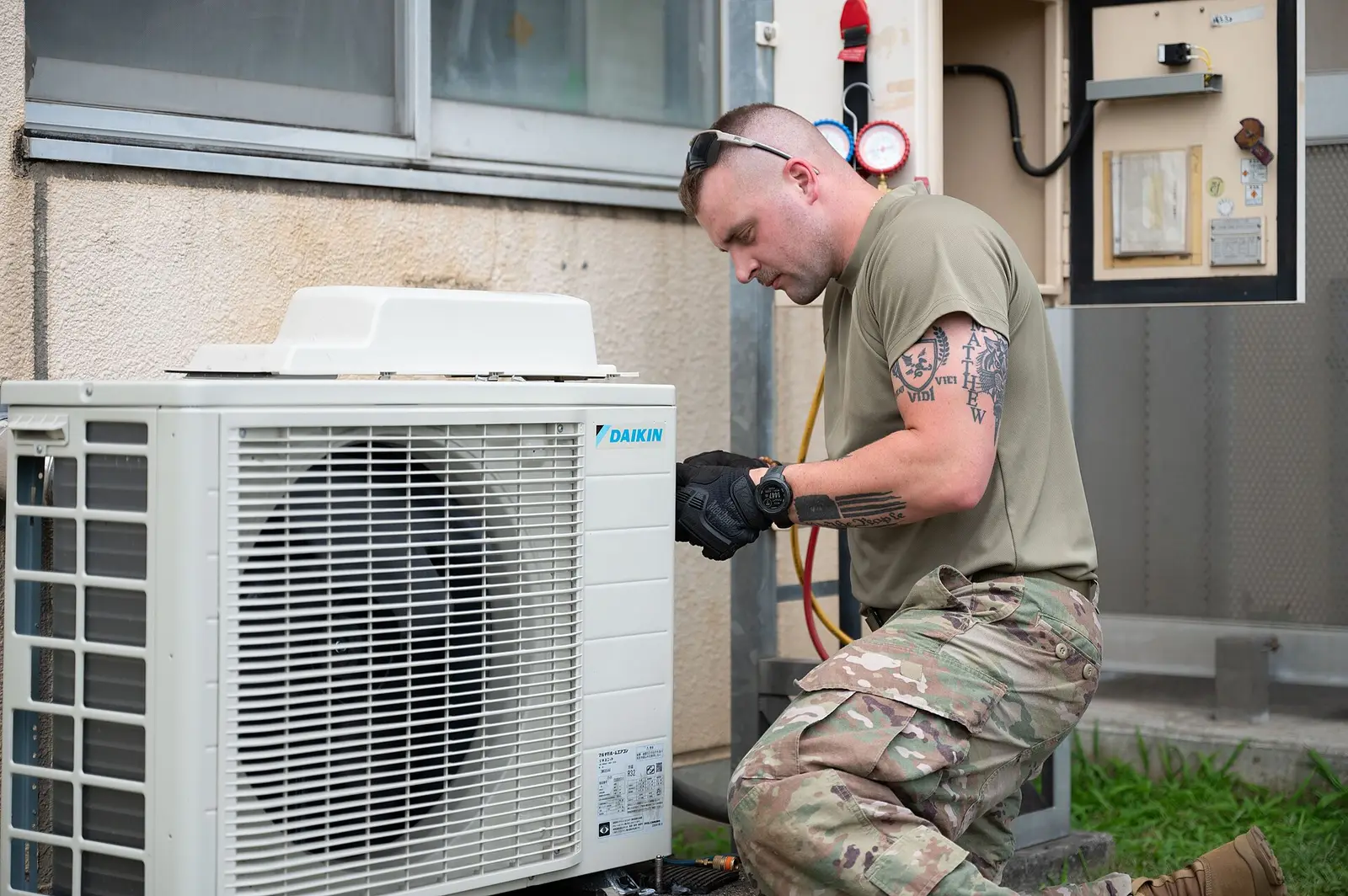
A technician servicing the outdoor unit of a heat pump. Photo: U.S. Air Force 102IW by Senior Airman Julia Ahaesy, Public domain, via Wikimedia Commons.
CSLB license class
C-20 Warm-Air Heating, Ventilating and Air-Conditioning, C-4 Boiler, Hot Water Heating and Steam Fitting, C-10 Electrical
Where it applies
San Francisco, East Bay, Peninsula, South Bay, North Bay
Request
Free, up to three local pros reply
Heat pump and HVAC jobs on Bay Area homes
Replacing a gas furnace with a heat pump
A ducted heat pump can take over from both a furnace and an air conditioner, using the same duct system. The Air District's Rule 9-4 is pushing that choice forward: under the current schedule, residential furnaces manufactured after January 1, 2029 must be zero-NOx, and the Air District notes that zero-NOx appliances with today's technology are electric. The date is still under review, with a report from its implementation working group due in fall 2026. Reusing the ducts brings the Energy Code's leakage test into the job.
Duct sealing at a changeout
When a space-conditioning system is altered, the 2025 Energy Code triggers duct sealing even if the ducts stay. The existing system has to test at no more than 10 percent of the air handler's airflow in total leakage, or 7 percent leakage to the outside. If neither can be met, an ECC-Rater can instead verify through a visual inspection and smoke test that every accessible leak has been sealed. Leave room in the schedule for the rater's visit, and for a second one if the first test fails.
New ducts in the crawlspace or attic
Older raised-floor houses often run their ducts through the crawlspace, where decades of crushed runs, disconnected boots and torn insulation go unseen. Replacing the whole system lets a contractor resize runs for a heat pump's airflow, move registers out of the way of furniture, and seal every joint while it is exposed. It also avoids chasing leaks, test after test, in a system already near the end of its life. The work is C-20, and in a tight crawlspace ask how the old duct will be removed and hauled away.
Ductless heat pumps
Houses heated by wall heaters, a boiler or nothing at all have no ducts to reuse, and adding them means opening ceilings and floors. A ductless system mounts indoor heads on walls or ceilings and connects them to an outdoor unit through small refrigerant lines, so it suits a flat in a converted Victorian, an addition, or an attic room that never got heat. It is C-20 work, and like any heat pump it adds electrical load that a C-10 contractor may need to plan for.
Boilers and hot-water radiators
Some older houses and small apartment buildings still heat with a boiler feeding radiators or convectors, which CSLB places in the C-4 class rather than C-20. Small gas boilers fall under the Air District's Rule 9-6, not the furnace rule. The Air District's July 2026 draft amendments to Rule 9-6 propose delaying the zero-NOx standard for hydronic water heating systems until 2031, so ask the contractor where that proposal stands before choosing a replacement.
Ducts wrapped in asbestos
Duct insulation and tape from the middle of the last century can contain asbestos, and a changeout is often the first time anyone looks closely at it. The Energy Commission notes that the presence, or even the suspicion, of asbestos in duct insulation or sealing can exempt a system from duct leakage testing. That exemption does not make removal simple: taking out enough asbestos material brings the Air District's notification rule into play before the work starts.
The license this work needs
C-20 Warm-Air Heating, Ventilating and Air-Conditioning
C-4 Boiler, Hot Water Heating and Steam Fitting
C-10 Electrical
CSLB's C-20 class covers warm-air heating, ventilating and air-conditioning systems with their ducts, registers, flues and thermostatic controls, and San Francisco accepts a C-20 license for a mechanical permit. A house heated by a boiler and radiators is C-4 work. The new circuit a heat pump needs is C-10 Electrical. Changing equipment is permit work, so it belongs with a licensed contractor; check the number at cslb.ca.gov.
California's Energy Code divides the state into 16 climate zones and assigns every ZIP code to one of them, and the Bay Area spans four. The bayside and coastal cities fall mostly in zone 3, the Santa Clara Valley in zone 4, inland Contra Costa and the Tri-Valley in zone 12, and parts of Marin, Sonoma and Napa in zone 2. The same house plan faces a mild marine climate in one zone and long hot summers two ridges inland, which changes how a system is sized.
Electrical service sized for gas heat
A gas furnace uses electricity only for its blower and controls, so a house that has always heated with gas may have a panel with little spare capacity. A heat pump's compressor and backup heat change that. Before settling on equipment, a contractor should look at the panel and the service size, because the answer can decide between a heat pump that fits the existing service, one that needs load management, and a job that waits on a panel upgrade.
Crawlspaces under raised floors
Where an older house stands on a raised foundation, its ducts, and sometimes the air handler itself, often live in the crawlspace below the floor. A crawlspace that stays damp through the rainy season corrodes metal duct, rots insulation and invites pests into the return air. Before new equipment goes in, it is worth having the space itself looked at: a vapor barrier, drainage or better venting can matter as much to the air in the house as the new heat pump.
Every San Francisco ZIP code sits in Energy Code climate zone 3. A mechanical permit is applied for online through PermitSF by a contractor holding a C-20 license, or an A license, or a B license after the scope is approved. Contractors authorized for Express Permits can skip staff review, and only owners of a stand-alone single-family house may take out a permit to do the work themselves.
The East Bay splits at the hills. Oakland, Berkeley, Alameda, Richmond, Hayward and Fremont are in climate zone 3, while Orinda, Lafayette, Walnut Creek, Concord, Danville, San Ramon, Pleasanton, Livermore and Antioch are in zone 12, where cooling carries far more weight. In Oakland, replacing small mechanical parts without changing the equipment needs no permit; replacing the equipment does.
Pacifica, San Mateo, Redwood City and Menlo Park fall in climate zone 3, but Palo Alto's ZIP codes are in zone 4. Palo Alto also runs its own electric utility, so a heat pump that needs a bigger service means a utility service application to the City of Palo Alto Utilities, which says it responds in about 10 business days, rather than a request to an outside utility.
San Jose, Santa Clara, Sunnyvale, Mountain View, Cupertino, Morgan Hill and Gilroy all sit in climate zone 4. The Air District covers the whole of Santa Clara County, so its furnace and water heater rules reach Gilroy at the county's southern end just as they do downtown San Jose.
Marin divides between two climate zones. Sausalito, Mill Valley, Tiburon and Corte Madera, nearer the bay, are in zone 3, while San Rafael, Larkspur and Novato are in zone 2. All of Marin County lies within the Bay Area Air District, so Rule 9-4 applies to a furnace replacement anywhere in the county.
Permits and rules to know
Energy Code duct sealing for altered systems
Under the 2025 California Energy Code, altering a space-conditioning system, including replacing heat pump equipment, triggers the code's duct sealing requirements even when the ducts themselves are not replaced. An ECC-Rater verifies the result. Since January 1, 2026, that field verification runs through the Energy Commission's Energy Code Compliance (ECC) Program, which replaced the HERS Program for code compliance. Properly permitted work is what triggers the required testing, so an unpermitted changeout skips a check the code expects.
Air District Rule 9-4 for furnaces
Regulation 9, Rule 4 regulates nitrogen oxides from fan-type residential central furnaces, covering small residential and commercial furnaces that heat indoor air. Amendments adopted in March 2023 set a zero-NOx standard for furnaces manufactured after January 1, 2029. It is a point-of-purchase standard that applies when a furnace is replaced at the end of its life; it does not order working furnaces out. The Air District says the furnace compliance date is being evaluated, with a full report expected in fall 2026.
Air District asbestos notification
Removing 100 square feet, 100 linear feet or 35 cubic feet or more of asbestos during a renovation requires notifying the Bay Area Air District at least 10 business days before work begins. For residential buildings of four or fewer units, the Air District offers a shorter 72-hour notification option. Long runs of old wrapped duct can reach the linear-foot threshold, so the notice belongs in the schedule for a full duct replacement in an older house.
Before you hire
Ask whether an ECC-Rater will test the existing ducts, and what happens in the quote if they fail.
Ask how the new system was sized, rather than accepting the same capacity as the unit coming out.
If old duct insulation looks chalky or cloth-wrapped, ask whether it will be tested for asbestos before anyone cuts it.
Look up the license at cslb.ca.gov: C-20 for furnaces, ducts and heat pumps, C-4 for boilers and radiators.
Ask whether the panel can carry the heat pump, and whether a C-10 electrician is part of the price.
Confirm the mechanical permit is pulled under the contractor's license, and that the final inspection is scheduled.
Ask for proof of workers' compensation coverage for crews working in the attic or crawlspace.
How a request works
Describe the job
A few sentences and a photo of the problem or the space. It takes about a minute.
Local pros get in touch
Up to three handymen or contractors who take this kind of work may call or text to ask questions and quote.
Check, compare, decide
Look up the license, compare what you hear, and agree the scope and price with the one you pick. Requesting costs nothing.
Questions about heat pump and HVAC work in the Bay Area
Will I have to remove my gas furnace in 2029?
No. The Air District's Rule 9-4 sets a point-of-purchase standard for furnaces manufactured after January 1, 2029. A working furnace can stay until it wears out, and the standard applies to the replacement. The Air District is still evaluating the furnace date, with a report expected in fall 2026.
Why does replacing my heat pump mean testing ducts I'm keeping?
Because the 2025 Energy Code treats replacing the equipment as altering the system, and altering the system triggers duct sealing. The existing ducts must test within the leakage limits, or an ECC-Rater must verify by smoke test that every accessible leak was sealed. Ask the contractor before signing whether any exemption, such as asbestos in the duct insulation, applies to your system.
Does a HERS rater still do the duct test?
Not under that name for code compliance. The Energy Commission says that from January 1, 2026 the HERS Program no longer supports Energy Code compliance, and field verification moved to the Energy Code Compliance (ECC) Program. The person testing your ducts will be an ECC-Rater.
How do I find out which climate zone my house is in?
The California Energy Commission publishes a list of building climate zones by ZIP code and an online lookup tool that works by address. In the Bay Area the answer is usually 2, 3, 4 or 12, and it matters because several Energy Code requirements change with the zone.
Who can work on an old boiler and radiator system?
A contractor with CSLB's C-4 Boiler, Hot Water Heating and Steam Fitting license, which covers hot-water heating boilers, radiators, convectors, piping, pumps and flues. A C-20 license covers warm-air systems and ducts instead. Some contractors hold both, which helps if you are weighing whether to keep radiators or change to a ducted or ductless heat pump.
My ducts may have asbestos insulation. What changes?
Two things. The Energy Commission says the presence or suspicion of asbestos in duct insulation can exempt the system from duct leakage testing, so a changeout can proceed without it. But removing the ducts is a renovation involving asbestos, and past the Air District's thresholds it needs advance notice, so have the material tested before deciding to rip it out.
Checked against these public sources in September 2026. Codes and programs change: confirm permit rules with your city's building department and a license on the CSLB website before work starts.