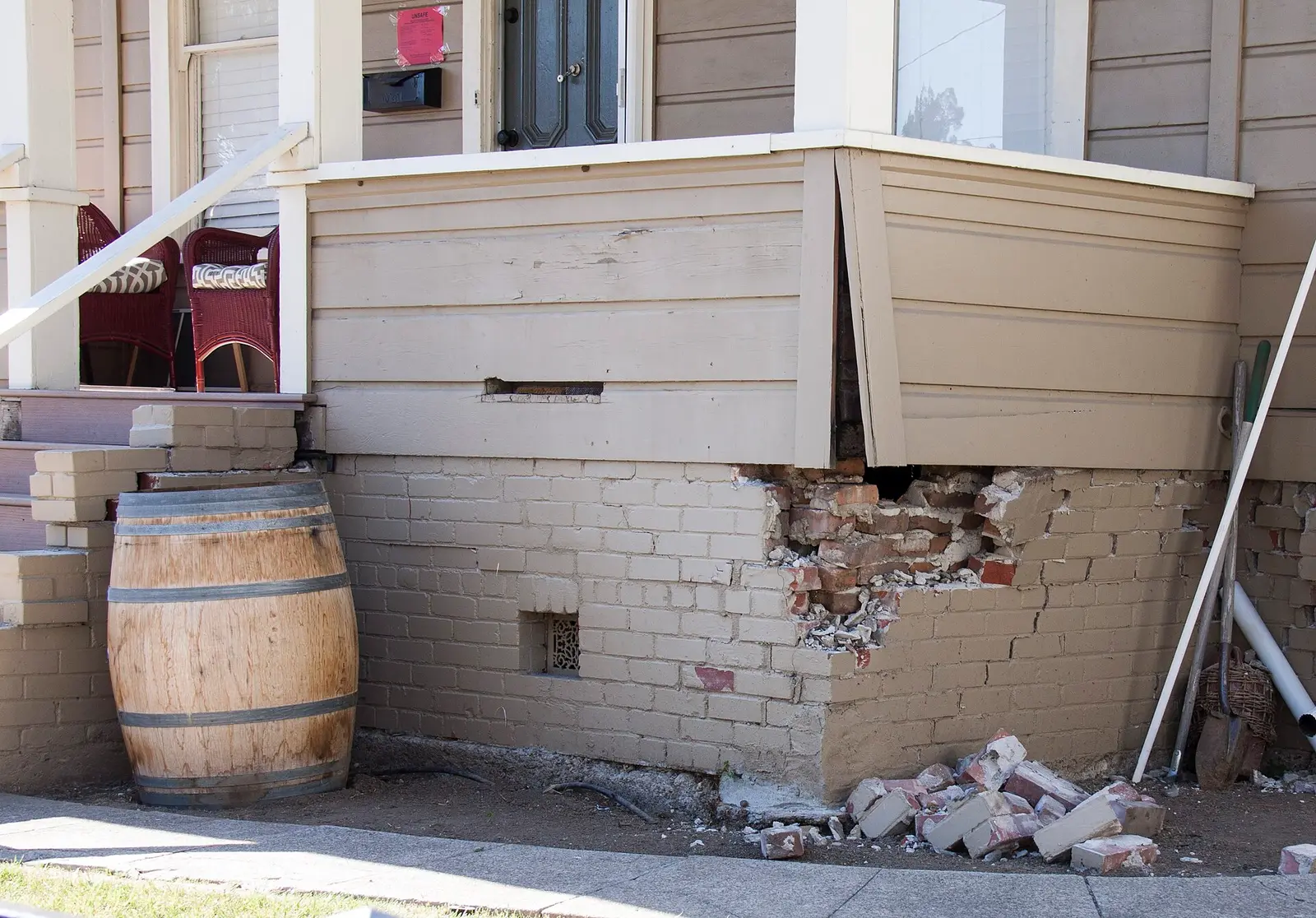
A crumbling brick foundation under a wood-frame building red-tagged after the 2014 South Napa earthquake
A crumbling brick foundation under a wood-frame building red-tagged after the 2014 South Napa earthquake. Photo: Department of Homeland Security. Federal Emergency Management Agency. Public Aff, Public domain, via Wikimedia Commons.

Foundation and seismic retrofit San Francisco

San Francisco quake work: garage stories, bay fill, tall cripple walls

San Francisco's mandatory soft-story program for apartment buildings closed in 2021 with about 4,900 buildings retrofitted, but the same weak ground floor sits under many single-family houses whose living floor spans a garage. City earthquake studies assumed more than half of single-family floor area is soft-story, and a state grant now targets those houses in 21 San Francisco ZIP codes. Steep lots and bay fill send many jobs to an engineer first.

Soft-story deadline
Work was due Sept 15, 2021; about 4,900 buildings done
Houses assumed soft-story
54% of single-family floor area (city CAPSS study)
Garage-house grant ZIPs
21 San Francisco ZIP codes on the 2025 ESS list
Brace + Bolt ZIPs
28 San Francisco ZIP codes on the 2025 list

The work

What strengthening a San Francisco house usually involves

  • Strengthening the wall around the garage door

    In a house with living space over a garage, the ground story has few solid walls: the garage door, utility and storage space and windows leave little to resist shaking. The state's Earthquake Soft-Story program, built on FEMA P-1100, lists what a retrofit may address: sill plate anchorage, the large openings, walls with little solid area, and unbraced stud walls at the garage level. It warns that such houses may be prone to partial or full collapse of the lowest story.

  • Hillside houses with tall cripple walls

    On the slopes around Twin Peaks, Bernal Heights and Diamond Heights, the downhill side of a house can stand on cripple walls much taller than the state's prescriptive limits. A DBI administrative bulletin on voluntary foundation strengthening notes that, because of those height restrictions, the prescriptive provisions apply to a limited number of buildings in San Francisco. Expect an engineer's design rather than a standard plan set on a sloping lot.

  • Retrofits on bay fill

    Much of the Marina sits on sand dredged and pumped into a cove in 1912 for the 1915 Panama-Pacific Exposition, never compacted. In 1989 the US Geological Survey found racked first stories common there in buildings with large garage openings, along with settlement where the fill liquefied. Strengthening the garage story on fill is still worthwhile, but the soil changes the design, and it can bring a geotechnical report into the job.

The Golden Gate Bridge and San Francisco, seen from the Marin Headlands
The Golden Gate Bridge and San Francisco, seen from the Marin Headlands. Photo: Paul.h, Public domain, via Wikimedia Commons.

The houses here

Living floors stacked over garage doors

The city's own earthquake study, completed in 2010, says the soft-story condition is well known in San Francisco because so many buildings have off-street parking on the ground floor. It assumed 54 percent of single-family home square footage, and the same share of duplexes, is soft-story. Two histories produced that. Sunset District builders put the garage inside almost every tract house from the 1920s on, and many older buildings that survived 1906 were raised later to fit a garage underneath, which the study notes changed their structural integrity. Add houses built close to their neighbors, which the study flags for pounding, and a San Francisco retrofit is more often about the garage story than the crawlspace alone.

Free request

Describe the seismic retrofit job once. Local pros who take work in San Francisco reply by call or text.

  • No fee to request, and no obligation to hire
  • You agree scope and price with the pro you choose
  • Photos help them quote without a first visit

Get quotes for seismic retrofit work in San Francisco

Two short steps. A local pro who takes this work calls or texts you back.

To send a request, call or text (415) 449-8213.

Free to request, and you agree the scope and price with the person you hire before work starts. In California, a job over $1,000 in labor and materials, or one that needs a building permit, must be done by a contractor licensed by the CSLB in the right class. Ask for the license number and check it at cslb.ca.gov.

Permits and local rules

Programs and requirements that apply here

  • The soft-story program is finished, not forgotten

    DBI states that the deadline to finish soft-story work was September 15, 2021. A 2025 Building Inspection Commission report counts about 4,900 buildings retrofitted under the 2013-2021 program, with an estimated 114,000 residents in safer buildings, and places the mandatory wood-frame programs in Chapter 5E of the San Francisco Existing Building Code. Anyone buying an older wood-frame apartment building should ask for its retrofit permit and final inspection record.

    San Francisco Building Inspection Commission (opens in a new tab)
  • Earthquake Soft-Story grants for houses over garages

    The state's ESS program, rules effective February 1, 2026, pays toward retrofitting a living-space-over-garage house: one whose upper living story extends over at least 75 percent of the depth of the garage. The house must be single-family, owner-occupied, no more than two stories, built before 2000, on level ground or a low slope, and in a listed ZIP code; 21 San Francisco ZIP codes are on the 2025 list. Partial retrofits do not qualify, and the contractor must hold an A or B license.

    California Residential Mitigation Program (opens in a new tab)
  • Geotechnical reports where the ground can fail

    SF Planning's Safety and Resilience Element explains that the California Seismic Hazards Mapping Act requires a geotechnical investigation and report for new or renovated buildings in Seismic Hazard Zones, and that DBI requires reports from a geologist and a geotechnical engineer for projects in areas susceptible to ground failure, including liquefaction and landslides. DBI also has procedures for extra review of projects it considers difficult or unusual in those areas.

    San Francisco Planning (opens in a new tab)

State license for this work: B General Building, C-8 Concrete. Look up a contractor's license on the CSLB website (opens in a new tab).

Part by part

Where the ground or the slope changes the plan

  • Marina

    The 1912 hydraulic fill under the area bounded roughly by Divisadero, Webster and Marina Boulevard liquefied in 1989, and garage-heavy buildings racked at the first story. Owners here should ask early whether the retrofit needs soils information.

  • Sunset and Parkside

    Rows of one-story-over-garage tract houses on old dune sand, the type the state's living-space-over-garage grant was written for. Where the lot is level or only gently sloped, a house here can also meet the grant's terrain rule.

  • Twin Peaks and Bernal Heights slopes

    Houses stepping down steep lots often have a full story of framing on the downhill side and tall cripple walls under the rest. Those exceed the prescriptive limits and fall outside the grant's level-ground rule, so budget time for an engineer.

Before you hire

Questions to ask before a quake retrofit

  • Ask whether the design follows FEMA P-1100 for the garage story, or is engineered, and who signs the plans.
  • If you want the ESS grant, ask whether the contractor is in its directory and holds an A or B license.
  • On a hillside lot, ask how tall the downhill cripple walls are and whether an engineer has looked at them.
  • In the Marina or other fill areas, ask whether DBI will want a geotechnical report for this scope.
  • Ask how the garage door opening will change, since new wall bracing can narrow or reframe it.

Questions

Earthquake questions from San Francisco owners

Our Sunset house has a garage under the living room. Is it a soft story?

Very likely by the city's own reckoning. San Francisco's earthquake studies assumed that 54 percent of single-family square footage is soft-story because of ground-floor parking, and the state defines a living-space-over-garage house as one whose upper floor spans at least 75 percent of the garage depth. A contractor or engineer can confirm by looking at the walls around the garage.

Is there grant money for retrofitting a San Francisco house over a garage?

The state's Earthquake Soft-Story program covers owner-occupied single-family houses of no more than two stories, built before 2000, on level ground or a low slope. Its 2025 ZIP list includes 21 San Francisco ZIP codes, from 94102 to 94134. Check the current registration window on the program's website before work begins, since grant work must follow its rules from the start.

Can we use Earthquake Brace + Bolt for a San Francisco house?

If the house has a crawlspace with cripple walls and sits in an eligible ZIP code. The 2025 Northern California list includes 28 San Francisco ZIP codes, and eligibility is based on ZIP code only. A house over a garage usually needs the garage-story work too, which is what the separate soft-story grant covers.

We're buying an older apartment building. How do we know it met the soft-story law?

Ask the seller for the retrofit permit and the city's compliance record, and check DBI's records for the address. The deadline to finish the work was September 15, 2021, and buildings that failed to comply were to be placarded with an Earthquake Warning sign. Have an engineer review the completed work before closing.

Why did the Marina suffer so much in 1989?

Much of it stands on sand pumped into a former cove in 1912 for the Panama-Pacific Exposition, placed without compaction at a time when liquefaction was not widely recognized. The US Geological Survey found racked first stories in buildings with large garage openings, settlement where the fill liquefied, and pounding between buildings close together.

Seismic retrofit work in San Francisco? Tell us what you see.

One request reaches local handymen and contractors who take this work. The Handyman SF connects you with them; it does not do the work.

HandymanNow for handymen Work in San Francisco? Get job leads by text. Pick your trades and areas, take only the jobs you want. No subscription. Start getting leads HandymanNow for homeowners Get the HandymanNow app. Send a request with photos, message your handyman and follow them on the way. Download the app

HandymanNow app

Fix it faster. Find work faster.

Homeowners send a job with photos and follow their handyman on the map. Handymen get local jobs by text and take only the ones they want.

Call Get a quote