Insulation Santa Clara

Santa Clara attics: what the city's table, SVP and the code each ask

Santa Clara's Building Division publishes its own Climate Zone 4 table for alterations, and it treats adding insulation over an existing ceiling as an altered ceiling: R-49, air sealing and attic ventilation to code, unless the attic already holds R-38, contains asbestos or knob-and-tube wiring, or is shared with a neighbor. Silicon Valley Power, the city's own utility, pays toward insulation only as an add-on to its heat pump rebate, and its R-44 bar sits below the code's.

  • Free to request, no obligation to hire
  • Up to five local pros who take this work can reply
  • Rules on this page checked against 17 public sources, October 2026

Asked most

Santa Clara attic insulation questions, from permits to SVP

Does adding attic insulation in Santa Clara need a permit?

Plan on one. The Building Division says a permit is required before a building is altered, repaired or improved, and its Simple Permits list covers HVAC, re-roofs, solar, sewer and water lines and water heaters, not insulation. Its own RN02 table treats added ceiling insulation as an altered ceiling with Energy Code requirements, and SVP's insulation add-on asks for proof of a permit final. Confirm the permit type with the Permit Center before work starts.

SVP's insulation add-on asks for R-44. Isn't that enough?

For the rebate, yes. For the code, the city's table asks an altered ceiling in Climate Zone 4 to reach R-49, or a U-factor of 0.02, unless at least R-38 is already in the attic. An attic finished at R-44 can therefore qualify for the add-on and still fall short of what the permit inspector checks. Specifying R-49, with the rating printed on the receipt, meets both.

We still heat with a gas wall furnace. Does the ceiling have to be air sealed?

Possibly not. The 2025 Energy Code excuses a home from ceiling air sealing when an atmospherically vented space-heating or water-heating combustion appliance sits inside its pressure boundary, and when at least R-19 is already at the ceiling. The city's RN02 table simply says air sealing is required, so have the contractor name the exception on the permit documents. The R-49 requirement for an altered ceiling still applies either way.

Mission Santa Clara de Asís
Mission Santa Clara de Asís. Photo: JaGa, CC BY-SA 3.0, via Wikimedia Commons.

Free request

Describe the insulation job once. Local pros who take work in Santa Clara reply by call or text.

  • No fee to request, and no obligation to hire
  • You agree scope and price with the pro you choose
  • Photos help them quote without a first visit

Get quotes for insulation work in Santa Clara

Two short steps. A local pro who takes this work calls or texts you back.

To send a request, call or text (415) 449-8213.

Free to request, and you agree the scope and price with the person you hire before work starts. In California, a job over $1,000 in labor and materials, or one that needs a building permit, must be done by a contractor licensed by the CSLB in the right class. Ask for the license number and check it at cslb.ca.gov.

Free, no obligation. Next, add your details in the request form.

Permits and local rules

The city table, the state code and the utility's rules

  1. RN02, Residential Prescriptive Requirements for Additions and Alterations

    Last revised April 9, 2026, the Building Division's bulletin sets out Climate Zone 4 requirements in five tables, the last of them for envelope alterations. An altered ceiling, which the table describes as adding ceiling insulation to an existing roof or a new roof on an existing building, gets R-49 or U-0.02, air sealing and ventilation per CRC R806. Added wall and raised-floor insulation have their own minimums. A footnote lists the conditions that exempt a project from every altered-ceiling requirement.

    Source: City of Santa Clara Building Division (santaclaraca.gov)

  2. Section 150.2(b)1J and its air sealing exceptions

    In the 2025 Energy Code, air sealing of the ceiling plane between attic and living space is required in Climate Zone 4 with two exceptions the city's table does not repeat. A house with at least R-19 already at the ceiling is excused from it, and so is one with an atmospherically vented space-heating or water-heating combustion appliance inside its pressure boundary. Where the attic is too shallow for the full R-value, the accessible space is filled instead, as long as the required venting clearance is kept.

    Source: California Energy Commission, 2025 Energy Code (energy.ca.gov)

  3. Residential Heat Pump HVAC Rebate Rules

    Updated September 15, 2026, SVP's rules limit the program to its residential customers in existing homes, exclude do-it-yourself installs, and allow one rebate per service address per measure every ten years. Landlords may take part when the tenant is an eligible SVP customer. The two add-ons are an insulation rebate, with the R-44 attic and R-13 wall thresholds, and a blower door rebate that needs test results from before and after the envelope work plus a list of what was done.

    Silicon Valley Power (opens in a new tab)
  4. Regulation 11, Rule 2, subsection 303.8.2

    For renovation or demolition of residential buildings with four or fewer dwelling units, the Air District does not require an asbestos survey. It requires a sample and laboratory test only when certain materials will be removed or disturbed, and heating, ventilation and air conditioning ducting and systems head that list, followed by acoustic ceilings and textured walls. Material found to hold more than 1 percent asbestos and to be friable must then be handled under the rule's removal standards.

    Source: Bay Area Air Quality Management District (baaqmd.gov)

State license for this work: C-2 Insulation and Acoustical, B General Building. Look up a contractor's license on the CSLB website (cslb.ca.gov).

The work

How insulation ends up on a Santa Clara work order

  • Topping up an attic on its own

    The Building Division's RN02 table lists adding ceiling insulation to an existing roof as an altered ceiling in Climate Zone 4. The ceiling then needs R-49, or a U-factor of 0.02 or less, air sealing, and attic ventilation that meets Section R806 of the California Residential Code. The same table names the attics excused from all of it: R-38 already in place, asbestos or knob-and-tube wiring in the attic, and an attic shared with a unit whose ceiling is not being altered.

  • Ducts replaced under a Simple Permit

    Like-for-like ductwork replacement in a single-family house, duplex or ADU qualifies for a Building Simple Permit, usually approved in one to two business days. The Energy Code still follows the ducts: a complete replacement duct system must test at 5 percent leakage or less, and when it and the air handler sit in a vented attic, the ceiling rules of Section 150.2(b)1J apply as well. An owner who asked only for new ducts can therefore end up with an attic insulation requirement.

  • Old duct wrap and vermiculite above the ceiling

    For a house of four or fewer units, the Air District skips the full asbestos survey but requires a sample and test before heating or air conditioning ducting is removed or disturbed. The Energy Code then steps aside: its ceiling rules do not apply where the alteration would directly disturb asbestos, and existing ducts built, insulated or sealed with asbestos are excused from the duct sealing an equipment change would bring. EPA's advice on vermiculite is to assume it holds asbestos, leave it alone, and remember that a contractor stirring it up can carry fibers into the rooms below.

  • Insulation alongside an SVP heat pump

    Silicon Valley Power's insulation add-on is available only while another of its home electrification rebates, usually the heat pump HVAC rebate, is in progress. The heat pump has to replace a gas, propane, oil or wood heater, or an electric one; the work must be done by a licensed contractor and closed out with a building permit final. The add-on asks for attic insulation of at least R-44, or wall insulation of at least R-13, with the rating on the receipt.

  • Walls and raised floors in older houses

    The same city table covers the rest of the shell. Wall insulation added in 2x4 framing needs at least R-15, or R-21 in 2x6, unless an existing 2x4 wall already holds R-11. Insulation added under a raised floor needs R-19, except over a crawlspace with controlled ventilation or an unvented crawlspace that meets the code. SVP's add-on threshold for walls is lower, at R-13, so a wall that earns the rebate may still fall short of the code figure.

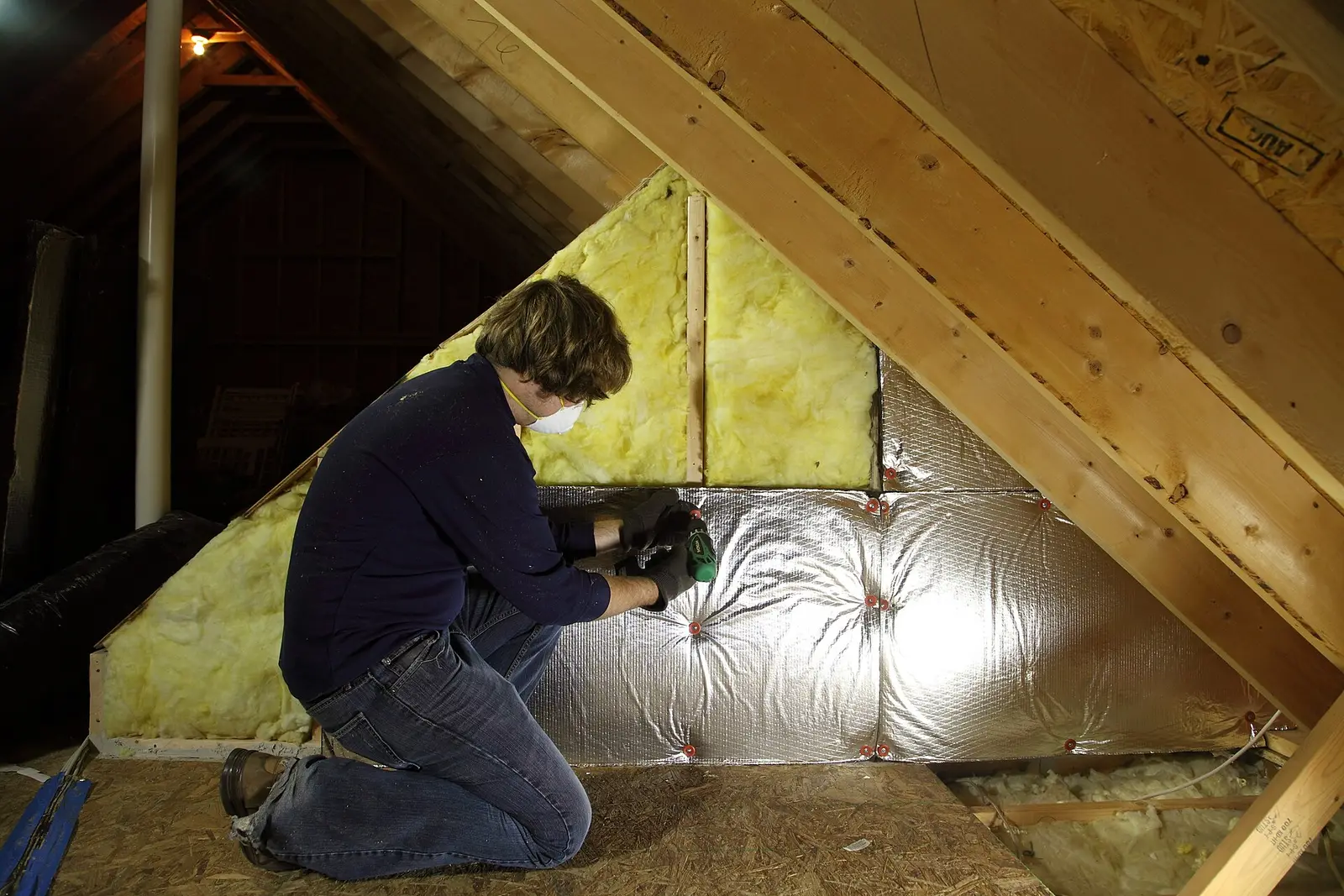
A worker in a mask fitting insulation batts between the rafters of an attic
A worker in a mask fitting insulation batts between the rafters of an attic. Photo: The EnergySmart Academy, CC0, via Wikimedia Commons.

The houses here

Ranch attics, low patio-home roofs and pre-war plaster

The city's design guidelines treat the ranch-style tract house as Santa Clara's ordinary home and name the exception: the Mackay and Fairmede patio homes, with low-sloped roofs, large overhangs and exposed beam ends, where any space above the ceiling can be shallow. The Old Quad holds older houses still, and the Planning Division's historic summary lists plaster removal among the interior changes that take a building permit there. Heating varies as much as the roofs: the Building Division keeps one bulletin covering attic, floor and wall furnaces. Its alteration tables are written for Energy Code Climate Zone 4, and that zone sets the numbers below.

Part by part

Where in Santa Clara the attic question changes

  • The Old Quad

    The Housing Element describes the early city as centered on downtown, Santa Clara University and the train station, and the Old Quad's blocks keep some of its oldest houses. The historic summary puts plaster removal among the interior changes that need a building permit on inventory, potentially historic and Mills Act houses, so opening walls to insulate one is permit work. If an electrician finds knob-and-tube wiring in the attic, the city's table exempts that attic from the altered-ceiling requirements.

  • Mackay and Fairmede

    The design guidelines describe these patio-home tracts as built with low-sloped roofs, large overhangs and exposed roof beam ends, and they ask additions there to keep gable or shed roofs no steeper than 3:12. Where a roof that low leaves only a shallow space above the ceiling, the Energy Code lets the accessible space be filled rather than reach R-49.

Timing

Sixty days from the final inspection

SVP's heat pump rebate application is due within 60 days of the building permit's final date, or of the purchase if no permit is needed, and the insulation add-on can only be claimed while that rebate is in progress. Proof of the permit sign-off is required, so the insulation should be inspected and finished with the heat pump, not months later. Permit applications filed since January 1, 2026 fall under the 2025 California codes, which is the edition the city's RN02 table reflects.

Before you hire

Questions for an insulation contractor in Santa Clara

  • Does the scope count as an altered ceiling under the city's RN02 table, and which permit will you apply for?
  • If an SVP add-on is planned, will the attic reach R-49 rather than stopping at R-44, and will the receipt print the rating?
  • Before old ducts or wrap come out, who takes the asbestos sample the Air District requires for a house of up to four units?
  • Who books the ECC-Rater for the duct leakage test, and what happens if the first test fails?
  • For insulation alone, check the C-2 Insulation and Acoustical license at cslb.ca.gov; a B general contractor may take it only within a job of two unrelated trades, or by subcontracting it.

Free, no obligation. Next, add your details in the request form.

More questions

Still deciding?

Our townhouse shares one attic with the units next door. What applies?

The Energy Code's attic rules do not apply where the attic above the altered unit is shared with other units whose own ceilings are not being altered, and the city's table lists a shared attic among its exemptions. Townhomes and condos are also excluded from Building Simple Permits, so a duct or furnace replacement there goes through a regular permit. The association's documents may set their own rules for work in a common attic.

Who tests the ducts now that HERS raters are gone?

An ECC-Rater. The California Energy Commission's Energy Code Compliance Program replaces the HERS program for field verification and diagnostic testing, and existing HERS raters are recognized as ECC-Raters. Results go into an ECC-Provider's data registry, and if a test fails, the installing contractor has to fix the system until it passes. Forms under the 2025 code say ECC where older ones said HERS.

Where these facts come from

Checked against these public sources in October 2026. Rules and programs change: confirm permit requirements with the city before work starts, and a contractor's license on the CSLB website.

  • santaclaraca.gov: 639179768475800000 (santaclaraca.gov)
  • santaclaraca.gov: simple permits (santaclaraca.gov)
  • santaclaraca.gov: building permit information (santaclaraca.gov)
  • santaclaraca.gov: information bulletins forms (santaclaraca.gov)
  • santaclaraca.gov: 639124505898430000 (santaclaraca.gov)
  • santaclaraca.gov: 639034700447970000 (santaclaraca.gov)
  • santaclaraca.gov: 639086641724700000 (santaclaraca.gov)
  • santaclaraca.gov: 639094307749200000 (santaclaraca.gov)
  • energy.ca.gov: CEC 400 2025 010 F (energy.ca.gov)
  • energy.ca.gov: energy code compliance program (energy.ca.gov)
  • siliconvalleypower.com: rebates
  • siliconvalleypower.com: hvac rebates

Insulation work in Santa Clara? Tell us what you see.

One request reaches local handymen and contractors who take this work. The Handyman SF connects you with them; it does not do the work.

HandymanNow for handymen Work in Santa Clara? Get job leads by text. Pick your trades and areas, take only the jobs you want. No subscription. Start getting leads HandymanNow for homeowners Get the HandymanNow app. Send a request with photos, message your handyman and follow them on the way. Download the app

HandymanNow app

Fix it faster. Find work faster.

Homeowners send a job with photos and follow their handyman on the map. Handymen get local jobs by text and take only the ones they want.

Call WhatsApp (opens WhatsApp) Free quote