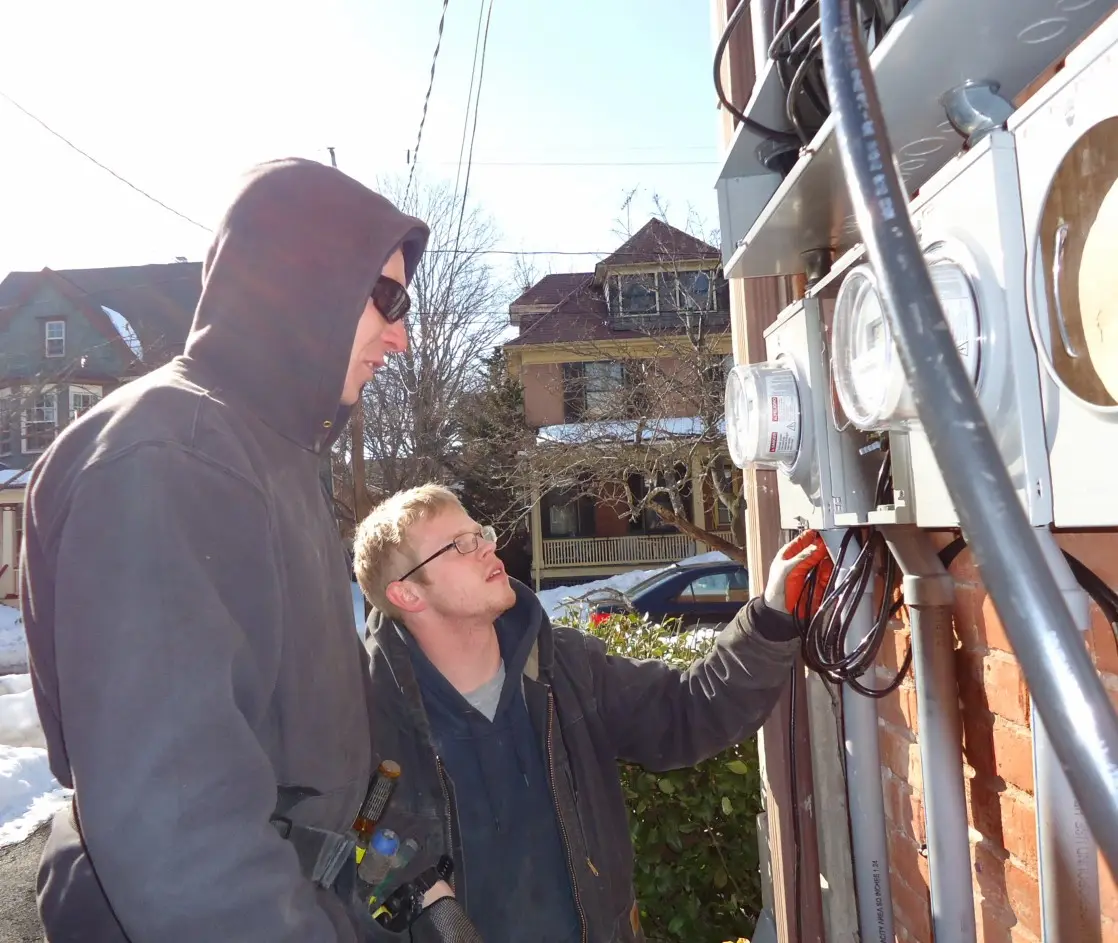
Electricians inspecting the electrical panels and meters on a multifamily house
Electricians inspecting the electrical panels and meters on a multifamily house. Photo: Tomwsulcer, CC0, via Wikimedia Commons.

Electrical Santa Clara

When the city owns the meter: electrical work on Santa Clara homes

In Santa Clara the electricity, the meter and the service drop belong to Silicon Valley Power, the utility the city has run since 1896, and its rules sit inside every panel job. Only SVP may disconnect its conductors, so after a service upgrade the city inspector authorizes the reconnect. SVP asks to be told about every home EV charger, and a solar or battery system needs its pre-approval before the building permit is filed.

  • Free to request, no obligation to hire
  • Up to five local pros who take this work can reply
  • Rules on this page checked against 21 public sources, October 2026
Electric utility
Silicon Valley Power, city-owned since its founding, July 23, 1896
Largest home service
400 amps, single-phase only, with SVP permission
SVP distribution lines
394.1 miles underground, 185.1 miles overhead
Energy Code climate zone
Zone 4 in ZIP codes 95050, 95051 and 95054

The work

Santa Clara electrical jobs that run through the utility

  • A service upgrade with no hot cutover

    The city's handout is blunt: only Silicon Valley Power works on its service conductors, and an electrician who moves the live drop over to the new equipment fails the inspection. The new service needs a single main disconnect, which the handout calls SVP policy, a surge-protective device, and an outdoor meter between 48 and 75 inches above the ground. Once the building inspector has seen the conductors landed in the meter section and passed the work, the inspector authorizes SVP to reconnect, and the city's finance department charges for the reconnection and the new meter.

  • Telling SVP about a Level 2 charger

    SVP asks to be notified of every charging station installed in the city, explaining that one Level 2 charger barely registers but several in the same area can overload its secondary wires and transformers. The city's charger submittal asks for the existing service size and a load calculation, and notes that most Level 2 chargers need at least a 40-amp, two-pole circuit. A plug-in Level 2 charger on an outlet that already exists needs no over-the-counter permit, while a new circuit, outlet or hard-wired unit does. Where a 240-volt dryer outlet already sits in the garage, SVP suggests a smart splitter that alternates the two loads.

  • A smart panel instead of a bigger service

    SVP's smart panel rebate says outright that it exists to avoid upgrades to the utility's own distribution system as more homes add electric appliances and cars. To qualify, the new panel must be between 100 and 200 amps and carry automatic load management that keeps the draw under the panel's rating; a standard panel does not count. The work must be done by an electrician holding a C-10 license, and projects started before July 1, 2025 are not eligible.

  • Prewiring for appliances that are not here yet

    SVP's add-on rebates cover new circuits prewired for up to four future appliances, limited to a dryer, a cooktop or range, an EV charger and a water heater, along with circuit pausers or splitters and a main panel upgrade. All three add-ons open only while another SVP electrification or EV charger rebate is in progress, and the panel add-on applies only when the existing main panel is under 200 amps. SVP also points out that a 110-volt heat pump water heater typically needs no panel upgrade at all.

  • Backup power kept off SVP's lines

    SVP's rules ask customers to tell the utility where a generator is, or will be, installed, and require a standby unit that can feed the house to have protective and isolating devices so it never runs in parallel with SVP's system. A portable generator may be connected only after the main switch is opened. A battery is the quieter route, and SVP's battery rebate expects solar on the house, existing or added with it, and a system of at least 3 kWh installed after July 1, 2024.

Mission Santa Clara de Asís
Mission Santa Clara de Asís. Photo: JaGa, CC BY-SA 3.0, via Wikimedia Commons.

The houses here

Overhead drops over low roofs, conduit under the yard

Silicon Valley Power's fact sheet counts 394.1 miles of underground distribution line against 185.1 miles overhead, and the city's service upgrade handout writes separate rules for each kind of house connection. An overhead drop lands on a rigid metal mast rising at least 30 inches above the roof, and the wires must clear any roof pitched under 4:12 by 8 feet, against 3 feet on steeper roofs. That bites on the Mackay and Fairmede patio homes, which the city's design guidelines describe as built with low-sloped roofs and large overhangs. An underground service runs in conduit at least 2 inches across and 24 inches down, with no more than four long-sweep bends, and the trench stays open until the conduit passes inspection. On a stucco wall, a semi-flush panel means breaking the stucco back 6 inches and passing a lath inspection at the same visit.

Free request

Describe the electrical job once. Local pros who take work in Santa Clara reply by call or text.

  • No fee to request, and no obligation to hire
  • You agree scope and price with the pro you choose
  • Photos help them quote without a first visit

Get quotes for electrical work in Santa Clara

Two short steps. A local pro who takes this work calls or texts you back.

To send a request, call or text (415) 449-8213.

Free to request, and you agree the scope and price with the person you hire before work starts. In California, a job over $1,000 in labor and materials, or one that needs a building permit, must be done by a contractor licensed by the CSLB in the right class. Ask for the license number and check it at cslb.ca.gov.

Permits and local rules

Utility and city papers behind a Santa Clara electrical bid

  • Silicon Valley Power Rules and Regulations

    SVP decides where a house connects, at what voltage, and whether the service comes overhead or underground. Meters must be outdoors or in a utility room reached from outside through an unalarmed door, and whoever needs SVP's own equipment moved pays for the move. Residential service tops out at 400 amps and three-phase service is not offered to homes. Notice of a load increase, a larger service or a generator goes to SVP's Distribution Estimating group, and a change to an existing service carries a load increase fee from the city's fee schedule.

    Silicon Valley Power (opens in a new tab)
  • Solar and storage interconnection

    Every solar or battery system needs SVP's pre-approval before the building permit application, and SVP's Permission to Operate before it is energized. SVP accepts installers holding an active A, B, C-10 or C-46 license. The city's SolarAPP+ instant review covers systems up to 15 kW with no more than one battery of up to 20 kWh, and the SVP pre-approval letter is one of its required documents. Customers still net-meter under Schedule NM and are billed once a year.

    Silicon Valley Power (opens in a new tab)
  • Arc-fault protection in dwellings

    The Building Division's AFCI handout requires arc-fault protection on existing branch circuits whose wiring is partly replaced during a service upgrade or relocation, where they serve rooms such as kitchens, bedrooms, living rooms, hallways and laundry areas. A relocated panel whose old circuits need less than 6 feet of new wire is exempt. New wiring for hard-wired smoke and CO alarms needs AFCI protection from a breaker, so a panel that cannot accept AFCI breakers must be replaced or supplemented with a subpanel.

    City of Santa Clara Building Division (opens in a new tab)

State license for this work: C-10 Electrical. Look up a contractor's license on the CSLB website (opens in a new tab).

Before you hire

Settle these before a Santa Clara electrician opens the panel

  • Ask how the service change will be sequenced so SVP's conductors stay untouched; a hot cutover of the drop fails the city's inspection.
  • For a Level 2 charger, ask who notifies Silicon Valley Power and what the load calculation says about the existing service.
  • Before quoting a bigger service, ask whether a 100- to 200-amp smart panel with automatic load management would carry the new loads.
  • For solar or a battery, ask to see SVP's pre-approval letter before anyone files for the building permit.
  • Check the C-10 Electrical license at cslb.ca.gov; SVP's smart panel rebate counts only work by a C-10 electrician.

Questions

Santa Clara owners ask about SVP, panels and chargers

For a bigger electric service in Santa Clara, do we deal with PG&E or Silicon Valley Power?

Silicon Valley Power. The city owns the electric utility, and its Rules and Regulations send notice of a load increase, a larger service or a generator to SVP's Distribution Estimating group. The building permit comes from the city's Permit Center, which also schedules temporary power disconnects and reconnects, and the city inspector authorizes the reconnect once the new service passes.

Does SVP have a cheaper overnight rate for charging an EV?

No. SVP says there are no special rates for EV charging because Santa Clara residents already benefit from lower electric rates all day. What it asks instead is to be notified whenever a charging station goes in, so its wires and transformers stay adequately sized. A hard-wired charger or a new outlet needs a permit; a plug-in Level 2 unit on an existing outlet does not need an over-the-counter permit.

Will SVP's net metering change if we add solar now?

Not yet. SVP still net-meters under Schedule NM and says it has not reached the 5 percent threshold in state law. If the City Council adopts a successor tariff, SVP says it might be structured and priced differently from the NEM 2.0 or NEM 3.0 offered by other utilities. Solar customers stop receiving monthly bills and are billed once a year.

Our ranch house still has a 100-amp panel. Must it go before we add an induction range?

Not necessarily. A load calculation decides it. SVP suggests lighter loads first, such as a 110-volt heat pump water heater, and favors a smart panel of 100 to 200 amps with automatic load management over a bigger service. Its main panel upgrade rebate is an add-on, available only for an existing panel under 200 amps and only alongside another SVP electrification rebate in progress.

Can we plug a portable generator into the house during an outage?

Only in a way that isolates the house from SVP's lines. SVP's rules allow a portable generator to be connected only after the main switch is opened, and ask customers to tell SVP where a generator is installed. A standby unit needs protective and isolating devices that prevent parallel operation, which is transfer equipment for a C-10 electrician to install under a permit.

Will an EV charger permit make us replace old toilets in Santa Clara?

No. Santa Clara's Building Division applies SB 407, which requires non-compliant plumbing fixtures to be replaced when a pre-1994 property is added to or altered. Its handout interprets solar and EV charging work as not triggering that upgrade, in line with the state's goal of streamlining those systems. A kitchen or bath remodel permit, on the other hand, does trigger it.

Electrical work in Santa Clara? Tell us what you see.

One request reaches local handymen and contractors who take this work. The Handyman SF connects you with them; it does not do the work.

HandymanNow for handymen Work in Santa Clara? Get job leads by text. Pick your trades and areas, take only the jobs you want. No subscription. Start getting leads HandymanNow for homeowners Get the HandymanNow app. Send a request with photos, message your handyman and follow them on the way. Download the app

HandymanNow app

Fix it faster. Find work faster.

Homeowners send a job with photos and follow their handyman on the map. Handymen get local jobs by text and take only the ones they want.

Call Get a quote