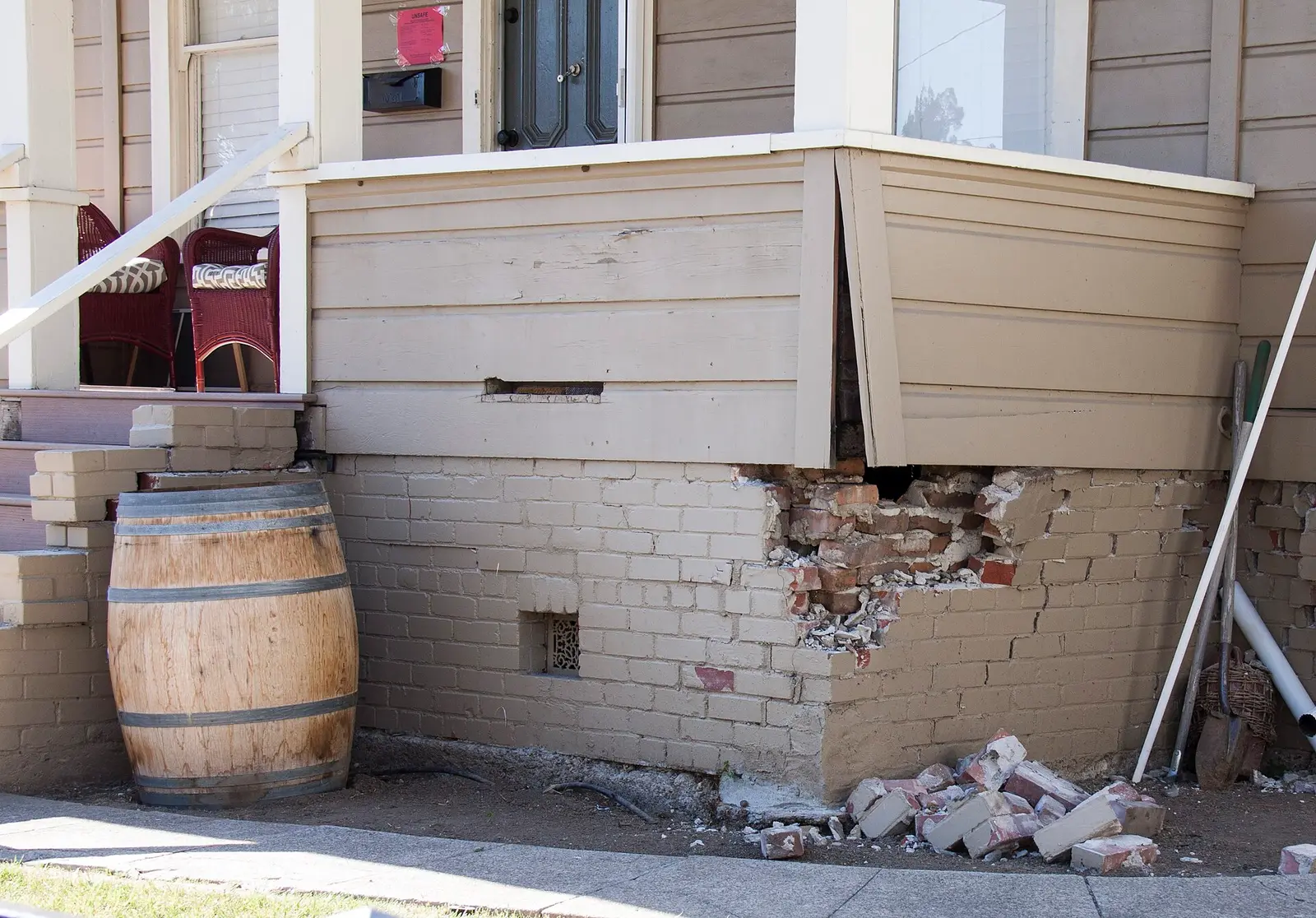
A crumbling brick foundation under a wood-frame building red-tagged after the 2014 South Napa earthquake
A crumbling brick foundation under a wood-frame building red-tagged after the 2014 South Napa earthquake. Photo: Department of Homeland Security. Federal Emergency Management Agency. Public Aff, Public domain, via Wikimedia Commons.

Foundation and seismic retrofit Oakland

Bolting Oakland houses to their foundations along the Hayward Fault

An Oakland retrofit usually begins in a crawlspace framed before the Second World War. The city's own rehab manual warned that many Oakland houses sit on brick foundations with no anchor bolts, and that pre-war houses lean on rows of wood posts set on concrete piers. Every retrofit needs a city building permit first, and Oakland will not issue any building permit until an approved recycling plan is on file.

Fault under the city
Hayward Fault; its 1868 earthquake was magnitude 6.8
Older footings
Brick from the 1860s into the 1920s; concrete from about 1906
Before any permit
An approved recycling plan (WRRP) through Green Halo
Apartment program
Mandatory soft-story retrofit, Ordinance No. 13516

The work

The retrofits Oakland crawlspaces keep calling for

  • Anchoring a sill to an old brick footing

    The city's 1978 manual called brick foundations without anchor bolts a very serious liability in an earthquake, and said many Oakland houses had them. Anchors into brick are set in the masonry rather than cast into concrete, so the condition of the mortar matters: powdery joints, diagonal cracks and bricks that are no longer level are the warning signs it listed. An honest bid starts with that inspection and says plainly whether the brick can take anchors or needs replacing first.

  • Pouring a new footing under a very old house

    Where a house still sits on a mudsill laid on the ground, or a brick foundation has largely crumbled, the guide's advice was to replace it with concrete and hand the project to a contractor. That means shoring the house, pouring new footings in sections, and tying any new concrete into the old where the two meet. It is structural work for a licensed contractor (B General Building), with C-8 concrete work inside it, and it changes the retrofit from bolting to rebuilding.

  • Hillside houses outside the state grant

    California's Earthquake Brace + Bolt grant only covers houses built before 1980 that sit on level ground or a low slope, on a continuous raised perimeter foundation. Houses on Oakland's steep hill lots can fail that test, and so do houses rebuilt after 1991, which are simply too new. Neither group is excused from earthquake risk; their retrofits are designed case by case, usually by an engineer, and paid for without the state grant.

  • Soft-story work in older apartment buildings

    Oakland's mandatory program targets wood-frame residential buildings put up before 1991 with large ground-floor openings, such as garages or storefront windows, carried on slender columns. It grew out of a 2009 ordinance, 12966 C.M.S., that only required owners to report what their ground floors were like. The current ordinance requires the retrofit itself, and the city keeps a list of subject properties, dated May 2026 in its latest version, along with forms for exemptions, extensions and changes of compliance tier.

Downtown Oakland and Lake Merritt from the air
Downtown Oakland and Lake Merritt from the air. Photo: Dcoetzee, Public domain, via Wikimedia Commons.

The houses here

Mudsills, brick footings and posts on piers

Oakland was built across a long stretch of changing foundation practice, and Rehab Right, the rehab manual the city's planning department issued in 1978, traces it. Houses from 1840 to 1870 often had no masonry foundation at all, just a wood mudsill on levelled earth or on flat stones laid without mortar. Brick footings came in during the 1860s and stayed common through the 1920s, while concrete appeared around 1906. Most styles built before the Second World War also rest on rows of wood posts over concrete piers in the middle of the crawlspace. A retrofit contractor's first task is finding out which of these a house has, because bolting assumes a footing sound enough to hold the anchors.

Free request

Describe the seismic retrofit job once. Local pros who take work in Oakland reply by call or text.

  • No fee to request, and no obligation to hire
  • You agree scope and price with the pro you choose
  • Photos help them quote without a first visit

Get quotes for seismic retrofit work in Oakland

Two short steps. A local pro who takes this work calls or texts you back.

To send a request, call or text (415) 449-8213.

Free to request, and you agree the scope and price with the person you hire before work starts. In California, a job over $1,000 in labor and materials, or one that needs a building permit, must be done by a contractor licensed by the CSLB in the right class. Ask for the license number and check it at cslb.ca.gov.

Permits and local rules

Permits, programs and grant rules behind an Oakland retrofit

  • A building permit before any seismic work

    Oakland's Planning & Building Department states that building permits are required before any seismic work may be done, including work that strengthens an existing building against earthquake damage and collapse. Applications go through the Online Permit Center, from either a contractor with an appropriate state license class and a current Business Tax Certificate or the building's owner. Every Oakland building permit also needs an approved Waste Reduction and Recycling Plan, set up in Green Halo, before it is issued.

    City of Oakland Planning & Building (opens in a new tab)
  • Oakland's Mandatory Soft Story Retrofit Program

    Under Ordinance No. 13516, owners of vulnerable soft-story residential buildings built before 1991 must retrofit them. Compliance runs in steps: proving a building is not subject or belongs in a later tier, the mandatory evaluation with an initial affidavit, a retrofit permit or a target-story evaluation report, and finally the completed retrofit, a final inspection and a final affidavit. The city cites its position along the Hayward Fault as the reason retrofitting can save lives and housing.

    City of Oakland (opens in a new tab)
  • Earthquake Brace + Bolt eligibility

    The state grant program's 2026 rules accept only owner-occupied, detached houses of one to four units, built before 1980, on level ground or a low slope, with a continuous raised perimeter foundation and in a ZIP code the program lists. No brace-and-bolt work may start before the program approves it, structural damage must be repaired first, and a homeowner hiring help must choose from its directory of FEMA-trained contractors.

    California Residential Mitigation Program (opens in a new tab)

State license for this work: B General Building, C-8 Concrete. Look up a contractor's license on the CSLB website (opens in a new tab).

Part by part

How the job shifts across Oakland

  • Prescott, Oak Center and Clinton Park

    Rehab Right dates the Italianate houses on these blocks to the 1860s through the 1880s, the decades of brick footings and, at the very oldest, wood sills set on the ground. Expect the foundation itself to be the first question here, before any talk of bolts and plywood.

  • Montclair and the hill streets

    Steep lots mean stepped foundations, taller cripple walls on the downhill side and houses the state grant's level-ground rule leaves out. A retrofit here is often an engineered design for that one house rather than a standard plan set.

  • Grand Lake and the Lakeshore corridor

    Apartment buildings from the 1920s to the 1950s over garages and street-level shops are the building type Oakland's soft-story program was written for. Owners deal with tiers, affidavits and engineers, and garages and storage rooms are often opened up while the work goes on.

  • Upper Rockridge and the 1991 rebuild

    Houses rebuilt after the firestorm went up in the 1990s, so they fall outside the state brace-and-bolt grant's pre-1980 cutoff. Any strengthening there starts from an engineer's review of that particular house rather than from the grant's standard scope.

Before you hire

Checks before a retrofit crew goes under the house

  • Ask whether the footing is brick or concrete, and what state the mortar is in, before accepting a bolt-only bid.
  • Check at cslb.ca.gov that the license lists B General Building, and C-8 Concrete if new footings are part of the job.
  • Ask who sets up the Green Halo recycling plan, since Oakland issues no building permit without an approved one.
  • On a hill lot, ask whether an engineer will design the work and whether the slope rules out the state grant.
  • Owners of soft-story buildings: ask which compliance step the city lists for your address and who files each affidavit.

Questions

Retrofit questions from Oakland owners

Our West Oakland Victorian sits on a brick foundation. Can it simply be bolted?

Sometimes, but the brick decides. Oakland's Rehab Right guide told owners to look for cracks running diagonally between bricks, mortar that powders under a screwdriver, crumbling bricks and walls that are no longer level. Sound brick can take anchors set into the masonry; a thoroughly deteriorated footing was, in the guide's words, a project to turn over to a professional contractor for a new concrete foundation.

We rebuilt after the 1991 fire. Can we get a Brace + Bolt grant?

No. The program's 2026 rules accept only houses built before 1980, and every house rebuilt after the firestorm is newer than that. A 1990s house was also built under far more recent codes than the pre-war houses the grant targets, so if anything needs strengthening, an engineer should identify it before you collect quotes.

How does Oakland's 2009 soft-story ordinance differ from the current one?

The 2009 ordinance, 12966 C.M.S., asked owners of potential soft-story buildings to report structural information about the ground floor, but it required no retrofit. The later ordinance, No. 13516, turned that screening into a mandatory retrofit program with compliance tiers, affidavits and a final inspection.

The permit counter asked for a WRRP. What is it?

It is Oakland's Waste Reduction and Recycling Plan, and every building permit in the city needs an approved one before it is issued, seismic work included. After the permit application is processed, a project is created in Green Halo, where the applicant pays its fee and writes the plan. Ask your contractor to handle it as part of the permit.

Our house is on a steep Montclair lot. Does the state grant help?

Probably not. Brace + Bolt only accepts houses that sit on level ground or a low slope with a continuous raised perimeter foundation. A steep lot with a stepped foundation usually needs a retrofit designed for that house, so start with an engineer's assessment of the downhill cripple walls and the foundation.

Seismic retrofit work in Oakland? Tell us what you see.

One request reaches local handymen and contractors who take this work. The Handyman SF connects you with them; it does not do the work.

HandymanNow for handymen Work in Oakland? Get job leads by text. Pick your trades and areas, take only the jobs you want. No subscription. Start getting leads HandymanNow for homeowners Get the HandymanNow app. Send a request with photos, message your handyman and follow them on the way. Download the app

HandymanNow app

Fix it faster. Find work faster.

Homeowners send a job with photos and follow their handyman on the map. Handymen get local jobs by text and take only the ones they want.

Call Get a quote