Handyman help for Union City's 1970s tracts and Old Alvarado
Clay soils that swell in winter and shrink in summer, mapped in Union City's eastern uplands and near Decoto Road, move doors and fence posts with the seasons. The Hayward Fault runs along the foot of the hills. The city grew from 14,724 to 39,406 people in the 1970s, yet 1880s houses survive north of Smith Street.
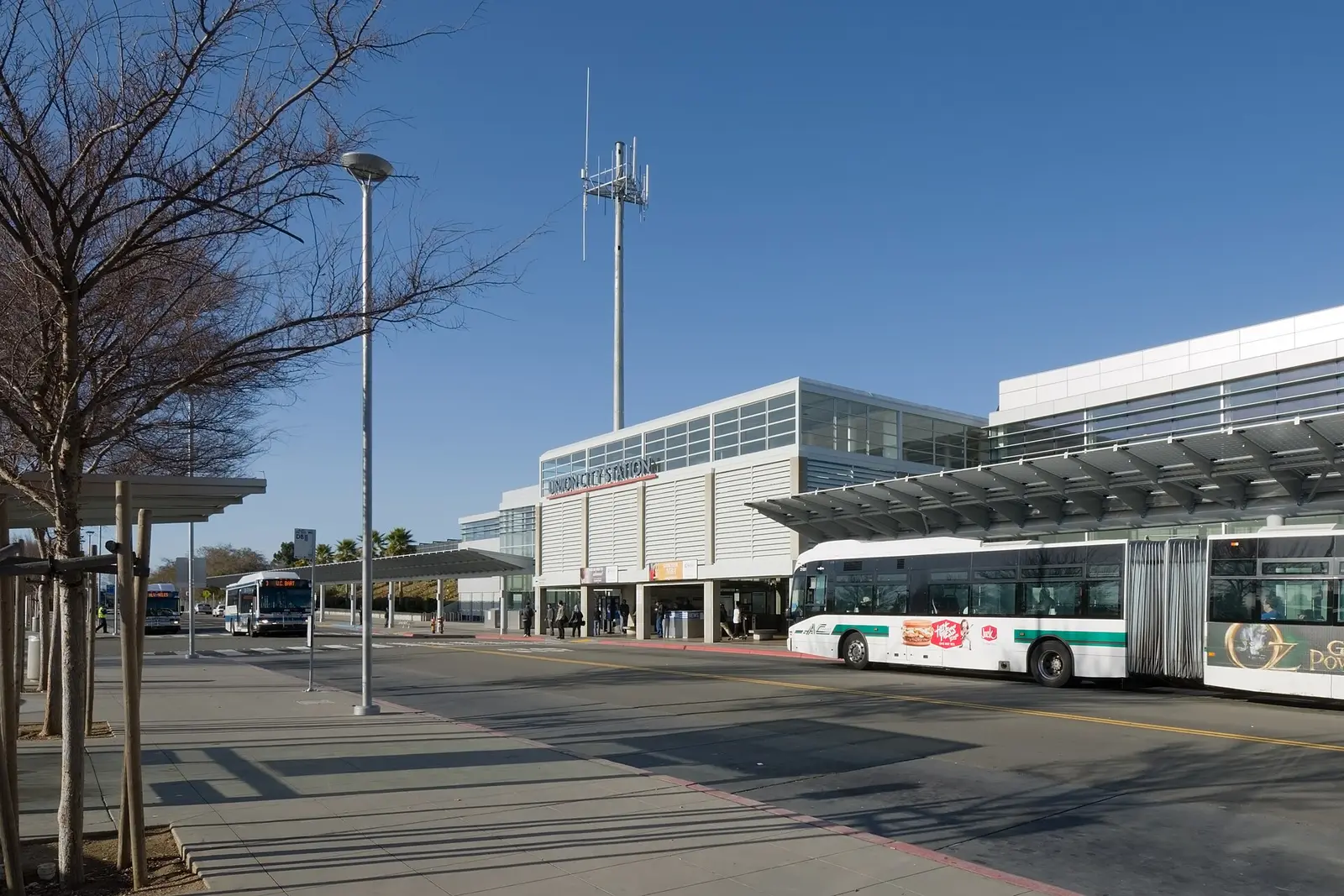
Union City BART station and its bus plaza. Photo: LPS.1, CC0, via Wikimedia Commons.
ZIP codes
94587
When the homes were built
1880s-1990s
Main streets
Smith Street, Vallejo Street, Decoto Road, Alvarado-Niles Road
Landmarks
Union City BART station, Masonic Home on Mission Boulevard, Dry Creek Pioneer Regional Park
What homes in Union City need most
Doors that change with the clay
Environmental review for the city's 2040 General Plan maps soils with high shrink-swell potential in the eastern, upland parts of Union City and the hillside area, and soil near Decoto Road is Rincon clay loam, rated moderately to highly expansive. That clay swells in the wet months and shrinks as it dries, so a door rubbing at the head in February can rattle in its latch by September. Adjusting hinges and strike plates for the season, instead of planing heavily, avoids an oversized gap once the ground dries. More about door and window repair
Porches and trim on 1880s Alvarado houses
North of Smith Street, along Vallejo and Watkins Streets, single-family houses date from the 1880s, and the Smith Street core holds commercial buildings from the 1880s through 1930. The city's Design Guidelines for Old Alvarado, adopted in 1989, center on keeping those historic buildings. On houses this old, the carpentry that fits is repair in kind: replacing a rotted porch board or step with the same profile, splicing in matching siding and trim, and rebuilding window sills rather than covering them. More about carpentry, shelves and trim
Fence posts in shrink-swell soil
Expansive clay works on fences as well as houses. It swells around posts with winter rain and pulls away from them as it shrinks through the dry months, so posts in east-side yards gradually lean and loosen, and gates stop latching. Resetting failed posts with gravel at the base for drainage, replacing rotted rails and rehanging a sagging gate are the common jobs. On lots backing onto the open Hillside Area, confirm where the property line runs before replacing a back fence. More about fence, deck and gate repair
TVs and tall furniture near the fault
An environmental report for the Station East site, bounded by Decoto Road, 7th Street and the Union Pacific tracks next to the BART station, places the Hayward Fault within 150 feet and estimates very strong to violent shaking there in a major earthquake on it. A flat screen hung on drywall anchors, or a tall bookcase standing free, is what comes down first. Mounting the TV to studs on a bracket rated for its weight, and strapping bookcases and dressers to the wall, are short jobs. More about tv mounting
Kitchens and baths from the 1970s boom
Union City went from 6,618 residents in 1960 to 14,724 in 1970 and 39,406 in 1980, so a large share of its houses were built within two decades and have kitchens and bathrooms updated piece by piece since. Dripping faucets, running toilets, shutoff valves that no longer close and brittle supply lines are the typical calls. Those are parts swaps a handyman finishes in a visit; trouble in the drain or supply piping itself goes to a plumber. More about faucet, toilet and fixture repair
How the houses here are built
Single-family houses from the 1880s line Vallejo and Watkins Streets north of Smith Street in Old Alvarado, and Decoto grew around a railroad stop after 1867. Much of the rest is tract housing from the 1970s and later, reaching east to Seven Hills below the protected Hillside Area.
West of the Hayward Fault the city sits on low, nearly level alluvial ground; east of it the land climbs into the hills. Soil mapped near Decoto Road and 7th Street is Rincon clay loam, rated moderately to highly expansive, and the eastern uplands carry soils with high shrink-swell potential, which can move foundations, frames and posts.
About 15 inches of rain arrives in a typical year, mostly in winter, and late-summer highs average 77°F, so clay soils soak up water for months and then dry out through a long rainless season.
Good to know before a job in Union City
Alvarado, the first county seat
John Horner laid out a town of eight square blocks beside the bay around 1850 and named it Union City after his steamer, The Union. Merged with New Haven in 1854, it became Alvarado, Alameda County's first county seat until 1865. On November 15, 1870, E. H. Dyer's factory there began refining sugar beets, the first successful beet sugar factory in the country; it closed in 1975 and was demolished in 1977. Alvarado and the railroad town of Decoto incorporated together as Union City in 1959.
Why the east side stops at the hills
Voters approved Measure B in 1989, which led to the Hillside Area Plan adopted in July 1995, and then Measure II in 1996, passed with 65 percent, which requires a vote of the people to change development policy in the Hillside Area above neighborhoods such as Seven Hills. The Hayward Fault marks roughly the same line: west of it the city is built up, east of it development is sparse. For yards at that edge, back fences and gates face open land rather than a neighbor.
The 1955 flood in Alvarado
The last recorded flood in Union City came just before Christmas 1955. After three days of rain, a 50-foot breach in a levee let Alameda Creek into Alvarado, up to four feet deep in places, and most residents could not return home for four days. In the 1970s twelve miles of the creek were channeled and diverted at Cann Park into today's flood control channel. On a house in Alvarado old enough to have been there, mention any old staining or soft wood low on the walls when you describe a job.
How a request works
Describe the job
A sentence and a photo or two is enough. It takes about a minute.
A local handyman gets in touch
By call or text, to ask what the photos don't show and give you a price.
You decide
Agree a time and price with the handyman directly, or don't. Requesting costs nothing.
Questions from Union City homeowners
Why does my door in Seven Hills stick in winter but close fine in summer?
Clay soil is the likely reason. The eastern uplands and hillside area of Union City have soils with high shrink-swell potential, which swell with winter rain and shrink in the dry season, shifting the house slightly. Small seasonal adjustments to hinges and strikes work better than heavy planing. If gaps and cracks grow year after year, have a structural engineer look before more cosmetic fixes.
Can I change the outside of an old house in the Historic Alvarado District?
Talk to Union City planning staff first. The General Plan asks development in the district to follow the 1989 Design Guidelines for Old Alvarado and to preserve important historic structures. Repairs in kind, such as matching siding, trim, porch boards and window sills, keep the house looking as it does and are the simplest route.
How close is the Hayward Fault to the Union City BART station area?
Very close. A 2020 environmental report for the Station East site, bounded by Decoto Road, 7th Street and the railroad tracks beside the station, places the fault within 150 feet and notes both its surface rupture in 1868 and its ongoing creep. Securing TVs, bookcases and tall cabinets to wall studs is worth doing anywhere in the city, and especially near there.
Did Alvarado flood before Alameda Creek was put in a channel?
Yes. In December 1955, after three days of rain, a 50-foot levee breach sent Alameda Creek into Alvarado up to four feet deep, and about 15 square miles of the area flooded. In the 1970s the creek was channeled for twelve miles and diverted at Cann Park, and 1955 remains the last flood recorded in Union City.
Checked against these public sources in September 2026. Rules change: confirm anything permit-related with the city or town of Union City before work starts.