More than half of Newark's homes went up between 1960 and 1979, on flat bayside ground two miles west of the Hayward Fault that state data maps as a liquefaction zone. Most are single-family tract houses; the oldest stand around Old Town and Mirabeau Park. Jobs that come up: dragging sliders, worn fixtures, gutters and quake-proofing furniture.
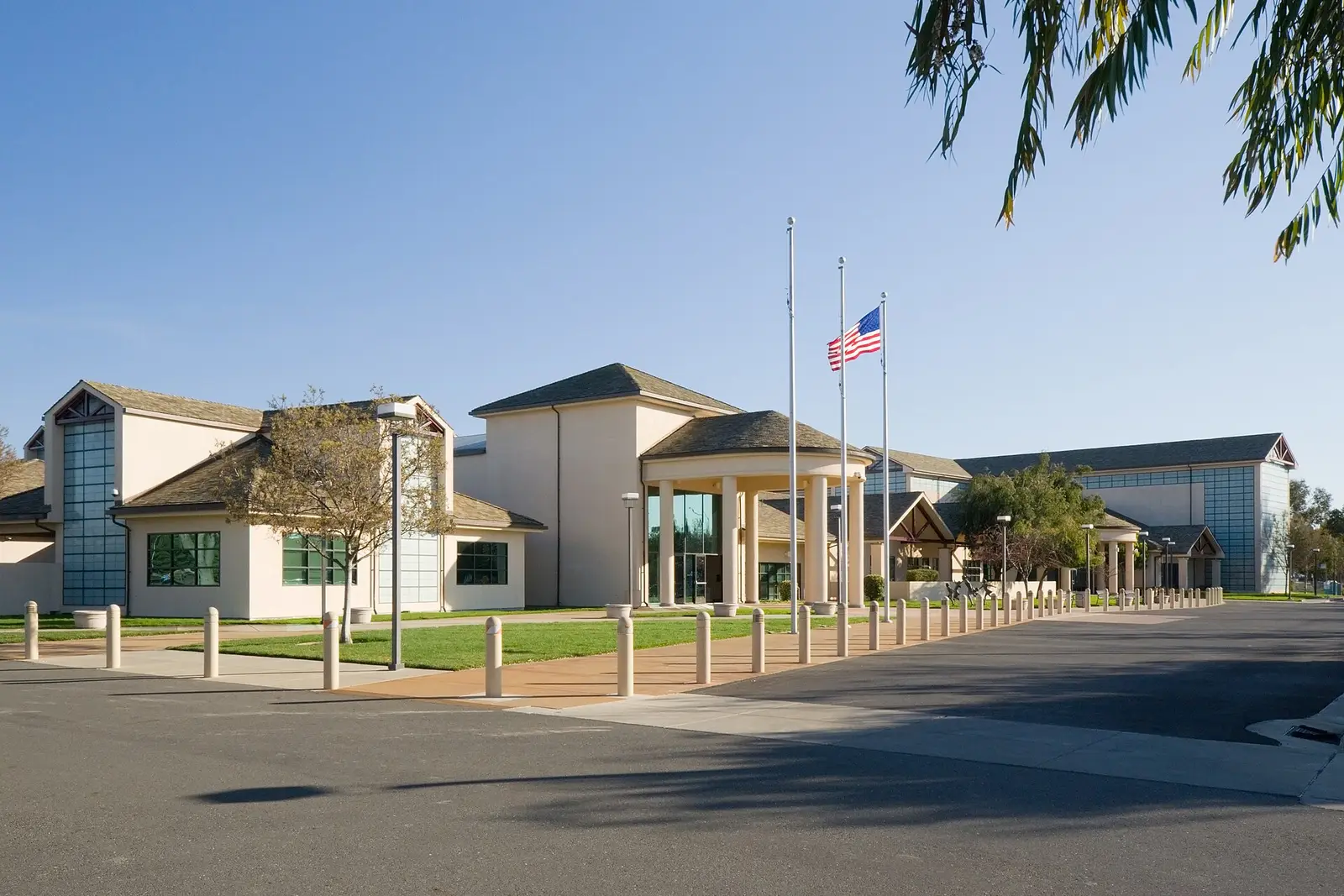
The Silliman Activity and Family Aquatic Center in Newark. Photo: LPS.1, CC0, via Wikimedia Commons.
ZIP codes
94560
When the homes were built
1960-1979
Main streets
Thornton Avenue, Mowry Avenue, Jarvis Avenue, Cedar Boulevard
Landmarks
Lakeshore Park, NewPark Mall, Silliman Community Activity Center
What homes in Newark need most
Sliders that drag after fifty years
Newark grew from 1,532 residents in 1950 to 27,153 in 1970, and 53 percent of its housing dates from 1960 to 1979, so a large share of the city's patio doors and windows are the same age. Where original sliders survive, worn rollers, bent tracks and dried-out weatherstripping make them drag, jump the track or let in drafts. New rollers, a cleaned and straightened track, fresh pile seals and an adjusted latch usually bring them back. A pane with a failed seal or a frame racked out of square is work for a glass or window company. More about door and window repair
Bathrooms that aged on one schedule
The first homes at The Lake were occupied by Thanksgiving 1966, and much of the rest of Newark filled in within the same few years, which means kitchens and bathrooms across whole neighborhoods have been updated piecemeal for decades. A single room can mix a newer faucet with an original shutoff valve that no longer closes. Dripping cartridges, running toilets, stiff angle stops and corroded supply lines are parts swaps a handyman can finish in one visit. Leaks inside a wall or under the floor are a job for a licensed plumber. More about faucet, toilet and fixture repair
Original ceiling lights from the 1960s
In a house built in Newark's late-1960s tracts, a hallway or bedroom fixture that has never been changed is more than fifty years old, and its sockets and glass shades show it. Swapping an old fixture for a new light, or a light for a ceiling fan, on an existing box is handyman work, as long as the box is rated for the fan's weight. Adding a new circuit, running wire to a new switch location or moving a box across the ceiling needs a licensed electrician.
Downspouts on flat, flood-mapped lots
Newark is low and level, and its Housing Element shows the 100-year flood zone covering much of the southern part of the city, with the 500-year zone reaching into established neighborhoods. On ground with so little slope, water from an overflowing gutter or a downspout that empties beside the wall tends to pool against the house instead of draining away. Clearing gutters before the rainy season, re-hanging sagging sections and adding downspout extensions that discharge well away from the foundation are small jobs that keep rainwater moving.
Anchoring furniture for the Hayward Fault
According to the city's Housing Element, most of developed Newark would feel very strong shaking in a magnitude 6.7 earthquake on the Hayward Fault, and some areas violent shaking, with the strongest levels in the south and west of the city. Tall bookcases, dressers, wall shelves and flat-screen TVs are the things most likely to topple. Strapping furniture to wall studs, fitting cabinet latches and mounting shelves into framing rather than drywall anchors are quick, practical jobs. Bracing a water heater or any foundation retrofit is for a plumber or contractor. More about general handyman repairs
How the houses here are built
Seventy percent of Newark's homes are detached single-family houses, most from the 1960s and 1970s tracts such as The Lake, planned in 1965 with ranch-style homes around a man-made lake; the oldest housing is in Mirabeau Park and Old Town/Central Newark along Thornton Avenue, and newer subdivisions include NewPark Place and Sanctuary Village.
Because most of the city was built within two decades, houses on the same street tend to share doors, windows and fixtures of the same age and wear out on the same schedule. The ground under them is sandy loam that the city's Housing Element calls prone to liquefaction, so anything involving foundations or settlement belongs with a structural engineer.
Newark sits about 20 feet above sea level at the south end of the bay, where winter storms fall on ground that the city's flood map puts largely inside the 100-year flood zone across its southern half.
Good to know before a job in Newark
One city, one liquefaction zone
Newark's 2023-2031 Housing Element states that the city sits two miles west of the Hayward Fault, has a sandy loam soil prone to liquefaction, and, based on California Geological Survey data, lies entirely within a liquefaction hazard zone. The same document puts much of the south of the city in the 100-year flood zone and notes that the municipal code requires new lowest floors to sit at or above the 100-year flood elevation. None of this stops routine repairs, but a crack that keeps widening or a floor that has started to tilt calls for a structural engineer before any patching.
How The Lake was built
In March 1965, Transamerica Development Co. filed a plan for 283 acres of the former Patterson Ranch between Jarvis Avenue and the Nimitz Freeway: 770 ranch-style homes on lots of 6,000 to 8,000 square feet, set around a man-made freshwater lake meant as the center of a small park. That lake is now Lakeshore Park. Newark had incorporated only ten years earlier, in September 1955, as the first new city in Alameda County in 47 years, and in the early 20th century much of the land was still marsh and waterways leading to the bay.
Repair help from the city
Newark's Housing Element includes Program H1.1, Housing Rehabilitation and Repair, which supports low- and moderate-income homeowners with repairs, and says outreach will focus on Mirabeau Park and Old Town/Central Newark, where some of the city's oldest houses stand. The existing rehabilitation program has helped about ten homes a year. If you own an older house and a repair is more than you can manage, ask the city's housing staff whether you qualify before booking the work.
How a request works
Describe the job
A sentence and a photo or two is enough. It takes about a minute.
A local handyman gets in touch
By call or text, to ask what the photos don't show and give you a price.
You decide
Agree a time and price with the handyman directly, or don't. Requesting costs nothing.
Questions from Newark homeowners
Is all of Newark really in a liquefaction zone?
Yes, according to the city's Housing Element, which cites California Geological Survey data showing the entire city as a liquefaction hazard zone, on sandy loam soils two miles west of the Hayward Fault. It mainly shapes how new buildings are engineered. It does not stop ordinary repairs, and anchoring tall furniture and shelves to studs is a sensible small step for any house here.
Newark is surrounded by Fremont. Will a handyman come to 94560?
Yes. Newark is an enclave inside Fremont, with Interstate 880 along its eastern edge and the bay to the west, and 94560 is its only ZIP code. Handymen who work in Fremont usually cover Newark as well. Give your street address when you describe the job so it goes to someone close by.
When were the houses in The Lake neighborhood built?
Transamerica Development Co. filed the plan for The Lake in March 1965, and the first homes were occupied by Thanksgiving 1966, so most houses there date from the late 1960s. For the exact year of your own house, check the Alameda County Assessor's record or the original permit, which also helps when matching replacement parts for doors, windows and fixtures.
Our house is in the flood zone near the bay. What small repairs actually help?
Keep gutters clear, make sure every downspout discharges several feet from the house, and seal gaps at door thresholds and along the bottom of the garage door. These keep everyday rain out. None of them flood-proofs a house against a real bay flood; elevation and flood insurance are questions for an engineer and an insurance agent.
Checked against these public sources in September 2026. Rules change: confirm anything permit-related with the city or town of Newark before work starts.