Livermore repairs, from First Street bungalows to Springtown
Livermore's tap water is hard, and harder in winter when more groundwater enters the blend, so scaled aerators and stiff faucet cartridges are routine repairs. Summer afternoons pull westerly wind through the valley toward Altamont Pass, which works fences and gates loose. Houses run from pre-war bungalows on the grid south of First Street to 1960s Springtown starter homes.
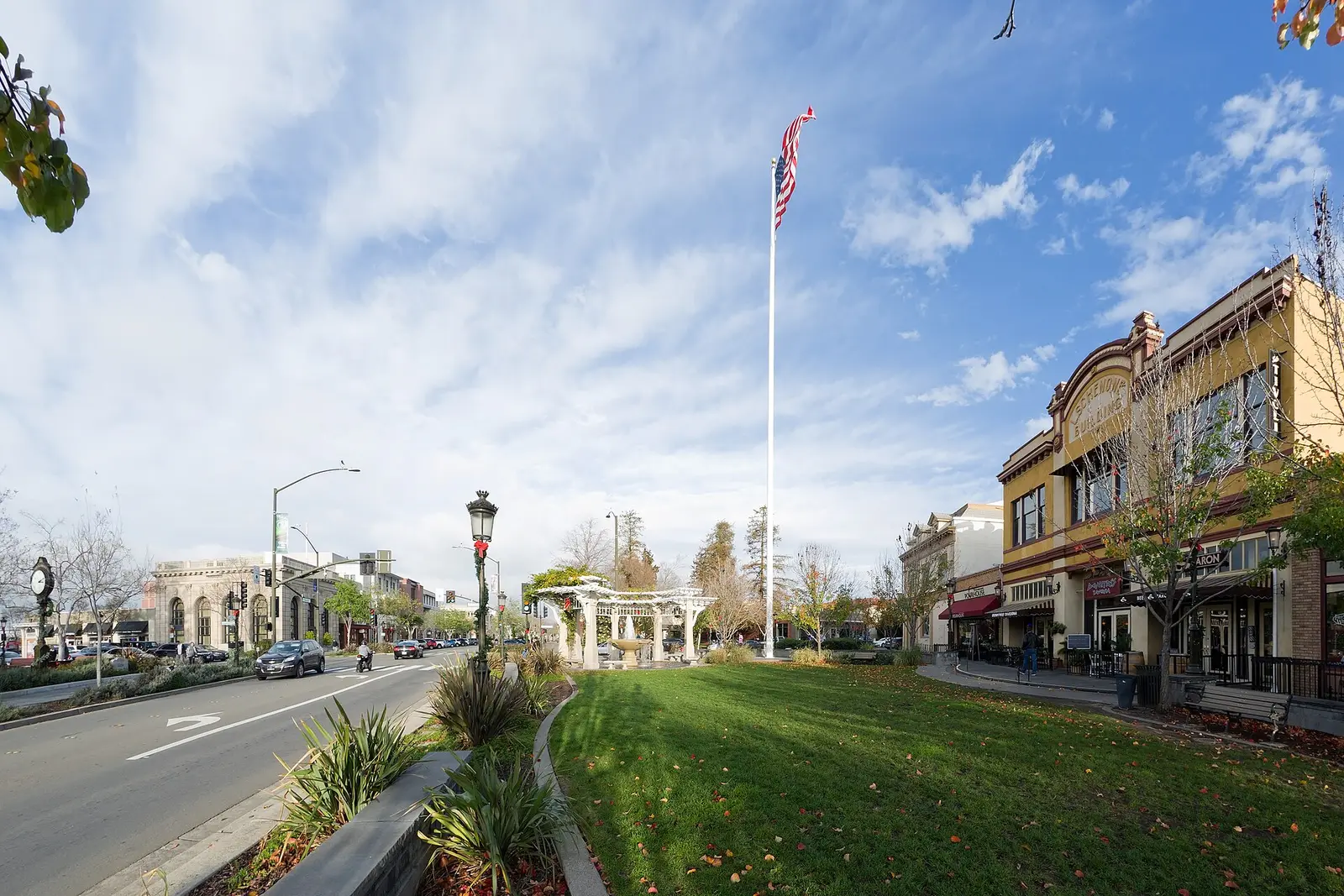
The flagpole in downtown Livermore, a landmark since 1905. Photo: LPS.1, CC0, via Wikimedia Commons.
ZIP codes
94550, 94551
When the homes were built
1870s-1990s
Main streets
First Street, Railroad Avenue, South L Street, McLeod Street
Landmarks
Carnegie Library on Third Street, Livermore Railroad Depot, Centennial Light at Fire Station 6
What homes in Livermore need most
Mineral scale from hard tap water
Livermore Municipal Water, which serves the northern and eastern parts of the city, reports hardness of about 213 to 287 parts per million, climbing in winter when it takes more groundwater. Cal Water, which serves the rest, lists its local and Zone 7 groundwater at averages above 300 ppm, though the surface water it buys is far softer. That mineral load clogs aerators and showerheads, stiffens faucet cartridges and wears out toilet fill valves. Descaling or replacing those parts fits in one visit; anything inside the walls is a plumber's job. More about faucet, toilet and fixture repair
Fences that take the afternoon wind
In summer a pressure gap between the ocean and the heated interior drives westerly and southwesterly wind through the Livermore Valley and out through Altamont Pass, strongest from late afternoon into early evening. A long wood fence broadside to that flow flexes day after day, so posts work loose, rails split at the fasteners and gates slam or sag. Resetting failed posts, screwing rails instead of relying on nails and fitting stronger gate hinges are the usual fixes, and the gravelly soil makes each post hole slow digging. More about fence, deck and gate repair
Wood sash on the old downtown grid
When the town grew after the 1869 railroad depot, houses went up on the gridded streets south and southeast of First Street, and the city's 2021 survey found historical resources along South L Street, South M Street and McLeod Street. Many of these houses keep original wood sash that sticks, loses its cords or rots at the sill after a century of dry summers. Freeing painted-shut sash, restringing weights, replacing worn hardware and rebuilding sills keeps the original windows working. More about door and window repair
Storage in small Springtown houses
Springtown was built in the 1960s around a public golf course, and its first houses were two- and three-bedroom homes of roughly 870 to 1,300 square feet. At that size closets and garages fill quickly, so the common carpentry is shelving inside existing closets, a wall of garage shelves above the car, and hooks or a bench by the back door. Fastening into studs matters here, since loaded shelves hung on drywall anchors alone tend to pull out over time. More about carpentry, shelves and trim
Dried caulk and dusty drafts
Summer days near 90°F bake the caulk around window frames, trim and siding joints until it shrinks and cracks, and the evening wind then drives dust and warm air through every gap it leaves. Cutting out failed caulk and resealing, fitting new weatherstripping on doors that face west, and adding sweeps at thresholds keep rooms cooler and floors cleaner. New sealant cures best when it is applied in a mild month, not on a wall already too hot to touch. More about weatherstripping, caulking and sealing
How the houses here are built
Early houses stand on the gridded streets south and southeast of First Street, and Trevarno Road keeps 13 officers' houses built for a fuse company in 1913-15. Most of the city is post-war tract housing that followed the Radiation Laboratory's arrival in 1952, including Springtown, begun in the 1960s in the northeast.
Downtown's older houses are wood-frame with wood sash windows, siding and porches, the parts that wear first. The valley floor's soil is classified as very gravelly coarse sandy loam, so digging for a fence post or footing usually means working through stones rather than clay.
July highs average 89°F with a record of 116°F, and on summer afternoons wind pulled from the coast toward the hot Central Valley crosses the valley on its way to Altamont Pass.
Good to know before a job in Livermore
What the 2021 historic survey found
A citywide survey update in 2021 identified 53 historical resources: 52 individual properties, many on First, Second and Third Streets and the residential grid around them, and one district, Trevarno Road. It flagged 195 more as potential historical resources. The consultants also checked post-war tracts through tract maps and found none that met the thresholds for significance, and properties with assessor dates after 1975 were not evaluated. Owners of an older house near downtown can ask city planning staff whether it is listed before changing windows, siding or a porch.
Trevarno Road's fuse-company bungalows
In 1913-14 the Coast Manufacturing and Supply Company moved its safety-fuse works from Oakland to Livermore and built a two-story brick headquarters and 13 houses for its officers, between First Street and the railroad. Most were modest Craftsman bungalows; the company president's larger Mission Revival house still stands at First Street and Trevarno Road. The houses were sold to a developer in 1976 and resold to individual owners as Trevarno Estates. Work here is mostly repair in kind of trim, windows and porches.
Springtown after the golf course
The nine-hole Springtown golf course closed in 2015, and voters kept its 85 acres as open space through Measure FF in 2016. Separately, the city has replaced close to 70 polybutylene water service lines between Springtown Boulevard and Rhododendron Drive, because that type failed more often than lines in surrounding areas. The city's work runs from its main to the meter. Piping from the meter into the house belongs to the owner, which is worth knowing when a leak shows up in the yard.
How a request works
Describe the job
A sentence and a photo or two is enough. It takes about a minute.
A local handyman gets in touch
By call or text, to ask what the photos don't show and give you a price.
You decide
Agree a time and price with the handyman directly, or don't. Requesting costs nothing.
Questions from Livermore homeowners
Should I install a water softener in Livermore?
Livermore Municipal Water discourages salt-regenerated softeners: the salt ends up in wastewater, raises the salinity of recycled water used for irrigation, and can seep back into the groundwater that supplies drinking water. The city suggests an exchange tank service if you want softened water. Without one, periodically cleaning aerators and replacing worn cartridges and fill valves keeps fixtures working.
Is my old house south of First Street on Livermore's historic list?
It may be. The 2021 survey update identified 53 historical resources and 195 potential ones, concentrated downtown and on the residential grid south and southeast of First Street, with addresses on South L Street, South M Street and McLeod Street among them. Post-war tracts were not found significant. Ask city planning staff about your address before changing the look of the house.
Why do my fence posts loosen every summer in Livermore?
Wind is a likely cause. In summer, westerly wind is pulled through the valley toward Altamont Pass and peaks from late afternoon into evening, so a fence facing it flexes almost daily. That loosens posts and fasteners and drags gates out of line. Resetting the failed posts, adding screws at the rails and rehanging gates on sturdier hinges usually holds.
The city replaced Springtown's polybutylene service lines. Does that cover my house?
No. The project replaced lines from the city main to the water meter on streets between Springtown Boulevard and Rhododendron Drive. Everything on the house side of the meter is the owner's. If a fixture's supply line is old or kinked, a handyman can swap it along with the shutoff valve; replacing piping in the walls or yard is work for a plumber.
Checked against these public sources in September 2026. Rules change: confirm anything permit-related with the city or town of Livermore before work starts.