Drywall and plaster Fremont

Fremont walls: prewar plaster in the old towns, gypsum board in the tracts

Fremont's walls divide at the Second World War. Houses from the tracts platted around Niles, Centerville and Irvington before it date from the plaster era, on wood lath or, by the late 1930s, gypsum rock lath. Glenmoor Gardens, Mission Ranch and the postwar tracts that followed are gypsum board. The city's list of work needing no permit names painting and similar finish work but not wallboard, and every construction debris box in Fremont has to come from Republic Services.

  • Free to request, no obligation to hire
  • Up to five local pros who take this work can reply
  • Rules on this page checked against 12 public sources, October 2026

Asked most

Fremont wall-repair questions, answered from city and state rules

Does a drywall patch in Fremont need a building permit?

The city's handout of work that needs no permit exempts painting, papering, tiling and similar finish work, but it does not name drywall, and it tells owners to check with the Building Department when unsure. A patch that restores the fire-rated wall to an attached garage, or one that comes with replacing concealed pipe, is the kind of job to ask about first. Plans and Permits staff answer questions by email.

Our 1920s house in Niles has cracked plaster. Does an interior repair need historic review?

Not for that reason alone. Fremont's Permit Types page requires a Historic Evaluation Request for properties 50 years or older before permits for demolition, relocation or exterior modifications, so wall work inside the house does not trigger it. Brief 21 favors keeping old plaster wherever it can be repaired: loose areas screwed back with plaster washers and holes filled over metal lath, rather than stripping rooms to the studs.

Can drywall scraps go out with a Republic bulky pickup?

No. Households with their own curbside service get two free on-call Bulky Goods pickups a year for things like furniture, appliances and televisions, and the city says construction and demolition debris will not be accepted. Broken board from a wall repair goes into a Republic debris box or leaves in the contractor's own vehicle for an approved recycling facility.

Mission Peak above Lake Elizabeth in Fremont
Mission Peak above Lake Elizabeth in Fremont. Photo: Oleg Alexandrov, CC BY-SA 3.0, via Wikimedia Commons.

Free request

Describe the drywall job once. Local pros who take work in Fremont reply by call or text.

  • No fee to request, and no obligation to hire
  • You agree scope and price with the pro you choose
  • Photos help them quote without a first visit

Get quotes for drywall work in Fremont

Two short steps. A local pro who takes this work calls or texts you back.

To send a request, call or text (415) 449-8213.

Free to request, and you agree the scope and price with the person you hire before work starts. In California, a job over $1,000 in labor and materials, or one that needs a building permit, must be done by a contractor licensed by the CSLB in the right class. Ask for the license number and check it at cslb.ca.gov.

Free, no obligation. Next, add your details in the request form.

Permits and local rules

The Fremont and state papers behind a wall repair

  1. What Fremont's no-permit handout leaves out

    The Building & Safety Division's handout of construction work you can do without a permit, drawn from the building code and the Fremont Municipal Code and last updated in May 2020, exempts painting, papering, tiling, carpeting, cabinets, countertops and similar finish work. Drywall is not named, and the handout tells owners to check with the Building Department whenever they are unsure. Stopping a leak is exempt, but once a concealed trap, drain, water, waste or vent pipe has to be replaced, that is new work needing a permit and an inspection.

    Source: City of Fremont Building & Safety Division (fremont.gov)

  2. Express record, general permit or historic evaluation

    The city's Permit Types page lists express permits that Citizen Access issues automatically for limited work, among them the like-for-like kitchen and bath remodel that removes or alters no wall. Residential alterations and repairs beyond that use the general Building Permit. On the Planning side, a property 50 years or older goes through a Historic Evaluation Request before permits for demolition, relocation or exterior modification, so wall work confined to the inside of an old Niles or Irvington house does not set one off.

    Source: City of Fremont Planning & Building Permits (fremont.gov)

  3. Section 1529 and the 1980 cutoff

    Title 8, Section 1529, Cal/OSHA's asbestos standard for construction work, defines presumed asbestos-containing material as thermal system insulation and surfacing material found in buildings constructed no later than 1980. Surfacing material means anything sprayed, troweled on or otherwise applied, acoustical plaster on ceilings being the standard's own example. An employer may rebut the presumption by testing. Until then, repair and maintenance likely to disturb it is Class III work, and training for Class III workers includes hands-on practice and takes at least 16 hours.

    Source: Cal/OSHA, Title 8 Section 1529 (dir.ca.gov)

  4. Republic's boxes, or the contractor's own truck

    Fremont's Waste Handling Guidelines, revised in January 2026, make Republic Services the exclusive debris box hauler for all construction debris apart from separated loads of soil, asphalt or concrete, and prohibit using a third-party hauling company. A contractor may self-haul only when removing the debris is incidental to its own work, using its own employees, vehicles and equipment, delivering to an approved recycling facility and listing Fremont as the city of origin on every weight tag and receipt. Scrap drywall is named among the recyclable debris.

    Source: City of Fremont Environmental Services Division (fremont.gov)

State license for this work: C-9 Drywall, C-35 Lathing and Plastering, C-22 Asbestos Abatement. Look up a contractor's license on the CSLB website (cslb.ca.gov).

The work

What keeps cracking, staining and breaking in Fremont walls

  • Straight cracks over rock lath in a 1930s house

    Rock lath came as 16-by-36-inch gypsum panels that took two coats of plaster, Brief 21 explains, and cracks can open along the joints between panels when a nail rusts or loosens or the framing behind them shifts. In a house from one of the later prewar tracts in Niles or Centerville, a crack running in straight lines is often that seam. Wood-lath plaster fails another way: the strips take on and give off moisture, and the Brief ties that to horizontal cracks that reappear every year.

  • Holes in the wall shared with the attached garage

    Because the postwar Ranch house put its garage against the rooms, the wall between them is a fire separation under Table R302.6 of the 2025 California Residential Code. At minimum that means half-inch gypsum board facing the garage, rising to 5/8-inch Type X where a room is built over the garage. Old shelf anchors, a cut-in dryer vent or a pipe passing through all leave openings, and patching one means putting back board of the required kind, not just compound.

  • A sprayed ceiling in a Glenmoor Gardens or Mission Ranch house

    Both tracts were finished long before 1981, and that date matters to the crew. Cal/OSHA's construction asbestos standard presumes that sprayed or troweled-on surfacing material in a building constructed no later than 1980 contains asbestos until testing shows otherwise, and repair likely to disturb it is Class III work. The Air District has a timing rule of its own: removing regulated asbestos material dry needs advance notice whatever the size of the area.

  • Walls opened for a kitchen or bath that keeps its layout

    Fremont issues an express Residential Kitchen and Bath Remodel, Like for Like permit online, automatically, for work that neither removes nor alters a wall. Opening drywall to reach a shutoff and closing it again is the patch most of these jobs end with. Moving a wall sends the project to a general Building Permit, and the city's handout counts replacing a failed concealed drain, water or vent pipe found behind the board as new work that needs a permit of its own.

  • Board that stayed wet after a leak

    The California Department of Public Health says moldy porous materials such as drywall cannot be completely disinfected and must be removed, and that bleach is unnecessary once mold has been cleaned off hard surfaces. Its booklet gives rough sizes: a small problem under 10 square feet, about 3 feet by 3, is one an owner may try to clean, while one over 100 square feet may be better handed to an experienced contractor. Stop the leak first, then cut back to sound board.

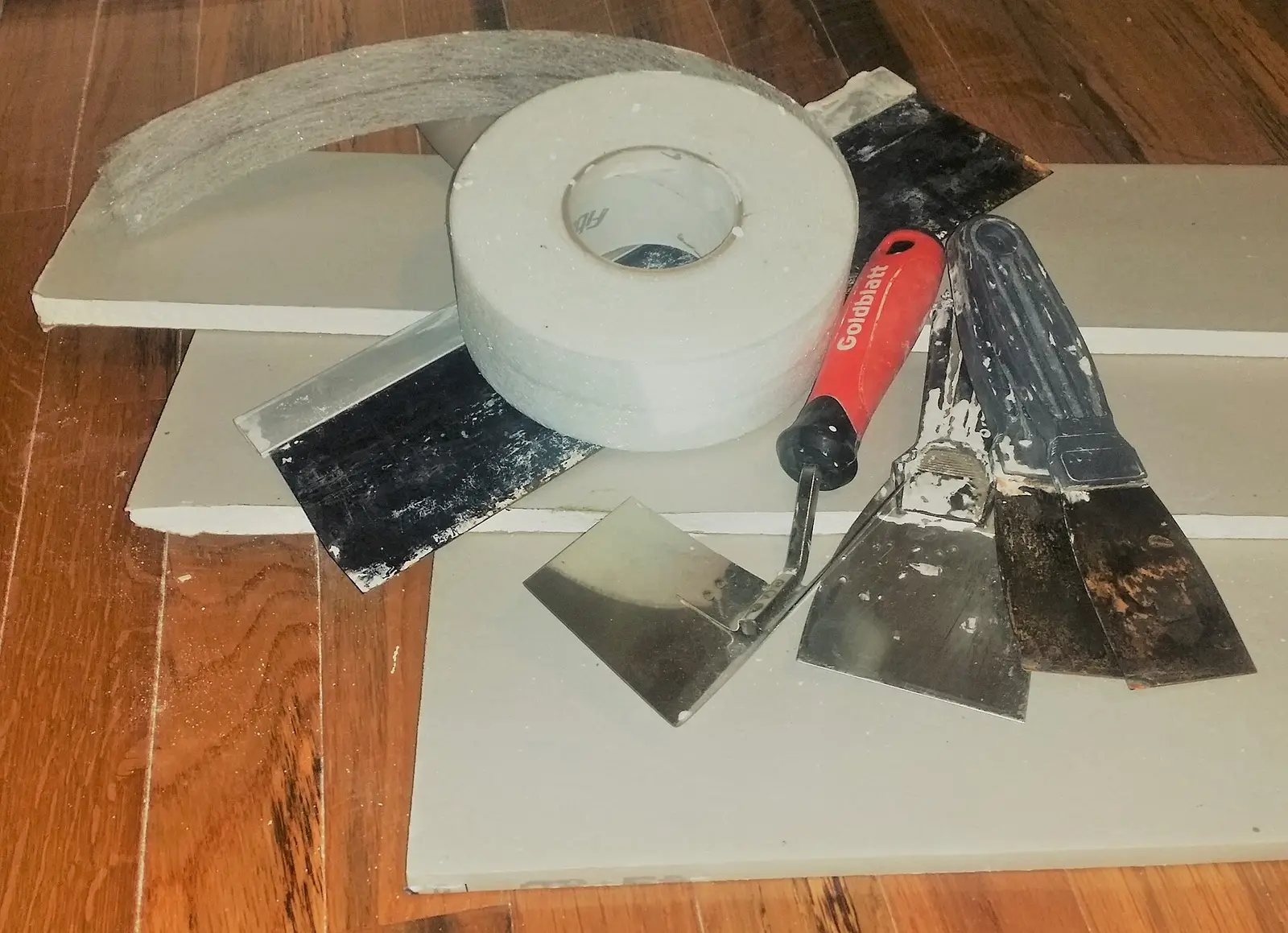
Drywall sheets on a wood floor with a roll of mesh joint tape and several taping knives
Drywall sheets on a wood floor with a roll of mesh joint tape and several taping knives. Photo: Timothyjosephwood, CC BY-SA 4.0, via Wikimedia Commons.

The houses here

Plaster in the five old towns, board in the ranch tracts

Before the 1950s this was farmland and small towns, and the city's 2009 historic context of Glenmoor Gardens and Mission Ranch counts only about 30 block-and-lot tracts platted here between the Gold Rush and the early 1950s. Niles had its town plat of 1888 and at least 17 subdivisions between 1900 and 1942; Centerville gained six between 1906 and 1926, Irvington four between 1907 and 1924. The Park Service's Preservation Brief 21 says plaster was the wall surface for nearly all buildings until the 1930s or 40s, and that rock lath had become almost the only residential base by the late 1930s. Then came the postwar wave: 1,624 houses in Glenmoor Gardens from 1952 and 318 in Mission Ranch between 1956 and 1961, Ranch houses whose hallmark, the study notes, is the attached garage.

Part by part

Where in Fremont the wall behind the paint changes

  • Niles

    The Central Pacific Railroad platted the town in 1888, eight blocks of narrow lots, and the grid was later pushed west by the Mortimer Addition of 1906 and 1909 and the Sullivan tracts of 1910 and 1922. Most of its older houses date from the plaster era, and interior repair alone does not call for a historic evaluation.

  • Centerville

    Its prewar tracts surround the old crossroads between Central and Thornton Avenues: the August May Tract of 1906, Overacker in 1920, Parish Homes in 1923 and the Hansen Tract in 1926, laid out by the owner of the township's leading lumber company. A house from those years may be plastered over wood lath or over rock lath.

  • Irvington

    Four tracts were platted here between 1907 and 1924, and the town's leading developer, Otto N. Hirsch of a prominent mercantile family, laid out two small residential ones. His 450-lot Bond Tract north of town was sold but never built on, and the land became Mission Ranch half a century later, so plaster-era houses and a 1950s board-walled tract sit close together.

  • Glenmoor Gardens

    The city's largest subdivision, 1,624 houses built by Glenmoor Homes from 1952. Its brochures let buyers combine or change features of the plans, so two houses that look alike from the street can differ inside. The wall each shares with its attached garage is the patch here that carries fire rules.

  • Mission Ranch

    Its 318 houses went up between 1956 and 1961 on former farmland bordered by Driscoll Road and Mission Creek, below the hills. All of them predate Cal/OSHA's 1980 cutoff, so a crew treats a sprayed or troweled ceiling there as presumed asbestos until a lab result says otherwise.

Before you hire

Before a Fremont wall is cut open, settle these

  • If the house is prewar, will you repair the plaster or rock lath where it is sound instead of covering it with new board?
  • Whose debris box will it be? In Fremont it must be Republic's, or your own vehicle to an approved recycler with Fremont on the weight tag.
  • With a sprayed or troweled ceiling in a house built before 1981, will a sample be tested before anyone sands or scrapes it?
  • On the wall to the attached garage, which gypsum board goes back in, and does the city want a permit for that patch?
  • For a stained ceiling, will you find and stop the water first, and cut out moldy board rather than paint over it?

Free, no obligation. Next, add your details in the request form.

More questions

Still deciding?

Is the popcorn ceiling in our Mission Ranch house asbestos?

It may be, and nobody should guess. Cal/OSHA presumes that sprayed or troweled-on surfacing in a building built by 1980 contains asbestos until it is tested, and every Mission Ranch house dates from 1956 to 1961. For a house of four or fewer units, the Air District's Rule 2 requires a sample before an acoustic ceiling is disturbed, and its list also takes in HVAC ducting, stucco and resilient flooring.

Can the person patching our wall take the old drywall away in a pickup?

Only on the city's terms. Fremont's Waste Handling Guidelines let a contractor self-haul when removing the debris is incidental to the work, with its own employees, vehicles and equipment, to an approved recycling facility, and with Fremont listed as the city of origin on all weight tags and receipts. Hiring some other hauling company instead of Republic Services is prohibited.

Where these facts come from

Checked against these public sources in October 2026. Rules and programs change: confirm permit requirements with the city before work starts, and a contractor's license on the CSLB website.

  • fremont.gov: 637769005420130000 (fremont.gov)
  • fremont.gov: permit types (fremont.gov)
  • fremont.gov: 638416080467670000 (fremont.gov)
  • fremont.gov: environmental services faqs (fremont.gov)
  • fremont.gov: construction demolition debris (fremont.gov)
  • fremont.gov: 639116743413000000 (fremont.gov)
  • nps.gov: preservation brief 21 flat plaster (nps.gov)
  • codes.iccsafe.org: chapter 3 building planning
  • dir.ca.gov: 1529 (dir.ca.gov)
  • baaqmd.gov: rg1102 (baaqmd.gov)
  • cdph.ca.gov: MMIMH 050619 ADA (cdph.ca.gov)
  • cslb.ca.gov: Licensing Classifications Detail (cslb.ca.gov)

Drywall work in Fremont? Tell us what you see.

One request reaches local handymen and contractors who take this work. The Handyman SF connects you with them; it does not do the work.

HandymanNow for handymen Work in Fremont? Get job leads by text. Pick your trades and areas, take only the jobs you want. No subscription. Start getting leads HandymanNow for homeowners Get the HandymanNow app. Send a request with photos, message your handyman and follow them on the way. Download the app

HandymanNow app

Fix it faster. Find work faster.

Homeowners send a job with photos and follow their handyman on the map. Handymen get local jobs by text and take only the ones they want.

Call WhatsApp (opens WhatsApp) Free quote