Painting Fremont

Repainting Fremont's post-war ranch tracts and its older town centers

Thousands of Ranch houses went up around Fremont in the quarter-century after World War II, making the Ranch the city's most common house type, and the tract version was typically stucco-sheathed. Glenmoor Gardens, Irvington Square and Mission Ranch were built between 1952 and 1966, so their original walls fall under the EPA's lead rule for pre-1978 housing. A repaint needs no Fremont building permit; lead-safe prep is the part that cannot be skipped.

  • Free to request, no obligation to hire
  • Up to five local pros who take this work can reply
  • Rules on this page checked against 16 public sources, October 2026

Mission Peak above Lake Elizabeth in Fremont
Mission Peak above Lake Elizabeth in Fremont. Photo: Oleg Alexandrov, CC BY-SA 3.0, via Wikimedia Commons.

How painting work goes in Fremont

Fremont and Alameda County rules a paint job meets

  1. No permit to repaint, with a caveat

    Fremont's Building and Safety Division publishes a list of construction work that needs no permit, taken from the California Building Code and the Fremont Municipal Code, and painting is on it along with papering, tiling, carpeting, cabinets and countertops. The same sheet adds that an exemption does not authorize work done in violation of the code or of any other law or ordinance, which leaves the federal lead rule and any historic review exactly where they were. When in doubt, the division asks residents to check with it first.

    Source: City of Fremont Building and Safety Division (fremont.gov)

  2. Color counts in a Historical Overlay District

    Inside a Fremont Historical Overlay District, the city must find a project compatible with the district's historical character in terms of siting, massing, scale, size, material, texture and color, with the Historical Architectural Review Board advising the decision. The overlay chapter of the municipal code exempts most single-family and two-family houses, except one that is a listed or potential register resource, or that sits where council-approved guidelines require review. A new exterior color on an older house in Niles is worth a call to Planning before the paint is bought.

    Source: City of Fremont Planning Division (ESA review, 2018) (fremont.gov)

  3. Household paint, household drop-off

    Alameda County runs four household hazardous waste facilities, and Fremont's is at 41149 Boyce Road, open Wednesday to Friday from 8:30 a.m. to 2:30 p.m. and Saturday from 8:30 a.m. to 4:30 p.m. Residents bring ID with an Alameda County address and stay in the car while staff unload. Latex and oil-based paint, stains, varnishes and thinners are accepted, up to 15 gallons or 125 pounds a trip in containers of 5 gallons or less. Business waste is not.

    StopWaste (Alameda County Waste Management Authority) (opens in a new tab)
  4. Cleanup water stays out of the street

    The Alameda Countywide Clean Water Program, which Fremont belongs to, asks homeowners to make sure painting and remodeling contractors dispose of their materials properly and not in a gutter, storm drain or roadside ditch, and to take unused paint and thinner to a hazardous waste facility. In Fremont that matters because the storm drains and the sanitary sewer are separate systems, and the storm side runs to the creeks and the Bay without treatment, so a roller rinsed at the curb ends up there.

    Alameda Countywide Clean Water Program (opens in a new tab)

State license for this work: C-33 Painting and Decorating. Look up a contractor's license on the CSLB website (cslb.ca.gov).
Free request

Describe the painting job once. Local pros who take work in Fremont reply by call or text.

  • No fee to request, and no obligation to hire
  • You agree scope and price with the pro you choose
  • Photos help them quote without a first visit

Get quotes for painting work in Fremont

Two short steps. A local pro who takes this work calls or texts you back.

To send a request, call or text (415) 449-8213.

Free to request, and you agree the scope and price with the person you hire before work starts. In California, a job over $1,000 in labor and materials, or one that needs a building permit, must be done by a contractor licensed by the CSLB in the right class. Ask for the license number and check it at cslb.ca.gov.

Free, no obligation. Next, add your details in the request form.

The work

The work a Fremont repaint tends to involve

  • Stucco walls on a minimal ranch

    On a tract house the question that decides the product is what is on the stucco now, since the Park Service's stucco guidance makes compatibility with the existing coating the first test. Chalky areas need attention before latex goes on, and a stucco patch where a window was replaced may only disappear if the whole face of that wall is painted. Ask for the existing coating to be named in the quote rather than assumed.

  • Board and batten, fascia and a barn-style garage door

    The wood on a Ranch is where the lead rule bites soonest. Outside, the EPA's exemption ends at 20 square feet of disturbed paint, and the face of a garage door alone is larger than that, before counting fascia boards that run the length of a wide-eaved house. Scraping that much on a pre-1978 house means plastic on the ground for 10 feet out, closed windows within 20 feet, and no open-flame stripping or unshrouded power sanding.

  • Interior repaints and the test before scraping

    Indoors the rule allows 6 square feet of disturbed paint per room before it applies. A wall of cracked paint over a 1950s finish passes that quickly. Testing is not required, but it can take a component out of the rule: a renovator can use an EPA-recognized test kit or send paint chips to an EPA-recognized lab, and an inspector or risk assessor can read the walls with an X-ray fluorescence instrument. Without that paperwork, the paint is treated as if it contains lead.

  • Collecting chips and the painted scraps

    Under the EPA rule, renovation waste stays contained until it leaves the work area, and at the end of a job the chips and debris are sealed in heavy-duty bags without being spread around. None of it belongs in Fremont's compost cart, which takes wood only when nothing on it is painted, stained or treated. Paint, stains, thinners, caulk and stucco mix are on the city's list of items not accepted in any cart, so they go to a hazardous waste drop-off instead.

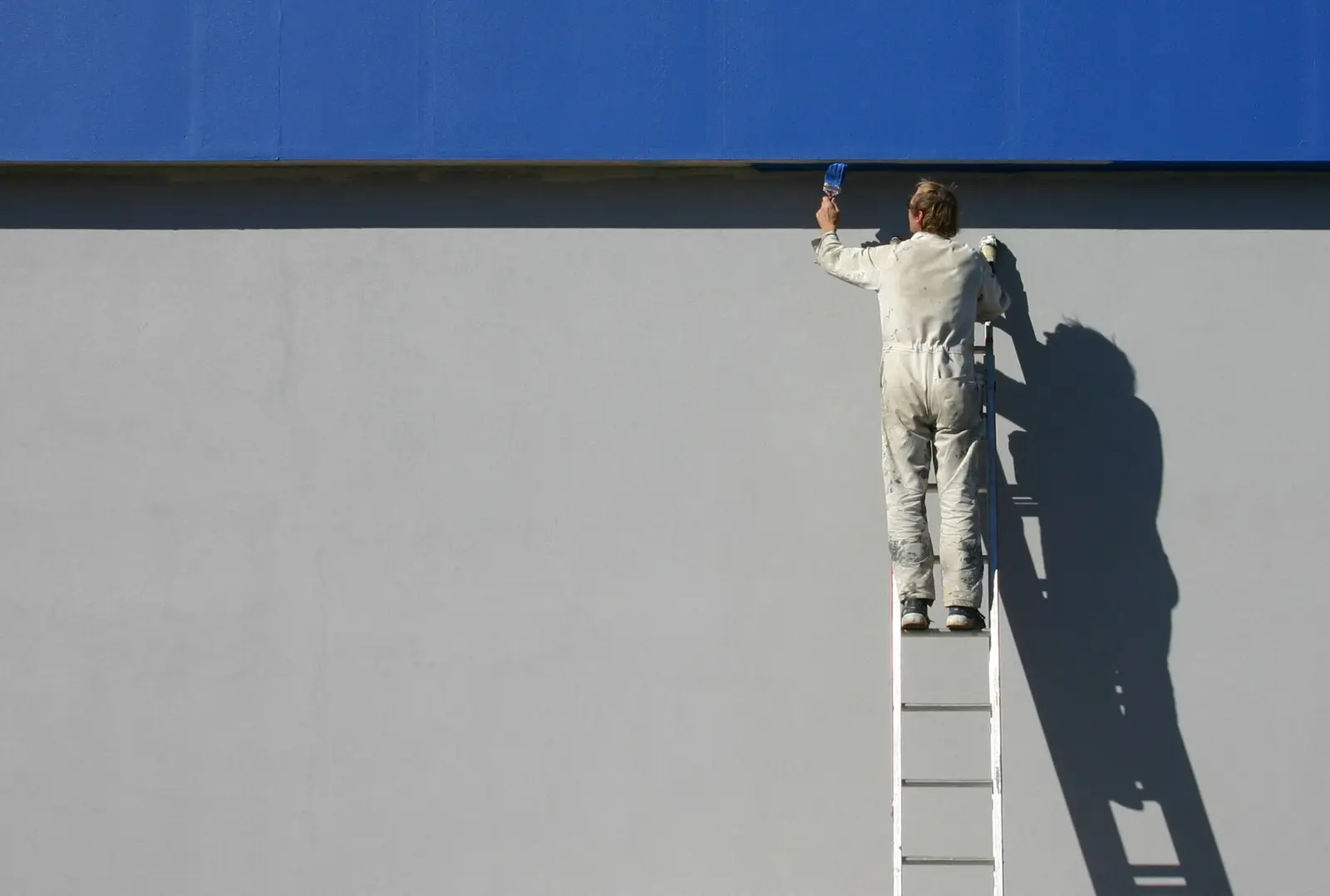
A painter in white overalls on a ladder, brushing paint along the top edge of a gray wall
A painter in white overalls on a ladder, brushing paint along the top edge of a gray wall. Photo: Lukeroberts, CC BY-SA 2.5, via Wikimedia Commons.

The houses here

Stucco boxes trimmed in wood, under wide low eaves

Fremont's 2009 historic context of Glenmoor Gardens, Mission Ranch and Ranch house design describes two versions of the house that fills its tracts. The full Ranch borrowed from farm buildings, with board and batten siding, shake roofs, Dutch doors and garage doors made to look like barn doors, all under low-pitched roofs with wide eaves. The tract version, which architectural historian Alan Hess called the minimal ranch, was mass-produced with less variety and was typically stucco-sheathed, on a rectangular footprint with a front ell for the garage. For a painter that usually means two surfaces on one house: stucco walls, and wood at the fascia, the eaves, the doors and any siding.

Part by part

Three Fremont neighborhoods, three different paint jobs

  • Glenmoor Gardens

    Building began here in April 1952 and ended in 1966 at slightly more than 1,600 houses, so every original one predates the 1978 line. The developer, Glenmoor Homes, planned larger than usual lots and large setbacks, which leaves room for ground sheeting, and it even kept a color specialist to advise new owners on interior finishes.

  • Irvington Square

    Laid out in 1954 and 1955 as Irvington's first large development, the 700-lot subdivision had lots of 5,000 square feet, and the city's study puts standard frontages of that era at 50 to 60 feet. On a lot that narrow, a side wall can easily stand within 10 feet of the property line, where the EPA rule calls for vertical containment or equivalent extra precautions.

  • Niles

    Niles is one of the Historic Overlay Districts, and its Design Guidelines and Regulations, adopted by the City Council in 2002, are written for the commercial properties in its core. Houses on the surrounding blocks are mostly exempt unless they are register resources, but color is one of the measures of compatibility here, so the paint choice on an older Niles house is not purely a matter of taste.

Before you hire

Ask a Fremont painter these before any scraping

  • For a Glenmoor or Irvington ranch from the 1950s, ask to see the firm's EPA renovation certification before scraping is even quoted.
  • On a lot about 50 feet wide, ask how the side walls within 10 feet of the property line will be contained.
  • Ask what coating is on the stucco now and which paint they will use over it.
  • Ask who takes the leftover cans; Boyce Road accepts household waste only, not a contractor's business waste.
  • For an older house in Niles, ask Planning whether a new exterior color needs review before the paint is ordered.

Free, no obligation. Next, add your details in the request form.

Questions

What Fremont owners ask before a repaint

Does Fremont make me pull a permit to repaint the house?

No building permit is needed. The city's Building and Safety handout of work exempt from permits, drawn from the California Building Code and the municipal code, lists painting as finish work. The exemption does not cover anything else, though: the EPA lead rule still governs scraping on a pre-1978 house, and a house in a Historical Overlay District may still need a word with Planning about color.

Our Glenmoor Gardens house was built in 1958. Should we assume lead paint?

Assume it until shown otherwise. Alameda County's lead program warns that most structures built before 1978 have lead-based paint under the surface layers, and the EPA rule treats the paint as lead-based unless there is documentation that it is not. A renovator can test with an EPA-recognized kit, or an inspector can use an X-ray fluorescence instrument, before the scope of the prep is decided.

Where do leftover cans go in Fremont?

To the county's household hazardous waste facility at 41149 Boyce Road, Wednesday through Saturday, with ID showing an Alameda County address and no appointment. Up to 15 gallons or 125 pounds a trip, each container 5 gallons or smaller. PaintCare drop-off sites, which take paint from households and businesses alike, are the other option, as long as the paint is in its original labeled can.

Can we choose any color for an older house in Niles?

Probably, but check first. Most single-family houses in a Fremont Historical Overlay District are exempt from historic review unless the house is a listed or potential register resource or sits where council-approved guidelines require review. Where review applies, the city judges compatibility partly by color. The Niles Design Guidelines from 2002 are aimed at the commercial core rather than the houses around it.

Can scraped trim and paint chips go in the green cart?

No. Fremont's compost cart takes wood only when it is not painted, stained or treated, and paints, thinners, caulk and stucco are among the items the city accepts in no cart at all. On a pre-1978 house the EPA rule also wants chips and debris sealed in heavy-duty bags without spreading them, so the waste is part of what to settle with the painter.

Where these facts come from

Checked against these public sources in October 2026. Rules and programs change: confirm permit requirements with the city before work starts, and a contractor's license on the CSLB website.

Painting work in Fremont? Tell us what you see.

One request reaches local handymen and contractors who take this work. The Handyman SF connects you with them; it does not do the work.

HandymanNow for handymen Work in Fremont? Get job leads by text. Pick your trades and areas, take only the jobs you want. No subscription. Start getting leads HandymanNow for homeowners Get the HandymanNow app. Send a request with photos, message your handyman and follow them on the way. Download the app

HandymanNow app

Fix it faster. Find work faster.

Homeowners send a job with photos and follow their handyman on the map. Handymen get local jobs by text and take only the ones they want.

Call WhatsApp (opens WhatsApp) Free quote