Patching Bay Area walls, from lath plaster to Type X garage board
Wall repair on a Bay Area house turns on what the wall is made of. Houses built before the 1940s were plastered, and the National Park Service advises keeping old plaster wherever it can be repaired, while postwar tracts have gypsum board. Older painted and textured surfaces raise a second question before anyone cuts or sands, because lead and asbestos may be in the layers.
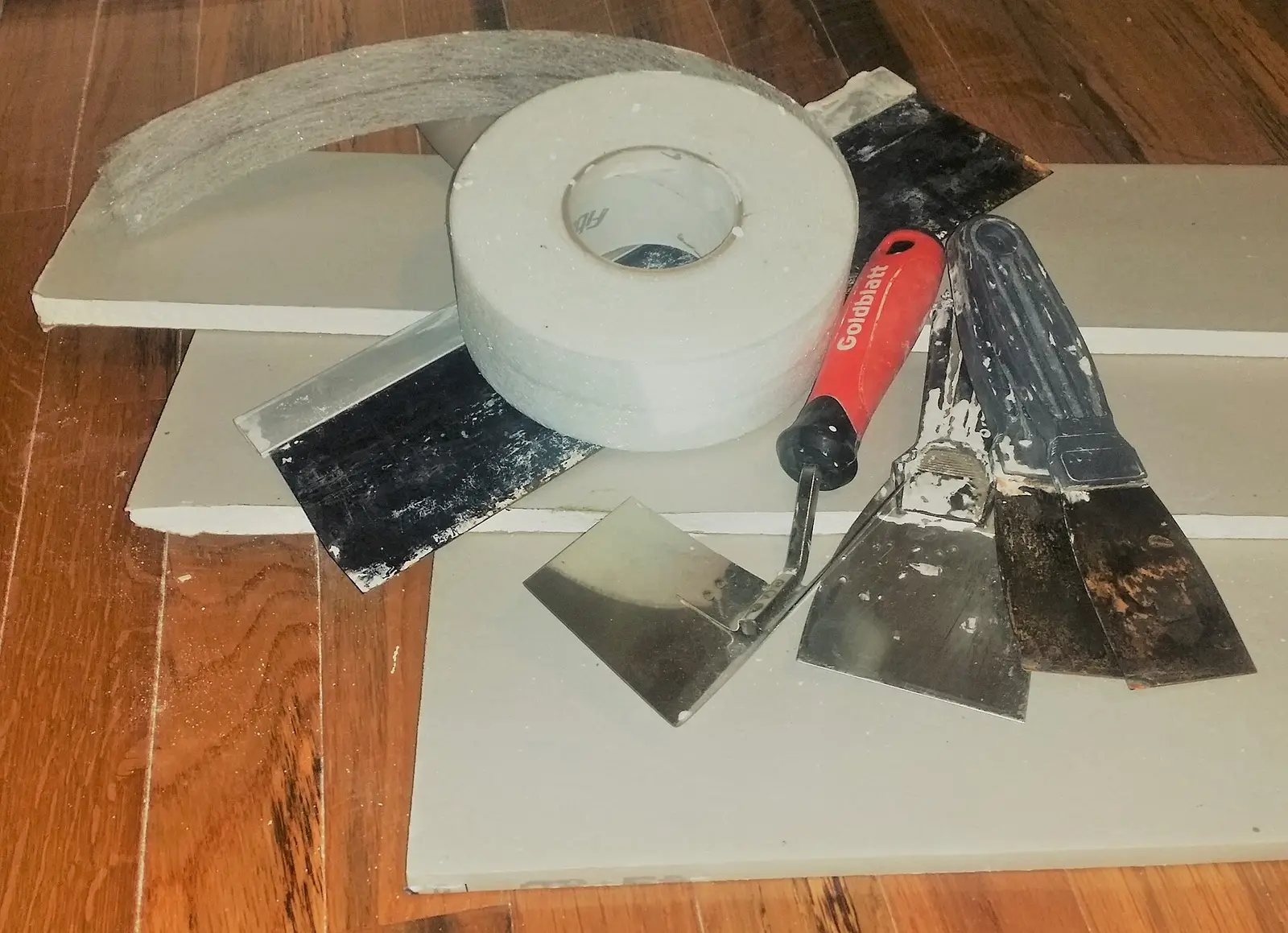
Drywall sheets on a wood floor with a roll of mesh joint tape and several taping knives. Photo: Timothyjosephwood, CC BY-SA 4.0, via Wikimedia Commons.
CSLB license class
C-9 Drywall, C-35 Lathing and Plastering, C-22 Asbestos Abatement
Where it applies
San Francisco, East Bay, South Bay
Request
Free, up to five local pros reply
Drywall jobs on Bay Area homes
Reattaching and patching old lath plaster
Plaster on wood lath holds by the keys that squeeze through the gaps between the strips, and a ceiling sags once those keys break. The Park Service's Preservation Brief 21 describes the usual fixes: loose plaster screwed back to the lath with flat-head screws and plaster washers, and a hole filled over metal lath fastened across the old wood lath, built up in layers. It adds that three-coat plaster resists fire and cuts sound transmission, two reasons to repair a sound wall rather than strip it.
Closing walls after plumbing or electrical work
A repipe, a new circuit or a leak repair leaves rectangles cut out of walls and ceilings, and the patch is often a different trade from the work behind it. On gypsum board the job is new board, tape and compound matched to the texture around it. On plaster, Brief 21 warns that quick-set joint compounds are hard to sand, so it keeps them for bedding tape and filling large holes and uses an all-purpose compound for the final coat. A patch through a garage fire wall has its own rules, set out below.
Ceilings and walls stained by a leak
Once the leak is fixed, the clock matters. The EPA says water-damaged areas should be dried within 24 to 48 hours to keep mold from growing, and that porous materials which do turn moldy, ceiling tiles among them, may have to be thrown away. It also warns against painting or caulking over a moldy surface, and points out that mold hides on the back side of drywall. A stain that comes back through fresh paint usually means wet or moldy board that needs cutting out.
Garage walls and ceilings shared with the house
The wall between an attached garage and the house is a fire separation, not just a partition. Table R302.6 of the California Residential Code calls for at least 1/2-inch gypsum board on the garage side, and 5/8-inch Type X board where rooms sit above the garage. Holes from old shelving, a dryer vent or a new pipe break that separation, and Section R302.5.3 requires penetrations through it to be protected. San Jose and San Francisco both leave fire-rated work out of their drywall permit exemptions.
Scraping or patching a textured ceiling
Acoustic and textured ceilings, and textured or skim-coated walls, are the finishes the Bay Area Air Quality Management District singles out. For a house of four or fewer units, its Regulation 11, Rule 2 does not require a full asbestos survey, but it does require the material to be sampled and tested before acoustic ceiling material or textured or skim-coated wall surfaces are removed or disturbed. The EPA lists textured paint and patching compounds used on walls and ceilings among the places asbestos may be found.
Replacing plaster that cannot be saved
When plaster is past repair, Brief 21 favors veneer plaster over drywall in a historic room: gypsum panels the size of drywall sheets, taped with fiberglass mesh and finished with thin coats of hard plaster that look closer to the original. Thickness matters too. Plaster over wood lath runs about 3/4 to 7/8 inch, and the Brief notes that plaster thickness sets how far trim projects from the wall, so ask how casings and baseboards will meet a thinner board.
The license this work needs
C-9 Drywall
C-35 Lathing and Plastering
C-22 Asbestos Abatement
Filling a crack or patching a hole stays handyman work while the whole job is under $1,000 in labor and materials and needs no permit. Above that line the CSLB splits the trade in two: C-9 covers hanging gypsum board and the taping and texturing that finish it, and C-35 covers lath and troweled or sprayed plaster coats. Removing material that tests positive for asbestos is a separate C-22 class, held only by contractors registered with Cal/OSHA. Check any license number at cslb.ca.gov.
Seasonal cracks in plaster often start in the ground. Brief 21 explains that houses on clay soils are especially vulnerable, because expansive clays such as montmorillonite shrink as they dry in summer and swell in the rainy season, leaving a house riding on an unstable footing. Diagonal cracks running in opposite directions suggest settling and soil conditions are at fault, and the Brief says a crack that seems to be expanding calls for a structural engineer before it is patched. Stable cracks can be taped and skimmed.
Eichler walls that are not drywall at all
Eichler houses change the job entirely. The National Register nomination for the Fairglen Additions tract in San Jose describes the original ceilings as the stained underside of 2-by-8 tongue-and-groove redwood roof decking, and the interior wall finishes as deep-toned Philippine mahogany veneer paneling. The same nomination compares one of its plans to an Eichler model also built in Palo Alto, Terra Linda and the San Mateo Highlands. Damage in an original Eichler room is usually a paneling or woodwork repair, not a drywall patch.
Lead in the paint layers
The EPA estimates that about three-quarters of U.S. homes built before 1978 still contain some lead-based paint. Sanding a patch smooth, cutting out a damaged section or scraping a ceiling turns those layers into dust. Its Renovation, Repair and Painting Rule requires anyone paid to disturb paint in a pre-1978 home to hold EPA lead-safe firm certification, with small jobs of 6 square feet or less per room exempt, though demolishing painted surfaces is always covered.
San Francisco's Department of Building Inspection lists minor repairs to existing interior plaster or wallboard as work that needs no permit, unless they are required for fire protection. For bigger jobs, the 2025 San Francisco Existing Building Code, in its rule on substantial changes that can pull a whole building into seismic upgrades, says stripping and replacing interior gypboard or plaster in a wood-framed building of one or two units is not a substantial change, but the replacement board must be 5/8-inch Type X with 5d cooler nails at 4 inches on center or equivalent screws.
Oakland's list of work exempt from a building permit includes painting, papering and similar finish work, but carves out painting that disturbs paint on a pre-1978 structure. In an older Oakland house, the repaint that follows a drywall or plaster patch is therefore not automatically permit-free, and it is worth asking the permit counter before the walls are scraped. The EPA's lead-safe rules apply on top of whatever the city requires.
San Jose exempts sheetrock and taping joints from building permits, with one exception written into the same list: fire-rated sheetrock requires a permit. That line usually falls at the garage, where the wall and ceiling against the house are a rated separation. The city's Eichler tracts add another wrinkle, since their original interiors were finished in mahogany paneling rather than gypsum board.
Permits and rules to know
The garage fire separation
Section R302.6 of the California Residential Code, carried into the 2025 edition that took effect on January 1, 2026, requires an attached garage to be separated from the house as Table R302.6 sets out: 1/2-inch gypsum board on the garage side, and 5/8-inch Type X under any living space above. A door between the two must be solid wood or steel at least 1 3/8 inches thick, or a 20-minute fire-rated door, and it must self-latch and self-close. Penetrations through the separation must be protected, so every patch there matters.
Asbestos testing and notice in the Bay Area
Regulation 11, Rule 2 of the Bay Area Air Quality Management District requires sampling and testing before textured or skim-coated walls or acoustic ceilings are disturbed in a house of four or fewer units, and it lists joint compound among friable asbestos-containing materials. The Air District must be notified at least 10 business days before a renovation that removes 100 square feet or more of asbestos, or 72 hours ahead for small residential buildings with an added fee. Cal/OSHA registration is required for contractors removing 100 square feet or more.
Lead-safe work in pre-1978 houses
The EPA's Renovation, Repair and Painting Rule applies whenever someone is paid to disturb painted surfaces in a home built before 1978. The contractor's firm must hold EPA lead-safe certification and follow lead-safe work practices. Minor repair and maintenance that disturbs 6 square feet or less of paint per room inside is exempt, but window replacement and demolition of painted surfaces are covered regardless of size. The rule generally does not reach owners working on their own homes, unless part of the home is rented or it is being renovated for resale.
Before you hire
Ask whether they will repair the plaster or cover it, and how the trim will meet a thinner wall.
In a pre-1978 house, ask to see the firm's EPA lead-safe certification before any sanding starts.
Before a textured ceiling or skim-coated wall is disturbed, ask whether a sample will be tested for asbestos first.
On a garage wall against the house, ask which board they will use and whether the city wants a permit.
After a leak, ask how they will confirm the framing behind the patch is dry before closing it.
For a job over $1,000, check the C-9 or C-35 license number at cslb.ca.gov before paying a deposit.
Ask for proof of workers' compensation coverage if anyone besides the owner of the business will work in your house.
How a request works
Describe the job
A few sentences and a photo of the problem or the space. It takes about a minute.
Local pros get in touch
Up to five handymen or contractors who take this kind of work may call or text to ask questions and quote.
Check, compare, decide
Look up the license, compare what you hear, and agree the scope and price with the one you pick. Requesting costs nothing.
Questions about drywall work in the Bay Area
Should old plaster walls be torn out and replaced with drywall?
Usually not. The National Park Service recommends keeping historic plaster wherever it can be repaired, and notes that three-coat plaster resists fire and reduces sound transmission. Loose areas can be screwed back to the lath with plaster washers and holes filled over metal lath. Where a wall is beyond saving, Brief 21 prefers veneer plaster to drywall in a historic room, and plaster's greater thickness means thin board can leave trim sticking out.
When is a crack in a wall more than a cosmetic problem?
When it keeps moving. Brief 21 says diagonal cracks running in opposite directions suggest settling and soil conditions, which matters on clay soils, and that a crack which seems to be expanding should be seen by a structural engineer before it is patched. Hairline cracks in sound plaster, and stress cracks over door frames, can be filled and taped. Mark the ends of a crack in pencil and check whether it grows.
Can the popcorn ceiling just be scraped off?
Not without a test first. For houses of four or fewer units, the Bay Area Air Quality Management District requires acoustic ceiling material and textured or skim-coated wall surfaces to be sampled and tested before they are disturbed. The EPA lists textured paint and patching compounds among the places asbestos may be found. If the test is positive, removal belongs with an asbestos abatement contractor in CSLB class C-22, and Cal/OSHA registration is required once 100 square feet or more is involved.
Does patching drywall need a city permit?
Generally not, until fire rating comes into it. San Francisco exempts minor repairs to interior plaster or wallboard unless they are required for fire protection, and San Jose exempts sheetrock and taping except fire-rated sheetrock. The wall and ceiling between an attached garage and the house are the usual rated surfaces. Other cities draw the line differently, and Oakland carves pre-1978 paint disturbance out of its finish-work exemption, so check with your building department.
Our ceiling got wet from an upstairs leak. Does the drywall have to come out?
It depends on how fast it dries and whether mold has started. The EPA says water-damaged materials should be dried within 24 to 48 hours to prevent mold, that porous materials which become moldy may have to be thrown away, and that mold often grows on the hidden back side of drywall. Do not paint over a moldy stain. Sagging, soft or stained-again board is usually cut out and replaced.
What is behind the walls of an Eichler, if not drywall?
In an original Eichler, often wood. The National Register nomination for San Jose's Fairglen Additions describes interior walls of deep-toned Philippine mahogany veneer paneling and ceilings formed by the stained underside of tongue-and-groove redwood roof decking. A dent or water mark there calls for matching veneer and finish, and later owners may have covered some walls with gypsum board, so look before assuming.
Checked against these public sources in October 2026. Codes and programs change: confirm permit rules with your city's building department and a license on the CSLB website before work starts.