Level 2 chargers, panel capacity and permits for Bay Area homes
A Level 2 charger in a Bay Area garage is an electrical job first and a permit second. State law makes cities offer a streamlined EV charger permit limited to health and safety review, but the circuit still has to fit the panel. San Francisco's building department notes that existing circuits are rarely EV ready outside recently built homes, and a load calculation decides whether the panel can take a charger or needs an upgrade.
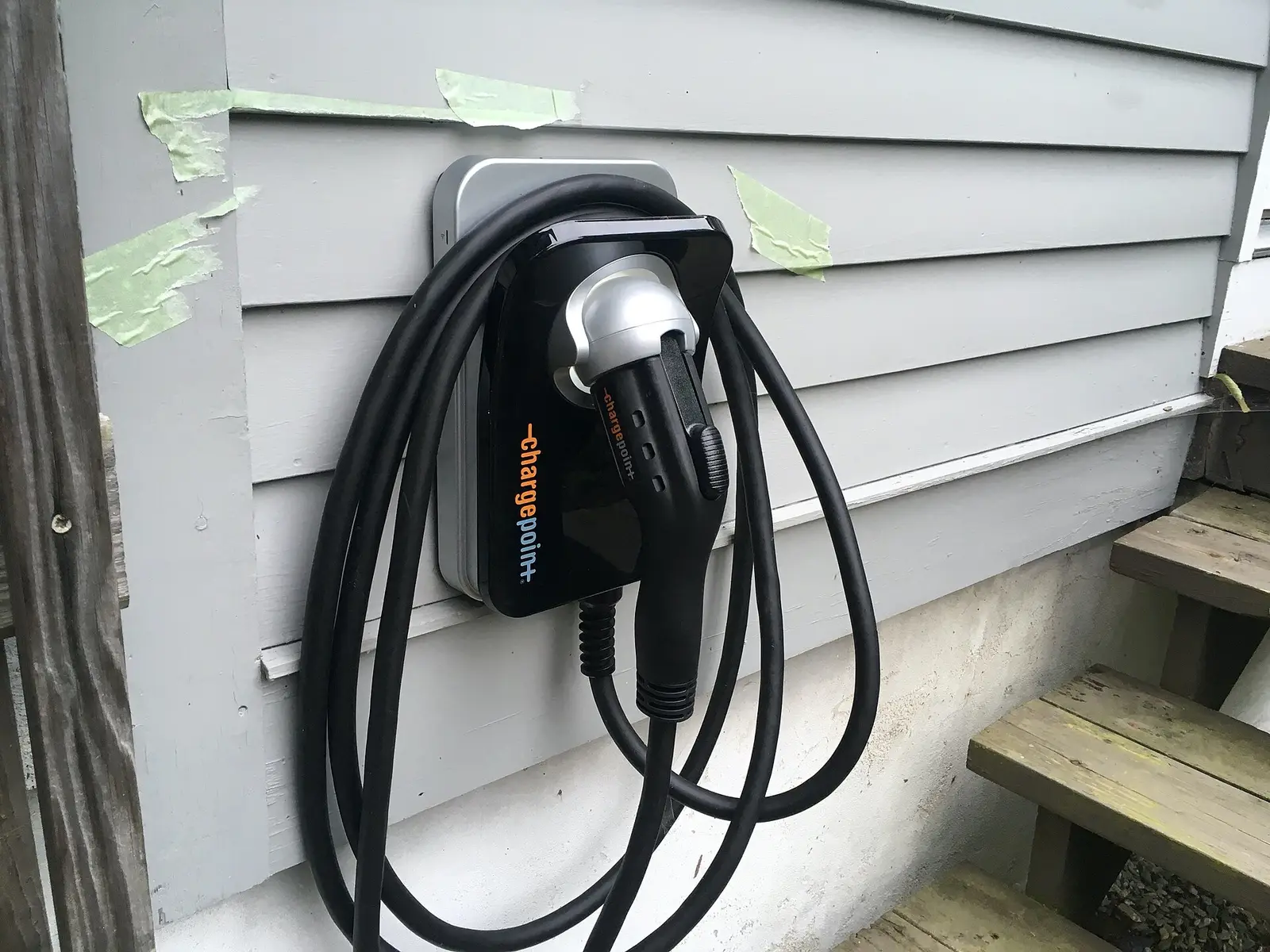
A wall-mounted electric car charger with its cable coiled, installed on a house's siding. Photo: Ken Fields, CC BY-SA 2.0, via Wikimedia Commons.
CSLB license class
C-10 Electrical
Where it applies
San Francisco, Peninsula, East Bay
Request
Free, up to three local pros reply
EV charger jobs on Bay Area homes
A dedicated circuit for a Level 2 charger
In a house, Level 2 chargers run on 208 or 240 volts. San Francisco's permitting checklist lists low-power Level 2 units of 3.3 to 3.8 kW on a 20-amp circuit for single-family and multi-unit homes, and typical Level 2 units of 5.7 to 19.2 kW on circuits of 40 to 100 amps. Berkeley's checklist cites the California Electrical Code rule that an EV charging outlet be supplied by its own branch circuit with no other outlets on it.
Load calculations before the circuit
San Francisco allows only one shortcut past a load calculation: plugging a cord-connected charger into an already approved receptacle with enough ampacity for that charger. Every other installation needs one. A single Level 1 or Level 2 charger can go on an electrical trade permit when the electrician's calculation shows the existing panel has the ampacity for the new circuit and space for its breaker. If it does not, a building permit is required and a new panel may have to be installed.
Panel replacements and service upgrades
When the panel cannot carry the charger, the job grows. In San Francisco, installing or modifying panelboards, a new electric service or the main service disconnect takes both a building permit and an electrical permit, reviewed by the department's mechanical and electrical plan reviewers, with most applications reviewable over the counter. The utility has its own approval for the grid connection, separate from the city permit.
Replacing panels flagged as hazards
A charger project puts an electrician inside the main panel. Palo Alto's utility names Federal Pacific Electric, Zinsco, Challenger, Pushmatic, GTE-Sylvania and some Schneider Electric models as older panels that may pose fire or shock hazards. If the house has one, replacing it is a separate decision from the charger, but it changes the permit and the schedule, so ask about it at the first visit.
Outdoor and driveway chargers
A charger on an outside wall or a post by the driveway has to keep the car and cord on private property. Berkeley requires outdoor installations to show that the parked vehicle and every part of the charging station will stay out of the public right of way, meaning on or over the sidewalk, unless Public Works approves. San Francisco generally does not permit chargers in the public right of way either, apart from a curbside pilot in some locations.
The license this work needs
C-10 Electrical
CSLB's C-10 Electrical class covers placing, installing and connecting electrical wires, fixtures, appliances, raceways and conduits, which takes in a charger circuit, a subpanel and a panel replacement. San Francisco issues an electrical-only permit for a single home charger when a licensed contractor (C-10) registered with its building department files it. Plugging a charger into an existing approved outlet that already meets the maker's specifications needs no permit there; any new wiring is C-10 work. Look the number up at cslb.ca.gov and confirm C-10 is listed.
Deciding between a new panel and managing the load
Palo Alto's utility notes that home panels are typically 100 or 200 amps, that a 200-amp panel is adequate in most cases, and that many fully electric homes can operate on 100 amps depending on usage and appliance choices. Before replacing a smaller panel for a charger, it points to alternatives: smart panels and circuit-sharing devices, a Level 1 charger on a standard outlet, or subpanels and tandem breakers where breaker space is short.
Garages built before EV-capable rules
California's green building code now requires new one- and two-family houses and townhouses with attached private garages to have conduit capable of supporting a Level 2 charger. San Francisco also requires charging equipment and electrical capacity in new buildings and in alterations to residential off-street parking areas. A garage built before those rules usually needs a new circuit run from the panel, which is why San Francisco's building department says existing circuits are rarely EV ready.
Different utilities in different cities
Utility approval for a service change is a separate process from the city permit, and responsibilities vary by utility territory, so the state's permit streamlining guidance tells applicants to involve their utility early. Before a charger can be used it must pass final inspection by both the city and the utility, and the guidance recommends coordinating the two to avoid delays and repeat visits. Which utility that is depends on the city, since PG&E does not serve every Bay Area home.
San Francisco's Information Sheet E-02 sorts home charger work into three tiers. A charger plugged into a previously approved receptacle that meets the maker's specifications needs no permit. A charger in a single-family or two-family house, on a panel with room for it, gets an electrical trade permit, issued instantly when a registered electrical contractor files online. Panel, service or disconnect changes need a building permit as well. Because state law limits the review to health and safety, charger-only permits are not referred to the Planning Department.
In Palo Alto the utility is the city itself, so a panel or service upgrade for a charger means following the steps set by City of Palo Alto Utilities Engineering, including an application for the service upgrade and possibly a site visit when overhead or underground service lines change. A building permit from Development Services is required for most electrical projects, and the city's placement standard puts the upgraded panel between 48 and 75 inches above grade.
Berkeley's EV charging checklist does not require a site plan or signed electrical plans for a charger at a single-family house, duplex or ADU, and the permit can be filed through Permits Online, by email or at the Permit Service Center. In the City of Alameda, homes are served by Alameda Municipal Power rather than PG&E, so a service upgrade there is coordinated with that community-owned utility.
Permits and rules to know
AB 1236 and AB 970 permit streamlining
AB 1236, in Government Code section 65850.7, requires every California city and county to adopt a streamlined permitting ordinance and checklist for EV charging stations and to limit review to health and safety. AB 970, section 65850.71, adds deadlines: for 1 to 25 chargers at a site, an application is deemed complete if the city neither accepts it nor issues a deficiency notice within 5 business days, and deemed approved 20 business days after that unless specific conditions apply.
HOA and rental rules for chargers
California Civil Code section 4745 limits a homeowner association's ability to prohibit or restrict a member's installation of an EV charging station, which matters for Bay Area condos and townhouses with assigned garage spaces. Civil Code section 1947.6 gives residential tenants a right to install a charger, with landlords required to grant permission under specified circumstances. San Francisco notes that a charger for an assigned parking space in private housing does not trigger accessible charging requirements.
Before you hire
Ask for the load calculation in writing, showing whether the panel has the ampacity and breaker space for the charger circuit.
Confirm the license is C-10 Electrical at cslb.ca.gov, and in San Francisco that the contractor is registered for online permits.
Ask what brand the existing panel is, and whether it is one of the older models utilities flag as a fire or shock hazard.
Ask whether load management or a lower-amp circuit could avoid a service upgrade, and how charging speed changes with each option.
If the service needs upgrading, ask who applies to PG&E or your city utility and how their inspection fits with the city's.
For an outdoor charger, ask where the parked car and cord will sit relative to the sidewalk.
Ask for proof of workers' compensation coverage before anyone works inside the panel.
How a request works
Describe the job
A few sentences and a photo of the problem or the space. It takes about a minute.
Local pros get in touch
Up to three handymen or contractors who take this kind of work may call or text to ask questions and quote.
Check, compare, decide
Look up the license, compare what you hear, and agree the scope and price with the one you pick. Requesting costs nothing.
Questions about EV charger work in the Bay Area
Do we need a permit to plug a charger into our garage outlet in San Francisco?
Not if the receptacle and circuit were previously approved and meet the charger maker's specifications, for example a 240-volt receptacle with 40-amp protection for a charger rated for it. San Francisco adds that existing circuits are rarely EV ready outside recently built homes, so have an electrician confirm the circuit first. A new circuit needs an electrical permit.
Will a Level 2 charger mean replacing our 100-amp panel?
Not automatically. The load calculation decides it. Palo Alto's utility notes that many fully electric homes can run on a 100-amp panel, and lists smart panels, circuit sharing and lower-power charging as ways to avoid an upgrade. If the calculation shows the panel lacks ampacity or breaker space, San Francisco requires a building permit and a new panel may be needed.
Can our HOA stop us from installing a charger in our assigned space?
California Civil Code section 4745 limits an association's ability to prohibit or restrict a member from installing an EV charging station. What an association may still require is spelled out in that section, so read it alongside your association's rules before the electrician starts and before you sign anything.
How long can our city take to approve an EV charger permit?
Under AB 970, for up to 25 chargers at one site, the city has 5 business days to find the application complete or send a deficiency notice, and the application is deemed approved 20 business days after it is complete unless the city makes certain findings or an appeal is filed. San Francisco issues electrical-only charger permits instantly to registered contractors filing online.
Our townhouse is new. Is the garage already wired for a charger?
Likely partly. California requires new one- and two-family houses and townhouses with attached private garages to include conduit capable of supporting a Level 2 charger. That is a pathway, not a finished circuit, so an electrician still has to confirm the panel capacity, run or finish the circuit and install the charger under a permit.
Can we put a charger at the curb in front of our house?
Usually not. San Francisco generally does not permit EV chargers and their equipment in the public right of way, apart from a curbside pilot in some locations, and Berkeley requires an outdoor charger and the parked car to stay off the sidewalk unless Public Works approves. Plan the charger for a garage or driveway.
Checked against these public sources in September 2026. Codes and programs change: confirm permit rules with your city's building department and a license on the CSLB website before work starts.