EV chargers and panel upgrades San Francisco

Putting a Level 2 charger into a San Francisco garage

Here the first question is often not the panel but whether the building has anywhere off the street to park, because the Planning Code requires no parking of any property and cutting a garage into a pre-1913 building is a Planning matter before it is an electrical one. Where a garage or driveway does exist, the building department sorts the work into three permit tiers and state law holds the review to health and safety.

  • Free to request, no obligation to hire
  • Up to five local pros who take this work can reply
  • Rules on this page checked against 12 public sources, October 2026
The Golden Gate Bridge and San Francisco, seen from the Marin Headlands
The Golden Gate Bridge and San Francisco, seen from the Marin Headlands. Photo: Paul.h, Public domain, via Wikimedia Commons.
Cord into an approved outlet
No DBI permit, per Building Code 106A.1.16
Off-street parking
Not required by the Planning Code for any property
Fire bulletin AB 4.29
Level 3 and above; not Level 1, 2 or R-3 houses
Curbside chargers
SFMTA permits companies, not individual residents

Permits and local rules

Four San Francisco documents that decide the job

  1. The three permit tiers in Information Sheet E-02

    Revised in March 2025, the building department's sheet splits home charger work three ways. A cord-connected unit on a receptacle already approved and meeting the maker's specifications needs no permit under Building Code 106A.1.16, though the sheet warns that circuits in older buildings are seldom ready for a charger as they stand. One unit in an R-3 house, on a panel the contractor's calculation shows has the ampacity and a space for the breaker, is an electrical trade permit. Panelboards, a new service or the main disconnect pull in a building permit as well. Because state law caps the review at health and safety, charger-only applications are not referred to the Planning Department.

    Source: San Francisco Department of Building Inspection (media.api.sf.gov)

  2. Who may file, and on which license

    The city's electrical permit page names the license classes that may file one, among them a C-10, which covers any electrical work, and B, C-7, C-45, C-46, C-61 and D-34, each held to a narrower scope. A contractor authorized for Express Permits on the PermitSF portal skips staff review and pays straight away. An owner may file for themselves only on a stand-alone single-family dwelling of R-3 occupancy, a status the city says to confirm on the Assessor's map, and must then bring identification to the Permit Center help desk at 49 South Van Ness. The page points to the exemptions in San Francisco Electrical Code Section 89.121, and asks that wiring be inspected before it is covered.

    Source: City and County of San Francisco (sf.gov)

  3. The sprinkler bulletin that stops at the house door

    Garages here are usually enclosed and sitting under bedrooms, which makes the Fire Department's Administrative Bulletin 4.29 the first thing owners worry about. It raises sprinkler protection over parking spaces tied to charging stations, or requires one-hour fire-rated separation where no sprinkler system exists. It applies to every occupancy except R-3, and only where the stations are Level 3 or Level 4; it says plainly that it does not apply to Level 1 and Level 2 chargers. The building department adds that it does not reach equipment in a non-enclosed, generally exterior, location. Household charging therefore sits outside it, and so does a Level 2 unit in an apartment garage.

    San Francisco Fire Department (opens in a new tab)
  4. Charging at the curb is a vendor program

    The city launched its Curbside Electric Vehicle Charging Program in August 2026, formalizing a pilot whose first chargers came online in April 2025. The transportation agency leads the permitting, in two stages: an operator permit screened on a company's experience, qualifications, financial readiness and ability to meet reliability requirements, then a site permit for each location with a site plan and a neighborhood outreach plan. Residents are not the applicants. What a resident can do is nominate a location on the Environment Department's feedback map; the target set in the Climate Action Plan is 100 curbside stations by 2030.

    Source: Office of the Mayor, San Francisco (sf.gov)

State license for this work: C-10 Electrical. Look up a contractor's license on the CSLB website (cslb.ca.gov).

Free, no obligation. Next, add your details in the request form.

Free request

Describe the EV charger job once. Local pros who take work in San Francisco reply by call or text.

  • No fee to request, and no obligation to hire
  • You agree scope and price with the pro you choose
  • Photos help them quote without a first visit

Get quotes for EV charger work in San Francisco

Two short steps. A local pro who takes this work calls or texts you back.

To send a request, call or text (415) 449-8213.

Free to request, and you agree the scope and price with the person you hire before work starts. In California, a job over $1,000 in labor and materials, or one that needs a building permit, must be done by a contractor licensed by the CSLB in the right class. Ask for the license number and check it at cslb.ca.gov.

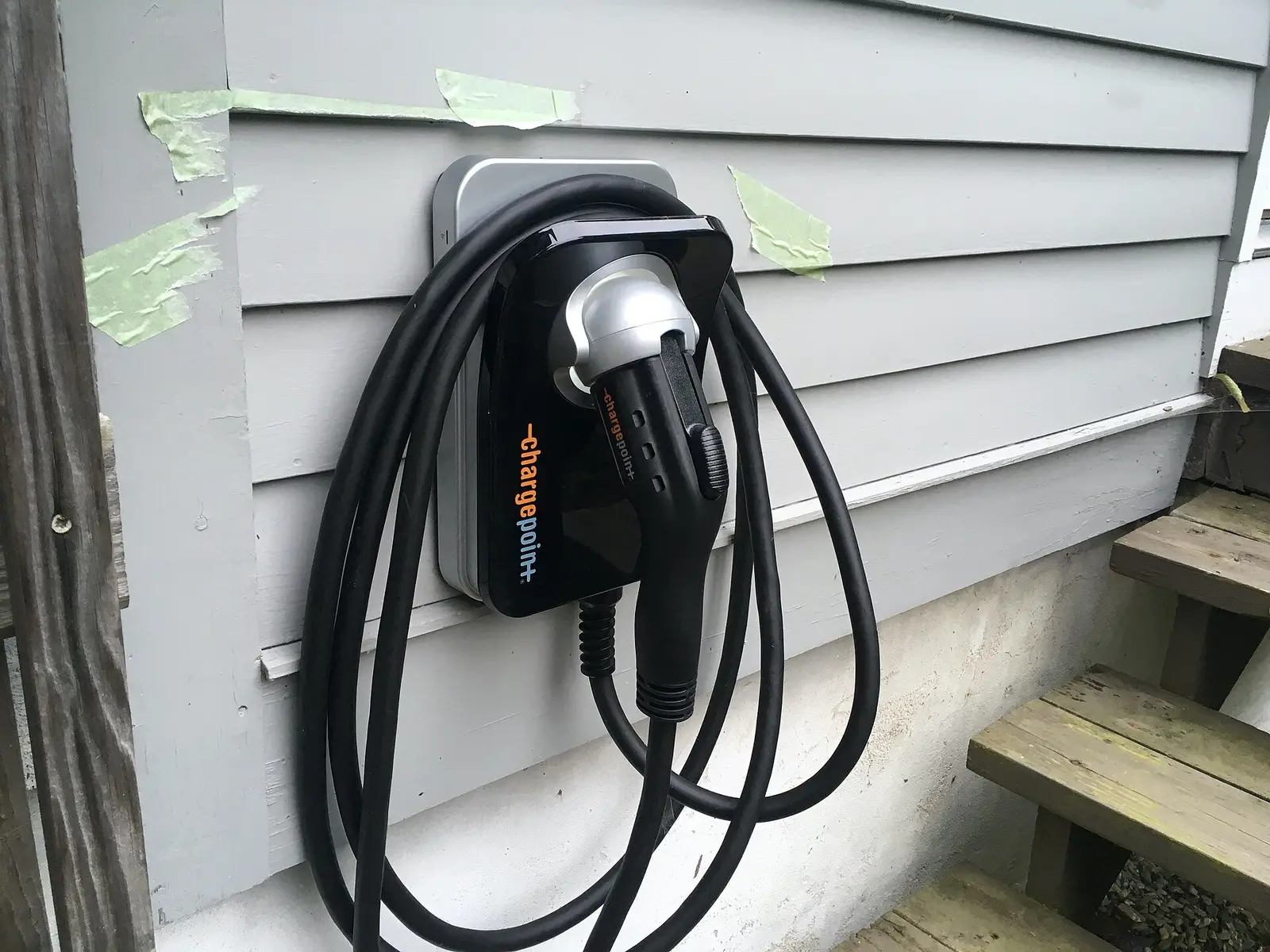
A wall-mounted electric car charger with its cable coiled, installed on a house's siding
A wall-mounted electric car charger with its cable coiled, installed on a house's siding. Photo: Ken Fields, CC BY-SA 2.0, via Wikimedia Commons.

The houses here

Two questions decide how this job starts

First, whether there is off-street parking at all. Planning's own guidelines state that the Code does not require it for any property, and a new garage with its curb cut is weighed against the voter-approved Transit-First Policy, a 10-foot standard curb cut, the loss of street trees and the effect on any ground-floor dwelling, and a building from 1913 or earlier can be examined as a potential historic resource. Second, where that parking sits relative to the panel. The Sunset tracts stacked living rooms over a combined garage and basement story, which Planning describes as a uniquely San Franciscan landscape of nearly attached single-family houses with prominent ground-story garages, so panel and car frequently share a wall. In a building of flats the same ground floor is common space while the meters are not, and in the residence parks the garage sits at the far end of the lot.

Part by part

Three parking patterns, three different jobs

  • Ramona Street, north Mission

    This single-block street between 14th and 15th was deeded to the city in 1910, and Planning's district record calls its buildings some of the earliest in San Francisco, and in the nation, conceived with an integrated garage. Nearly all 36 properties went up from 1911 with a ground-floor garage, the two-flat ones over what the trade then called an auto basement. The garage is already there; which flat's service feeds it is the open question, and the record notes the area's overhead utilities.

  • The Sunset's period-revival tracts

    Planning's identified-eligible district of 253 buildings, spread over 13 separate Sunset tracts built between 1931 and 1938, shares one-story-over-garage massing with deeply recessed garage openings and double-hinged wood garage doors. The cable run is short, since the panel usually sits a few feet away on the same story. The constraint is the opening: a deeply recessed door and a car parked tight to the wall leave little clear wall at a sensible mounting height.

  • Sea Cliff and Balboa Terrace

    Sea Cliff's developers put the utilities underground and placed detached garages at the rear of lots wherever they could, for a more artistic arrangement of houses; every Balboa Terrace block carries an interior alley giving communal access to the garages. Charging in one of those means a feeder from the house to a separate structure, a conduit or trench route to agree, and a drawn site plan the city reads next to the calculation.

The work

What the work looks like behind a city garage door

  1. A short run in a one-story-over-garage house

    The easiest version, and the commonest shape of house in the western neighborhoods: rooms above, garage and basement below, panel already on the garage wall. The building department's checklist still fixes what an inspector looks for. Equipment carries a listing mark from a nationally recognized testing laboratory, UL 2202 or UL 2200, and is connected and fastened the way the manufacturer's instructions say. The coupling that holds the cord is stored no lower than 18 inches above an indoor floor. On the application the electrician also declares whether the job includes category 3 work, the city's heading for services, subpanels, generators and transformers among others.

  2. Finding breaker space in a panel sized for a wall furnace

    Plenty of these houses still run a board that was specified for a furnace, a washer and not much else. Where the answer is a new panelboard, a new service or a new main disconnect, the city wants a building permit alongside the electrical one, and the file goes to its mechanical and electrical reviewers. Most are handled over the counter, with in-house review kept for large projects. The documents are a load calculation and a panel schedule under Article 220 of the state code, and the only scope that escapes the calculation is the cord-and-receptacle case above.

  3. A feeder out to a garage at the back of the lot

    The residence parks pushed the car away from the street, so the charger is not a wall job but a feeder leaving the house. The permit package then carries a site plan showing where the panel, the meter and the charging unit each sit, and any trenching is built to Articles 225 and 300 of the state electrical code. Outdoors the coupling is stored at least 24 inches above grade unless the equipment is specifically listed and marked otherwise. Where the run crosses a shared alley rather than the owner's own ground, settle the route with the neighbors first.

  4. Charging where the ground floor belongs to the whole building

    In a two- or three-flat building the garage is shared and the meters are not, so who feeds the charger drives the paperwork. The San Francisco Green Building Code carries an exception letting a condominium connect a unit's charger to that unit's own panel and metered utility service. Accessible charging is the question owners expect and do not get: Chapter 11B of the building code does not require an accessible station where the equipment serves an assigned parking space in private or public housing. An association's own rules still come first, so read them before equipment is ordered.

  5. Adding storage next to the charger

    Some households pair the charger with a battery. In this city that is a different application: work on photovoltaic panels or energy storage systems takes a separate solar permit, while wiring alone, with no panels going in, stays on an electrical permit. The distinction matters for sequencing, since each permit brings its own inspection and nothing may be closed up before the wiring has been looked at. Ask at the quote stage which permits the job actually needs and who files each, rather than meeting a second application after the conduit is up.

Before you hire

Four things to settle before the deposit

  • Ask whether the scope stays strictly inside the charging equipment, since anything extra reopens a Planning review that a charger-only application avoids.
  • Ask for the load calculation and panel schedule, and whether the application declares category 3 work: services, subpanels, generators, transformers.
  • If a battery is in the quote, ask who files the separate solar permit this city requires for energy storage systems.
  • Check the C-10 Electrical license at cslb.ca.gov, and ask whether the contractor is authorized for Express Permits on PermitSF.

Timing

Two queues, and the route that is not a queue

The paths diverge sharply. An electrical trade permit filed by a contractor authorized for Express Permits is paid for and in hand without staff review. A building permit written specifically for charging equipment and what it needs to be safe is, where no deficiencies turn up, reviewed within 20 business days or less for up to 25 chargers, and 40 days or less above that number; an applicant may instead ask for over-the-counter review when the scope can be read in an hour or less. Add any scope beyond the equipment itself and those limits stop applying, because other agencies now get the file.

Free, no obligation. Next, add your details in the request form.

Questions

Five things people ask once the car arrives

We park on the street. Can we get a charger at our own curb?

Not as a resident. The Curbside Electric Vehicle Charging Program launched in August 2026 permits charging companies: an operator permit first, then a site permit for each location, with a neighborhood outreach plan attached. The building department's own sheet says chargers and their supporting equipment are generally not permitted in the public right of way. You can nominate a spot on the Environment Department's feedback map, and the city is working toward 100 curbside stations by 2030.

Our Edwardian has no garage. Can we cut one in for the charger?

That is a Planning question before it is an electrical one. The guidelines for adding garages and curb cuts weigh the voter-approved Transit-First Policy, a 10-foot standard curb cut, the loss of street trees and the effect on any ground-floor dwelling, and a new garage requires a new street tree. Buildings from 1913 or earlier are examined as potential historic resources. Since the Planning Code requires no off-street parking for any property, nothing obliges a yes.

Does a Level 2 charger in our enclosed garage mean sprinkler work?

No. The Fire Department's Administrative Bulletin 4.29 covers every occupancy except R-3, and only stations at Level 3 or above; it states that it does not apply to Level 1 and Level 2 chargers. The building department adds that it does not apply to equipment in a non-enclosed location either. Faster equipment is a different matter: a new Level 3 installation in an enclosed off-street parking area draws Fire Department plan review.

Can I pull the electrical permit myself for my own house?

Only if it is a stand-alone single-family dwelling of R-3 occupancy, and the city tells owners to check that status on the Assessor's map. Even then the online form is followed by a visit to the Permit Center help desk at 49 South Van Ness with identification, where an inspector may tell you to hire a contractor and have that contractor file a fresh permit. Most homes in this city are attached, so the route is narrower than it sounds.

Our building has eight flats. Is there a program for the garage?

EV Charge SF, run by the Public Utilities Commission, takes existing buildings and new construction that are multifamily of five units or more, or commercial, and are CleanPowerSF or Hetch Hetchy Power customers on a qualifying electric rate. Offerings go first come, first served. An applicant converting at least four parking stalls may ask the program for technical assistance. Enrollment runs through a handbook, an agreement and a technical orientation, so begin it before a board votes on a design.


Where these facts come from

Checked against these public sources in October 2026. Rules and programs change: confirm permit requirements with the city before work starts, and a contractor's license on the CSLB website.

EV charger work in San Francisco? Tell us what you see.

One request reaches local handymen and contractors who take this work. The Handyman SF connects you with them; it does not do the work.

HandymanNow for handymen Work in San Francisco? Get job leads by text. Pick your trades and areas, take only the jobs you want. No subscription. Start getting leads HandymanNow for homeowners Get the HandymanNow app. Send a request with photos, message your handyman and follow them on the way. Download the app

HandymanNow app

Fix it faster. Find work faster.

Homeowners send a job with photos and follow their handyman on the map. Handymen get local jobs by text and take only the ones they want.

Call WhatsApp (opens WhatsApp) Free quote