Tile San Jose

Setting tile in San Jose, from the pan test to the permit desk

In San Jose the tile is the permit-free part. The city's exempt list names floor finishes and tile installations with no structural change. The permit comes with what sits behind the tile, and with the shower: a pan is filled and tested at the rough inspection before anything covers it, and the city adds an amendment of its own for a stall built without a curb.

  • Free to request, no obligation to hire
  • Up to five local pros who take this work can reply
  • Rules on this page checked against 9 public sources, October 2026

Asked most

Tile questions San Jose owners ask early

Do I need a permit to retile my shower in San Jose?

Not for the tile. The city lists tile installations entailing no structural change, and floor finishes including tile, among the surface improvements that need no building permit. The shower around it is a different matter: replacing the fixtures is work the city permits, and if a concealed trap, drainpipe or vent pipe has to be replaced that counts as new work with its own plumbing permit. Ask the contractor what the demolition is likely to expose.

We want a shower with no curb. Does San Jose allow that?

Yes, with more waterproofing than a curbed stall. The city's residential construction guidelines treat the floor space in the same room as a wet location when there is no threshold, and the city's own amendment requires waterproofing to extend at least four feet past the shower area on wood-frame floor construction. Have it drawn that way from the start, because it affects the membrane, the floor slope and the framing, not just the tile.

Our block floods. Does that limit which tile we can use?

Below the design flood level it does. San José's guidelines point flood-resistant construction at FEMA Technical Bulletin 2, which classes ceramic and porcelain tile set in mortar as acceptable for floors and walls but the same tile over an organic adhesive as unacceptable. Public Works runs the flood program for the city and keeps elevation certificates on file, so check the zone before materials are ordered rather than after.

Hotel Valencia at Santana Row in San Jose
Hotel Valencia at Santana Row in San Jose. Photo: Payton Chung, CC BY 2.0, via Wikimedia Commons.

Free request

Describe the tile job once. Local pros who take work in San Jose reply by call or text.

  • No fee to request, and no obligation to hire
  • You agree scope and price with the pro you choose
  • Photos help them quote without a first visit

Get quotes for tile work in San Jose

Two short steps. A local pro who takes this work calls or texts you back.

To send a request, call or text (415) 449-8213.

Free to request, and you agree the scope and price with the person you hire before work starts. In California, a job over $1,000 in labor and materials, or one that needs a building permit, must be done by a contractor licensed by the CSLB in the right class. Ask for the license number and check it at cslb.ca.gov.

Free, no obligation. Next, add your details in the request form.

Permits and local rules

The rule sets a San Jose tile bid runs into

  1. Where the tile exemption ends

    Municipal Code Section 24.02.110 holds the city's list of exempt projects, and the building permit page spells out the surface improvements inside it: floor finishes such as carpet, linoleum and tile, floor sheathing repairs up to 10 square feet, sheetrock and taping joints, and tile installations entailing no structural change. The page is blunt that exempt is not unregulated, saying no project may violate city codes or any state or federal law. Alteration of walls or any structural change still needs a permit, and so does plumbing work that is not on the short exempt list.

    Source: City of San José, When Is a Building Permit Required? (sanjoseca.gov)

  2. The pan test comes before the tile

    San José's residential construction guidelines put shower pans in the rough inspection, which is to say before any tile. A hot-mopped pan is three layers of 15-pound felt, or a listed 40-mil liner instead, carried at least three inches above horizontal surfaces and over the top of the finished dam. For the test the drain is plugged below the weep holes and water stands at least two inches deep behind a temporary barrier at the rough threshold while the inspector looks for leaks, then the plug comes out to prove the subfloor drains and the weep holes work. The shower floor slopes a quarter to a half inch per foot.

    Source: City of San José, 2025 Residential Construction Guidelines (sanjoseca.gov)

  3. Finishes below the design flood level

    San José is a member of the National Flood Insurance Program and Public Works administers it here: in return for federally backed mortgages and disaster assistance the city makes new development and remodels of existing buildings follow rules that limit flood damage. In Zone A, AE, AH or AO the city's guidelines route flood-resistant construction through FEMA Technical Bulletin 2 and Municipal Code 17.08.280, and its minor remodel page asks a floodplain project to show how wall finishes below the flood level comply. That bulletin classes ceramic and porcelain tile set in mortar as acceptable on floors and walls, and the same tile over organic adhesive as unacceptable.

    Source: City of San José Public Works, Flood Hazard Zones (sanjoseca.gov)

  4. Which license covers which part

    The state writes a class for exactly this work. CSLB's C-54 Ceramic and Mosaic Tile class prepares surfaces and installs glazed wall, ceramic, mosaic, quarry, paver, faience and glass mosaic tile, thin tile resembling full brick, and natural or simulated stone slabs for bathtubs, showers and horizontal surfaces inside a building; hollow and structural partition tile fall outside it. A San José bathroom often carries more than one license, because the plumbing permit for the valve and the drain is pulled by a plumbing contractor and a wall that proves to be load-bearing brings in a general building contractor. Check each number against the name on the contract at cslb.ca.gov.

    Source: CSLB, Licensing Classifications: C-54 (cslb.ca.gov)

State license for this work: C-54 Ceramic and Mosaic Tile. Look up a contractor's license on the CSLB website (cslb.ca.gov).

The work

Four tile scopes, and which of them brings an inspector

  • Retiling a shower that stays where it is

    Stripping three walls and resetting them is, by itself, outside the building permit. San Jose's exempt list names tile installations entailing no structural change, and separately floor finishes such as carpet, linoleum and tile. What hides behind the tile is where that stops. The city treats a concealed trap, drainpipe or vent pipe that has to be replaced as new work needing a plumbing permit, and a cut stud or a rotted subfloor is a structural change. Demolition day usually settles which it is, so agree beforehand who applies if the wall opens onto something.

  • Taking the alcove tub out for a walk-in stall

    Swapping a tub for a tiled shower is a fixture replacement the city can permit online, and the finished stall has to meet the plumbing code geometry its checklist lists. There must be at least 1,024 square inches of finished interior able to contain a 30-inch circle, a threshold wide enough to leave a 22-inch clear opening, and a dam sitting an inch below the sides and back and between 2 and 9 inches above the drain. Where the new stall is no wider than 36 inches, the code lets a tub-to-shower retrofit keep a smaller trap and trap arm.

  • A curbless shower on a wood-framed floor

    Leave the curb off and San Jose stops treating the stall as the only wet area. Its construction guidelines say that without a threshold the floor space within the same room counts as a wet location, and the city's own amendment makes waterproofing extend at least four feet past the shower area on wood-frame floor construction. That reaches the membrane, the slope of the whole floor and where the drain sits, so it belongs in the drawing rather than in a change order later. In a new detached unit the aging-in-place rules also want solid grab-bar blocking framed in before board and tile cover it.

  • Lifting the old resilient floor before the new one

    New tile starts with taking the old floor out, and in a house from the tract years that is often 9- or 12-inch resilient tile stuck down with black mastic. California's asbestos standard for construction tells employers to assume resilient flooring, its mastic and its backing contain asbestos unless an industrial hygienist has tested it, forbids ripping up resilient sheet material, and pulls in registration with the Division of Occupational Safety and Health once a job disturbs more than 100 square feet of asbestos-containing construction material. Settle that before demolition, because it governs who may touch the floor.

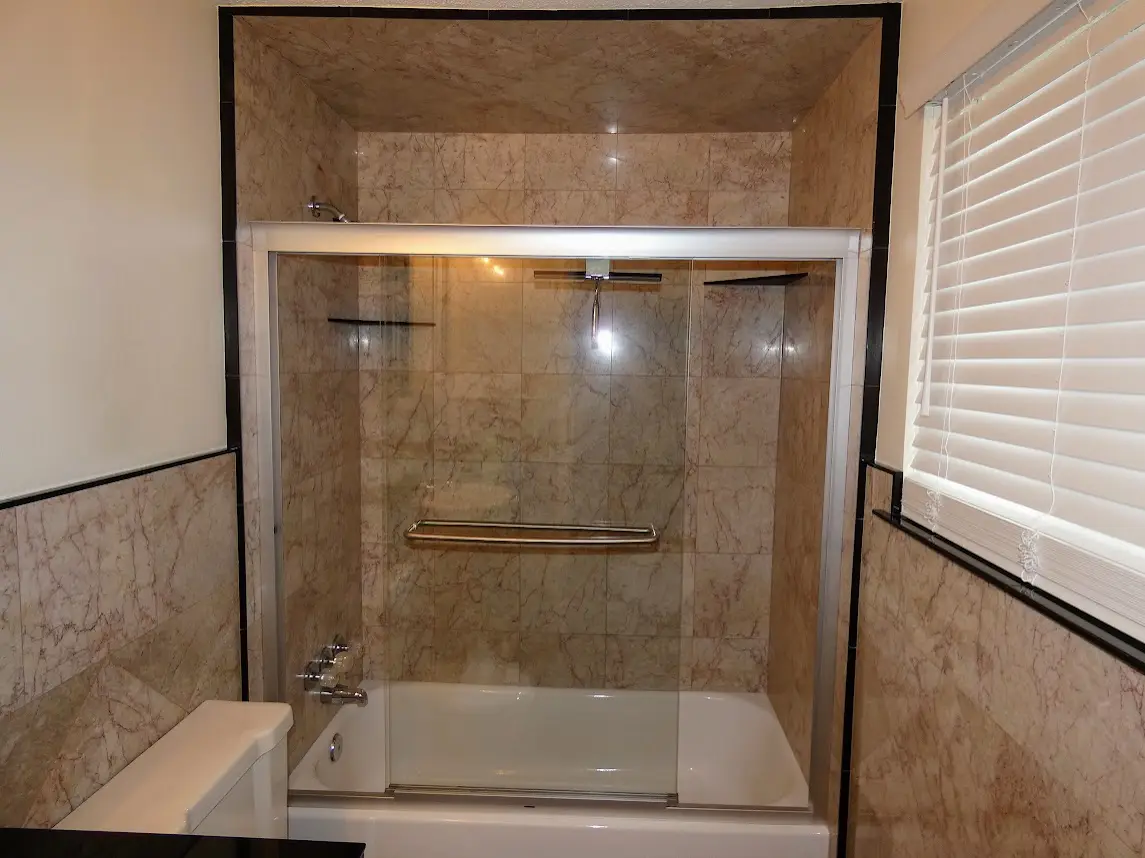
A marble-tiled bathtub and shower surround behind a sliding glass door
A marble-tiled bathtub and shower surround behind a sliding glass door. Photo: Tile Marble Granite, CC BY-SA 4.0, via Wikimedia Commons.

The houses here

Valley-floor tracts, and what holds the tile up

Most single-family housing here came out of the postwar tract years on the valley floor, and the floor under a tile job is either a concrete slab or wood joists over a crawlspace. On a slab, relocating a shower drain means cutting and patching concrete, and a crack already moving in that slab will come back up through new tile unless it is isolated first. Over joists the question is stiffness, and the Building Division's handbook makes the point in passing: its worked example for sizing floor joists counts tile and mortar at 10 pounds per square foot of dead load and holds the floor to an L/360 deflection limit. Bathrooms in those tracts tend to be tight, a tub in a three-wall alcove, so a retile is as much about the walls as the floor, and the city wants a smooth, nonabsorbent surface on that framing to at least 70 inches above the drain inlet.

Part by part

Two corners of the city where tile work changes

  • Fairglen Additions, Willow Glen

    The National Register nomination for this Eichler tract records slab-on-grade foundations with radiant heating, finished with 12-inch asphalt tile. Both halves land on a tile job. The heating pipes are inside the concrete, so coring for a drain or drilling an anchor needs them traced first, and that original flooring is precisely the resilient tile the state's asbestos rule says to treat as asbestos-containing until an industrial hygienist proves otherwise.

  • Alviso and the Coyote Creek corridor

    These are the low ends of the city, and the reason is on record: the U.S. Geological Survey reports that land beside the south end of the bay sank by 1969 far enough to put 17 square miles of dry ground below the high-tide line, now held back by dikes and levees with local runoff pumped over them. A bathroom floor here can sit below the design flood level, which turns tile choice and the adhesive under it into a code question rather than a preference.

Before you hire

What to settle with a tile contractor before work starts

  • Ask who applies for the plumbing permit if the valve or a concealed drain line has to be replaced once the old tile is off.
  • For a shower, ask when the pan test is scheduled and confirm no tile goes on before the inspector signs off the rough.
  • If the stall is drawn without a curb, ask how far the waterproofing runs past it and who puts that on the plan.
  • Ask whether the old resilient floor and its mastic get tested for asbestos before demolition, and who does the testing.
  • Look up the C-54 at cslb.ca.gov, and ask for proof of workers' compensation coverage for anyone working in the house.

Free, no obligation. Next, add your details in the request form.

More questions

Still deciding?

Can the original 12-inch floor tile in our Eichler just be pulled up?

Not without thinking about two things first. California's asbestos standard for construction tells employers to presume resilient flooring, its mastic and its backing contain asbestos unless tested, and registration kicks in past 100 square feet of asbestos-containing material. The slab underneath carries the radiant heating pipes recorded in the tract's National Register nomination, so scraping, grinding or drilling has to keep clear of them.

Why would a stone floor mean work on the joists before any tile?

Because stone asks more of the structure than ceramic does. The city's own joist-sizing example counts tile and mortar at 10 pounds per square foot and holds the floor to an L/360 deflection limit, which is the ceramic benchmark; natural stone is held to a stiffer one. On an upstairs bathroom or a house on a raised foundation that can mean another layer of plywood, or sistered joists, before a setter starts.

Where these facts come from

Checked against these public sources in October 2026. Rules and programs change: confirm permit requirements with the city before work starts, and a contractor's license on the CSLB website.

  • sanjoseca.gov: when is a building permit required (sanjoseca.gov)
  • sanjoseca.gov: kitchen bathroom minor remodels (sanjoseca.gov)
  • sanjoseca.gov: 639116084251770000 (sanjoseca.gov)
  • sanjoseca.gov: flood hazard zone (sanjoseca.gov)
  • fema.gov: fema tb 2 flood damage resistant materials requirements (fema.gov)
  • dir.ca.gov: 1529 (dir.ca.gov)
  • cslb.ca.gov: Licensing Classifications Detail (cslb.ca.gov)
  • npgallery.nps.gov: d06ce6c1 514d 4ec8 9284 95bfcaeaa6be (npgallery.nps.gov)
  • pubs.usgs.gov: 05SantaClaraValley (pubs.usgs.gov)

Tile work in San Jose? Tell us what you see.

One request reaches local handymen and contractors who take this work. The Handyman SF connects you with them; it does not do the work.

HandymanNow for handymen Work in San Jose? Get job leads by text. Pick your trades and areas, take only the jobs you want. No subscription. Start getting leads HandymanNow for homeowners Get the HandymanNow app. Send a request with photos, message your handyman and follow them on the way. Download the app

HandymanNow app

Fix it faster. Find work faster.

Homeowners send a job with photos and follow their handyman on the map. Handymen get local jobs by text and take only the ones they want.

Call WhatsApp (opens WhatsApp) Free quote