Pressure washing San Jose

Washing San Jose driveways, stucco and siding inside the water rules

Three sets of rules meet on a San Jose wash job. The city's permanent water-waste ordinance lets a hose clean walls, decks and paving only if it has a self-closing valve. Valley Water's countywide ordinance allows washing paved ground only where health and safety are at risk. And the city's sewer code makes it unlawful to leave polluted water where it is likely to reach a storm drain, which in San Jose runs untreated to a creek.

  • Free to request, no obligation to hire
  • Up to five local pros who take this work can reply
  • Rules on this page checked against 16 public sources, October 2026
Hose rule, SJMC 15.10.240
Self-closing valve required to wash walls, decks, patios or paving
Paved ground, countywide
Washed only where health and safety are at risk (Ordinance 23-02)
Where rinse water goes
Planting or gravel, or an indoor drain or cleanout with the owner's OK
Fairglen Additions siding
No high-pressure power-washing of original cladding in permitted work

Get quotes for pressure washing work in San Jose

Two short steps. A local pro who takes this work calls or texts you back.

To send a request, call or text (415) 449-8213.

Free to request, and you agree the scope and price with the person you hire before work starts. In California, a job over $1,000 in labor and materials, or one that needs a building permit, must be done by a contractor licensed by the CSLB in the right class. Ask for the license number and check it at cslb.ca.gov.

Hotel Valencia at Santana Row in San Jose
Hotel Valencia at Santana Row in San Jose. Photo: Payton Chung, CC BY 2.0, via Wikimedia Commons.
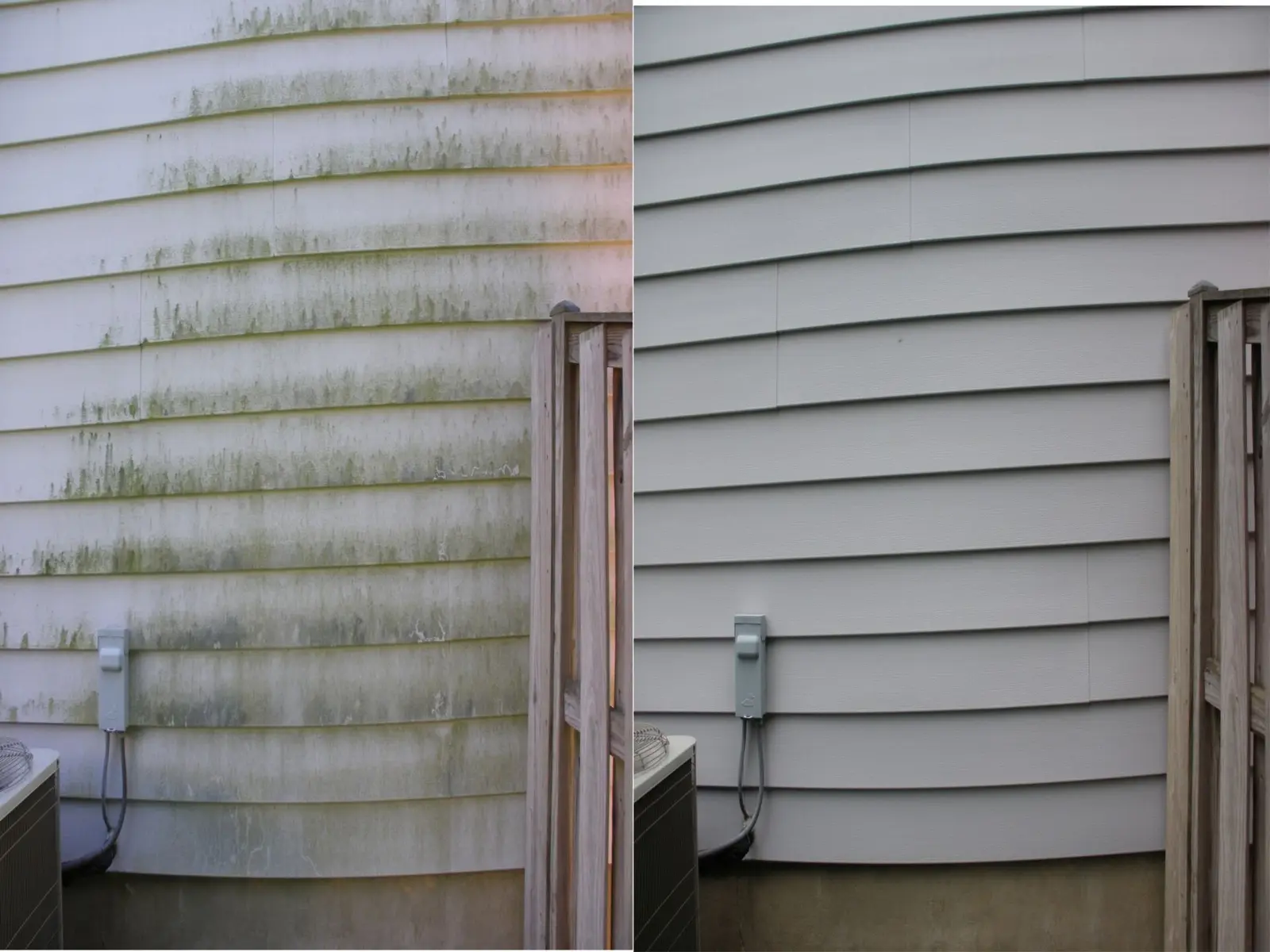
The same stretch of house siding before and after washing: green mildew streaks on the left, clean siding on the right
The same stretch of house siding before and after washing: green mildew streaks on the left, clean siding on the right. Photo: East Coast Powerwashing, CC BY-SA 3.0, via Wikimedia Commons.

The houses here

Lap siding, stucco, sandstone and grooved plywood

A San Jose street can put four surfaces in front of one crew. The city's preservation guide, Your Old House, records wood lap siding, shingles and stucco as the main materials on its houses, with brick and stone kept mostly for foundations and chimneys, and in the Naglee Park Conservation Area many foundations and porches are Greystone quarry sandstone. Craftsman houses are typically wood-framed in clapboard or shingle; Spanish Revival houses have flat stucco walls, smooth or textured. Then came the boom: between 1950 and 1975 the city grew from 17 square miles to more than 120, mostly in low-density single-family tracts, among them Eichler homes clad in vertical-groove plywood that was first finished with an opaque stain.

Free, no obligation. Next, add your details in the request form.

The work

Four surfaces, four different washes

  1. An oil-stained tract-house driveway

    Valley Water's permanent rule comes first on paved ground: washing it is allowed only where health and safety are at risk. When an oily driveway qualifies, the county runoff program's checklist for mobile cleaners asks for the storm drain inlets to be sealed and sloped areas blocked before washing, the wash area contained with sandbag berms, wattles or bermed mats, and the contained water taken up with a sump pump or wet-vac. Sweeping and absorbent come before any water, and the drain protection comes off only when the crew leaves.

  2. Stucco on a Spanish Revival house

    Your Old House asks owners of older San Jose homes to clean a structure by the gentlest means possible and to try a test patch first, because many procedures speed up deterioration or damage a material beyond repair; it names sandblasting as a harsh method that changes a surface's appearance. On a flat stucco wall, smooth or textured, that means trying the lowest pressure that lifts the dirt on a hidden patch before the whole face. Watershed Watch, the county's runoff campaign, adds that buckets and wet-vacs of dirty water go down a sink drain.

  3. Greystone sandstone in Naglee Park

    Many Naglee Park houses stand on foundations and porches of Greystone quarry sandstone, and the city's guide sets an order for work on them: building cleaning starts only after any repointing has completely cured. Stone is also where the Park Service's masonry guidance warns that the pressures common to power washing can etch marble, other soft stone and some brick, so a pro working here should start low and stop if sand shows up in the runoff. A test patch on a hidden corner of the porch wall tells both of you what the stone will take.

  4. Original siding in Fairglen Additions

    Fairglen Additions, listed on the National Register in 2019, is the one Eichler neighborhood on San José's Historic Resources Inventory, so the city's 2025 Eichler Objective Design Standards apply there. Standard 4.2.2 prohibits sand-blasting and high-pressure power-washing original cladding, and the standards' cleaning advice is low-pressure water and natural bristle brushes, chemical cleaners tested on a small hidden area first, and openings tightly covered. The standards bind only projects that need a building permit for exterior changes or a Single-Family House Permit.

Permits and local rules

The ordinances a San Jose wash has to clear

  1. The city's hose rule, in force all year

    Part 2 of Chapter 15.10 sets San José's permanent water conservation measures, which apply to water from any source. Section 15.10.240 forbids using a hose to clean the exterior of a building or structure, or sidewalks, driveways, patios, decks, parking lots and other hard surfaces, unless it has an automatic positive self-closing valve, one that flows only while someone holds pressure on it at the outlet. Section 15.10.220 bars runoff onto sidewalks, driveways, gutters or streets but excepts cleaning done under 15.10.240; the storm drain rules still apply.

    San José Municipal Code, Chapter 15.10 (opens in a new tab)
  2. Valley Water's limits for the whole county

    Valley Water's Ordinance 23-02, passed in June 2023 alongside its board's declaration that conservation is a way of life in Santa Clara County, permanently prohibits washing sidewalks, walkways, driveways, patios, parking lots and other hard, non-porous ground except where health and safety are at risk, and states that power washing for those reasons is not a violation. A building exterior may be washed only with a hose fitted with an automatic shutoff nozzle. The city points San Jose residents to Valley Water to report water waste.

    Valley Water (Santa Clara Valley Water District) (opens in a new tab)
  3. Nothing left where a storm drain can take it

    Section 15.14.515 makes it unlawful to discharge polluted waters into any storm sewer, natural outlet or channel without an NPDES permit, and equally unlawful to place, leave or maintain a pollutant where it is likely to enter one. Section 15.14.770 then requires all persons to implement BMPs, the code's term for pollution controls, or make reasonable efforts on their own property to keep pollutants out of the storm sewer system. On a wash job that reaches the grit left on the driveway, not only the water already running for the curb.

    San José Municipal Code, Chapter 15.14 (opens in a new tab)
  4. Where the county program sends rinse water

    The fact sheet for mobile cleaners from the Santa Clara Valley Urban Runoff Pollution Prevention Program, which San José links from its page for mobile businesses, says wash water can usually go to the sanitary sewer through a drain at the property, such as a utility sink, floor drain, mop sink, toilet or sewer cleanout, with the owner's permission obtained before the job. It also allows washing on a planted or gravel surface where the water soaks in with no runoff, and says every sewer discharge must meet local limits.

    Santa Clara Valley Urban Runoff Pollution Prevention Program (opens in a new tab)

State license for this work: C-61/D-38 Sand and Water Blasting, C-33 Painting and Decorating. Look up a contractor's license on the CSLB website (cslb.ca.gov).

Timing

When a water shortage is declared

The rules tighten on a council vote. Once the City Council declares a water shortage of 25 percent or more, Section 15.10.340 allows potable water on sidewalks, driveways, patios and other paved areas only from a bucket or under a written exception from the Environmental Services director. A building exterior gets the same treatment, unless the wash is surface preparation for paint or another architectural coating, or for waxing. Valley Water, for its part, issues fines only while its board has called for mandatory reductions, and its page says no such call is in effect.

Before you hire

Questions for a San Jose crew before the water goes on

  • Ask how the hose or wand stops flowing when it is let go; San José requires a self-closing valve on any hose used to clean walls or paving.
  • For a driveway or patio, ask whether a broom and absorbent will do, since Valley Water limits washing paved ground to health and safety needs.
  • Ask which drain or cleanout on your property they want to use for the collected water, and give that permission before the job starts.
  • In Fairglen Additions, if the wash is part of permitted exterior work, ask for low-pressure water and natural bristle brushes on the original siding.
  • On Greystone sandstone in Naglee Park, ask that any repointing cure completely before the stone is cleaned.

Free, no obligation. Next, add your details in the request form.

Questions

What San Jose owners ask before a wash, answered from the codes

Is it legal to pressure wash my driveway in San Jose?

The two rules read differently. The city's resident guidance says to sweep hard surfaces and that hosing is allowed with an automatic shut-off nozzle. Valley Water's countywide Ordinance 23-02 is stricter: it prohibits washing driveways and other hard ground except where health and safety are at risk. For now Valley Water answers reports with letters and education rather than fines, because its board has not called for mandatory reductions.

Our Eichler is in Fairglen Additions. Can the siding be power-washed?

Not at high pressure if the wash is part of a project needing a building permit for exterior changes or a Single-Family House Permit: the city's Eichler standards prohibit sand-blasting and high-pressure power-washing original cladding. They recommend low-pressure water and natural bristle brushes. As of 2025 Fairglen Additions is the only one of the city's five Eichler neighborhoods on the inventory, so Morepark, Fairglen, Hudson and Fairhaven are outside the standards.

Where should the rinse water from washing our house go?

Into the sanitary sewer through a drain at your home, such as a utility sink, floor drain, toilet or sewer cleanout, with your permission, or onto planting or gravel where it soaks in. In San José, water from those indoor drains is treated at the San José-Santa Clara Regional Wastewater Facility before it reaches South San Francisco Bay. Water left in the street reaches a creek with no treatment at all.

We are washing the stucco to repaint. Do the shortage rules still let us?

Yes, for the walls. Even after the City Council declares a shortage of 25 percent or more, Section 15.10.340 lets potable water clean a building exterior as surface preparation for an architectural coating. Paved areas get no such exception. On a house built before 1978, a wash that takes off more than 20 square feet of exterior paint also falls under the EPA's lead rule, including containment of the waste water.

Should the sandstone porch on our Naglee Park house be pressure washed?

Gently, if at all. The city's guide asks for the gentlest cleaning method that works, tested on a small patch first, and for cleaning only after any repointing has fully cured. The Park Service warns that power-washing pressures can etch soft stone, with sand in the runoff as the sign the pressure is too high. For stains that low pressure will not lift, the Park Service suggests a preservation specialist, who may use poultices or mild chemicals.

Where these facts come from

Checked against these public sources in October 2026. Rules and programs change: confirm permit requirements with the city before work starts, and a contractor's license on the CSLB website.

Pressure washing work in San Jose? Tell us what you see.

One request reaches local handymen and contractors who take this work. The Handyman SF connects you with them; it does not do the work.

HandymanNow for handymen Work in San Jose? Get job leads by text. Pick your trades and areas, take only the jobs you want. No subscription. Start getting leads HandymanNow for homeowners Get the HandymanNow app. Send a request with photos, message your handyman and follow them on the way. Download the app

HandymanNow app

Fix it faster. Find work faster.

Homeowners send a job with photos and follow their handyman on the map. Handymen get local jobs by text and take only the ones they want.

Call WhatsApp (opens WhatsApp) Free quote