Pressure washing a Bay Area house without rinsing it into the Bay
On a Bay Area house, pressure washing is mostly a question of where the water ends up. In most of the region the storm drains run to creeks and the Bay with no treatment, and the regional stormwater programs treat a mobile cleaner's rinse water as a pollutant: it is screened onto planting or collected for the sanitary sewer. Pressure matters as well, since preservation guidance warns that high-pressure water etches soft masonry and drives water into wood walls.
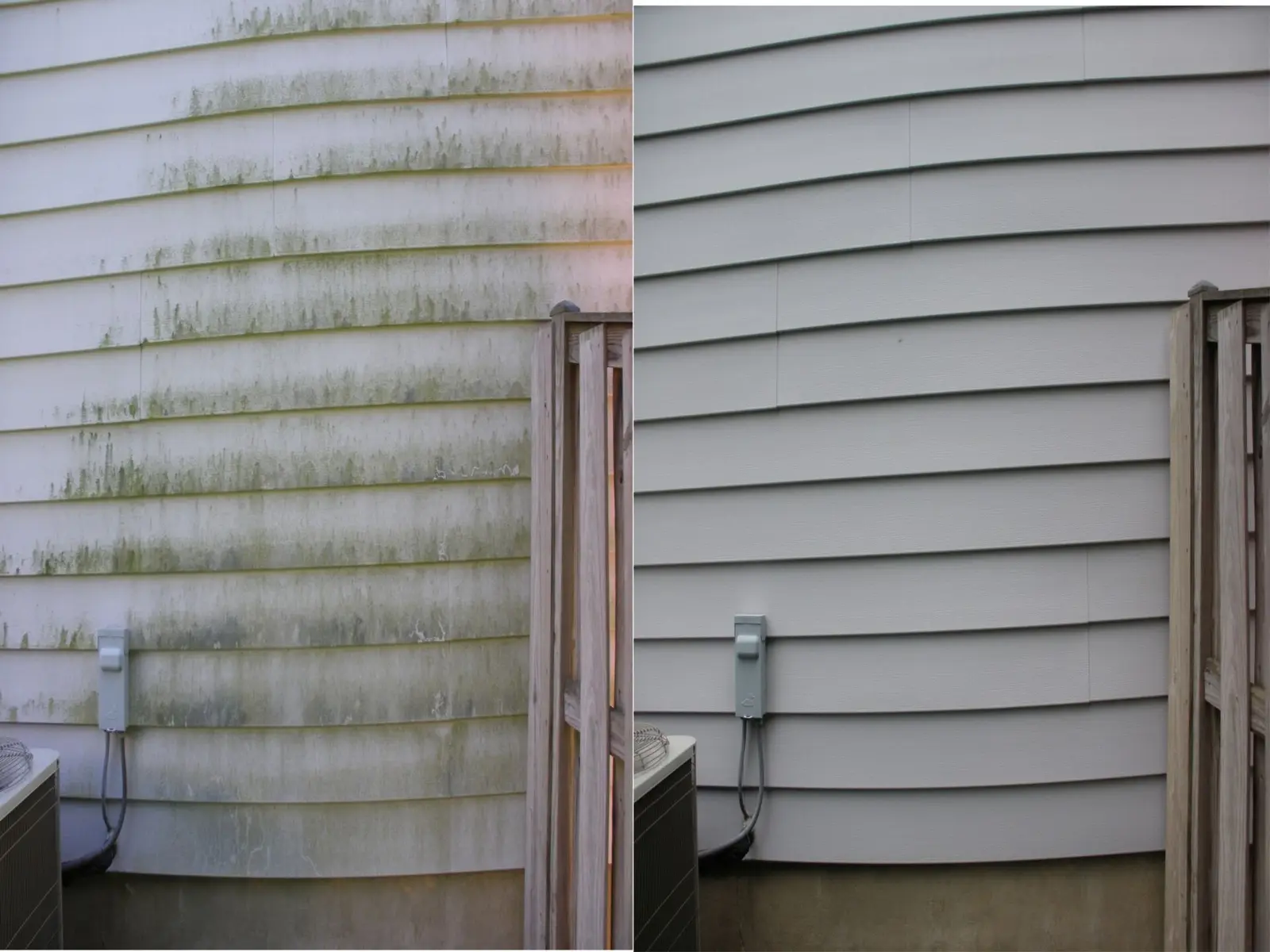
The same stretch of house siding before and after washing: green mildew streaks on the left, clean siding on the right. Photo: East Coast Powerwashing, CC BY-SA 3.0, via Wikimedia Commons.
CSLB license class
C-61/D-38 Sand and Water Blasting, C-33 Painting and Decorating
Where it applies
South Bay, East Bay, Peninsula
Request
Free, up to five local pros reply
Pressure washing jobs on Bay Area homes
Driveways, front walks and patios
The regional surface-cleaning guidance written by BASMAA, the Bay Area's stormwater agencies, sorts flat work by what is on it. A sidewalk or patio with ordinary grime is swept first, washed without soap, and the water is run through a 20-mesh or finer screen onto landscaping. A driveway or parking pad with oil drips is a different job: absorbents and a dry sweep come first, the storm drain is blocked, and any water used afterward is collected and pumped to the sanitary sewer once the local wastewater authority's requirements are checked.
Stucco walls, smooth and textured
The National Park Service's stucco guidance allows that smooth unpainted stucco, and heavily textured painted stucco, can sometimes be cleaned with a low-pressure water wash, scrubbed with soft natural bristle brushes and perhaps a non-ionic detergent. Algae, mold and metal stains call for poultices and suitable solvents rather than more pressure. Rough finishes are the risk: on roughcast, pebble-dash or exposed-aggregate stucco, the same guidance warns that dirt may be hard to remove without taking part of the decorative surface with it.
Wood decks, siding and trim
Wood is where too much pressure does quiet damage. The Park Service's brief on paint problems on exterior woodwork does not recommend waterblasting above 600 psi, because it forces water into the wood instead of lifting grime off it, and at worst pushes water through the sheathing to damage interior finishes. Its gentlest water method is a detergent solution, a medium-soft bristle brush and a garden hose to rinse. Rinse water from a wood restorer or acid wash should test between pH 6 and 10 before it goes onto landscaping.
Washing ahead of a repaint
When washing is meant to take loose paint off, the rinse water carries the paint. BASMAA's guidance puts painted surfaces cleaned to remove paint in their own category: block the storm drain, collect the wash water in a tank, and pump it to the sewer or handle it as hazardous waste. It tells cleaners to ask the wastewater authority or the state Department of Toxic Substances Control whether the old paint holds lead, mercury or tributyltin. Paint chips gathered in dry cleanup can often go in the trash, it adds, once the local solid waste authority confirms it.
Brick, stone and chimney faces
Masonry is the surface pressure washing scars most visibly. The Park Service's brief on cleaning historic masonry recommends starting at 100 psi or less, even with a garden hose, and rising only as needed, generally no higher than 300 to 400 psi. Pressure common to power washing and water blasting is abrasive enough to etch marble, soft stone and some brick, and the brief names a field sign worth watching for: grains of stone or sand turning up in the runoff mean the pressure is too high.
Moss on the roof, water in the walls
Growth on a roof or the walls below it tempts people toward the pressure washer, and the Park Service's maintenance guidance for older buildings steers the other way. Where moss or algae is eroding roofing, it recommends low-pressure garden hose water with a natural or nylon brush and a plastic or wood scraper. For walls, it warns that power washing drives excess moisture into wall materials and even into wall cavities and interior walls, and it advises against high-pressure washes on window glass and garage doors.
The license this work needs
C-61/D-38 Sand and Water Blasting
C-33 Painting and Decorating
The CSLB has a class for this trade: D-38 Sand and Water Blasting, a C-61 limited specialty for a contractor who uses compressed air with abrasives, or water, to clean or prepare surfaces for a protective, decorative or functional treatment. A painter's C-33 scope also begins with preparing surfaces by scraping, sandblasting or other means, so washing ahead of a repaint sits inside a painting license. Jobs under $1,000 in labor and materials that need no permit fall under the state's minor-work exemption. Check any license number at cslb.ca.gov.
BASMAA's guidance for surface cleaners starts from how Bay Area drainage works: in most of the region, storm drains carry whatever reaches the street, gutter or pavement straight to a creek or the Bay, Ocean or Delta. Letting polluting substances into one is prohibited in California, and the guidance spells out who answers for it. Both the person who discharges the pollutant or leaves it behind, and the owner of the property where it was generated, are liable, which is why the questions about disposal belong to the homeowner as much as to the crew.
Biodegradable is not the same as drain-safe
Soap labeled nontoxic or biodegradable still harms fish and wildlife once it reaches a storm drain, according to both BASMAA and the Santa Clara Valley Urban Runoff Pollution Prevention Program. The difference shows up only on the sewer side: if wash water goes down a sink or cleanout to a treatment plant, the plants prefer biodegradable products to harsher cleaners. BASMAA's own first advice is to test whether hot water under pressure will do the job before reaching for soap at all.
Rinse water that tests as more than dirt
Surface cleaning water has been measured here. A 1999 study by the Bay Area Pollution Prevention Group, cited by BASMAA, sampled local cleaners alongside data from Arizona and Texas and found cadmium, copper, lead, mercury, zinc, pH, oil and grease and petroleum hydrocarbons at times high enough to break the limits set for discharges entering treatment plants. Its guidance lists wash water containing lead paint chips, oil-soaked absorbents and solvent cleaners among the hazardous wastes surface cleaning can produce, so a wash on an old painted house or an oily driveway is not a hose-it-off job.
Santa Clara County has a permanent rule on top of the stormwater one. Valley Water's Ordinance 23-02 prohibits washing sidewalks, walkways, driveways, patios and other hard, non-porous ground except where health and safety are at risk, and power washing for those reasons is not a violation. Building exteriors may be washed only with a hose fitted with an automatic shutoff nozzle. Valley Water issues fines only while its board has called for mandatory water use reduction.
In Central San's service area, which takes in Concord, Walnut Creek, Lafayette, Danville, San Ramon, Martinez, Moraga, Orinda and Pleasant Hill, a mobile washer that sends wastewater to the sanitary sewer needs the district's permit, issued at no cost, and a pretreatment system. The district also issues zero-discharge permits to washers that haul their water away, and it posts a list of permitted mobile washers showing the surfaces each is authorized to clean.
San Mateo County's stormwater program, Flows To Bay, says every discharge to the sanitary sewer must be approved by the local sewer treatment authority, and that water sent to landscaping must soak in completely before the crew leaves. It also writes to the people who hire: ask about wash water disposal before hiring, let the contractor use a sewer connection where possible, and make proper disposal part of the contract.
Permits and rules to know
Recognized Surface Cleaner training
BASMAA's Surface Cleaner Training and Recognition Program, started as a pilot in 1996 with the Regional Water Board, still runs after BASMAA dissolved as a nonprofit in 2021 and the region's stormwater programs carried on as the Bay Area Municipal Stormwater Collaborative. A cleaner registers, watches a 16-minute video in English or Spanish, takes a self-quiz and emails to confirm. Certificates go to individuals rather than companies and expire after one year, and the list of recognized cleaners is published for anyone hiring. It is training, not a license.
The regional stormwater permit behind the rules
The San Francisco Bay Regional Water Quality Control Board issues one Municipal Regional Permit covering stormwater for most of the Bay Area, held by San José and 75 other co-permittees. One of the two primary goals of federal stormwater permits is to effectively prohibit non-stormwater discharges to storm drains, and BASMAA counts wash waters among the more commonly observed of them. The permit reaches a driveway through city stormwater ordinances and the inspectors who visit mobile businesses.
Lead rules when washing loosens paint
Under the EPA's Renovation, Repair and Painting Rule, renovation includes surface preparation that may generate paint dust, on housing built before 1978, once it disturbs more than 20 square feet of exterior paint. EPA's answer on pressure washing is that it is not a prohibited practice but takes the same containment as other work: before starting, the firm isolates the work area so no dust or debris, including in the waste water, leaves it, keeps the plastic intact, and checks with the local treatment authority on disposing of the water.
Before you hire
Ask where the rinse water will go on your property: planting beds, a sink or cleanout, or the crew's own tank.
Ask whether the person doing the work holds a current Recognized Surface Cleaner certificate; it lapses after a year.
Ask for a pollution prevention voucher recording the surface, the cleaning method and how the water was disposed of.
On stucco, wood or soft stone, ask what pressure they plan to use and whether they will test a small patch first.
For a pre-1978 house where the wash will take paint off, ask for the firm's EPA renovation certificate and containment plan.
Ask them to sweep and lay absorbent on oil stains before any water touches the driveway.
For a job over $1,000 in labor and materials, check the C-61/D-38 or C-33 license at cslb.ca.gov.
How a request works
Describe the job
A few sentences and a photo of the problem or the space. It takes about a minute.
Local pros get in touch
Up to five handymen or contractors who take this kind of work may call or text to ask questions and quote.
Check, compare, decide
Look up the license, compare what you hear, and agree the scope and price with the one you pick. Requesting costs nothing.
Questions about pressure washing work in the Bay Area
If the crew uses plain water, can the driveway runoff go into the street?
No. BASMAA's guidance for surface cleaners says wash water should never go to the street or a storm drain, plain water included. Sidewalk and patio water with no soap is screened and sent onto landscaping; a driveway with oil on it is swept and treated with absorbent first, and any water used is collected and pumped to the sanitary sewer. The property owner shares liability for what the crew leaves behind.
Does a pressure washing company need a contractor's license in California?
It depends on the job. The state's definition of a contractor covers cleaning of grounds or structures done in connection with construction, alteration or repair, and the CSLB has a D-38 Sand and Water Blasting class for cleaning or preparing surfaces for a treatment. Washing before a repaint is that kind of work; the statute does not spell out a stand-alone wash. Under $1,000 with no permit, the minor-work exemption applies either way.
Will a pressure washer damage our stucco or wood siding?
It can. The National Park Service recommends a low-pressure wash with soft bristle brushes for stucco and warns that textured finishes can lose part of their surface with the dirt. For painted wood, it does not recommend waterblasting above 600 psi, which forces water into the wood and can reach the sheathing and interior finishes. Ask what pressure will be used and for a test patch on an out-of-sight wall.
Our house was built in 1965. Can it be pressure washed before painting?
Yes, but if the wash disturbs more than 20 square feet of exterior paint, the EPA's lead rule treats it as renovation. EPA says pressure washing is allowed under the rule with the same containment as other work, so no dust or debris, including in the waste water, leaves the work area. The firm doing it needs EPA certification, and the collected water and chips need proper disposal.
What does a Recognized Surface Cleaner certificate actually show?
That the named person took the region's pollution prevention training for surface cleaners, passed a self-quiz on it, and agreed to follow its practices for cleaning and wash water disposal as far as practical. Certificates are personal, not company-wide, and expire after a year. Recognized cleaners also carry pollution prevention vouchers, filled out in duplicate after a job, that record the surface, method and disposal.
Is biodegradable soap safe to rinse down the gutter?
No. Bay Area stormwater programs say nontoxic and biodegradable cleaners still harm fish and wildlife when they reach a storm drain. If soap is needed at all, the water should be collected and sent to the sanitary sewer, where treatment plants prefer biodegradable products, or onto landscaping where the guidance allows. BASMAA suggests trying hot water under pressure first.
Checked against these public sources in October 2026. Codes and programs change: confirm permit rules with your city's building department and a license on the CSLB website before work starts.