Painting Bay Area houses on either side of the 1978 lead line
Painting a Bay Area house means working over what earlier owners put on: stucco on post-war tracts, wood siding and trim on older houses, grooved plywood on Eichlers. The year the house was built shapes the job most. Before 1978, paid work that disturbs paint past the EPA's small-job limits needs a firm holding EPA certification and contained dust, and San Francisco presumes lead in any building from before 1979.
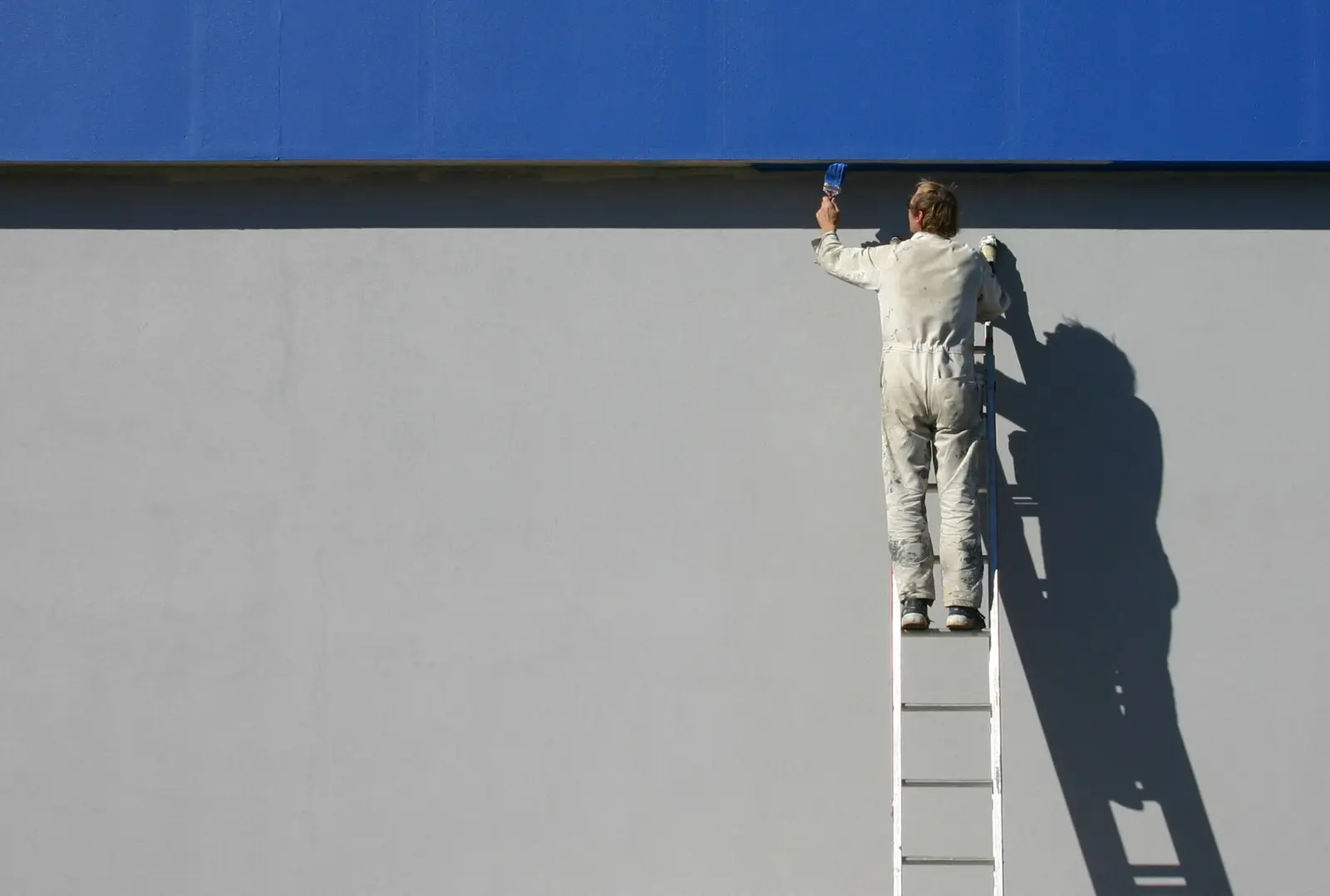
A painter in white overalls on a ladder, brushing paint along the top edge of a gray wall. Photo: Lukeroberts, CC BY-SA 2.5, via Wikimedia Commons.
CSLB license class
C-33 Painting and Decorating
Where it applies
San Francisco, East Bay, Peninsula, South Bay
Request
Free, up to five local pros reply
Painting jobs on Bay Area homes
Repainting a stucco wall that was painted before
When a stucco wall has been painted before, the National Park Service's preservation guidance on stucco puts compatibility first: the new coat has to suit whatever coating is already on the wall. Loose or peeling paint comes off by hand scraping or a natural bristle brush, then the wall is cleaned. Latex tolerates a slightly damp wall but will not stick to chalky, powdery spots. Oil-based paint needs a dry wall, and new stucco can need up to a year to cure before it takes oil paint.
Exterior prep on a house built before 1978
Outside, the EPA's rule sets out the containment before any scraping. Doors and windows within 20 feet of the work are closed, and plastic sheeting covers the ground for 10 feet beyond the surfaces being worked on, or farther if debris will fall farther. When the work is within 10 feet of the property line, the firm has to put up vertical containment or take equivalent extra precautions, a distance a side wall on a narrow lot can easily fall within. Open-flame burning of paint is banned outright, and power sanding or grinding is allowed only with a shroud and HEPA vacuum attachment.
Interior repaints with patching in older rooms
Indoors the rule starts counting at small areas. Minor repair and maintenance that disturbs 6 square feet or less of paint per room is outside it; scraping a whole wall of failing paint, or opening plaster to patch, is not. Testing is optional, but without paperwork showing the paint is not lead-based, the requirements apply. Before the work, the firm must hand the owner EPA's Renovate Right pamphlet no more than 60 days ahead and get a signed acknowledgment, or mail it at least 7 days before starting.
Painting the whole face after a stucco patch
A stucco repair rarely matches the wall around it on its own. The Park Service's guidance notes that tinting a small patch by hand seldom gives a color close enough on a prominent wall, and that the fix may be painting the entire patched elevation, or the whole building. It also warns against filling hairline cracks with caulk before repainting: caulk weathers differently, collects dirt and shows through the new paint within a year, where a thin slurry of the finish-coat ingredients or the paint itself blends in.
Dealing with the cans that are left over
California's paint stewardship program, run by PaintCare since October 2012, takes leftover house paint, primers, stains, sealers, shellac and varnish at drop-off sites across the state, 822 of them open year-round, with no charge for dropping it off. Cans must be in their original containers of 5 gallons or less, with the manufacturer's label and a secure lid; open or leaking cans, aerosols, thinners and solvents are refused. A painting contractor with 100 gallons or more can ask PaintCare for a free large-volume pickup.
The license this work needs
C-33 Painting and Decorating
The CSLB's C-33 class covers preparing surfaces by scraping, sandblasting or other means and applying paints, papers, textures, stains, varnishes, sealers and similar finishes to a structure, whether to decorate or to protect it. A handyman can take a painting job while labor and materials together stay under $1,000 and no permit is involved; past that line it needs a licensed contractor (C-33). The EPA's lead rule is a separate test, set by the house's age and how much paint is disturbed, not by the price. Check any license number at cslb.ca.gov.
Many Bay Area stucco houses were never meant to be painted. The Park Service traces brightly colored stucco to O.A. Malone, whose California Stucco Products Corporation, founded in 1927, made the first stucco with colored pigment in its pre-packaged factory mix. The first coat of paint changes the upkeep for good. The guidance notes how hard it is to wash dirt off textured stucco without wearing away the finish, suggests that difficulty is why so many textured walls ended up painted, and points out that painted stucco needs repainting after every repair.
Where the rinse water goes
San Francisco runs a combined sewer, so water off a street there reaches a treatment plant. Most other Bay Area cities do not: Sunnyvale tells residents that water entering its storm drains flows to the Bay without treatment and that anything but rain is illegal there, and it asks people to call 911 when they see paint dumped into one. Alameda County's Clean Water Program asks homeowners to make sure painting contractors dispose of materials properly, not in a gutter, storm drain or roadside ditch, which rules out rinsing rollers at the curb.
Lead under the newer coats
Alameda County's lead program warns that most structures built before 1978 hold lead-based paint beneath the surface layers, and that uncontained sanding, scraping, water blasting or flame torching of it can contaminate a property. Under state law that is more than advice. Health and Safety Code Section 17920.10 lists disturbing lead-based paint without containment among the lead hazards that put a dwelling in violation of the state housing law, and Section 105256 lets the state health department or a local agency order the person causing a lead hazard to stop.
San Francisco's Department of Building Inspection presumes that paint in a building built before 1979 contains lead unless an inspector shows otherwise, a year past the federal cutoff. Before lead-related work, owners must tell neighbors at least three business days ahead and post a 32-by-24-inch Lead Work in Progress sign at the front. Dry sanding or scraping without containment and open-flame removal are banned, and violations can bring a Notice of Violation, fines or a stop to the work.
The Alameda County Lead Poisoning Prevention Program offers a free one-day EPA Renovation, Repair and Painting class to owners and managers of pre-1978 homes in Alameda, Berkeley, Emeryville and Oakland. The county's Healthy Homes Department also runs lead hazard repair grants for pre-1960 homes, with free lead testing, for low-income households with a young child or a pregnant person. Its advice on hiring: search the firm on EPA's site and ask to see the site supervisor's card.
San Mateo County takes leftover paint, solvents and other household hazardous waste for free, but only by appointment at its drop-off facility, booked online or by phone through County Health's program. That differs from counties where residents can simply drive up, so a painter who leaves partial cans of oil-based primer or thinner behind on the Peninsula is leaving the owner an appointment to make. Paint still in its original labeled can can also go to a PaintCare site.
Sunnyvale's Eichler Design Guidelines, adopted in 2009, speak to finishes on the grooved plywood siding these houses wear. Plywood may be stained or painted: stain shows the grain and keeps the crisp edges of the vertical grooves, but needs reapplying more often than paint. Window trim, the guidelines add, usually looks most like an Eichler when it is painted to match the wall beside it rather than contrast with it.
Permits and rules to know
The EPA's Renovation, Repair and Painting Rule
Since April 22, 2010, firms paid to disturb paint in housing and child-occupied facilities built before 1978 must be certified by the EPA or an authorized state, and must use renovators who have taken the rule's training, hold its certification and follow its work practices. It covers painting preparation as well as carpentry, plumbing, electrical work and window replacement. Housing built in 1978 or later is outside it, as is work disturbing 6 square feet or less per room inside or 20 square feet or less outside, though window replacement is covered at any size.
Air district limits on what goes on the wall
The Bay Area Air Quality Management District's Regulation 8, Rule 3, first adopted in 1978 and last amended in 2009, limits the volatile organic compounds in architectural coatings sold or applied in the district, and it binds anyone who applies or solicits the application of a coating. Since 2011, flat coatings are held to 50 grams per liter, nonflat to 100 and high-gloss to 150. Thinning a coating past its limit is prohibited, and containers of solvent and solvent-based coatings must stay closed when not in use.
No building permit, but state lead law still applies
The California Building Code's list of work exempt from a building permit includes painting, papering and similar finish work, which is why an interior or exterior repaint seldom involves the building department. The exemption does not authorize breaking any other law. A historic district can still review exterior changes, and the state's lead rules apply regardless: Alameda County's program notes that uncontained paint removal is now a violation under Title 17 of the California Code of Regulations.
Before you hire
On a house built before 1978, ask for the firm's EPA renovation certification and the name of the renovator who will oversee the work.
Ask how the ground, windows within 20 feet and any wall near the property line will be contained before scraping starts.
For a job over $1,000 in labor and materials, check the C-33 license number at cslb.ca.gov.
Ask where brushes and rollers will be rinsed; the answer should never be the driveway, the street or a storm drain.
On stucco, ask what coating is already on the wall and which paint they will use to suit it.
Ask who keeps the leftover paint, and keep anything you want in its original labeled can.
Ask for proof of workers' compensation coverage before anyone sets up ladders or scaffolding.
How a request works
Describe the job
A few sentences and a photo of the problem or the space. It takes about a minute.
Local pros get in touch
Up to five handymen or contractors who take this kind of work may call or text to ask questions and quote.
Check, compare, decide
Look up the license, compare what you hear, and agree the scope and price with the one you pick. Requesting costs nothing.
Questions about painting work in the Bay Area
Do I need a permit to repaint my Bay Area house?
Usually not from the building department. The California Building Code lists painting, papering and similar finish work among the jobs exempt from a building permit. Two things still apply. On a house built before 1978, the EPA's lead rule governs any paid work that disturbs paint beyond its small-job limits. And in a historic district, an exterior color change may need a word with the city's planning staff first.
Our house was built in 1977. Does the lead rule cover a repaint?
Yes, if the prep disturbs more than 6 square feet of paint in any room, or more than 20 square feet outside. The federal rule reaches housing built before 1978, so a 1977 house is inside it. Testing is not required, but unless you have documentation that the paint is not lead-based, the firm has to follow the rule's work practices. In San Francisco the city's own presumption reaches buildings from 1978 as well.
Should we paint stucco that has never been painted?
Think about it first. A lot of California stucco carries its color in the finish coat, a practice the Park Service traces to California Stucco Products in 1927. Once a wall is painted it joins the repaint cycle, and the Park Service notes that painted stucco needs repainting after repairs too. If a repair is the reason, painting the whole elevation may be the only way to hide the patch.
Why can't the painter just thin the paint to make it spray better?
In the Bay Area, thinning can break the air district's rule. Regulation 8, Rule 3 measures a coating's VOC content as thinned to the manufacturer's maximum recommendation, and prohibits anyone applying it from thinning beyond its limit. The label or lid states that maximum, so if a painter wants to thin for a sprayer, ask how they will stay within it.
What happens to half-empty cans after the job?
Keep what you will use for touch-ups, sealed and labeled with the room or wall. The rest can go to a PaintCare drop-off site at no charge, in the original labeled container of 5 gallons or less with a secure lid. Thinners and solvents are not PaintCare products; they go to a county household hazardous waste facility, which in San Mateo County means booking an appointment.
Is a lead-safe exterior repaint different on a narrow city lot?
Yes. When the work is within 10 feet of the property line, the EPA rule requires vertical containment or equivalent extra precautions, on top of plastic over the ground and closed windows within 20 feet. In San Francisco, owners also have to notify neighbors at least three business days before lead-related work and post a Lead Work in Progress sign at the front of the building.
Checked against these public sources in October 2026. Codes and programs change: confirm permit rules with your city's building department and a license on the CSLB website before work starts.