Re-roofing Bay Area houses, from Eichler flats to hill fire zones
Most roofing work on Bay Area houses is a full re-roof, and the address decides the rules. In San Francisco a C-39 roofer can pull that permit online only when no sheathing is replaced. Inside a fire hazard severity zone, replacing half or more of a roof within 12 months requires a Class A roof assembly, and Berkeley's hill fire zone bans wood shakes.
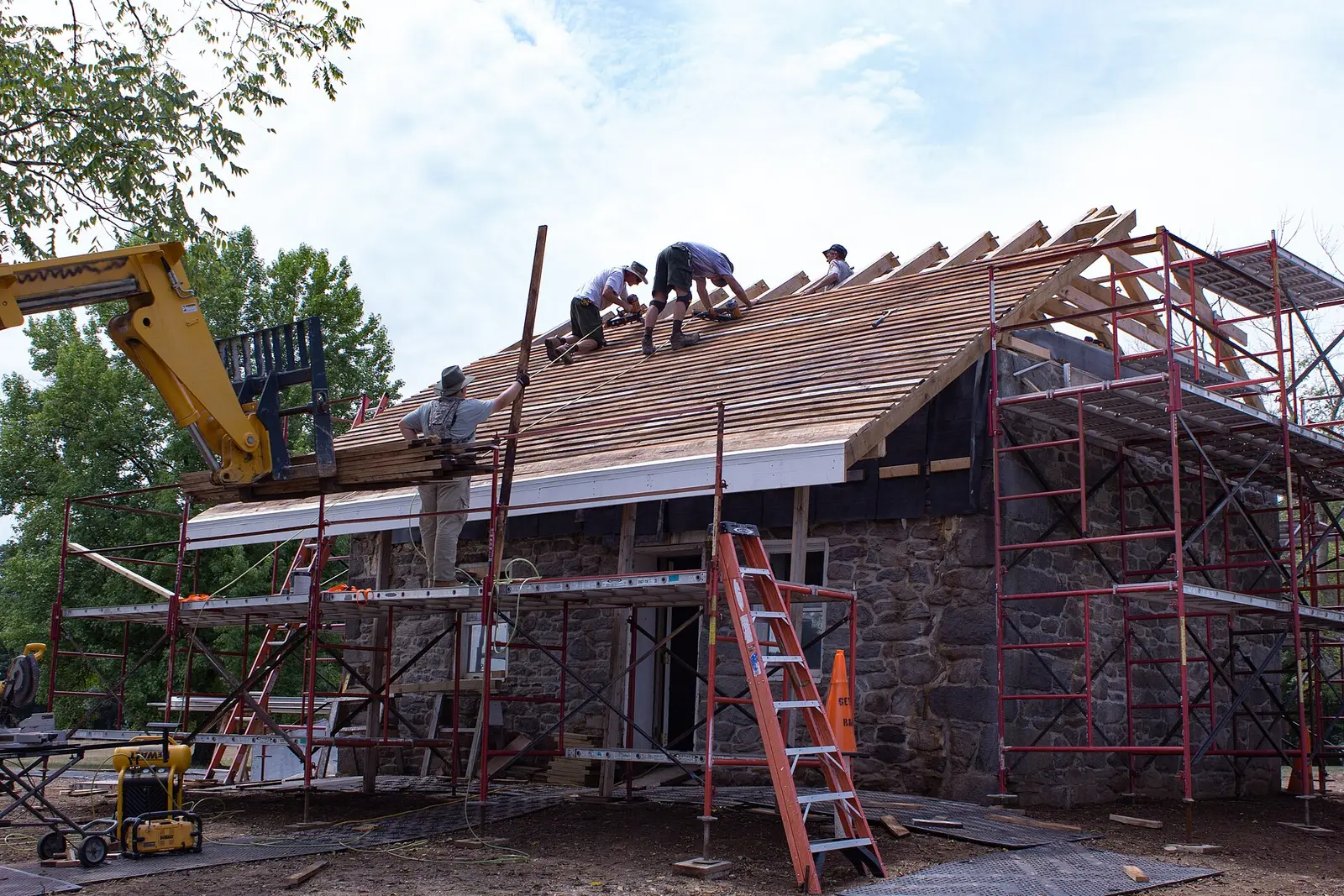
Roofers installing cedar shingles near the ridge while a telehandler lifts bundles onto the roof. Photo: NPS photo, Public domain, via Wikimedia Commons.
CSLB license class
C-39 Roofing, B General Building
Where it applies
San Francisco, East Bay, Peninsula, South Bay
Request
Free, up to three local pros reply
Roofing jobs on Bay Area homes
Tear-off or a single overlay
Whether the old roof must come off depends partly on the city. San Bruno allows one new layer over one existing layer, and its inspector wants the ridge caps and valleys opened to prove only one is there. Once roofing comes off, damaged decking has to be replaced and knot holes covered before underlayment goes down. Low pitches need more of it: San Bruno calls for two layers under asphalt shingles on slopes from 2:12 to 4:12, and allows no shingles below 2:12.
Flat and low-slope roofs on Eichler houses
Between 1949 and 1966 Eichler Homes built more than 11,000 houses, including tracts in Palo Alto, Sunnyvale, San Mateo, San Jose and Marin. Their roofs are flat or low-sloping, and the tongue-and-groove decking doubles as the ceiling inside. With no attic, the only place to add insulation is above that deck, so it is a decision to make when the roof comes off rather than afterward. In some climate zones the Energy Code makes that decision for you.
Torch-applied membranes and roof drains
Some flat-roof membranes go down with an open torch, and cities treat that as fire-code work as well as roofing. San Bruno requires a hot work operational permit, an inspection before the material goes on, a UL-listed torch and two fire extinguishers on the roof during installation. The same handout wants secondary drains or scuppers wherever roof drains are required, and it will not let a roof drain onto a neighbor's property or into the sewer.
Class A details at valleys, eaves and gutters
A Class A rating in a fire zone reaches past the shingles. The California Wildland-Urban Interface Code sections quoted in San Bruno's re-roof handout call for a listed underlayment tested with the assembly, bird stops at the eaves where the profile fits, hip and ridge caps mudded in against embers, and valley flashing of 26-gauge metal over a 36-inch-wide mineral-surfaced cap sheet. Gutters must be noncombustible with a way to keep leaves out, and roof vents need noncombustible, corrosion-resistant mesh no wider than 1/8 inch.
Chimney crickets and spark arrestors
A re-roof is when chimney details get checked. San Bruno requires a cricket, a small saddle that sheds water, on the ridge side of any chimney or penetration wider than 30 inches, plus a spark arrestor on top of every fireplace termination. Flashing around the chimney is roofing work. If the chimney itself is cracked, leaning or losing mortar, that part of the job belongs to a masonry contractor, and it is better found before the new roofing is tied into it.
Skylights and solar panels in the way
Skylights and rooftop solar complicate a tear-off. San Francisco's re-roof application asks what else is being replaced and names skylights and solar panels, and San Jose adds that replacing, altering or removing solar or other rooftop equipment needs its own electrical or mechanical permit. In a fire hazard severity zone, operable skylights also need a noncombustible mesh screen with openings no larger than 1/8 inch. Mention panels before the bid, since taking them off and putting them back involves electrical work.
The license this work needs
C-39 Roofing
B General Building
The CSLB's C-39 Roofing class covers installing and repairing the materials that seal and weatherproof a building, from shingles, shakes, tile and slate to metal roofing and membranes. San Francisco lets only a C-39 contractor apply for a re-roof permit online. A B General Building contractor takes framing and carpentry, which matters when rafters or sheathing are rotten. Anything on a roof that needs a permit goes to a licensed roofer; check the number at cslb.ca.gov.
The State Fire Marshal classifies Fire Hazard Severity Zones as Moderate, High or Very High, scoring fire history, vegetation, predicted flame length, blowing embers, terrain and typical fire weather. The maps rate hazard without counting home hardening or fuel clearing, so a new roof does not move a property out of a zone. San Bruno's building division calls checking the state map critical for every re-roof there, and it is worth doing before the first bid, because it changes which roofing a contractor can offer.
Asbestos in older roofing
The Bay Area Air District lists roofing among the materials where asbestos turns up, and treats anything that is not wood, metal, glass or rubber as suspect until a lab says otherwise. Removing 100 square feet or more of regulated asbestos material means notifying the district at least 10 working days before work starts; houses with four or fewer units can use a faster 72-hour notice. Owners of those small residential buildings may take their own samples instead of hiring a consultant.
Cool-roof rules follow climate zones
The state Energy Code sets cool-roof requirements by climate zone, and a qualifying product must carry a Cool Roof Rating Council label the inspector can read. BayREN's guide to the 2022 code limited Bay Area residential cool-roof rules to parts of Alameda, Contra Costa and Solano counties in Climate Zone 12, extending to parts of Santa Clara County for large re-roofs. Permits applied for since January 1, 2026 fall under the 2025 Energy Code, so confirm the rule for the address.
San Francisco's re-roof application asks whether any change will be visible from the street, and a landmark building needs photos of the existing roof plus a Planning approval letter or Planning's word that none is needed. Roofline details matter in the Sunset, where tract houses from the late 1920s carry red Spanish clay tile accents on shaped and crenellated parapets. SF Planning has identified several of those tracts as eligible for the National Register, so ask before changing what the street sees.
Berkeley's Fire Zone Two, the Combined Hillside District plus land CAL FIRE maps as Very High, has applied its wildfire rules to re-roofing since July 1, 2008. Two details catch tile and fireplace owners there: where a roof profile leaves a space between covering and deck, it must be fire-stopped or laid over a 72-pound mineral-surfaced cap sheet, and every solid-fuel chimney needs an approved spark arrestor whenever the house is re-roofed.
The largest contiguous Eichler development is the Highlands in San Mateo, built from 1956 to 1964, so many roofs there are flat or low-slope. San Mateo County sits in Climate Zone 3, which BayREN's 2022 guide left out of the Bay Area's cool-roof requirement. San Bruno goes further on fire than the state does: a local amendment makes Class A the minimum roof covering for every building in the city, not only those in mapped zones.
Parts of Santa Clara County are in Climate Zone 4, where BayREN's guide to the 2022 Energy Code applied two roof triggers at once: the cool-roof rule for re-roofs replacing more than half the roof, and added insulation on low-sloped roof replacements unless the roof already had R-10 continuous insulation. With Eichler tracts in Palo Alto, Sunnyvale and San Jose, ask which zone the address is in before comparing flat-roof bids.
Permits and rules to know
Re-roof permits in San Francisco
San Francisco requires a permit before roofing material is installed, repaired or removed, with narrow exemptions in Building Code Section 106A.2, including limited re-roofing of no more than 25 percent of a roof in 12 months. A C-39 contractor can apply online through PermitSF when the job needs no plans and replaces no framing or sheathing; otherwise it becomes an over-the-counter building permit. Historic residential applications get staff review, with a goal of approval within two business days.
Class A roofs in fire hazard severity zones
Under the California Wildland-Urban Interface Code, as cited in San Bruno's 2025 re-roof requirements, a house in a Fire Hazard Severity Zone or wildland-urban interface area needs a roof assembly rated Class A under ASTM E108 or UL 790 when 50 percent or more of the roof covering is replaced within 12 months. Roofing applied during a smaller alteration or repair must also meet Class A. The zone comes from the State Fire Marshal's map, not from anyone's judgment on site.
Re-roof permits in San Jose
San Jose requires a building permit once 25 percent or more of a roof is re-roofed in any 12-month period; less is treated as a repair. Most permits are issued online through SJPermits, and on a single-family property the house and a detached garage can share one. A property on the Historical Resources Inventory needs Planning clearance first, a City Landmark needs a Historic Preservation Permit, and some heavier materials send the job to Building review.
Before you hire
Look up the roofer's C-39 license number at cslb.ca.gov and confirm the business name matches the contract.
Ask whether the address is in a mapped fire hazard severity zone and how the bid meets Class A at valleys, eaves, vents and gutters.
Ask who will sample old roofing for asbestos before tear-off, and who files the Air District notice if it is needed.
In San Francisco, ask what happens to the online re-roof permit if rotten sheathing turns up mid-job.
For a torch-applied flat roof, ask who holds the hot work permit and who stands fire watch.
Ask for proof of workers' compensation coverage and their liability insurance certificate before anyone goes up a ladder.
On a flat or low-slope roof, ask whether the Energy Code requires added insulation above the deck at this address.
How a request works
Describe the job
A few sentences and a photo of the problem or the space. It takes about a minute.
Local pros get in touch
Up to three handymen or contractors who take this kind of work may call or text to ask questions and quote.
Check, compare, decide
Look up the license, compare what you hear, and agree the scope and price with the one you pick. Requesting costs nothing.
Questions about roofing work in the Bay Area
Are wood shake roofs still allowed in the Berkeley hills?
Not in Fire Zone Two for a full replacement. Berkeley's building guideline for that zone says wooden shakes and shingles are prohibited roof coverings regardless of the assembly rating, and roofs must be Class A at minimum. It exempts replacing less than half the roof area within five years. If a shake roof there is due for replacement, ask roofers to bid Class A materials from the start.
Does an Oakland re-roof get a city inspection?
Not necessarily. Oakland issues Re-Roofing Certificates to building owners, or to a licensed contractor holding the right classification and a current Business Tax Certificate, through its online permit center. After the work, the applicant uploads a completion form certifying the work, and the city says no inspection is required. A certificate covers a single structure and is valid for 180 days, so a detached garage needs its own.
Why does a San Francisco roofer need a fire watch?
If any part of the job uses a torch, open flame or LP-gas, the San Francisco Fire Department requires its permit and a dedicated fire watch whose only task is watching the torch work. That person carries a phone and a fire extinguisher and stays on site for at least an hour after the day's work ends. The department also suggests checking your homeowner's policy for fires caused by contractors.
Our San Jose house is on the historic inventory. Can the new roof be black?
Probably not. For a property on San Jose's Historical Resources Inventory, Planning reviews the proposed roofing before a building permit is issued, and its guidance says the material should be similar in scale, color and texture to what was used historically, with black and dark gray listed as not appropriate. Bring photos of the existing roof and the manufacturer, style and color of the new one.
Who files the asbestos notice before a tear-off?
Under the Bay Area Air District's Regulation 11, Rule 2, the property owner or the contractor files it, online through the district's MyAirOnline portal, when a renovation removes 100 square feet or more of regulated asbestos material. The job number that comes back is proof of notice and is separate from any city building permit. Settle in writing who files it before the old roofing comes off.
Checked against these public sources in September 2026. Codes and programs change: confirm permit rules with your city's building department and a license on the CSLB website before work starts.